'Friday Night Fun': the Indonesian community bringing childhood back to combat Gen Z burnout
A grassroots initiative in Indonesia is drawing thousands of young people back to childhood games as a way to cope with urban stress and burnout. Founded in 2024, the Playing Community has expanded across major cities, combining nostalgia with collective stress relief.
- Playing Community has grown from a viral TikTok video into a nationwide network exceeding 20,000 members.
- Participants and psychologists say traditional games help reduce stress and strengthen social connection.
- The movement is expanding nationally while attracting commercial partnerships and promoting cultural preservation.

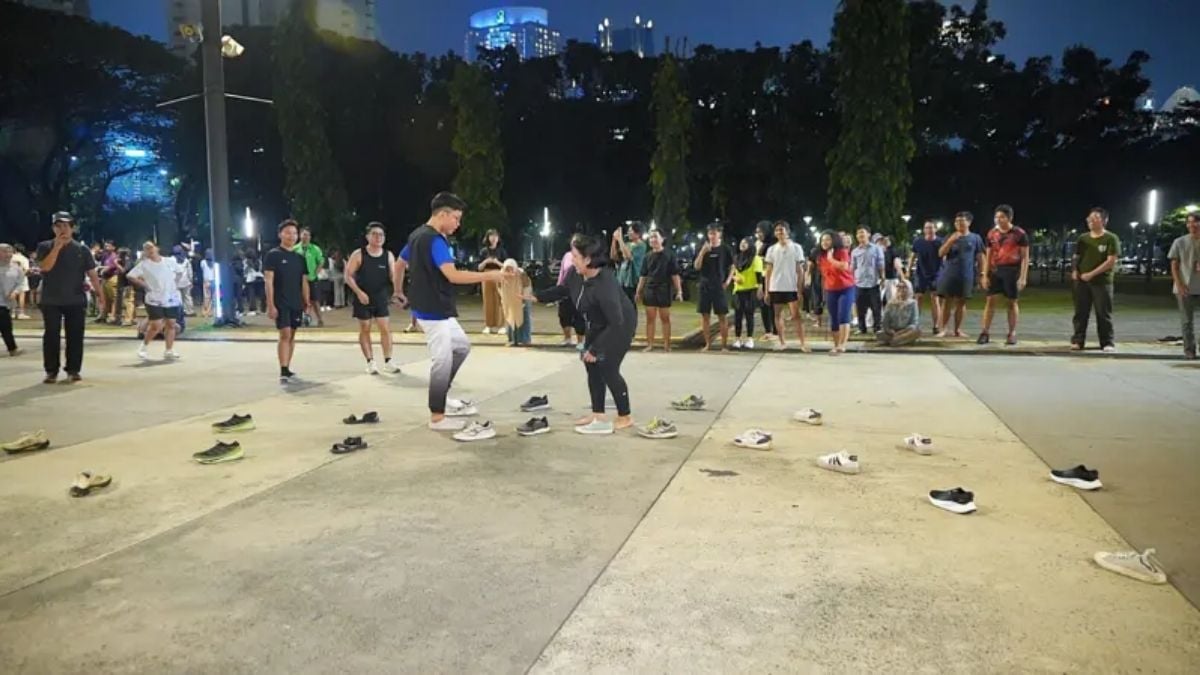
Hundreds of young Indonesians are gathering each Friday night at a major Jakarta stadium to play rubber-band skipping and fort-guarding games, as a grassroots community built around childhood pastimes grows into a nationwide mental health phenomenon drawing the attention of sociologists, psychologists and global brands alike.
Playing Community (Komunitas Bermain), founded on 4 August 2024, now counts more than 20,000 members spread across Jakarta and its surrounding areas, Bandung, Yogyakarta, Palembang, Padang, Surabaya, Makassar, Malang and Bali, according to the community's official Instagram account.
The community traces its origins to a single social media upload. Akihiko Akira, a 24-year-old office worker known by the nickname Kiko, joined a group of strangers playing lompat karet — a traditional game involving jumping over a long rope braided from elastic bands — at Gelora Bung Karno (GBK) stadium in central Jakarta. He filmed the session, posted it to TikTok and watched it reach the platform's "For You Page."
Akira, founder of Playing Community, said: "I loved playing lompat karet as a child. Someone was already playing there, I joined in and posted it. It turned out to go viral. After that, I thought about setting up a community. So if people ask who first played karet at GBK, it wasn't me — but for the community itself, yes."
Akira co-founded the community with a friend, Iqbal — who, like Akira, is a fan of Taylor Swift — after recognising that both shared a need for open-air social connection. Akira, who lives in an apartment and spends much of his day commuting between Thamrin and Sunter in Jakarta, said the city's pace left him with little time to socialise.
"It started because, like most Gen Z folks, I was stressed out by work, burnt out with life," Akihiko Akira told Agence France-Presse.
What began with roughly ten participants at GBK has since expanded. The community's WhatsApp Channel, used to share event information and coordinate among members, now has approximately 3,600 followers. The broader membership — counted across all cities and chapters — exceeds 20,000.
Friday Night Fun and a growing roster of games
The community's flagship event, known as Friday Night Fun, takes place every Friday at 19:00 local time at GBK, typically drawing between 75 and 100 participants. On larger occasions, attendance has reached around 500 people. Participants arrive in a mix of sportswear and office attire, some still wearing their work lanyards.
Games played at sessions include lompat karet, bentengan (a fort-guarding team game), petak jongkok (a variant of tag), gobak sodor, ular naga, suit monopoli, congklak (a counting game using seeds or stones), bola bekel (similar to jacks), engklek, kotak pos and others, selected by agreement among those present on the day.
In addition to the Friday evening sessions, the community holds a Sunday morning activity at 07:00 during Car Free Day and runs a monthly school visits programme called Goes To School. Participation is free of charge; members are asked only to bring a water bottle and wear comfortable clothing.
New members who join the WhatsApp group are asked to share their name, place of residence and reason for joining. The platform allows participants to find others who live or work nearby and travel together to GBK on Fridays. Each city chapter is overseen by a local coordinator, referred to within the community as a ketua kelas ("class leader"), who organises activities independently in their area.
Members cite stress relief and a sense of belonging
Participants and experts have linked the popularity of the movement to rising urban stress and reduced social interaction in city life.
A participant identified as Annisa told Agence France-Presse (AFP), as reported by Global Nation: “The more energy we exert, the more we sweat, the more our stress is released.”
She added: “Of course, our happy chemicals are released too—endorphins—and that’s what makes us feel more energized and motivated.”
Jakarta-based psychologist Ratih Ibrahim told AFP that such activities act as a “drug-free antidepressant”, noting that they help build social connection and belonging.
“There’s a sense of togetherness; you meet new people, and in that moment, you become human again,” she said.
Housewife Intan Permata also told AFP that the activities provide relief from daily pressures. “We get so caught up in school issues, the kids, the house… it really feels like such a refreshing break.”
Akira noted that the community is open to all ages and backgrounds. He said one participant with autism had joined with their parents, who described the sessions as a form of play and social therapy.
Psychologist and sociologist weigh in
Jakarta-based psychologist Ratih Ibrahim said communities such as Playing Community offered something that could not be prescribed.
"There's a sense of togetherness; you meet new people, and in that moment, you become human again," Ratih Ibrahim, a Jakarta-based psychologist, told AFP, as reported by Global Nation.
Ibrahim described the initiative as invaluable as a drug-free antidepressant, particularly given urban Indonesia's high rates of work-related stress among younger adults.
Oki Rahadianto Sutopo, a sociologist at Gadjah Mada University (UGM) in Yogyakarta, told BBC Indonesia that the resurgence of childhood games was not simply a matter of nostalgia. He attributed the phenomenon to what he described as a need for collective experience in an increasingly competitive and individualistic urban environment.
"The content is competition. These games — whether traditional or modern — also involve winning and losing, but the sense is of playing. As when we were children, losing doesn't matter. The difference is that in work culture, competition is not driven by a sense of playing," Oki Rahadianto Sutopo, a sociologist at UGM, told BBC Indonesia.
Sutopo told BBC Indonesia that city-dwellers — many of whom live in apartments and lack access to open outdoor spaces — faced structural barriers to physical and social play. He said communities such as Playing Community were filling that gap and drawing individuals towards collective engagement.
Brand partnerships and national expansion
Playing Community has begun attracting interest from commercial partners. Japanese clothing brand Uniqlo has invited the community to participate in one of its events, with Akira describing the arrangement as brands approaching the community rather than the other way around.
According to the community's official Instagram, Playing Community has now been active for more than one year and has tried dozens of traditional games since its founding. The community's stated mission is to preserve traditional Indonesian games while building an inclusive social space that transcends differences in background, ethnicity, age, religion and other factors.
The community is structured with nine core administrators overseeing operations, alongside divisional coordinators and city-level chapter leaders. Members can join via the community's Discord server, WhatsApp Channel or Instagram, or simply by turning up to a session.
Akira said the effect had extended beyond recreation.
"After going through it, many people feel the same thing — they need to be able to play together, they need the atmosphere of open space. You get stressed if you keep looking at walls. This turns out to have an impact on mental health too," Akihiko Akira said.
BBC Indonesia reported that the initiative has since developed structured roles, including a central management team and regional coordinators, to support activities across different cities.
According to the community, its broader goal is to preserve traditional Indonesian games while building inclusive social spaces.
“Komunitas Bermain is a community that aims to preserve Indonesian traditional games while becoming a space for inclusive friendship without seeing background, ethnicity, age, religion, or other differences,” the group stated on Instagram.