Indonesian children in West Aceh swim across river after bridge destroyed by floods seven months ago
Children in a remote Aceh village are crossing a river on foot, by swimming, or on their parents' backs to reach school after floods destroyed a suspension bridge seven months ago and reconstruction has yet to begin.
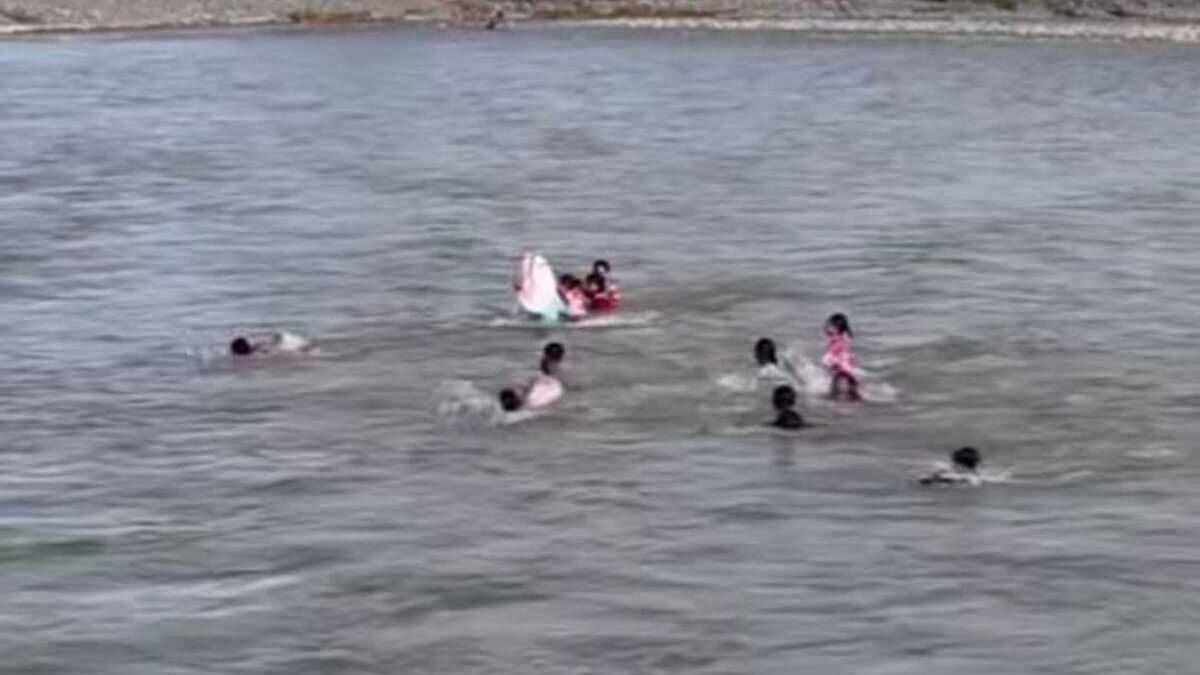
- Children cross a river daily after floods destroyed a suspension bridge in November 2025.
- Parents accompany pupils because alternative routes are significantly longer and more difficult.
- The school has urged authorities to rebuild the bridge and consider relocating the campus.

Children in a remote village in Indonesia's Aceh province are swimming across a river or being carried by their parents to school after a bridge destroyed by floods seven months ago has yet to be rebuilt.
Pupils from Cangai village in Pante Ceureumen district, West Aceh Regency, have been forced to cross a river each day to reach SD Negeri Alue Lhok, a primary school located in neighbouring Jambak village, following a hydrometeorological disaster in November 2025 that swept away the suspension bridge linking the two communities.
The situation was observed on 5 June as pupils travelled to school to sit their end-of-semester examinations.
Some children crossed the river while holding their parents' hands, while others were carried on their mothers' or fathers' backs. Several older pupils swam across independently. School uniforms, books and learning materials were packed into plastic bags to keep them dry during the journey.
The river separating the two villages is approximately 50 metres wide. In some sections, the water reaches the waist or chest of an adult.
"We can only cross the river to get there," said Syafira Adelia, a Year 5 pupil at SD Negeri Alue Lhok.
"If the water is not too high, we can still make it across, but when the water rises, we are afraid."
Despite the risks, Syafira said she attended school because examinations were being held that day.
"We hope the bridge will be rebuilt soon so we can go to school safely," she said.
Another Year 5 pupil, Agus Firmansyah, said crossing the river remained the quickest route to school.
"The bridge we used to use was destroyed by the flood," Agus said.
"Taking another road is much farther. That is why we cross the river so we can get to school more quickly. It is frightening, but because we do it often, we have become used to it."
Parents accompany many of the children across the river each day.
Muhammad Idrus, whose child attends the school, said families had little choice but to use the crossing because alternative routes were significantly longer.
"There is an alternative route, but it is around eight kilometres away. That is why we choose to cross the river because it is closer," he said.
"We take the children to school in the morning and collect them again in the afternoon."
According to Idrus, the suspension bridge that once connected the villages was swept away during the flood, while roads leading to the school also sustained severe damage.
Residents said pupils can reach the school by travelling about 800 metres if they cross the river directly. Alternative routes require journeys of between two and 11 kilometres depending on the mode of transport.
The flood also damaged SD Negeri Alue Lhok itself.
School principal Amir said the disaster affected classrooms, administrative offices, the library, teachers' accommodation and other facilities.
To maintain access to education after the bridge collapsed, the school established temporary learning centres in Cangai village and assigned teachers to conduct lessons there.
"One of the measures we took after the suspension bridge connecting Cangai village to the school collapsed was to establish remote classes for pupils living across the river," Amir said.
For nearly five months, teachers travelled to the village so children would not need to cross the river daily.
However, all pupils were required to attend the main school site for end-of-year examinations.
Amir said the school had discouraged pupils from crossing the river, but many families continued to do so because the alternative routes were too far.
"In fact, we have prohibited pupils from crossing the river. But because the alternative route is too far, parents still choose to accompany their children so they can sit their examinations," he said.
The school has called on authorities to rebuild the bridge and consider relocating the school to a safer location.
"We hope the government will rebuild the collapsed bridge as soon as possible," Amir said.
"We also hope the school can be relocated because the current site is highly vulnerable. Many school facilities were damaged or washed away by the floods."
Seven months after the disaster, signs of flood damage remain visible throughout the area, including former rice fields that have been transformed into stretches of rocks, sand and debris.
For dozens of children in Cangai village, the destruction of the bridge continues to affect their daily journey to school as the community awaits reconstruction of the critical link between the two villages.