The Straits Times uses Singh's conviction as if it explains itself — it does not
ST's piece on the WP leadership contest treats Pritam Singh's conviction as a self-explanatory political fact — without once asking how the case came to exist. Readers learn the courts upheld the conviction. They don't learn the referral was made by a parliamentary committee the PAP controls. That omission does a lot of work.
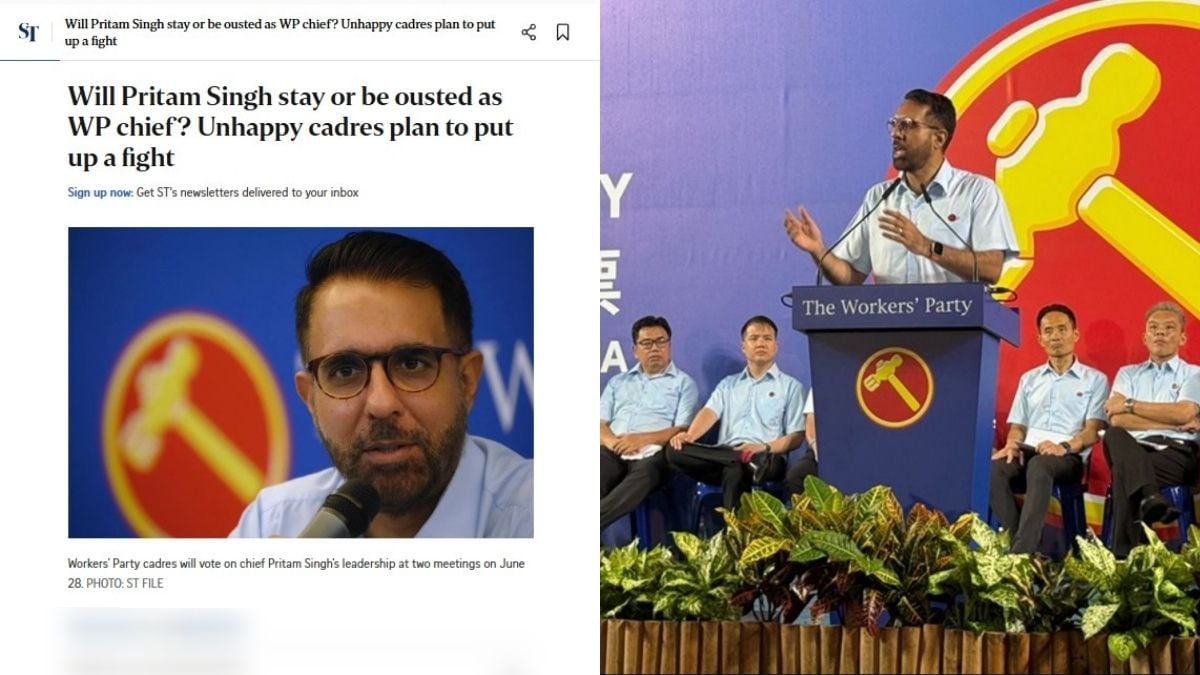

When The Straits Times ran its June 25 piece on the Workers' Party cadres pushing to unseat Pritam Singh, its central framing move was quiet and effective. It treated Singh's conviction not as a contested political event with a specific institutional history, but as a self-sufficient explanatory fact — one that, once accepted, makes everything else in the story flow naturally. Disgruntled cadres. Calls for accountability. A leadership challenge. Analysts weighing the fallout. The conviction is the engine. Everything else is downstream.
That framing survives scrutiny only if a legal judgment is taken as automatically settling the political meaning of that judgment. It does not.
To be clear about what this piece is not arguing: the courts adjudicated the matter referred to them and reached their findings according to law. Singh accepted the judgment fully and without reservation, paid the fine, and said publicly that he took responsibility for taking too long to respond to Raeesah Khan's lie. The criminal proceedings are concluded. The argument here is not about whether the court was right. It is about how ST uses the court's judgment to organise a political story — and what that framing leaves out.
What is in dispute is the provenance — how this case came before a court at all. Courts adjudicate what is referred to them. The decision about which matters enter that process is made upstream. In this instance, the upstream decision was made by Parliament's Committee of Privileges: a parliamentary body whose composition is determined by the parliamentary majority, which is the PAP. The referral that initiated Singh's criminal proceedings was made through parliamentary procedures by a body the PAP controls. The courts then did their job independently. But that job would never have begun without that prior decision — and that prior decision is precisely what ST's piece leaves out.
Readers of the ST article learn that Parliament found Singh had misled it, that the courts upheld his conviction, and that he was fined. They do not learn how the COP was constituted, who holds its majority, what the referral decision involved, or why this matter proceeded from parliamentary inquiry to criminal prosecution in the way it did. That institutional chain — the one that actually explains how a parliamentary committee finding became a criminal conviction — is entirely absent.
In its place, ST anchors the story on the conviction — returning to it repeatedly as both explanation and verdict. The phrase "convicted of lying" appears, and the word "conviction" recurs throughout as the article's organising shorthand. Legally accurate, but the legal dispute before the courts was considerably more specific: what Singh knew, when he knew it, and whether his statements to the COP constituted deliberately false testimony.
By compressing that dispute into a two-word descriptor, ST converts a complex factual and legal determination into something that reads as self-evidently damning — and that compression is what allows the entire narrative to function. Once a reader accepts "convicted leader," the subsequent paragraphs about moral high ground, leadership credibility, and justified cadre anger all follow without friction.
ST's piece is built substantially on anonymous sources: "disgruntled" cadres, "insiders," "party veterans," "those familiar with the matter." Their assertions — that the party expected to win another constituency, that the conviction undermines the WP's moral standing, that "people vote for WP because they trust us to be different" — are largely reported without further corroboration or independent examination. These sources supply the article's moral narrative. The conviction becomes the article's organising fact, giving those anonymous claims greater explanatory weight. Together they create a coherent story whose central premise is never interrogated.
Readers cannot assess whether the anonymous critics represent a majority of the membership, a substantial minority, or a vocal faction of roughly 25 out of just over 100 cadres. Repeated anonymous quotations naturally create the impression that internal discontent is the dominant mood — but the article itself does not demonstrate that. The impression and the evidence are not the same thing.
The editorial considerations are also different when anonymity is extended not to ordinary members but to former CEC members, election candidates, and long-serving party veterans seeking to influence a live leadership contest. Anonymity then protects the source while limiting readers' ability to assess the source's standing and motivations. There is nothing inherently improper about granting it — but it places a greater obligation on the journalist to test the claims and provide context readers cannot independently verify.
ST's piece does include countervailing voices, and that should be acknowledged. It quotes cadres recognising Singh's strong public support, notes his improved vote share in GE2025, quotes Yee Jenn Jong backing Singh, and cites analysts observing that voters have not expressed significant loss of confidence.
But the two camps are not treated with equal analytical depth. Critics of Singh receive detailed arguments, moral reasoning, and political vocabulary: readers understand specifically why they want him gone, what they believe it means for the party's integrity, and how they read the conviction as politically disqualifying.
Supporters, by contrast, receive acknowledgement and electoral data. Readers learn that support exists and that Singh has won votes — but not why party members who know the full picture continue to back him. Whether they believe Singh has already accepted responsibility, whether they view the prosecution as politically exceptional, or whether they judge his overall leadership record to outweigh the conviction are questions the article leaves unexplored. One camp is given a voice. The other is given a fact.
That asymmetry matters because the central question before the cadres is not whether support for Singh exists, but why competing groups within the party draw such different political conclusions from the same set of events. Readers are helped to understand one side's reasoning far more than the other's.
Notice also what ST does not do with its own evidence. The WP contested the 2025 general election with Singh as its convicted leader. Its vote share went up. ST records this and moves on. It never asks the obvious question: if a criminal conviction for dishonesty is the decisive political fact the article treats it as, why did ordinary voters apparently become more supportive? That question is not explored. The gap between cadre sentiment and voter sentiment is noted as a complication rather than interrogated as something that might challenge the article's organising premise.
A prosecution witness at Singh's trial, Yudhishthra Nathan, testified that in his view the COP "was primarily interested in matters such as how party leaders treated Khan and how she was expelled from the WP" — focused, that is, on WP leadership conduct rather than on Khan's admitted parliamentary lies, which were the ostensible subject of the inquiry. That testimony does not render the conviction invalid. But it bears directly on the question of how and why this case came to exist — the question ST never poses.
The issue is not that ST believes the court's findings. Newspapers generally treat legal judgments as authoritative, and reasonably so. The issue is that ST largely treats the conviction as exhausting the political significance of the case — as if the legal settlement is also a political settlement, and reasonable people need look no further. A legal judgment can be both settled and politically contested. Good political journalism should be able to hold both things at once.
Court reporting records what happened. Political journalism also asks why it matters, how different actors understand it, and what competing interpretations a reader ought to be able to weigh. That significance is rarely exhausted by the judgment itself.
The result is that one interpretation of June 28 becomes immediately legible to readers — an accountability moment, the party's inner circle reckoning with a compromised leader — while another remains largely absent: that the leadership contest cannot be fully understood without considering the parliamentary process that preceded it, including the COP referral that initiated the criminal proceedings.
Readers deserve to weigh both. ST's framing makes that weighing harder, not easier.