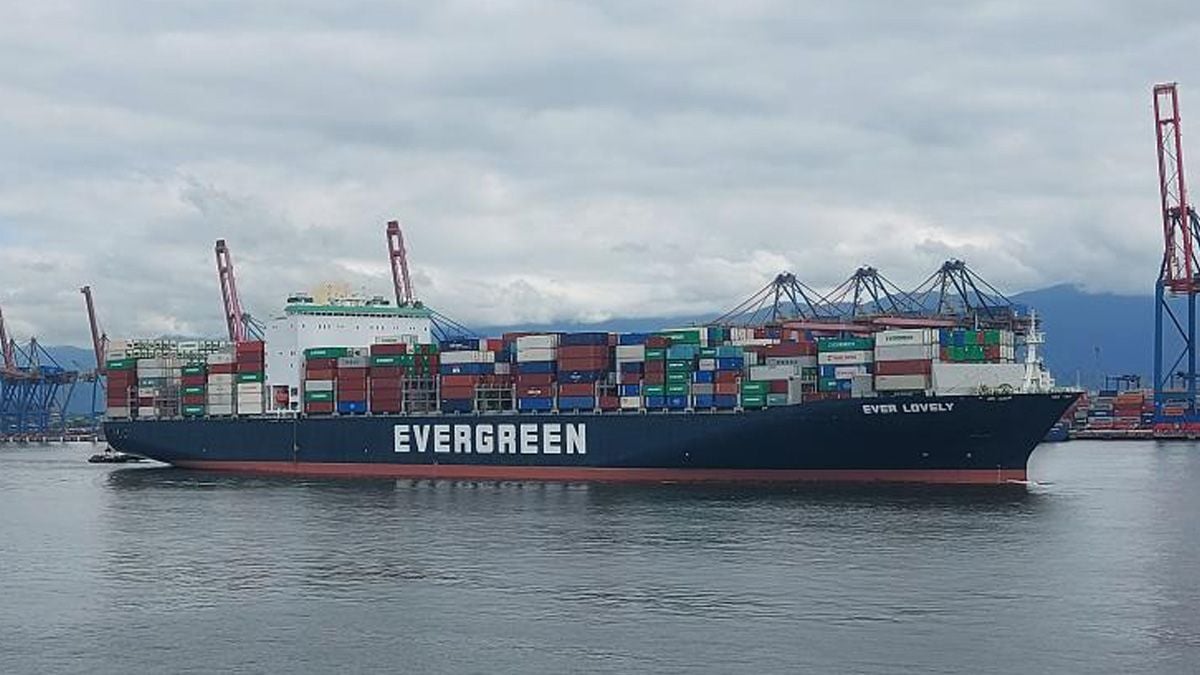
All 21 crew safe after drone strike on Evergreen Marine's Ever Lovely in Strait of Hormuz, MPA confirms
Singapore's Maritime and Port Authority has condemned the drone attack on the Ever Lovely as a breach of international law. All 21 crew members are safe and the vessel has completed its transit, owner Evergreen Marine confirmed on 26 June.
- MPA confirms all 21 crew are safe; damage limited to bridge eaves and two windows.
- Singapore condemns the attack as unprovoked and a breach of international law.
- Ever Lovely completed its transit and is continuing its voyage as scheduled.

Singapore's Maritime and Port Authority (MPA) said it was 'deeply concerned' about the incident, describing it as 'unprovoked, unjustifiable, and a breach of international law', confirming on 26 June that all 21 crew members are safe and the vessel has completed its transit through the Strait of Hormuz.
The MPA said it was aware that the Ever Lovely had sustained minor damage to the bridge area from an unknown projectile while leaving the strait at approximately 10pm Singapore time on 25 June. The authority confirmed that no Singaporeans were among the crew.
Owner Evergreen Marine confirmed that damage was confined to the eaves of the bridge and two of the bridge windows. The company said the main engine, navigation instruments, and essential shipboard systems were operating normally, and that the vessel remained seaworthy. The vessel and all cargo were described as safe.
The Ever Lovely is a 101,063 gross tonnage container ship built in 2015, owned by Evergreen Marine (Asia), a Singapore-based subsidiary of Taiwan's publicly listed Evergreen Marine. The vessel had been stranded in the Gulf for more than 100 days following Iran's effective closure of the strait in late February, according to financial data provider LSEG. It had loaded cargo in Iraq before attempting its transit on the morning of 25 June.
Vessel following recommended route at time of attack
According to The Strait Times, MPA confirmed that the Ever Lovely was following the recommended route published by the United Kingdom Maritime Trade Operations (UKMTO) centre when it was struck. The vessel had entered the strait via the southern corridor, close to the Omani coastline — the route that a large number of commercial vessels had been using since the partial reopening of the waterway.
The incident occurred 3.6 nautical miles off Oman's Khawr Naiwah. UKMTO recorded the strike as occurring 7.5 nautical miles southeast of Oman's port of Dahit. Ship-tracking service MarineTraffic recorded the vessel exiting on the eastern side of the strait at approximately 15:30 local time.
Crew members told the Wall Street Journal that they received no warning from the Iranian navy prior to the strike.
The attack was attributed to Iran's Islamic Revolutionary Guard Corps (IRGC) by two senior US officials, as reported by the Wall Street Journal. A US official separately told the Associated Press the ship was hit by a drone.
Singapore's MPA said it will remain in close contact with the vessel's management and provide necessary assistance. The authority reiterated that "all actions affecting international shipping must fully comply with international law, in particular the United Nations Convention on the Law of the Sea (UNCLOS), and not endanger the safety of seafarers and ships at sea."
UNCLOS designates the Strait of Hormuz as a waterway of unhindered transit passage, a status that the IRGC attack, if confirmed, would represent a direct breach of, according to maritime industry publication Seatrade Maritime.
IMO evacuation suspended; safety guarantees sought
The attack prompted IMO Secretary-General Arsenio Dominguez to suspend the organisation's ongoing evacuation operation, which had launched only on Tuesday following Oman's release of a phased framework for vessel departures. The framework had been designed to allow a "gradual and controlled" exit for more than 600 vessels and approximately 11,000 seafarers stranded in the Persian Gulf.
Dominguez confirmed that the Ever Lovely was not transiting under the IMO evacuation framework at the time of the attack. He said the evacuation plan would be paused until necessary safety guarantees could be reconfirmed.
UKMTO also confirmed the suspension, stating it would not be notifying vessels regarding inclusion in IMO planning batches during the pause period.
A scheduled IMO press briefing on the Strait of Hormuz, timed to coincide with the Day of the Seafarer on 25 June, was postponed "until further notice" due to what the organisation described as "urgent matters."
At least two vessels were nonetheless observed on tracking systems lining up for transits via the southern corridor at the time the suspension was announced. Maritime intelligence firm Windward recorded 43 transits on 25 June and described the strait as "operationally open," while noting that the southern corridor — previously understood as not requiring Iranian approval — was now "subject to active IRGC enforcement."
Shipping industry questions clarity of US-Iran agreement
The attack has sharpened concerns within the shipping industry about the adequacy of the Memorandum of Understanding (MOU) signed by the United States and Iran on 17 June, which established a 60-day period for nuclear negotiations and committed Iran to use its "best efforts" for the safe passage of commercial vessels without charge.
Jakob Larsen, chief security officer at BIMCO, the world's largest shipping association, said in a statement that the incident underscored "the importance of clear and unambiguous agreements between the US and Iran regarding a resumption of maritime traffic through the Strait," adding that "the wording of the US-Iran MOU is currently not sufficiently clear."
Iran and Oman have since announced talks to define what Iranian Foreign Minister Seyed Abbas Araghchi described as the "future administration and maritime services" of the strait. An Iranian official told the New York Times that Oman faces pressure from the US to reject any monetisation of the waterway but cannot provide security guarantees to vessels without Iranian cooperation.
Oil prices, which had briefly fallen below US$72.48 a barrel on 25 June — returning to pre-war levels — rose more than two per cent to approximately US$75.26 following news of the attack before easing to US$74.03 a barrel in early trading on 26 June.
US Secretary of State Marco Rubio, currently in Bahrain for talks on the US-Iran agreement, reiterated on Tuesday that no country is permitted to impose tolls on what he described as "an international waterway."