Crossing the Causeway for Dear You: why I chose Teochew over the Mandarin dub
Our correspondent crossed into Johor Bahru twice to watch the Teochew-language film Dear You in its original dialect, rather than the Mandarin-dubbed version released in Singapore. A first-person review of a film that moved them to tears more than once.
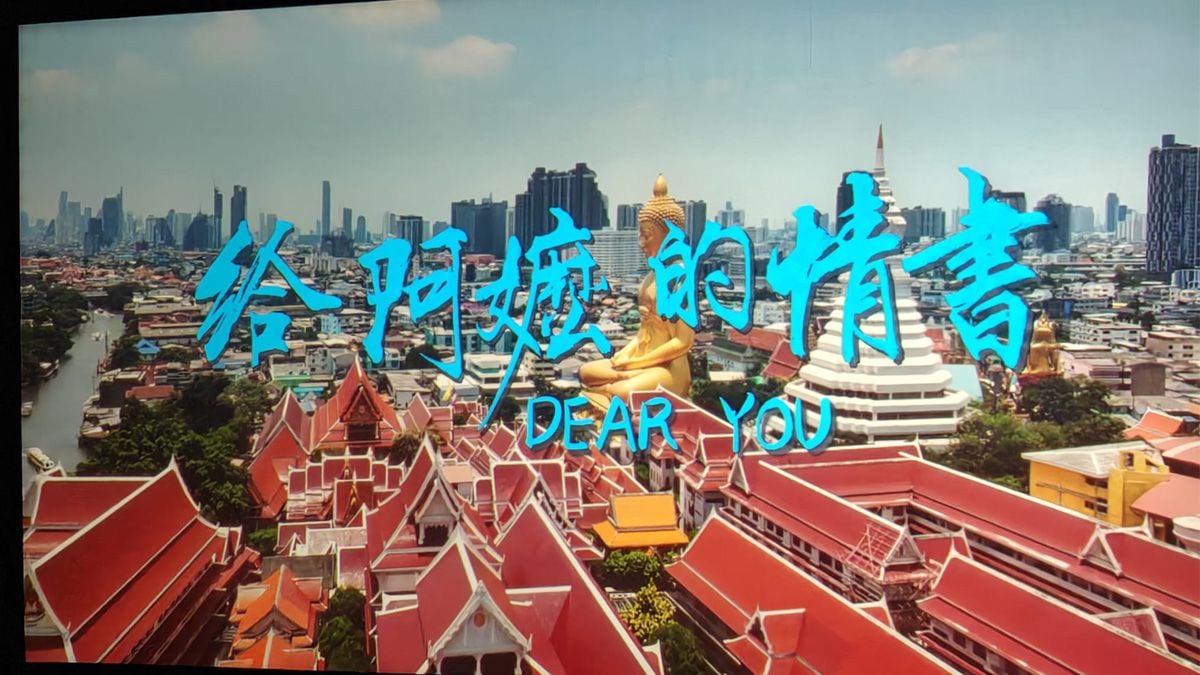

This is a first-person review by TOC’s correspondent and warning, it contains some plot spoilers.
I watched Dear You twice, and both times in Malaysia. The first was during a holiday in Kuala Lumpur, at GSC Kepong. The second was after work, at GSC SouthKey in Johor Bahru.
Getting there the second time was its own small adventure. Faced with the long evening-peak bus queue, I spent twenty minutes walking across the Causeway to the Johor Bahru checkpoint instead.
It was, by my reckoning, faster than waiting. While I was on foot on the Causeway, not a single Singapore bus overtook me.
I could not really tell whether the audience was made up of Singaporeans. The woman beside me sounded Malaysian, judging by how fluently she spoke Teochew.
A film that earned its tears
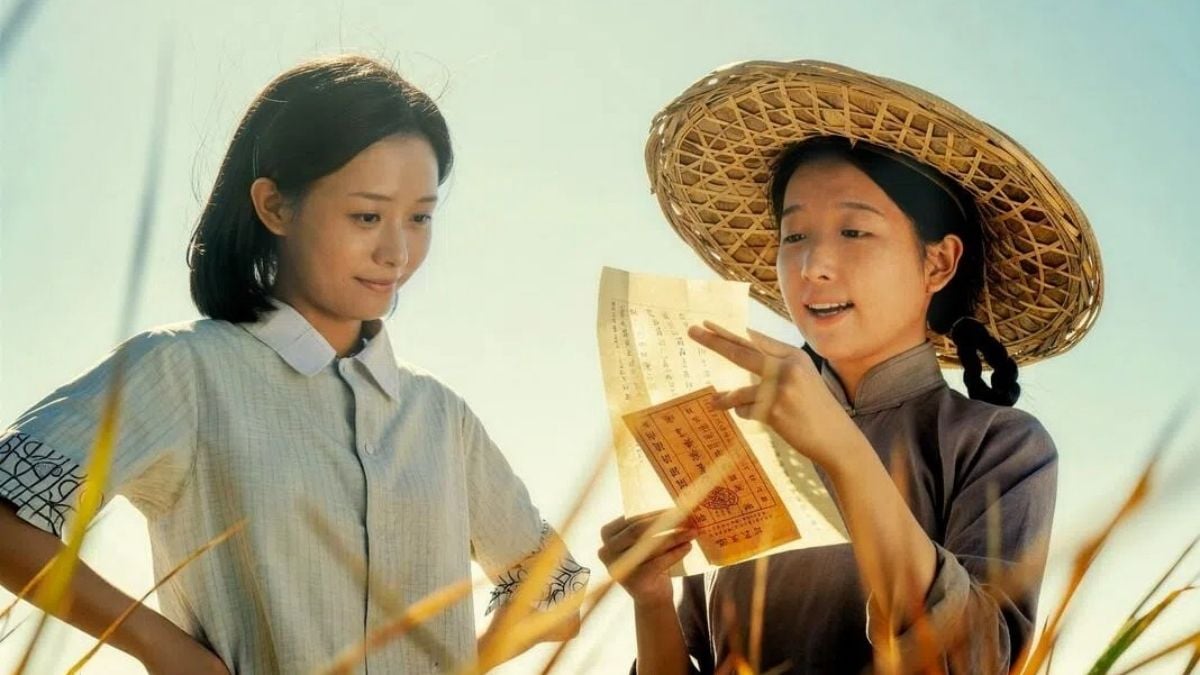
The film moves between two timelines. In the present day, a young man named Xiaowei travels to Thailand to trace his long-lost grandfather, Zheng Musheng, who had left China during the civil war and sent home qiaopi — remittance letters — before contact was abruptly severed. The decades-old story Xiaowei uncovers centres on Zheng's wife, Ye Shurou, who waited in their Shantou village, and on Xie Nanzhi, a Thai-Chinese woman in Bangkok.
I cried many times over the course of the film. Three moments in particular stayed with me.
The first comes when Ye Shurou — the grandmother who has spent her life waiting for the husband who sailed for the Nanyang — dreams of his return on the night of Qixi, the seventh evening of the seventh lunar month. As she dreams, Xie Nanzhi reads aloud a qiaopi to the late Zheng Musheng.
The weight of the scene lies in what Shurou does not know. Zheng had drowned in 1960, and Nanzhi, unable to bring herself to deliver the news, had quietly gone on sending letters and money in his name for over a decade, sustaining Shurou's hope. To me it felt as though Zheng's spirit had deliberately visited his wife in her dream, a moment the film ties to the early mourning period after a death.
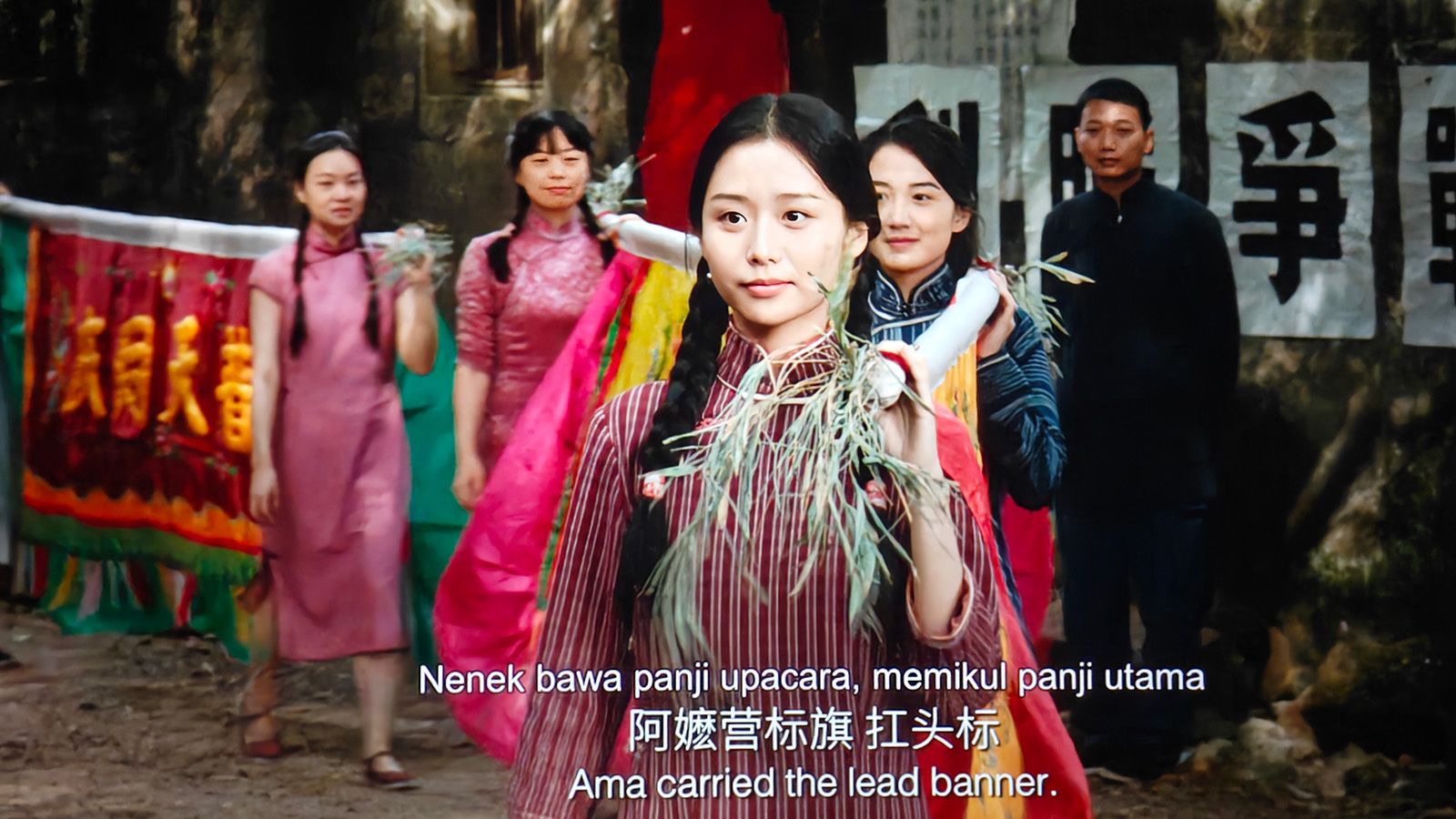
The second was Ye Shurou carrying her husband's ancestral tablet back to their hometown. At last, he returns home.
The third was the meeting between Ye Shurou and Xie Nanzhi — the woman who had carried Zheng's memory and her own quiet deception across all those years. They finally come face to face, but Nanzhi, now living with Alzheimer's, can no longer recall who Shurou is.
What stayed with me
Beyond the grief, two impressions lingered. I was glad the film allowed Xie Nanzhi and Zheng Musheng a platonic friendship, with no need to make it anything more.
I was also struck by Zheng Musheng's generosity, giving money for the education of the next generation rather than for himself.
It was said the director cut five scenes. I would rather they had stayed, for a fuller story.
I especially missed the scene in which Xie Nanzhi returns to China to break the news of Zheng Musheng's death to Ye Shurou, then decides not to tell her and goes home instead.
Teochew over Mandarin
I am Teochew myself, though not fluent. At times the dialogue moved so fast that I leaned on the subtitles to follow the story. Even so, I would choose the Teochew version every time.
Once it is dubbed into Mandarin, the essence is lost. I have not seen the Mandarin edition, and I suspect that unless I had, I would not be able to put my finger on exactly what was missing — only that something would be.
There were practical reasons to watch in Johor too. The cineplex there ran many screenings a day, sometimes one every half hour.
Tickets were far cheaper, at RM12 for seniors over 55, and the trip could be folded into a day excursion: a good meal, a massage, some shopping.
And there was no scramble for the limited, costly tickets back home. The hassle of that, to my mind, reflects a system that treats Singaporeans as though they cannot be trusted to choose for themselves.
Why I went back
In my university days, several friends found the film Ghost deeply touching and romantic, watching it again and again. I did not cry when I saw Ghost.
Dear You was different. I cried several times, and went back to watch it again within the week.
If I ever come across Dear You on an in-flight entertainment system or on television, I will certainly watch it once more.
Background
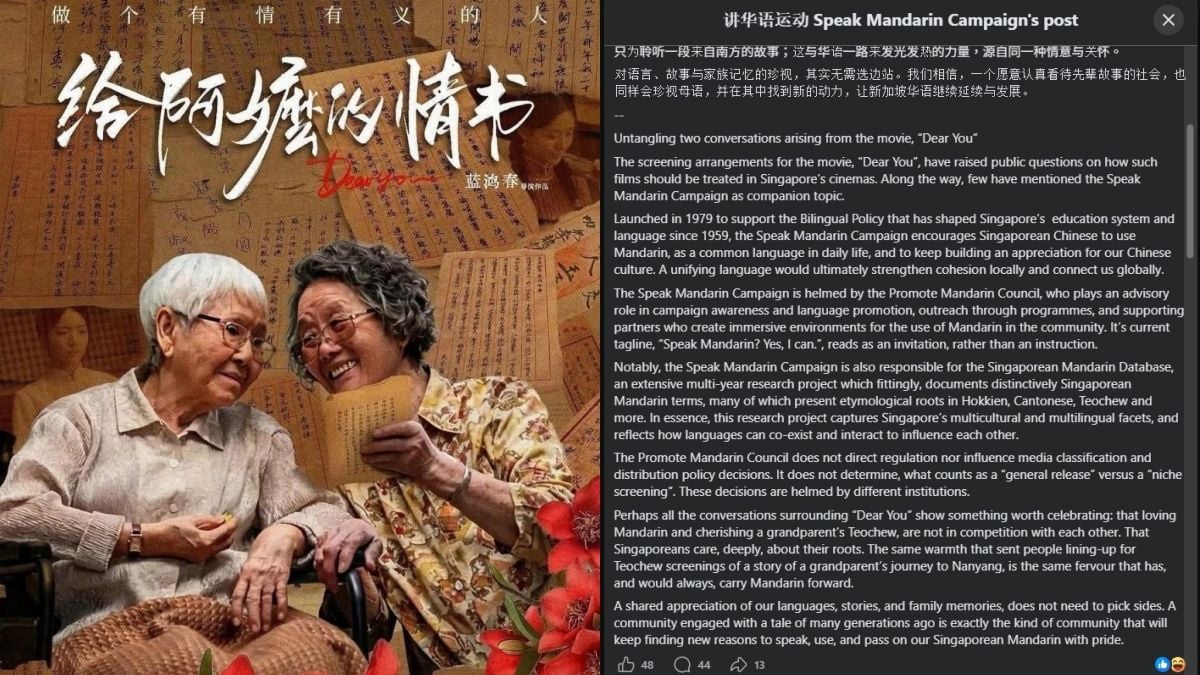
Dear You, directed and co-written by Lan Hongchun, follows two interconnected timelines: a grandson searching for his long-lost grandfather in present-day Thailand, and a newly married man who leaves China for Southeast Asia during the 1940s in search of work. The story turns on qiaopi — the remittance letters Nanyang migrants sent home, carrying money and word to the families they left behind.
The film has been one of China's biggest box-office successes this year, grossing more than 1.7 billion yuan (US$250 million) and fuelling interest ahead of its release in other markets, including Singapore.
It was shot almost entirely in Teochew. But when it opened for general cinema release in Singapore on 18 June 2026, only a Mandarin-dubbed version was approved for wide screening. The original Teochew version was initially confined to the premiere and to niche screenings.
The Infocomm Media Development Authority (IMDA) said the arrangement supported the bilingual policy, which promotes Mandarin as the main language among Chinese Singaporeans. The dubbing requirement traces back to the 1979 Speak Mandarin Campaign, which sought to make Mandarin the common tongue among Chinese Singaporeans at the expense of dialects.
Public demand for the original quickly outstripped supply. Golden Village's first eight Teochew sessions sold out all 4,800 tickets within two hours of their launch on 16 June. Eight further sessions, announced on 19 June, sold out within one and a half hours.
The restriction drew sustained appeals from Singapore's creative community. On 19 June, film-makers Eric Khoo and Jack Neo published a letter urging a new direction, arguing that screening a dialect film was no different from screening a French or Malay one, and questioning why cinemas alone should bear what they called an outdated policy.
Others joined them. Director Boo Junfeng said he would not watch the dub, as it diminished the film's authenticity. Royston Tan said he would travel to Malaysia for the original. Producer Huang Junxiang argued that a dub stripped away the nuance of the performances and the context of the Nanyang migrant era.
The film also drew commentary beyond the industry. Hong Kong-based academic Donald Low, who saw it in Teochew, called Singapore's handling an "own goal", arguing that the migrants in the film identified with their villages and dialect communities rather than an abstract "China" — a nuance he suspected the Mandarin dub flattened.
The authorities then shifted their position. On 22 June 2026, the Ministry of Digital Development and Information (MDDI) said it had heard the calls for dialect films to be screened more freely, and that IMDA would take a more flexible approach to such applications, while reaffirming Mandarin's unifying role and recognising dialects as part of Singapore's cultural heritage.
On 25 June 2026, IMDA and MDDI approved 50 additional Teochew screenings, citing strong demand. The approval added to 22 Teochew sessions already cleared — 18 to distributor Clover Films and four under a separate application by SPH Media Limited.