WP cadre vote signals confidence in Pritam Singh; party has moved beyond Raeesah Khan saga: Ian Chong
National University of Singapore political scientist Associate Professor Ian Chong said the Workers' Party's overwhelming cadre vote to retain Pritam Singh as secretary-general reflects confidence in the party's leadership, adding that the party appears to have moved beyond the Raeesah Khan episode.
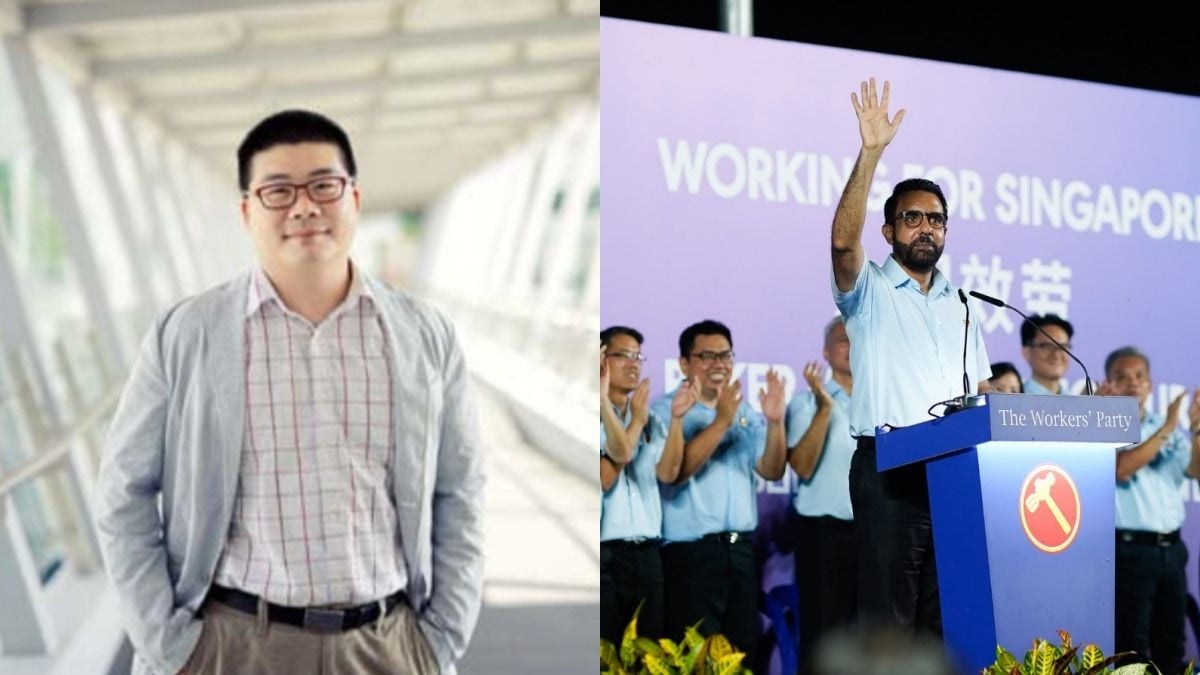
- Associate Professor Ian Chong said the Workers' Party cadre vote showed strong confidence in Pritam Singh and the party leadership.
- He said the vote reflected a political judgement independent of previous court proceedings involving Singh.
- Chong said internal debate is normal in political parties and warned against media reliance on unverified rumours.

SINGAPORE: The Workers' Party's (WP) overwhelming endorsement of Secretary-General Pritam Singh through a secret cadre vote reflects continued confidence in the party's leadership rather than any challenge to previous court rulings, according to National University of Singapore political scientist Associate Professor Ian Chong.
In comments responding to media queries and later published in full on his Facebook page, Assoc Prof Chong said the outcome of the party's Special Cadre Members' Conference demonstrated that party members had made a political judgement about Singh's leadership and the direction of the opposition party.
His remarks came after the WP convened a Special Cadre Members' Conference on 28 June 2026 following a requisition submitted by more than 20 cadres, which was later finalised at 25.
The meeting culminated in a secret ballot in which cadres voted by a supermajority to retain Singh as secretary-general.
Vote reflects confidence in party leadership
Responding to a question from Shin Min Daily News on whether the result showed party members were prepared to move beyond previous legal proceedings involving Singh, Assoc Prof Chong said the vote should be understood as an expression of confidence in the party's leadership.
"The (WP) cadre votes indicate their confidence in their leadership and their Central Executive Committee (CEC)," Chong said.
"There is no direct bearing from the court rulings, just like Tharman Shanmugaratnam was previously convicted. Yet, the People's Action Party felt that he could be brought into their ranks and become a leader. After he left the party, he became nominated for — and won — the Presidency."
President Tharman and then-Senior Minister in ruling PAP government was charged in 1992 over accusation of leaking Singapore's economic growth rate for the second quarter of that year before it was officially published. Tharman was then fined S$1,500.
Assoc Prof Chong drew a distinction between legal outcomes and political decisions, arguing that parties ultimately make leadership choices based on broader political considerations.
Electoral performance strengthened leadership
Assoc Prof Chong said there was little incentive for the party to replace its leadership given the WP's electoral performance under Singh.
He noted that following the General Election last year, the WP increased its parliamentary representation to 12 seats, including Non-Constituency Member of Parliament (NCMP) seats, making it the largest opposition party in Parliament.
"The WP continued to consolidate their position during Pritam Singh's term. Both politically and when facing voters, there is no major motivation or reason for change," he said.
According to Assoc Prof Chong, the party's official statements also suggest it has moved beyond the controversy surrounding former WP MP Raeesah Khan and the subsequent questions over whether Singh had lied before a parliamentary committee.
"From official statements by the Workers' Party, they seemed to have put Raeesah Khan's case as well as whether Pritam Singh lied before a Parliamentary Committee behind them," Chong said.
"They absorbed the necessary lessons and look to continue forward."
He added that while political opponents continued to raise those issues, such attacks were an expected feature of Singapore's political contestation.
"The issue is that their political opponents keep raising the issue, but this is to be expected in Singapore politics. This is completely unsurprising in the process of political contestation," he said.
Internal debate is healthy
Asked whether the vote demonstrated that the WP was not an "echo chamber" and that support for Singh was not simply blind loyalty, Assoc Prof Chong said differing opinions were both normal and desirable in political organisations.
"To have different views in a party is very normal. The same goes for any organisation," he said.
"More important is how to enable those voices to be presented so as to reflect various perspectives and interest in a party or even society, and then to have reasonable and legitimate processes to address them."
Assoc Prof Chong said transparency and robust internal procedures were especially important for political parties because of the public responsibilities they carry.
"I think politics affects everyone in the country, which includes political parties. This creates an imperative for procedure to be as transparent as possible. Parties with sufficient size and seats in Parliament all the more so," he said.
He added that while Singh and the WP's CEC clearly enjoyed substantial backing, cadres still had an important role in overseeing the party's direction.
"From the election results, Pritam Singh and the WP CEC have substantial support within the party. However, the WP is not an echo chamber. Cadres need to actively oversee and participate in decisions."
"Overall, the opportunity to present different voices, to be more transparent, to have trusted and effective oversight mechanisms are positive political developments."
Assoc Prof Chong cautions against reporting based on unverified rumours
While acknowledging that differing opinions inevitably exist within any sizeable organisation, Assoc Prof Chong also cautioned against overstating internal divisions based on speculation.
He said attention often focused on disagreements within political parties, but warned that some reporting appeared to rely on claims that could not be independently verified.
"Of course, there are also some media outlets who seem to rely on uncorroborated and unverifiable rumours, which can appear leading, or at least make people outside feel that differences within the party are larger than actually the case," he said.
Uncontested leadership not unexpected
Separately, responding to questions from Berita Harian about Singh's uncontested re-election as secretary-general, Assoc Prof Chong said the outcome should not have come as a surprise.
"This was surprising only to those who followed uncorroborated rumours," he said.
"There were no other indications of dissatisfaction with Pritam's leadership."
He said the result represented a continuation of the party's existing direction following its electoral gains under Singh's leadership.
"For the WP, this is a consolidation of their original position, given that they have performed well electorally under Pritam's leadership. The WP looks to move on."
Whether political opponents and parts of the media would allow the party to do so remained an open question, he added.
Assoc Prof Chong also argued that the voting process itself demonstrated the party's willingness to accommodate differing views before reaching a collective decision.
"That said, Pritam won the no confidence motion and the secretary-general election with an overwhelming number of votes and after deliberation," he said.
"This demonstrates that the WP has a process that enables different voices to air their concerns, which its cadres and members respect."
He added that what mattered most was whether members accepted internal procedures as "fair, even-handed, transparent, and achieved without fear or favour".
Separating legal and political judgements
Berita Harian also asked whether continued support for Singh, despite his conviction, reflected different standards applied by the public to opposition politicians compared with members of the ruling PAP.
Assoc Prof Chong said legal findings should be distinguished from political and ethical assessments made by voters.
"Without prejudice to the court judgement on Pritam, it is probably useful to separate what happens legally from how people may view a situation politically and ethically," he said.
He again pointed to President Tharman's earlier conviction for negligence involving state secrets, noting that the PAP nevertheless considered him a strong leadership candidate.
"Singaporeans are discerning. I would not underestimate their ability to distinguish what they see as credible."
Background to the disciplinary process and conference
The WP CEC had previously indicated that any conference would follow the conclusion of disciplinary proceedings.
Those proceedings stemmed from the 2021 case involving Khan’s false parliamentary statement.
A Committee of Privileges inquiry and subsequent court proceedings found that Singh had knowledge of aspects of the matter and mishandled its correction, resulting in criminal charges and a conviction upheld by the High Court in December 2025.
Following internal review in January 2026, a disciplinary panel found breaches of party rules but characterised them as errors of judgement rather than intentional wrongdoing.
The CEC issued a formal reprimand on 30 April 2026.
Parliament had earlier voted in January 2026 to deem Singh unsuitable for the LO role, a decision subsequently acted upon by the Prime Minister. The WP chose not to nominate a replacement.
Constitutional framing and leadership remarks
After the conference, Singh described the proceedings as a “constitutional exercise initiated by party cadres,” adding that the party respects the internal process.
He said the meeting itself was less dramatic than portrayed externally, noting that members simply voted after procedural acceptance of the requisition.
He also indicated that the result reflected a supermajority sentiment within the cadre base, consistent with internal descriptions provided by senior party figures.