Yeoh Lian Chuan: Goh Chok Tong out of touch and wrong on the issue of Ministers’ pay
Law practitioner Yeoh Lian Chuan has criticised Emeritus Senior Minister Goh Chok Tong’s defence of high ministerial pay, arguing that financial sacrifice is overstated and that salary benchmarks favour a narrow elite.
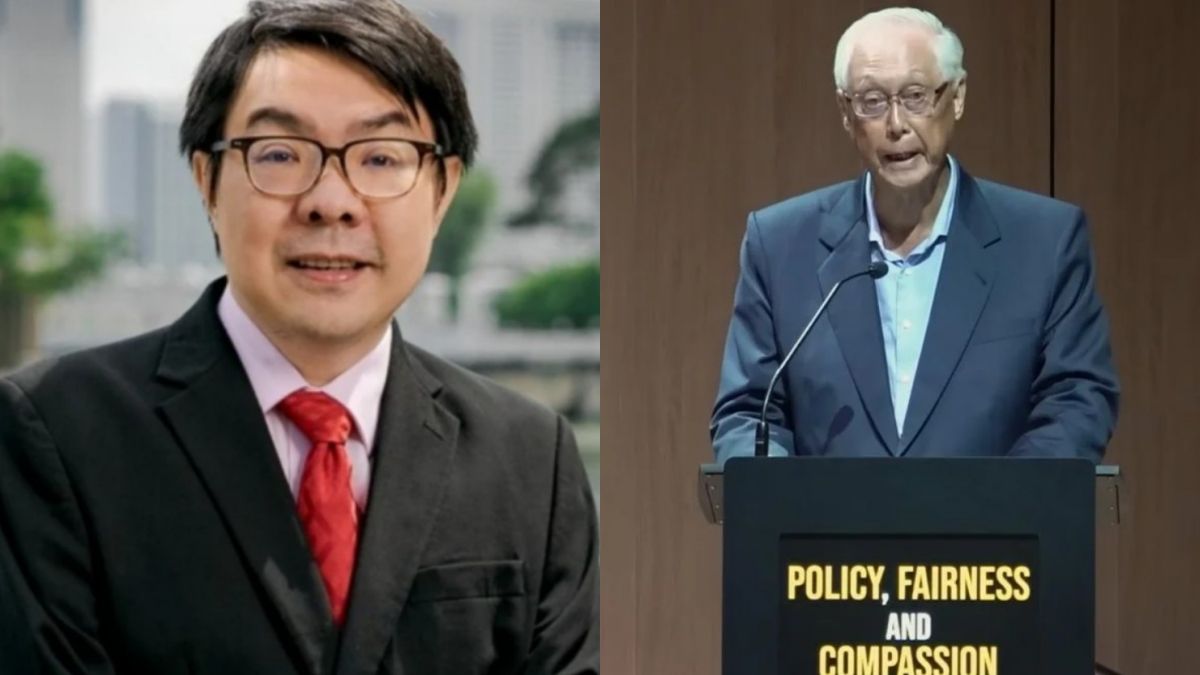
- Lawyer Yeoh Lian Chuan criticised ESM Goh’s remarks on the need for high ministerial pay to attract talent.
- Yeoh argued that financial sacrifice is overstated and that benchmarks favour an extremely small elite.
- Netizens echoed concerns over transparency, inequality, & whether pay motivates the right kind of leadership.

SINGAPORE: Law practitioner Yeoh Lian Chuan has publicly criticised remarks by Emeritus Senior Minister (ESM) Goh Chok Tong on the need for competitive political salaries to attract and retain top talent in Singapore’s leadership.
In a Facebook post dated 7 February 2026, Yeoh said ESM Goh was “out of touch and wrong” on the issue of ministers’ pay, disputing the claim that financial sacrifice significantly deters capable individuals from entering politics.
According to Yeoh, individuals worth around S$100 million are already able to generate substantial investment income, making it “not hard” to reach annual earnings of S$5 million when ministerial salaries are included.
“At those levels,” Yeoh wrote, “it is hard to generate any sympathy at all for financial sacrifice.”
Allowances and bonuses often overlooked
Yeoh also highlighted that all ministers receive a Members of Parliament annual allowance of S$192,000 in addition to their office-holder salaries, which he argued is often overlooked in public discussions on political pay.
Referring to figures released by the Government in 2018, Yeoh noted that average bonuses for ministers amounted to 9.7 months, nearly three months higher than the stated benchmark of seven months.
He argued that when allowances and bonuses are considered together, the frequently cited 40 per cent “discount” for political service is effectively reduced by about half.
Yeoh further criticised the benchmark used to determine ministerial salaries, which is based on the median income of the top 1,000 Singaporean earners.
Questioning the top-1,000 benchmark
He said this group represents roughly 0.02 per cent of earners, questioning whether the talent required to govern Singapore can only be found within such a narrow segment of society.
“Not even the top 1 per cent, and not even the top 0.1 per cent,” Yeoh wrote, adding that he did not believe effective political leadership was confined to this group.
He also rejected the assumption that the highest earners necessarily make the best political leaders, arguing that wealth creation requires skills and dispositions different from those needed to govern a country.
Yeoh raised concerns about what he described as a failure to account for income volatility, noting that the benchmark reflects whoever happens to be at the top in a given year rather than long-term earning patterns.
He added that the benchmark applies only to entry-grade ministers, with further increases available at higher grades, including the Prime Minister, whose salary is set at twice the benchmark.
According to Yeoh, the Government is insufficiently transparent about total ministerial remuneration beyond the entry level, arguing there is “no good justification for the opacity”.
He singled out mayoral salaries as particularly excessive, describing the role as one that can be discharged on a part-time basis, with some mayors concurrently holding Minister of State positions.
Goh Chok Tong warns against losing talent over political pay concerns
Yeoh’s comments followed remarks made by ESM Goh on 6 February 2026 during the launch of a new book by Coordinating Minister for National Security K. Shanmugam.
In his speech, ESM Goh reiterated that while money should never be the motivation for entering politics, it should not become a deterrent to public service.
He said Singapore’s long-term success depends on its ability to field the best candidates for political leadership across generations, particularly as social expectations and career opportunities evolve.
According to ESM Goh, it has become increasingly difficult to persuade individuals at the peak of their professional careers to enter public service, given the financial opportunity costs involved.
He cited Shanmugam’s decision to leave a lucrative legal career in 2008 as an example driven by public duty and personal convictions, but warned that similar cases are becoming rare.
“It will not be easy to find another Shanmugam who is willing to forgo tens of millions of dollars over a 20-year period as minister,” ESM Goh said during the book launch.
Beyond pay, ESM Goh also pointed to heightened public scrutiny and social media exposure as additional deterrents for potential candidates.
He warned that assumptions about the system continuing to function regardless of leadership quality were risky, stressing that attracting capable leaders must be treated as a systemic priority.
Without a “top-rate government”, ESM Goh cautioned, Singapore’s long-term trajectory could be undermined.
ESM Goh’s comments coincide with the recent formation of an eight-member committee to review the salaries of political office-holders, including ministers and Members of Parliament.
Netizens: money has already become a major pull factor in politics
Observing comments on Yeoh's Facebook page, netizens questioned how much pay is truly necessary for ministers to serve with genuine commitment.
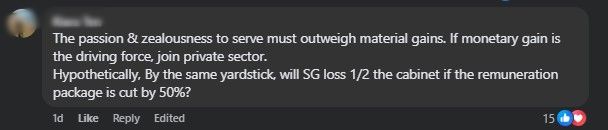
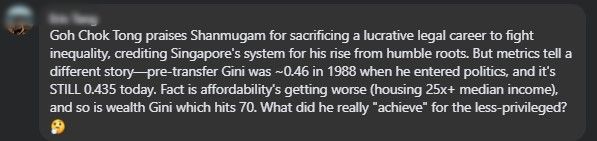
Some netizens argued that money has already become a major pull factor in politics, citing job security, pensions, prestige, and post-political “soft landings” as benefits that complicate claims of sacrifice.
Others contended that many Senior Counsel are qualified and willing to replace top ministers, criticising what they described as an “ownself check ownself” system for determining political salaries.
Several suggested that ministerial pay should be benchmarked against leaders of other G20 governments, rather than the private sector, arguing that the nature of public office is fundamentally different.

Wider concerns over inequality and trust
Comments on mainstream media platforms such as CNA reflected similar scepticism, with some rejecting the claim that high salaries are needed to offset foregone private-sector earnings.
Others argued that if individuals serve only because of high pay, their motivation is financial rather than civic, which they said is the wrong basis for political leadership.
Some linked the debate to rising housing costs and widening wealth inequality, while others expressed perceptions that institutions increasingly favour the wealthy over ordinary citizens.