Vivian Balakrishnan: Singapore to deepen middle power ties amid “tectonic” global rupture
Singapore will strengthen ties with middle powers and ASEAN as the post-war global order gives way to a more fragmented era, Foreign Affairs Minister Dr Vivian Balakrishnan told Parliament on 27 February 2026.
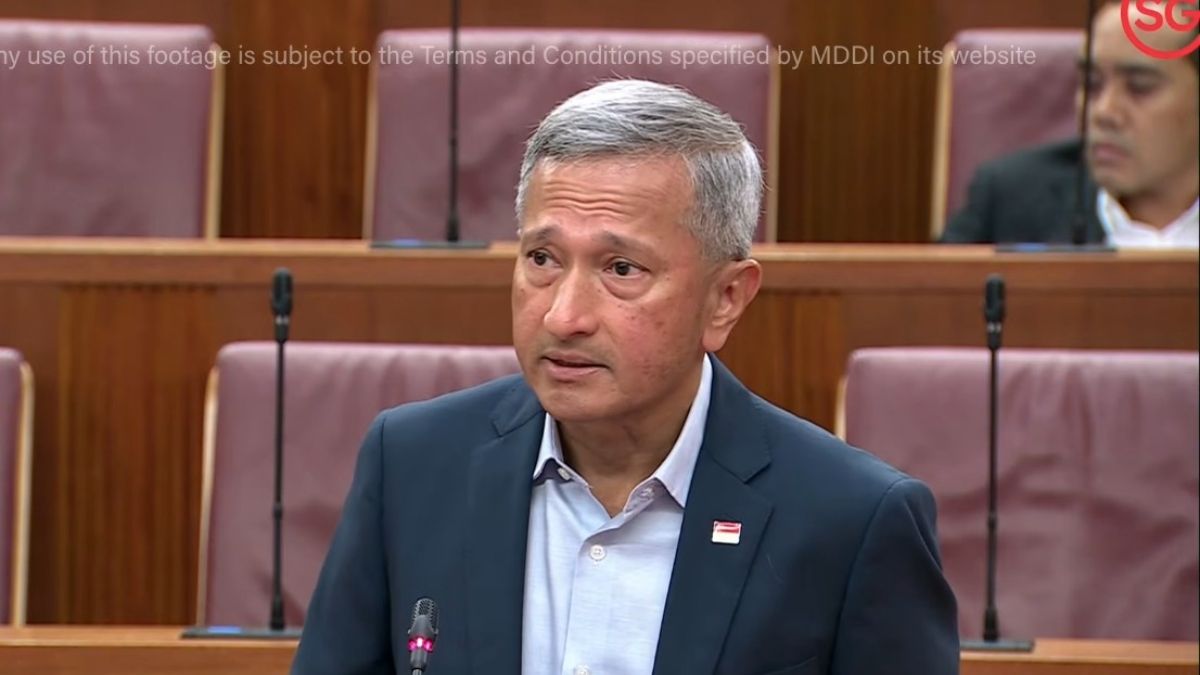
- Dr Vivian Balakrishnan said the post-World War II international order has ended, describing a “geostrategic tectonic plate rupture”.
- Singapore will strengthen partnerships with middle powers, ASEAN, and regional blocs while maintaining strategic independence.
- The minister stressed the need for domestic unity and resilience against foreign influence campaigns.

Singapore will strengthen partnerships with middle powers and regional blocs as it navigates what Foreign Affairs Minister Dr Vivian Balakrishnan described as a “geostrategic tectonic plate rupture” in global politics.
Speaking in Parliament on 27 February 2026, Dr Balakrishnan said the post-World War II international order has effectively come to an end, reshaping the strategic landscape for small states like Singapore.
He said the order, built on multilateralism, international law, free markets, global supply chains and institutions such as the United Nations, no longer commands the same level of support.
According to Dr Balakrishnan, a populist backlash against globalisation has been blamed for widening inequality, middle-class stagnation, job losses and deep political polarisation in many societies.
“This domestic dysfunction has now projected itself onto the global stage, and you'll see that this has undermined the support for the international order,” he said.
“This is not just a small tremor. This is a geostrategic tectonic plate rupture.”
He warned that great powers are increasingly willing to flex military and economic strength in pursuit of national interests, with “less pretence of legal or moral justification”.
“Where there was once economic integration, there is now fragmentation and weaponisation of interdependence and dependence,” he added.
Greater risks for small states
For small states lacking strategic heft, the environment has become more dangerous.
“For Singapore, a tiny city-state, the shoals are even more treacherous,” he said.
Dr Balakrishnan noted that Singapore has “never been naive” and has always operated with realism, acknowledging that size and power matter in international relations.
He pointed out that Singapore has consistently spent between 3 per cent and 6 per cent of its gross domestic product on defence for six decades to safeguard its sovereignty.
Five workstreams for a fractured era
Against this backdrop, he outlined five workstreams for the Ministry of Foreign Affairs this year: engaging all major powers constructively; expanding middle power partnerships; strengthening ASEAN; deepening ties with immediate neighbours; and reinforcing a rules-based international architecture.
Beyond major powers, Singapore will widen cooperation with middle powers and regional blocs that share an affinity for international law, multilateralism and free trade.
In 2025, Singapore upgraded partnerships with Australia, France, India, New Zealand and Vietnam, and established a new partnership with South Korea. It also signed the European Union-Singapore Digital Trade Agreement.
Singapore will expand its footprint in Africa and Latin America, establishing new diplomatic missions in Mexico and Ethiopia.
ASEAN at the core
The Association of Southeast Asian Nations remains the cornerstone of Singapore’s foreign policy, Dr Balakrishnan said, referring to ASEAN.
He said strong bilateral relationships with neighbouring countries form the bedrock of regional cohesion, with initiatives such as the ASEAN Power Grid and the ASEAN Digital Economy Framework Agreement advancing integration.
Singapore will assume the ASEAN chairmanship in 2027, coinciding with the bloc’s 60th anniversary, and intends to use the opportunity to pursue deeper unity and integration.
“We should give all major powers a stake in the stability and prosperity of our region and ensure that ASEAN remains a partner of choice,” he said.
The ability to say “no”
Dr Balakrishnan stressed that Singapore must retain the ability to say “no”, even at cost, to safeguard its independence.
“If we ever lose that ability to say no, then that is the day that Singapore loses its relevance, indeed, our independence,” he said.
Singapore will work with any country where interests align but will not align itself exclusively with a dominant power, he added, warning that doing so would undermine sovereignty.
Defending a rules-based system
On the rules-based order, he cited Singapore’s defence of principles under the World Trade Organization, including the Most Favoured Nation principle.
He said Singapore had expressed disappointment over US tariffs that violated this principle, stressing that trade is the nation’s lifeblood.
Dr Balakrishnan also pointed to Singapore’s positions on global conflicts, including calling out violations of international law in Russia’s invasion of Ukraine and US actions in Venezuela.
On the Israel-Gaza conflict, he said Singapore condemned the 7 October 2023 attack on Israel while also stating that Israel’s military response had breached international humanitarian law.
Regarding relations with Washington and Beijing, he said Singapore aims to work with both where interests coincide.
“All countries, including Singapore, will have to find creative ways to work with both the US and China, because they are the major powers, and they are relevant to our future,” he said.
Guarding against foreign influence
Domestically, Dr Balakrishnan warned that geopolitical contestation has become a struggle for “hearts and minds”.
He cautioned that foreign actors would attempt to seed narratives, spread misinformation and deepen divisions, noting that information campaigns had surfaced during the 2025 General Election urging voters to cast ballots along religious lines.
“We do not necessarily have to agree on all our foreign policy stances, but we must agree that these are matters to be discussed and decided by Singaporeans alone,” he said.
He emphasised that domestic unity, economic relevance and defence capability are Singapore’s three prerequisites for continued success.
Quoting founding Prime Minister Lee Kuan Yew, he reminded Parliament that small countries “perform no vital or irreplaceable function in the international system”.
As long as Singapore maintains unity, resilience and the will to defend its interests, Dr Balakrishnan said, it can remain useful without being “made use of”.