Sylvia Lim presses Ong Ye Kung over TikTok video on IP riders; minister urges public to assess their needs
Health Minister Ong Ye Kung clarified the role of Integrated Shield Plan riders after concerns raised by Sylvia Lim that a TikTok video might imply riders were unnecessary. Ong said riders mainly cover deductibles and co-payments, urging individuals to assess their financial needs before purchasing one.
- Ong Ye Kung clarified that insurance riders mainly cover deductibles and co-payments, and individuals should assess their financial needs before purchasing one.
- Sylvia Lim raised concerns that a TikTok video could give the impression that riders are unnecessary.
- MediShield Life and MediSave will be extended to cover selected preventive surgeries later this year.

SINGAPORE: Health Minister Ong Ye Kung clarified that Integrated Shield Plan (IP) riders mainly cover deductibles and co-payments, urging individuals to assess their financial needs before purchasing them.
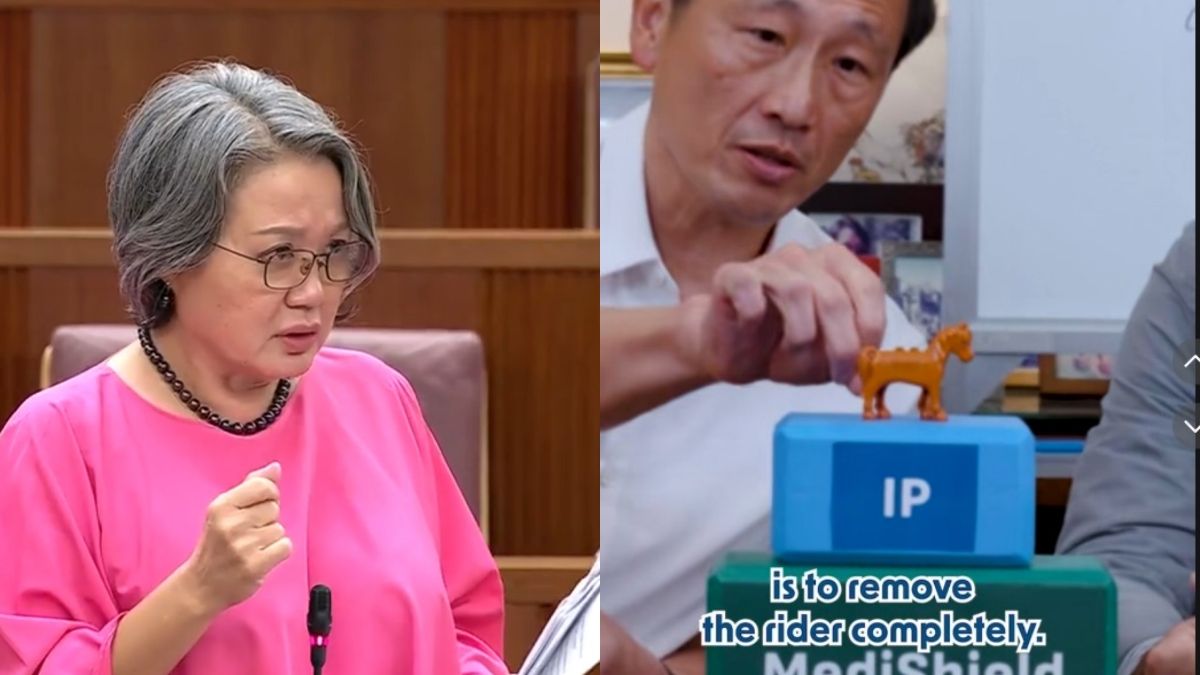
The clarification came after Workers’ Party MP Sylvia Lim raised concerns that a TikTok video by the minister may have created the impression that riders were unnecessary.
Speaking during the Ministry of Health’s Committee of Supply debate on 5 March 2026, Ong said the video’s message was intended to encourage individuals to review their insurance needs carefully rather than discourage riders entirely.
“The purpose of insurance is to cover expenses that we cannot afford,” Ong told Parliament.
“For most of us, if we have a big inpatient episode running into tens of thousands or hundreds of thousands of dollars, insurance plus subsidy can cover it.”
He added that riders serve a different purpose.
“The rider does not do that job… the rider covers deductibles and the co-payment, including the 5 per cent co-payment. That’s the core purpose of the rider,” he said.
Concerns raised over TikTok video
Lim raised the issue after receiving feedback from members of the insurance industry about one of Ong’s explanatory TikTok videos.
She said the video symbolised riders with a wooden horse, which the minister flicked off a table, potentially leading viewers to think riders were unnecessary.
“That video on integrated plans and riders created an impression in some members of the public that riders were not really necessary,” Lim said during the debate.
She asked whether the minister could reaffirm that riders could still be prudent for certain individuals.
Ong acknowledged that short videos could sometimes create misunderstandings.
“That’s the challenge when attention span is so short and you try to put so much information in a short video,” he said.
He reiterated that the government’s message was for individuals to evaluate whether riders suited their circumstances.
“I think talk to your financial adviser and balance the cost and benefit to see if a rider is suitable for you,” Ong said.
Changes to rider rules from April
Lim also raised concerns about changes to IP riders taking effect in April.
Under the new rules, new riders will no longer be able to fully cover minimum deductibles and will instead cap annual co-payments at S$6,000.
The changes aim to prevent the “over-erosion” of co-payments, which the ministry said could lead to unnecessary medical spending.
Ong said excessive erosion of co-payments could trigger a “buffet syndrome”, where patients face little financial incentive to consider costs, contributing to rising private hospital bills.
“The objective of the recent changes to the IP riders is to prevent the over-erosion of co-payment,” he said.
He emphasised that the rule changes apply only to new policyholders and not to those who already hold riders.
At the same time, premiums for new riders are expected to fall by about 30 per cent.
Cancer drug coverage unaffected
Lim also questioned whether the changes might affect cancer patients, particularly those requiring drugs not listed on the Cancer Drug List.
Ong clarified that rider coverage for non-listed cancer drugs used in outpatient treatment would not be affected.
“IP riders covering non-CDL drugs for outpatient treatment do not contribute to this erosion and therefore this feature will not be affected by the changes,” he said.
He added that the government would continue monitoring the impact of insurance policy adjustments on cancer patients.
“We will always watch out for the case of cancer patients when we make changes to IP riders,” he said.
Balancing premiums and protection
Ong also emphasised that riders can become expensive as policyholders age.
In some cases, premiums for riders in a person’s seventies or eighties may rise to about S$10,000 annually.
“If you are considering that you go to a private hospital where your bill may run up to hundreds of thousands of dollars and you want to protect yourself against that 10 per cent co-payment, a rider may be suitable for you,” he said.
However, individuals who mainly rely on subsidised public healthcare may face lower financial exposure due to MediShield Life coverage and government subsidies.
“For those who use subsidised public healthcare, MediShield Life plus subsidy makes it very unlikely you are exposed to tens or hundreds of thousands of dollars of bills,” Ong said.
He also pointed out that those who still struggle to pay medical bills can apply for assistance through MediFund.
Review of preventive surgery coverage
Separately, Lim asked for an update on insurance claims for preventive breast surgeries, citing a case published in The Straits Times forum page involving a young breast cancer patient.
The patient underwent surgery to remove both breasts following medical advice but was only partially covered for the non-cancerous breast.
Ong acknowledged that advances in medical science have blurred the distinction between preventive and curative treatment.
“The boundary between preventive and curative care is increasingly blurred,” he said.
For individuals with high genetic risk, preventive surgery could potentially avert more serious treatment later.
“If a high-risk individual is unable to undergo preventive mastectomy, she has a high chance of eventually needing cancer treatment,” Ong said.
He said the government was prepared to extend MediShield Life coverage for selected preventive procedures where there is clear clinical need and minimal risk of abuse.
Risk-reducing mastectomies and preventive surgeries for ovarian cancer were among the procedures identified as meeting these criteria.
Ong said MediShield Life and MediSave coverage for certain preventive surgeries would be extended later this year.