Why do we keep failing?' Singaporeans vent frustration over BTO ballot system
A viral TikTok video and HDB's response have unleashed a wave of public grievances over Singapore's public housing ballot, with citizens citing ethnic quota cutoffs, proximity hardships, and demands for a weighted lottery system.
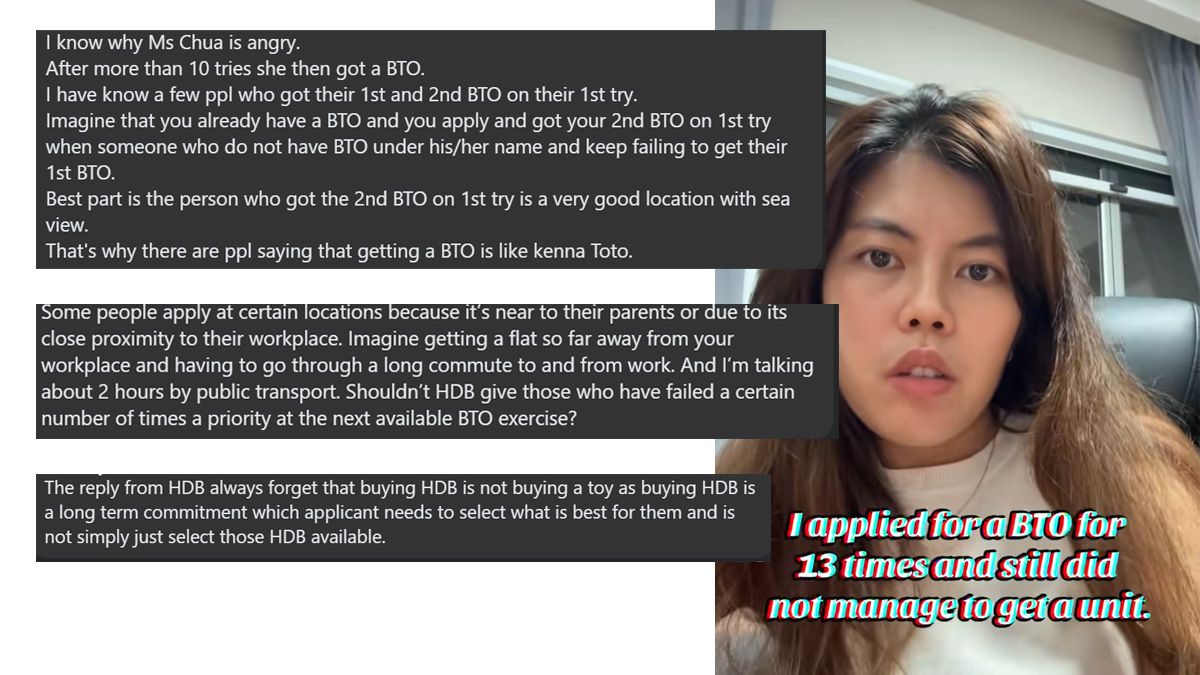
- Singaporeans cited ethnic quota cutoffs, proximity hardships and repeat failures as evidence of systemic flaws.
- Many called for a weighted ballot giving repeat unsuccessful applicants progressively better odds.
- HDB's advice to apply in less popular areas was widely criticised as dismissive of legitimate needs.

A video documenting one woman's years-long struggle to secure a public housing flat has become a lightning rod for broader public discontent over Singapore's Build-To-Order (BTO) ballot system, with hundreds of residents sharing accounts of their own repeated failures and calling for structural reforms.
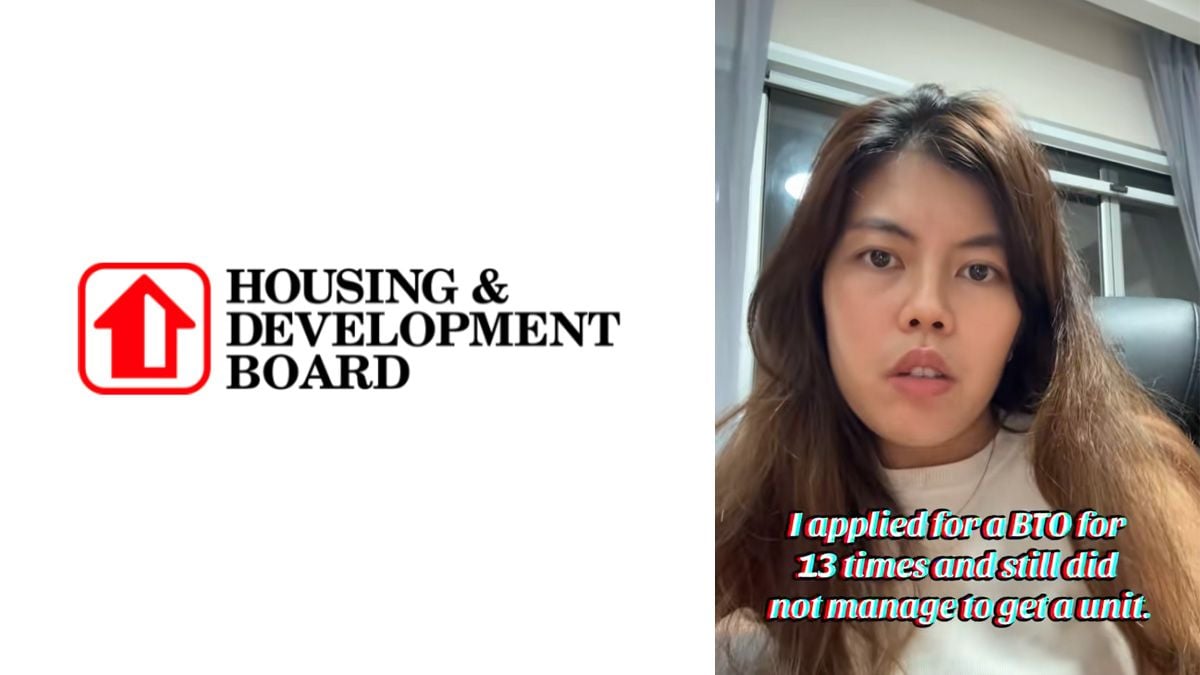
The response followed a TikTok post by a content creator known as Chua, who said she had applied for a four-room BTO flat 13 times before giving up and purchasing a resale flat.
The Housing and Development Board (HDB) subsequently issued a public clarification on 14 March 2026, confirming her application count as 11 and noting that in her final attempt she had been invited to select a flat but declined.
That clarification, rather than settling the debate, appeared to amplify it. The public reaction that followed drew on a wide range of personal experiences with the ballot system, revealing frustrations that extended well beyond Chua's individual circumstances.
Scepticism and the investment angle
A significant strand of commentary challenged the premise that Chua's experience reflected systemic failure, arguing instead that persistent applications for Kallang Whampoa and Bukit Merah amounted to targeting the most financially lucrative locations in the market.
"Everyone wants to stay at central area," one commenter wrote, questioning why applicants who targeted prime locations would then publicly criticise the system for failing to deliver them.
Another was more direct: "Apply for non mature BTO to increase her chances in getting one and not hoping to get a million dollars BTO in popular area."
One commenter described the ballot as mathematically sound, citing analysis that described it as "a zero-sum game in high-demand areas" and characterising Chua's outcome as statistically within the expected range for someone exclusively targeting the most competitive segment of the market. The same analysis noted that with 500 flats and 5,000 applicants, 4,500 people must fail regardless of how the system is administered.
The comparison to lottery products — TOTO, 4D, the Certificate of Entitlement for vehicles — appeared across multiple comments, with some using it sympathetically to describe the anxiety and unfairness of the process, and others using it to argue that applicants had no grounds to complain about probabilistic outcomes they had voluntarily entered.
'It is not just about prime areas'
On the flipside, another recurring theme in public responses was pushback against the suggestion — implicit in both HDB's statement and some public commentary — that persistent failure is primarily the result of targeting oversubscribed locations.
Multiple commenters said they had applied repeatedly in non-mature estates, including Sengkang, Punggol, Yishun and Khatib, and still failed to secure a queue number, let alone a flat.
"I even tried applying for non-mature estates but still couldn't get a queue number," one commenter wrote, describing more than eight unsuccessful attempts before eventually succeeding on her tenth or eleventh try. She noted that the scale of repeated failure across applicants suggested the system warranted review, rather than the choices of individual applicants.
Another said she had applied multiple times for Sengkang and Punggol and had ultimately decided to purchase a resale flat after receiving nothing. A third said they had applied for non-mature estates and SBF exercises alike. "Even for the SBF also the same," the commenter wrote, asking whether the system had been "purposely" skewed against certain applicants.
Others pointed to practical constraints that made location preferences non-negotiable. One commenter laid out the dilemma plainly: a couple working in Tuas South applying for Jurong West should not reasonably be expected to accept a flat in Punggol, a commute they described as approaching two hours by public transport each way.
"Considering the daily commute to their workplace in Tuas, should they take up the flat in Punggol?" the commenter asked.
Another framed the same point from a different angle. "It like i work in airport, parents in Tampines but have to choose Tengah just for a BTO," the commenter wrote, questioning why applicants with legitimate location constraints were consistently told to simply look elsewhere.
One commenter, who said she had applied for areas near her workplace and a school she hoped would be in catchment for her future children, said she had eventually settled for a resale flat. "This system is just not for everyone," she wrote.
Ethnic quota cutoffs on appointment day
Among the most pointed grievances were accounts of selection appointments cancelled on short notice because an ethnic quota for the relevant flat type had been reached.
Several commenters described experiences closely mirroring what Chua had described — receiving confirmation of a booking appointment, only to be informed on or near the day that all units under their ethnic quota in that project had already been allocated.
One commenter confirmed this had occurred in Kallang Whampoa specifically. Another offered a pointed summary of the experience: "you have to accept it especially if you are Chinese because you may just get 'ethnicity full' just few days before your appointment," the commenter wrote, adding that there was nothing the applicant could do at that stage.
The sentiment was echoed more bluntly by another commenter, who offered simply: "The pain of being Chinese in Singapore."
The experience was described as among the most demoralising aspects of the process — not merely failing to secure a flat through unfavourable queue position, but being told at the point of appointment that the opportunity had already closed.
Notably, this specific complaint — a booking appointment rendered functionally void by mid-selection ethnic quota exhaustion — does not appear to have been directly addressed in any parliamentary question or ministerial reply identified in the available Hansard record.
Proximity to ageing parents: a need dismissed
The issue of proximity to ageing parents generated some of the most emotionally charged responses.
One commenter wrote that she had applied eleven times specifically to secure a flat near her elderly parents and sister so she could assist with their care. She said she had eventually bought a resale flat in a non-mature estate with a significant bank loan. "Now they are gone," she added — a remark that drew considerable response from other users.
Another described applying repeatedly for areas near elderly relatives for similar caregiving reasons and ultimately being placed far from them. "I seriously glad you feels for most of us," a separate commenter replied to someone who raised the point, affirming that the experience was widespread.
One commenter put the structural issue directly: "I didn't even get a queue number when i applied under such circumstances, even though I genuinely had a need to do so, over applicants who just wanted good locations." The commenter said they had eventually had to settle for somewhere far away, or face what they called "a vicious cycle of unsuccessful applications."
Another raised the issue of proximity in the context of practical necessity rather than preference. "Some people apply at certain locations because it's near to their parents or due to its close proximity to their workplace," the commenter wrote. "Shouldn't HDB give those who have failed a certain number of times a priority?"
Several commenters noted that HDB does provide an additional ballot chance under the Married Child Priority Scheme (MCPS), which grants enhanced odds for those applying near parents. However, they said the benefit was insufficient in the most oversubscribed locations, and that in some instances they had not even received a queue number despite applying under the scheme.
A further dimension raised was the situation of single applicants, who face more restricted access to BTO flats under current eligibility rules. One commenter addressing a minister by name asked the government directly to "relook at the current policies for singles," while another noted that with birth rates already low, further restrictions on solo applicants were counterproductive.
A call for a weighted ballot
The most widely supported proposal in the public response was for the introduction of a weighted ballot — a system under which the probability of receiving a favourable queue number would increase incrementally with each unsuccessful application.
One commenter summarised the most commonly proposed model in plain terms: "it's simple, for those who fail, they should have a higher % chance to get the next." Most variants in the discussion included a reset mechanism: applicants who received an offer and declined without a valid reason would lose their accumulated priority.
Another laid out a more structured version: "a weighted ballot where the odds of getting the flat progressively increases with each ballot, with magnitude of increment larger each time." The same commenter added that applicants who declined a flat without justification should have their odds reset to the beginning.
Others pointed to what they described as the absurdity of HDB possessing the data necessary for such a system while declining to use it. "If HDB can pull out data that this person has applied for 11 times, why don't give the person priority?" one commenter asked. "Compared to those who can get under 1st try or 2nd try in the same location?"
One commenter described succeeding only on his seventeenth attempt. "One year 4 bto, imagine how many years have i tried," he wrote, without apparent bitterness but implicitly illustrating the scale of accumulated effort the current system can demand.
Another argued that the threshold for intervention should be lower: "After 3-5 tries aka 2 years, she should be given better odds." The same commenter compared the housing ballot to the Certificate of Entitlement vehicle bidding system — a comparison that drew both agreement and disagreement — and argued that housing, unlike car ownership, was a basic necessity that should not be subject to the same probabilistic indifference.
The underlying argument across these responses was that a system which assigns equal probability to all eligible first-time applicants regardless of application history may be statistically fair in aggregate, but produces outcomes that feel deeply inequitable to individuals who have spent years in the process. Several noted the particular frustration of seeing others secure a second BTO flat on their first attempt for it, while they had never obtained even a first.
New citizens and allocation priorities
A number of commenters raised concerns about the relative priority accorded to new citizens in the BTO system.
Several asked whether allocation data broken down by citizenship status was publicly available. "What will be worse is new citizens striking their BTO lottery faster than true blue Singaporeans," one commenter wrote. "Can HDB provide the stats?"
Another asked more pointedly: "Is new citizens with children and already have a resale flat to stay being prioritised over local young couples?" A third raised the specific question of whether sale of balance flats in popular locations might have been allocated to new citizens.
One commenter described overhearing a conversation at HDB Hub between what he described as a new citizen couple discussing unit selections, and said the episode had left him questioning who exactly was benefiting from the allocation process in prime areas.
These concerns were not substantiated in the available source material and HDB did not address them in its statement.
They nonetheless represented a recurring and independently expressed element of public sentiment across the comment thread, and are recorded here as indicative of broader anxieties about the system's fairness to long-term Singapore citizens over newer arrivals.
HDB's advice received poorly
HDB's concluding recommendation — that applicants with urgent housing needs consider projects with lower application rates — drew considerable criticism.
One commenter reproduced the advice in paraphrased form and subjected it to a pointed analogy: if a long-serving employee were made redundant and struggled to find work at the same level, would it be acceptable to tell them to "apply for a job with lower pay to improve their chance of securing a job"? The commenter described the recommendation as revealing of the board's priorities.
Another said the advice missed the point of what it means to commit to a flat. "You are going to buy a flat that in all probability will take decades of your if not entire working life to pay off," the commenter wrote, arguing that applicants were entirely justified in choosing an area suited to their long-term lives rather than one convenient for HDB's allocation statistics.
One commenter described the board's response in fewer words. Reproducing a line from HDB's statement and following it with "beggars can't be choosy," the commenter offered a sardonic summary of how the advice had landed.
Several noted the circularity of the recommendation: that non-mature and less central estates often have lower application rates precisely because they offer fewer amenities, less connectivity, and lower prospects of remaining desirable over a 99-year lease. "Who wants to stay at far flung areas, where you might be nearer to Malaysia than Orchard?" one commenter asked.
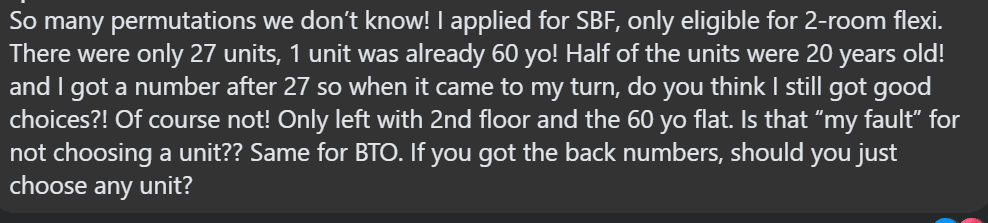
One commenter who described applying six times for a two-room flexi flat raised a different concern entirely: she said she had noticed units that appeared to remain vacant for more than a year, and could not understand why available stock was not matched more efficiently to waiting applicants. "I do not understand why they rather to left the flat empty than given to others," she wrote. "Forcing us to buy second-hand HDB?"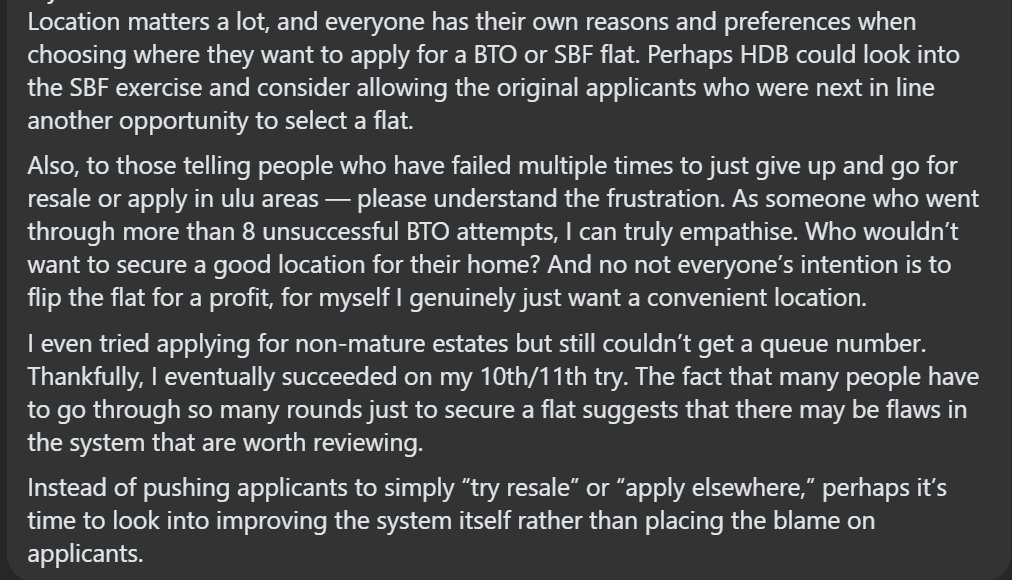
Transparency and the electronic ballot
A separate thread of concern focused on the opacity of the computer-generated ballot itself. One commenter offered a detailed critique of electronic balloting, arguing that software programmes are written by humans who define the parameters and criteria used to filter applicants, and that the shift away from observable physical draws had made independent verification effectively impossible.
Others questioned why HDB's own published data — showing queue numbers at multiples of two, three and beyond the available supply — did not translate into visible and verifiable outcomes for repeat applicants. "Is not 100% fair," one wrote. "Wonder whether has there been an audit on this before or ever."
These questions have in fact been put to the government in Parliament. In November 2022, Progress Singapore Party MP Leong Mun Wai asked the Ministry of National Development precisely how the ballot process was randomised and how the algorithm factored in household status, ethnic integration quota limits, and priority scheme parameters.
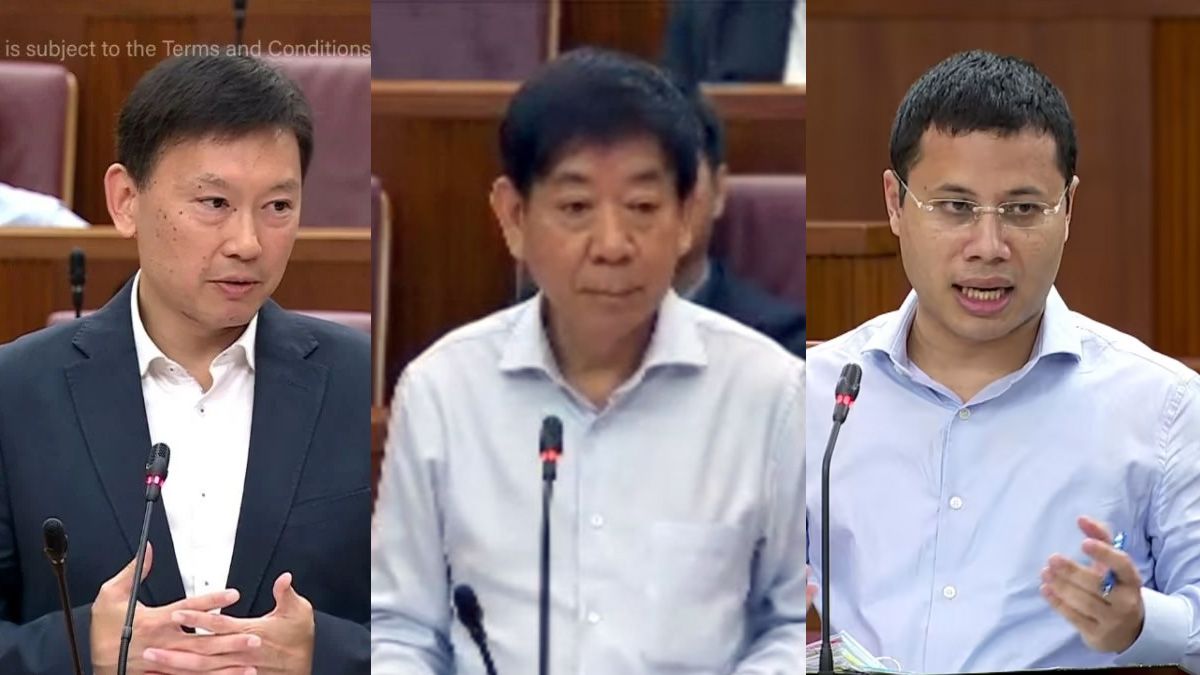
Then-Minister for National Development Desmond Lee provided a sequential description of the process: the computer first shortlists applicants qualifying for priority schemes that apply equally to first-timers and second-timers, then those qualifying for schemes that differentiate between the two, and finally the remainder according to residual allocation quotas — with Ethnic Integration Policy limits applied throughout. Lee stated that every computer ballot was subjected to rigorous audits before and after shortlisting by both internal and external auditors, covering the ballot algorithms and the verification of results.
On the question of errors, MP He Ting Ru asked in October 2024 how many BTO applications had been allocated a wrong ballot number due to system miscategorisation over the preceding five years. Lee replied that fewer than 0.1 per cent of approximately 370,000 applications processed over that period had required revision. Of those, only 23 cases since May 2023 were attributable to HDB processing errors rather than applicant-initiated changes.
The parliamentary record therefore confirms that audit mechanisms exist, that they cover both the algorithm and the results, and that the error rate is low by any measure.
What the parliamentary record does not provide, however, is a means by which individual applicants can independently verify their own queue position or confirm that the algorithm produced results consistent with the stated probability weightings for their specific application.
The question of whether institutional audit assurances constitute sufficient public transparency — or whether applicants in high-demand areas should have access to more granular data about how outcomes in specific projects were produced — has not been directly tested in Parliament and remains a matter of public disagreement.
Background: the Chua case and HDB's response
Chua's original video described 13 failed applications over approximately three years, citing published data showing unsold inventory in projects she had balloted for. She questioned why those units had not been offered to queue holders before being released as Sale of Balance Flats (SBF).
HDB said the figure was 11 applications, spanning November 2020 to May 2023, all in Kallang Whampoa and Bukit Merah. It explained that SBF flats are released only after all eligible applicants from the original BTO launch have concluded their selection, and that some flats are subsequently returned or cancelled. Releasing such flats through SBF exercises, HDB said, allowed all Singaporeans — not just original applicants — a fair opportunity to apply.
HDB confirmed that in her eleventh application Chua had been invited to select a flat but chose not to. She subsequently bought a resale flat using CPF Housing Grants.
The clarification prompted some commenters to note that, regardless of the precise application count, the broader pattern she described — a queue number far exceeding available supply, an appointment cancelled due to ethnic quota exhaustion, years without a successful outcome — was one widely shared across the public responses.
National Development Minister Chee Hong Tat said in a written parliamentary reply on 25 February 2026 that HDB currently holds close to 900 unselected flats from previous SBF exercises, reflecting broader softening in demand for Plus and Prime category flats under the new classification framework that took effect in October 2024.