HDB video on "maze-like" void decks draws pushback on privacy, ventilation and wayfinding claims
An HDB video explaining newer BTO void deck layouts has triggered strong online reactions, with netizens criticising maze-like designs while architects cite density, privacy and planning constraints.
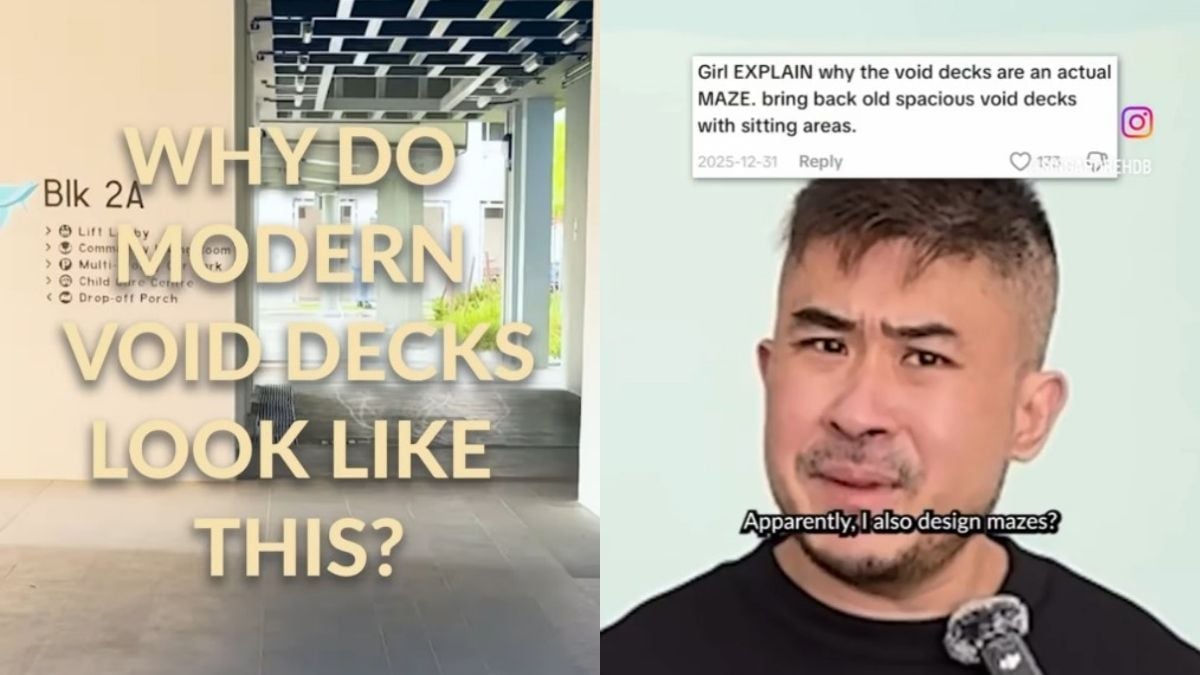
- HDB's claims that newer BTO layouts improve privacy and ventilation were directly contested by residents, who say outward-facing units still face neighbouring blocks at close range and flats are hotter than before.
- Netizens described void decks as maze-like and harder to navigate, with wayfinding signage criticised as inadequate and barriers that force lengthy detours around direct routes.
- Industry professionals attributed complex layouts to area efficiency targets and Gross Floor Area constraints, describing design workarounds they say can waste materials and contradict sustainability goals.

A Housing and Development Board (HDB) video explaining why newer Build-To-Order (BTO) void decks resemble "mazes" has prompted sustained online scrutiny, with residents directly contesting specific claims about improved ventilation, privacy and navigation — while self-identified architects and engineers pointed to density targets, Gross Floor Area requirements and institutional cost pressures as the structural forces shaping modern housing design.
In an Instagram Reel published on 7 May, principal architect Xianghua Wu outlined how public housing design has evolved in response to changing privacy requirements and building configurations.
From slab blocks to stacked designs
Wu said earlier HDB blocks were designed with bedroom windows facing common corridors, producing long, linear slab blocks and large continuous void decks beneath them. In contrast, newer flats prioritise outward-facing bedroom windows.
He stated: "Residents preferred more privacy and better views. So we redesigned each block using several stacks."
The video explained that this shift has resulted in more segmented building forms, reducing the continuity of void deck spaces at ground level. Wu acknowledged that newer layouts produce irregular building footprints, resulting in void decks that are smaller, less uniform and more fragmented.
He framed this as a trade-off, noting that modern estates incorporate wayfinding features and a wider range of communal spaces — including precinct pavilions, roof gardens, sky terraces and community living rooms — to compensate.
The video also revisited earlier public housing forms. Wu said slab blocks were central to rapidly rehousing residents: "These slab blocks were efficient to build and helped us move people out of slums and squatter settlements into proper housing."
According to The Straits Times, slab blocks were widely used in the 1960s for their construction simplicity, though most ranged between 10 and 16 storeys, with some reaching 24 storeys at maximum. They were gradually phased out as housing demand increased and design requirements evolved.
"Better privacy" — or just a different exposure?
One of the sharpest points of contention online concerned Wu's claim that newer designs improve resident privacy by eliminating corridor-facing bedroom windows.
Commenters across Reddit and Instagram argued that the redesign had not resolved the privacy problem — it had relocated it.
While older layouts exposed bedrooms to neighbours moving along the same corridor, several residents pointed out that newer stacked configurations often place units in close proximity to the windows of flats in opposite blocks.
One commenter wrote: "He quoted that residents preferred better views and privacy... but new in some BTO blocks are so close together that we can even watch TV with our neighbour or even read their books with them."

Others made the distinction more precisely: outward-facing bedrooms improve privacy within a single block, but when two blocks face each other at short range, residents find themselves looking directly into the living rooms and kitchens of neighbours across the way — an exposure that is constant rather than incidental.
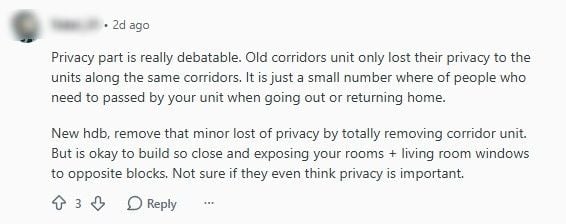
One user summarised: "Old corridors unit only lost their privacy to the units along the same corridors. It is just a small number of people who needed to pass by your unit when going out or returning home. New HDB, remove that minor loss of privacy... but is it okay to build so close and exposing your rooms and living room windows to opposite blocks?"
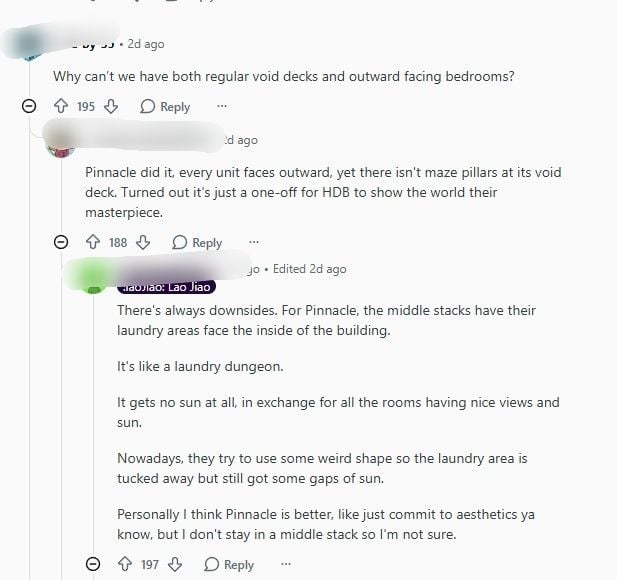
The Pinnacle@Duxton counterexample was raised repeatedly.
Multiple commenters noted that the landmark development managed to deliver outward-facing units for every flat without creating maze-like void decks beneath — and questioned why this had not become a standard template.
One commenter observed that Pinnacle "did it, every unit faces outward, yet there isn't maze pillars at its void deck. Turned out it's just a one-off for HDB to show the world their masterpiece."
Others acknowledged Pinnacle's own trade-off: middle-stack units at Pinnacle face inwards, resulting in laundry areas that receive little sunlight — a constraint one commenter described as a "laundry dungeon."
The observation reflected a broader thread in the discussion: that each design iteration involves trade-offs, and the question is which trade-offs residents are being asked to absorb.
"Better ventilation" — a claim residents dispute from experience
Wu stated that newer layouts improve ventilation and daylight.
This drew among the most direct experiential pushback in the comment sections.
Several residents described living conditions that contradicted the claim.

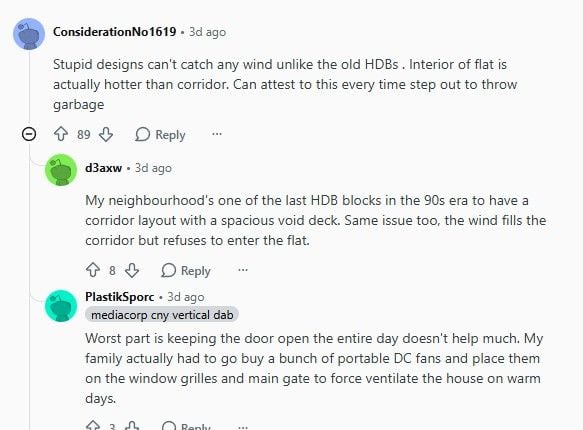
One commenter wrote: "Stupid designs can't catch any wind unlike the old HDBs. Interior of flat is actually hotter than corridor. Can attest to this every time step out to throw garbage."
Another noted: "Bad ventilation, smoke stays and lingers" — pointing to incense and cigarette smoke drifting and settling within enclosed block configurations rather than dispersing.
The cross-ventilation question was technically contested.
One user offered a defence of the newer designs, noting that ventilation in a cluster of blocks is primarily a function of how air enters the cluster from one end and exits from the other — a macro-level consideration independent of individual unit orientation.
Others pushed back, arguing that in practice, closely-spaced stacked blocks reduce effective airflow regardless of orientation, and that some kitchens remain dark even during daytime hours.
The clothes-drying issue was raised as a practical ventilation proxy. Residents in newer blocks noted that without adequate airflow across the laundry yard — often tucked inward between stacks — drying clothes without a mechanical fan or dryer is difficult.
Wayfinding: "We built a maze, then added a sign"
Perhaps the highest-volume thread of complaint concerned navigation.
Wu noted that modern estates incorporate wayfinding features including signage.
The online response was largely dismissive of this as a solution to a self-created problem.
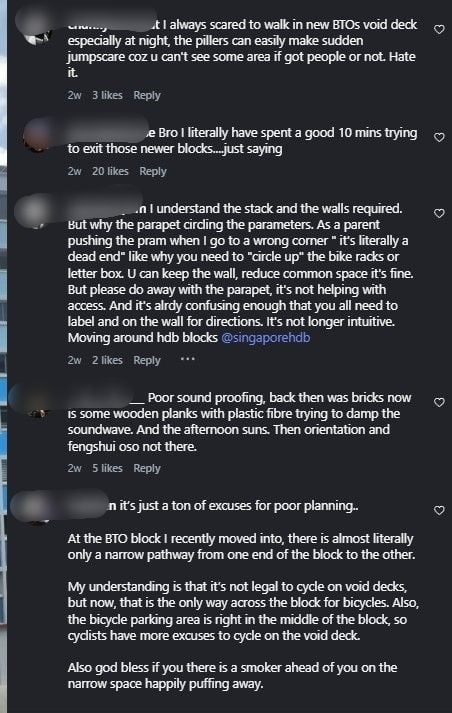
One Reddit commenter condensed the sentiment: "Instead of not building a maze, we built a maze a sign."
Another wrote: "u know what's missing on your wayfinding signs?? ACTUAL BLOCK DIRECTIONS!!" — while others described extended periods of disorientation within estates, citing dead ends, identical-looking columns, and walking paths that curved or terminated without explanation.
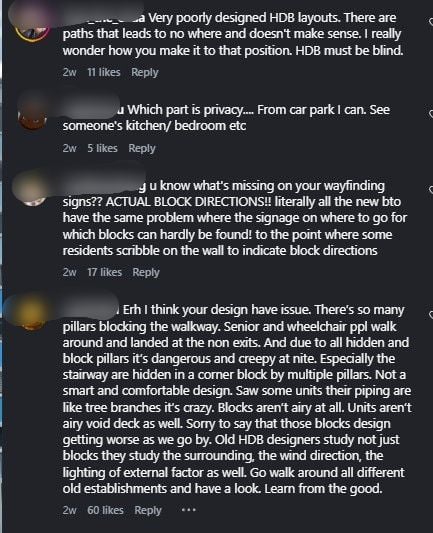
The knee-high concrete barriers separating sections of void deck drew particular frustration.
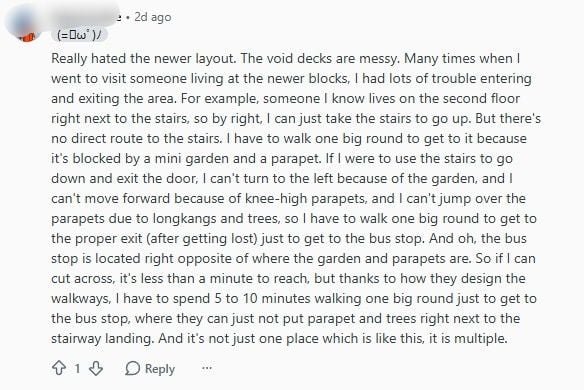
Residents described being forced to walk lengthy detours simply to reach a staircase or bus stop that was visually adjacent but structurally inaccessible.
One commenter described a specific experience: "If I were to use the stairs to go down and exit the door, I can't turn to the left because of the garden, and I can't move forward because of knee-high parapets... I have to spend 5 to 10 minutes walking one big round just to get to the bus stop, where they can just not put parapet and trees right next to the stairway landing."
The integrated carpark and multi-block configurations added a further layer of confusion for first-time visitors.
Several residents described the carpark as part of the maze, with routes requiring visitors to pass through car park levels before locating the correct lift lobby.
Practical consequences were raised: delivery riders, elderly residents, wheelchair users and parents with strollers were cited as groups disproportionately affected.
One commenter sketched a darkly hypothetical emergency scenario — paramedics navigating dead ends and misidentified lift lobbies before reaching a patient — raising the possibility that navigation complexity has implications beyond convenience.
The wayfinding signage itself was described as inconsistent and incomplete.
One user noted that signboard poles in their estate were still missing boards years after key collection. Another described following textured floor markings intended as navigation aids, only to be led to a dead end.
Professional context: area efficiency, GFA and institutional targets
Several contributors with claimed professional backgrounds in architecture and engineering offered broader structural explanations for the design trajectory — situating individual HDB decisions within industry-wide pressures.
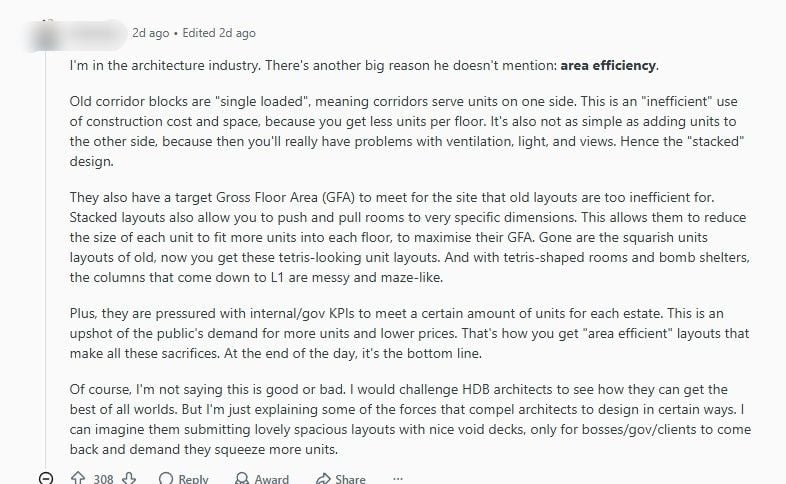
A Reddit user with claimed architecture industry experience explained that "area efficiency" is a central consideration in high-density residential planning.
Older single-loaded corridor layouts — where corridors serve units on one side only — use proportionally more floor area for circulation, making them less efficient per unit of buildable land.
Contemporary stacked forms address this by maximising unit yield per floor, a trade-off that has shaped public housing design across high-density urban environments globally, the commenter noted.
The same contributor pointed to a dynamic familiar across the industry: architects working within institutional constraints that prioritise unit count.
"I can imagine them submitting lovely spacious layouts with nice void decks, only for bosses/gov/clients to come back and demand they squeeze more units," they wrote.
They noted that stacked layouts also allow finer dimensional control over individual units — enabling rooms to be reduced to specific sizes in order to fit more units per floor.
This produces what the commenter described as "tetris-looking unit layouts," and the irregular column positions that result at ground level contribute to the maze-like void deck configurations.
GFA rules and design trade-offs
To understand some of the structural constraints shaping these decisions, it helps to know how Gross Floor Area is officially defined.
According to the Urban Redevelopment Authority (URA), GFA refers to the total area of covered floor space in a development, used to calculate building bulk and intensity relative to the plot — expressed as the Gross Plot Ratio (GPR) against what is permitted under the Master Plan.
As a general principle, the URA states that all covered floor area is included as GFA "regardless of whether the spaces are accessible or usable" — a clause that practitioners say creates design pressure at the margins.
A Reddit user, who claimed to be a registered professional engineer, shared what they described as a common industry observation — that GFA thresholds can create design pressure regardless of project type.
They described adjustments sometimes made specifically to keep areas below GFA thresholds, including leaving voids in structurally sensitive areas, backfilling spaces with soil or concrete, and altering slab or column dimensions.
The practical absurdity of some outcomes was illustrated by another commenter with adjacent industry experience: spaces that could serve as shelters are instead built as trellises — providing neither sun nor rain protection — solely to avoid GFA classification.
The professional engineer noted that such compliance measures can increase material use and structural loads, potentially working against sustainability benchmarks such as the Concrete Utilisation Index (CUI).
The user added that these dynamics are not unique to Singapore — similar GFA-type systems exist in neighbouring Asian countries, with their own histories of regulatory workarounds and downstream design consequences. TOC was unable to independently verify these claims.

Design as a set of trade-offs
Not all commenters were critical of newer designs.
Some noted genuine improvements — outward-facing units do provide better views in many cases, and newer estates avoid some of the privacy intrusions associated with corridor layouts.
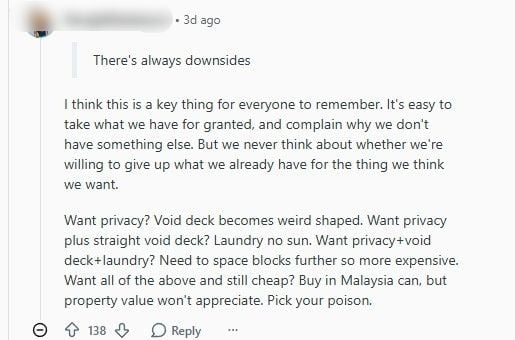
One commenter offered a framework that drew significant agreement: "Want privacy? Void deck becomes weird shaped. Want privacy plus straight void deck? Laundry no sun. Want privacy plus void deck plus laundry? Need to space blocks further, so more expensive. Want all of the above and still cheap? Pick your poison."
Others questioned whether the current trade-offs reflect genuine necessity or accumulated institutional inertia — pointing to examples in other high-density cities where residential buildings achieve comparable density without producing maze-like ground-floor configurations.
The thread beneath the HDB video remained active for several days, with the breadth and specificity of resident complaints suggesting that the video had not resolved the questions it set out to answer — and may have sharpened them.