BTO grievances echo years of unanswered parliamentary questions on ballot reform
Singapore's BTO ballot debate, reignited by Chua's viral TikTok video and HDB's point-by-point rebuttal, mirrors a parliamentary pattern stretching back to 2008 — one in which technical corrections consistently displace the moral questions underneath them.
- The BTO ballot priority framework has existed in substantially its current form since 2008, with weighted ballots for high-demand areas consistently rejected.
- HDB's 2026 correction of Chua's application count repeats a strategy used in 2009 — shifting focus to individual accuracy to avoid the systemic question.
- Additional ballot chances apply only to Standard flat applicants; those targeting Plus, Prime or historically mature estate projects accumulate no priority regardless of how many times they fail.

The public debate triggered by Chua's account of repeated failures in Singapore's Build-To-Order (BTO) housing ballot has drawn attention to a set of grievances that have circulated in Parliament for more than seventeen years — and which the government has, with limited exceptions, declined to resolve in the manner that critics have sought.
When the Housing and Development Board (HDB) issued a public clarification on 14 March 2026 disputing key details of the TikTok video by the account XinandXuan, and advising unsuccessful applicants to target projects with lower application rates, many members of the public said the response felt familiar.
Parliamentary records confirm that it was — and that versions of the same exchange, including the same rhetorical move of correcting the applicant's numbers to sidestep the structural argument, have been playing out since at least 2008.
The architecture of the ballot: roots in 2008
The foundational structure of Singapore's BTO ballot priority system — including the additional ballot chance for repeat unsuccessful applicants in non-mature estates — was not introduced in recent years. It has been in place, in substantially its current form, since May 2008.
In a parliamentary reply in September 2008, then-Senior Minister of State for National Development Grace Fu explained that the May 2008 refinements had introduced two linked changes: first-timer priority would be removed for applicants who declined two consecutive opportunities to select a flat, and applicants who had been unsuccessful at least twice in non-mature estate BTO exercises would receive additional ballot chances from their third attempt onwards.
Fu described the effect as broadly positive. In six of the eight completed BTO exercises between August 2007 and March 2008, she said, between 80 and 100 per cent of first-timer applicants had been invited to select a flat. In the remaining two projects, both in Yishun, between 54 and 65 per cent had been invited — roughly one in two.
By November 2009, then-Minister for National Development Mah Bow Tan was able to report that in BTO exercises from 2007 to that point, 96 per cent of first-timer applicants in non-mature estates had been given a chance to select a flat within two tries. "You have to be unlucky not to be successful after three or four tries in the BTO exercise," Mah said.
The critical qualification — then as now — was that these figures applied specifically to non-mature estates. Chua, like many of the applicants whose experiences resurfaced in the public reaction to her video, applied exclusively in areas outside that category. The stated success rates said nothing meaningful about her situation or theirs.
In the same 2009 session, Mah directly addressed the immigration dimension of housing demand, confirming that HDB projected supply requirements based partly on household formation from immigration.
He noted that permanent residents were ineligible for new BTO flats and could only purchase resale flats, but acknowledged their demand on the resale market as a factor taken into account in supply projections. He said HDB expected to need between 10,000 and 12,000 new flats per year over the following five years to meet demand.
That figure proved, in retrospect, to be a significant underestimate of what the following decade and a half would require.
A historical echo: the correction as deflection
One dimension of the 2026 episode has a direct and striking precedent in the 2009 parliamentary session — one that deserves to be stated plainly rather than left as implication.
In his November 2009 reply, Mah described a pattern HDB had observed following a wave of media reports and emails from applicants claiming they had balloted many times without success — in some cases twelve, fifteen or eighteen attempts. HDB had reviewed the cases individually and found the accounts inaccurate.
"We found to our surprise that all those emails, complaints and letters to the media were not entirely accurate," Mah said. "Some of them were offered chances once or twice; some as many as seven times — seven chances for them to select a flat — and they did not select a flat."
When HDB followed up, it found that in many cases flats had been declined because they were on low floors, in less preferred locations, or with features the applicant found unacceptable. Mah used the episode to pivot to a discussion of unrealistic expectations, acknowledging that living standards had risen while implying that the frustration was at least partly self-inflicted.
Seventeen years later, HDB's 14 March 2026 clarification about Chua follows the same structural pattern with near-identical precision.
Chua said thirteen attempts; HDB said eleven.
Chua described repeated failure; HDB noted she had been invited to select a flat in her final application and declined.
The correction was accurate. But its rhetorical function was identical to 2009: by establishing that the applicant's account contained errors, the official response shifted the terms of the debate from the conditions that produced her frustration to the accuracy of her description of those conditions.
The systemic question — why Chua spent nearly three years applying for flats in areas where her queue numbers consistently ran at two to three times the available supply, why an appointment in Kallang Whampoa was cancelled because the Chinese ethnic quota had been exhausted before her turn, and why unsold inventory in projects she had applied for was subsequently released to the general public as Sale of Balance Flats (SBF) rather than offered to queue holders — received no substantive answer in either 2009 or 2026.
In both cases, the correction of the applicant's numbers was presented as the response. The moral argument was left untouched.
This is not to say HDB's corrections were wrong. They were accurate. But accuracy in counting failed attempts does not address whether the system that produced those failures is adequately designed.
Mah's 2009 formulation — "Is it unrealistic expectations? I think there are grounds to believe that there is" — and HDB's 2026 advice to Chua and others to consider projects with lower application rates are, in substance, the same answer. The system is working as intended. The problem is the applicant's expectations.
Whether that answer has become less defensible as the demographic pressures on the ballot pool have grown is precisely the question the seventeen-year parliamentary record does not resolve.
Weighted ballots: a long-running parliamentary ask
The proposal for a weighted ballot — a system in which the probability of receiving a favourable queue number would rise with each unsuccessful application — has been put to the government in various forms since at least 2013, building on a priority framework whose basic architecture dates to 2008.
In July 2013, an MP asked then-Minister for National Development Khaw Boon Wan whether the government would consider increasing ballot odds for applicants who had failed three or more times. Khaw replied that approximately 200 first-timer applicants had three or more unsuccessful attempts for non-mature estate BTO flats, and that the existing additional ballot mechanism was expected to be sufficient to clear this backlog.
In November 2019, an MP asked whether the additional ballot chance could be multiplied — for example, increasing odds by 20 per cent for each failed attempt so that success would be near-guaranteed by the fourth try. Minister Lawrence Wong replied that virtually all first-timer families were already successful within their first three tries for non-mature estate flats, and that the policy would continue to be reviewed.
In September 2023, Workers' Party MP Sylvia Lim asked whether the Ministry would consider adjusting the ballot system to accord weightage to prior unsuccessful attempts, covering both BTO and SBF exercises. Then-Minister for National Development Desmond Lee declined, noting that priority was already given to first-timer families and to those with young children under the First-Timer (Parents and Married Couples) (FT(PMC)) category introduced that same month.
In February 2025, Workers' Party chief Pritam Singh asked whether the new flat classification framework, introduced in October 2024, carried over additional ballot credits accumulated under the previous non-mature estate framework. Lee confirmed that it did not, and that data on success rates under the new system was not yet available.
Across all of these exchanges, the government's position was consistent: the system already prioritises those with the most urgent needs, and a weighted ballot would not meaningfully help applicants who target high-demand locations because the fundamental constraint is supply, not ballot design.
The critical limitation: location eligibility
The additional ballot chance mechanism carries a restriction that goes to the heart of the current public controversy.
Additional ballot chances for repeat unsuccessful applicants apply only to applications for Standard flats — a category that broadly corresponds to what was previously classified as non-mature estate flats. They do not apply to Plus or Prime category flats, nor did their predecessors apply to mature estate flats.
This matters directly in Chua's case. She applied exclusively for four-room flats in Kallang Whampoa and Bukit Merah — both mature estates under the previous framework, and now classified as Plus or Prime locations under the October 2024 system.
Under the rules as they stood during her application period from November 2020 to May 2023, she would not have accumulated any additional ballot credits regardless of how many times she applied. Each application was treated as if she had no application history at all.
In July 2016, an MP directly asked whether the additional ballot chance could be extended to mature estate applicants. Wong's response was unambiguous: extending the mechanism to mature estate applicants was unlikely to be effective given the high demand for a limited supply of flats, and applicants with location preferences for mature areas should consider resale flats instead.
That position has remained substantially unchanged through successive parliamentary sessions and four ministers.
In February 2025, responding to a question from MP Gan Thiam Poh about allowing unsuccessful first-timer applicants a second opportunity to choose flats remaining after the initial selection round, Lee declined, citing the range of existing priority measures and improvements in average application rates.
What the data shows
Parliamentary records and historical HDB data provide a clearer picture of who the ballot system serves and who it does not.
A table tabled in Parliament in July 2019, covering BTO and SBF exercises launched in 2017 and the first three quarters of 2018, showed that of first-timer families successfully allocated flats in the 2017 exercises, 11,433 succeeded on their first attempt, 5,319 on their second, 2,336 on their third, 1,157 on their fourth, and 1,135 on their fifth attempt or beyond.
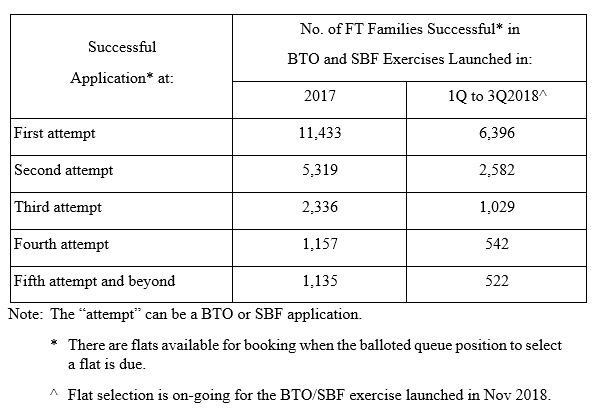
That final figure — more than 1,100 families requiring five or more attempts before succeeding — was cited by successive ministers as evidence that such cases, while real, were concentrated among applicants who repeatedly targeted high-demand projects.
The policy response was consistent: improve supply, extend priority schemes for qualifying family categories, and encourage applicants to consider non-mature or Standard locations.
Government data presented in Parliament consistently showed that virtually all first-timer families who applied for BTO flats in non-mature estates succeeded within three tries. The implicit message — reinforced in multiple ministerial replies across seventeen years — was that repeated failure was, in most cases, a function of location choice rather than systemic inadequacy.
Whether that framing fairly accounts for the range of circumstances driving location preferences — caregiving obligations that cannot be relocated, workplaces that cannot be changed, communities built over decades — is precisely what the current public debate is contesting.
Proximity to parents: system statistics over caregiving crises
One of the most emotionally charged threads in the public response to Chua's video concerned applicants who had applied repeatedly for flats near ageing parents or siblings for caregiving purposes, and been told, in effect, that the system offered them no special accommodation meaningful enough to make a difference.
Parliamentary records show this concern was raised repeatedly.
In July 2022, an MP asked whether applicants buying BTO flats near parents could receive four ballot chances instead of three under the Married Child Priority Scheme (MCPS). The minister declined to increase ballot chances, sidestepping the core of the MP's question about the emotional and practical necessity of proximity.
Instead, the reply focused on the mathematical effectiveness of the existing quota allocation, effectively prioritising system-wide statistics over individual caregiving crises. Extending priority in high-demand locations, the minister said, would reduce the scheme's effectiveness — a formulation that measured the policy's success by its own internal logic rather than by whether it was actually delivering flats to people who needed to live near ageing parents.
In October 2025, MP Jessica Tan raised the case of residents in her East Coast constituency who had made multiple unsuccessful attempts under proximity schemes to secure flats near family members, including for the Simei Symphony project.
She asked whether the Ministry would consider refining the ballot to give real priority to those who had attempted several times within a specific area close to their family, and whether the four-kilometre proximity radius could be extended.
Minister Chee Hong Tat acknowledged the concern and outlined the layered priority system — including the Family and Parenthood Priority Scheme (FPPS), which sets aside 40 per cent of BTO flat supply, and the Family Care Scheme (Proximity) (FCS (Proximity)), which sets aside 30 per cent. He noted that those qualifying for both schemes would receive two sequential ballot opportunities.
The response was, again, structural rather than substantive. The MP had asked whether repeated failure within a specific area for proximity reasons should confer increasing priority. The minister described the existing percentage allocations. Whether those allocations were sufficient to serve applicants in the situations the MP described was not directly addressed.
The FCS (Proximity) had been introduced in July 2025. In the BTO exercise launched that month, approximately six in ten first-timer families who applied under the scheme received a queue number.
Among those who did, about eight in ten were on their first attempt — suggesting the scheme provided most of its benefit to applicants who had not yet experienced the pattern of repeated failure that generated the most acute frustration.
Chua made her final application in May 2023 and purchased a resale flat shortly thereafter. The FCS (Proximity) arrived more than two years later. For the commenter who wrote that she had applied eleven times to live near elderly parents who have since passed away, it arrived too late to matter at all.
Electronic ballot transparency: audits exist, but details are limited
A separate strand of public concern focused on whether the computer-generated ballot could be independently verified as fair by applicants. Commenters questioned whether an algorithm administered internally by HDB could be trusted to apply stated probabilities without undisclosed filtering criteria.
This question was put directly to the government in November 2022, when Progress Singapore Party MP Leong Mun Wai asked how the ballot process was randomised and how the algorithm factored in household status, ethnic integration quota limits, and priority scheme parameters.
Lee provided a sequential description of the process: the computer first shortlists applicants qualifying for priority schemes that apply equally to first-timers and second-timers, then those qualifying for schemes that differentiate between the two, and finally the remainder according to residual allocation quotas — with Ethnic Integration Policy limits applied throughout.
Lee stated that every computer ballot was subjected to rigorous audits before and after shortlisting by both internal and external auditors, covering the ballot algorithms and the verification of results.
In October 2024, MP He Ting Ru asked about the incidence of ballot errors. Lee replied that fewer than 0.1 per cent of approximately 370,000 applications processed over five years had required revision, and that since May 2023, only 23 errors from approximately 55,000 balloted applications were attributable to HDB processing mistakes.
The parliamentary record therefore confirms that audit mechanisms exist, that they cover both the algorithm and its results, and that the documented error rate is low.
What those assurances do not provide is a means by which individual applicants can independently verify their own queue position, or confirm that the probability weightings stated for their applicant category produced results consistent with their experience.
The question of whether institutional audit assurances constitute sufficient public transparency has not been directly tested in Parliament and remains a point of unresolved public contention.
Non-selection and the rules around declined appointments
HDB's clarification noted that in her final application Chua had been invited to select a flat but chose not to proceed. Several public commenters questioned whether this invalidated her account of systemic failure.
The 2009 parliamentary record is instructive here. Mah described applicants who had declined flats on low floors or in less preferred orientations as illustrative of unrealistic expectations. The implication was that a declined invitation was functionally equivalent to a genuine opportunity foregone. That framing remains embedded in how HDB characterises application histories today.
The procedural context, however, is more complicated.
In March 2023, Muhammad Faishal Ibrahim confirmed that approximately 40 per cent of applicants who received booking invitations did not proceed to select a flat, and that the most common reasons included preferred units having been taken up — in other words, that the applicant had a queue number within the supply range but no acceptable unit remained when their turn arrived.
Since October 2023, tightened rules mean that applicants who decline to book receive a non-selection count (NSC). Lee confirmed in August 2024, however, that HDB does not issue an NSC to applicants with ten or fewer BTO flats, or five or fewer SBF flats, available at their booking appointment — an acknowledgement that applicants at the tail end of the queue face choices constrained enough that declining them should not be penalised.
Whether Chua's cancelled Kallang Whampoa appointment — which she said was voided because the Chinese ethnic quota had already been exhausted — would constitute a declined selection under these rules is not addressed in available parliamentary records.
It is also, notably, an experience corroborated by multiple other commenters describing identical situations in the same area. That specific complaint — a booking appointment rendered functionally void by mid-selection ethnic quota exhaustion — has not been raised as a parliamentary question in any of the records reviewed for this coverage.
What the system addresses, and what it does not
Taken together, the parliamentary record reveals a housing policy that has incrementally expanded priority mechanisms for certain applicant groups, while consistently maintaining that additional ballot weightings for high-demand locations would be counterproductive — and that has, across seventeen years and four ministers, deployed a recognisable pattern of response when challenged.
When applicants dispute the system's fairness by citing large numbers of failed attempts, the official response establishes the accurate count. When MPs ask whether repeat applicants in specific locations deserve more priority, the response describes the system-wide statistics that justify the existing allocation percentages.
When caregiving obligations are raised, the response cites the percentage of flat supply set aside for proximity schemes without addressing whether that percentage delivers meaningful results in the areas where caregiving needs are most acute.
Each of these responses is technically accurate. None of them engages with the structural argument that the system, designed for a more stable population, is operating under demographic pressures its architects did not anticipate and its current administrators have not publicly confronted.
The government's stated position rests on two linked arguments: that repeat failure in popular areas reflects a supply-demand mismatch that cannot be resolved through ballot design, and that Standard estate flats offer viable alternatives with measurably better success rates.
Critics, including the MPs who have raised these questions in Parliament and the hundreds of Singaporeans who responded to Chua's video, argue that this framing fails to account for the legitimate circumstances — caregiving obligations, workplace proximity, decades of community belonging — that make location non-negotiable for a significant portion of applicants.
The introduction of the FCS (Proximity) in July 2025 represents a partial concession to this argument. Whether it arrives in time, or with sufficient priority weighting, to address the pattern of repeated failure in sought-after areas remains to be demonstrated by future data. For applicants who exhausted their patience before July 2025, the concession came too late.
The parliamentary record on BTO ballot reform now spans nearly two decades, from the 2008 introduction of additional ballot chances through successive refinements under four ministers.
In that time, the core structure of the system — additional chances for Standard estate applications only, no enhanced weighting for high-demand locations, and a consistent presumption that persistent failure reflects unrealistic expectations more than systemic inadequacy — has remained substantially intact.
What has changed is the scale of the pressure the system faces. In 2009, Mah projected a need for 10,000 to 12,000 new flats per year.
By 2025, HDB was launching approximately 19,600 flats annually and still accumulating a stock of nearly 900 unselected units from previous SBF exercises.
The government now plans to admit 25,000 to 30,000 new citizens each year for the foreseeable future. The ballot system has been refined at its edges. Its foundations have not been revisited to account for the demographic environment in which it now operates.
The correction of Chua's application count from thirteen to eleven was accurate. It changed nothing.
Background: the Chua case
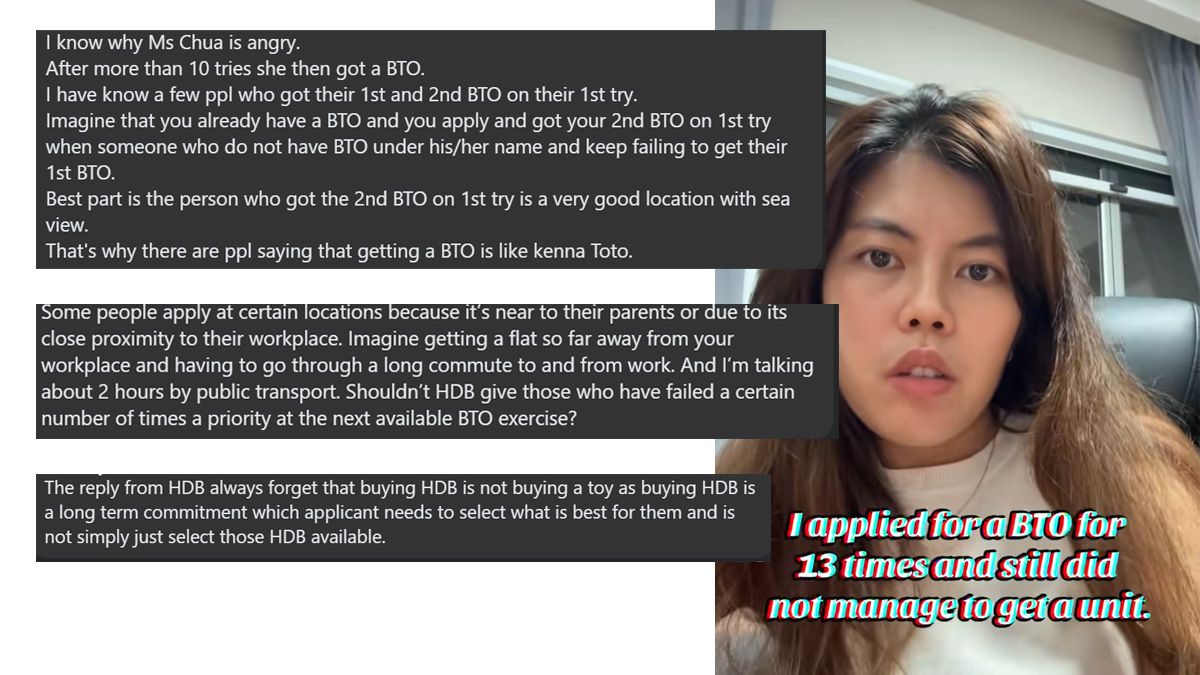
Chua documented her experience in a video posted on 4 March 2026 on the TikTok account XinandXuan, drawing more than 87,000 views within six days. She described 13 unsuccessful BTO applications over approximately three years before purchasing a resale flat.
HDB's statement on 14 March clarified that she had in fact applied 11 times, all for four-room flats in Kallang Whampoa and Bukit Merah, and that in her eleventh application she had been invited to select a flat but declined. She purchased her resale flat using CPF Housing Grants.
In a written parliamentary reply on 25 February 2026, National Development Minister Chee Hong Tat said HDB holds close to 900 unselected flats from previous SBF exercises, reflecting broader softening in demand under the Standard, Plus and Prime classification framework introduced in October 2024.