When the comments section knows more than the post
Ho Ching posted a cluster munitions explainer on 19 March. The comments erupted: Israel used them too — in Lebanon, in Gaza. Where was the mention? They were right. Six arms experts verified Israeli cluster munitions in Lebanon. Human Rights Watch documented white phosphorus over Gaza City. The comments section got there in twenty-four hours.


Sometimes the most important thing about a post is not what it says. It is what the replies say back.
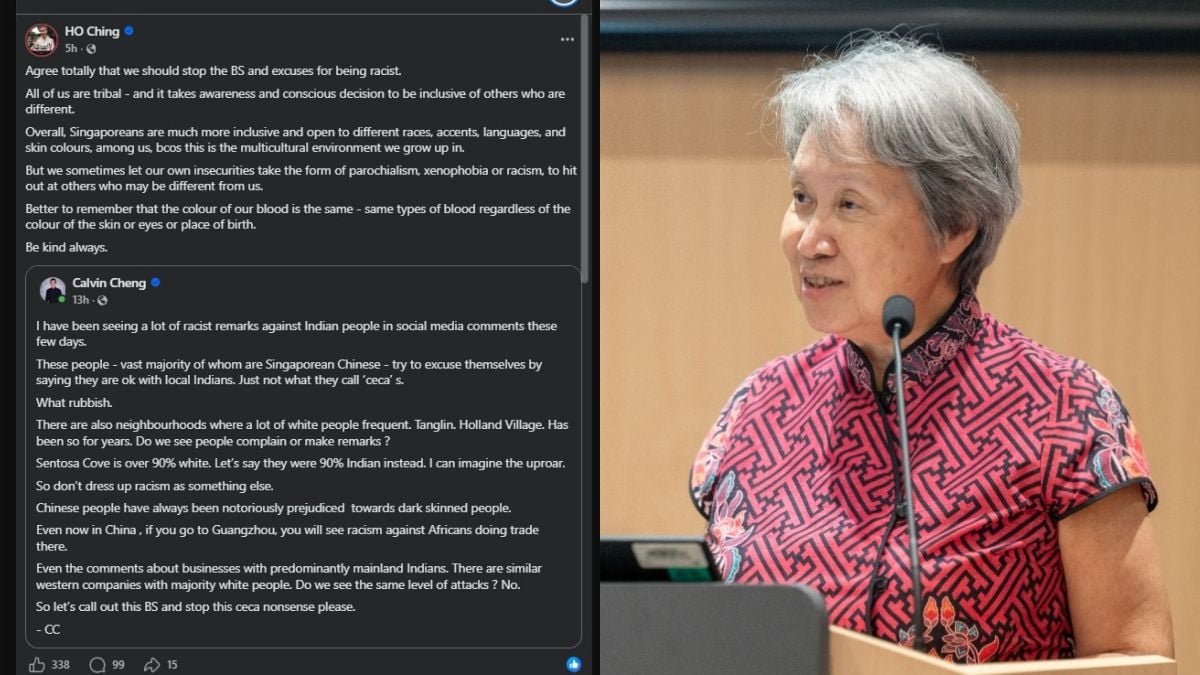
On 19 March 2026, Ho Ching — former CEO of Temasek, perennial fixture on Forbes' list of the world's most powerful women, spouse of former Prime Minister Lee Hsien Loong — posted an explainer on cluster munitions.
The post was informational in tone. It covered what cluster munitions are, why over a hundred countries have moved to ban them, why the 20% dud rate makes them a long-tail humanitarian problem. It noted that Russia had used them against Ukraine, and that Iran had used them against Israel.
The comments came fast, and they came with receipts.
"Not surprised you didn't mention Israel as using such munitions too. Either you only read propaganda news coming out of Israel, or you know but choose to exclude it." "What about the white phosphorus? Hope you talk about it too and don't appear just one sided." "You are silent when Israel uses white phosphorus." "Israel used widely banned cluster munitions in Lebanon — why no mention?" "Seems you have lots of concerns for the war Israel ordered."
Dozens of comments. Dozens of people pointing to the same gap.
The question is whether they were right. They were.
The Guardian reported in November 2025 — verified by six independent arms experts — that remnants of two types of Israeli cluster munitions were found in south Lebanon after Israel's 13-month war with Hezbollah. Both were produced by Elbit Systems: the 155mm M999 Barak Eitan and the 227mm Ra'am Eitan. The Israeli military, asked to respond, said it "uses only lawful weapons, in accordance with international law." It neither confirmed nor denied.
The white phosphorus question is equally documented. Human Rights Watch verified video footage of airburst 155mm white phosphorus artillery projectiles over Gaza City's port in October 2023. The same organisation documented Israeli white phosphorus use in Lebanon during the same period.
White phosphorus ignites on contact with atmospheric oxygen, burns at approximately 815 degrees Celsius, and is highly lipophilic — meaning it adheres to and penetrates human tissue. It can reignite when wound dressings are removed and re-exposed to air. Israel had previously committed, under a 2013 High Court ruling, to treat airburst white phosphorus in populated areas as "an extreme exception in highly particular circumstances." Gaza is one of the most densely populated territories on earth.
Several commenters also pointed out that Singapore itself is not a signatory to the Convention on Cluster Munitions. Also correct — and worth being precise about what Singapore's position actually is, because it is more layered than the comments suggested.
At the UN First Committee in November 2025, Singapore's representative explained its vote in favour of the resolution on implementing the Convention on Cluster Munitions. Singapore votes for the resolution. It attends the Meetings of States Parties.
It declared an indefinite moratorium on cluster munitions exports in 2008, and on anti-personnel mine exports as far back as 1998. It formally acceded to the Convention on Certain Conventional Weapons in September 2023, including Protocol III governing incendiary weapons such as white phosphorus — six weeks before Gaza. Israel has not ratified Protocol III. Singapore has.
What Singapore will not do is join the convention outright. Its stated reason, delivered to the UN on 4 November 2025: "as a small State, Singapore firmly believes that the legitimate security concerns and the right to self-defence of any State cannot be disregarded. In that regard, a blanket ban on all types of cluster munitions and anti-personnel landmines may be counter-productive."
And Singapore Technologies Engineering, within the Temasek ecosystem, stopped manufacturing cluster munitions entirely in 2015 — under investor pressure, without any treaty requiring it.
Vote yes. Export moratorium. No production. CCW accession. Just not full membership. That is a precise and deliberate position — not the casual non-signatory status the commenters assumed.
None of this changes what Ho Ching posted. She posted what she posted. The public read it as they read it — as a commentary on Iran's use of cluster munitions that found no equivalent concern for Israel's.
Whether that reading is fair is between her and her followers.
What is not in dispute is this: Israel condemned Iran for using "weapons with wide dispersal to maximise the scope of damage" in populated areas. That condemnation came from a military that had, by documented accounts, deployed cluster munitions in Lebanon and white phosphorus in Gaza. The spokesperson delivering that condemnation did not mention either.
Neither Iran nor Israel has signed the Convention on Cluster Munitions. Neither has signed Protocol III on incendiary weapons. They are, in the strictest legal sense, bound by nothing. The hundred-odd countries that have signed are not the ones currently deploying these weapons. The ones deploying them today are, notably, not among the signatories.
That is the bar. And the comments section of one post by one powerful Singaporean woman got there — messily, angrily, without documentation — in about twenty-four hours.