Ho Ching calls out racism excuses as online backlash targets immigration policy
Ho Ching, spouse of former Prime Minister Lee Hsien Loong, has urged Singaporeans to reject racism after former Nominated Member of Parliament Calvin Cheng condemned anti-Indian remarks circulating on social media, drawing a sharp public backlash over immigration grievances.
- Ho Ching endorsed Calvin Cheng's call to reject anti-Indian racism on social media.
- Both public figures responded after authorities ordered platforms to block 14 inflammatory posts.
- Online commenters pushed back, framing grievances as immigration policy concerns rather than racism.

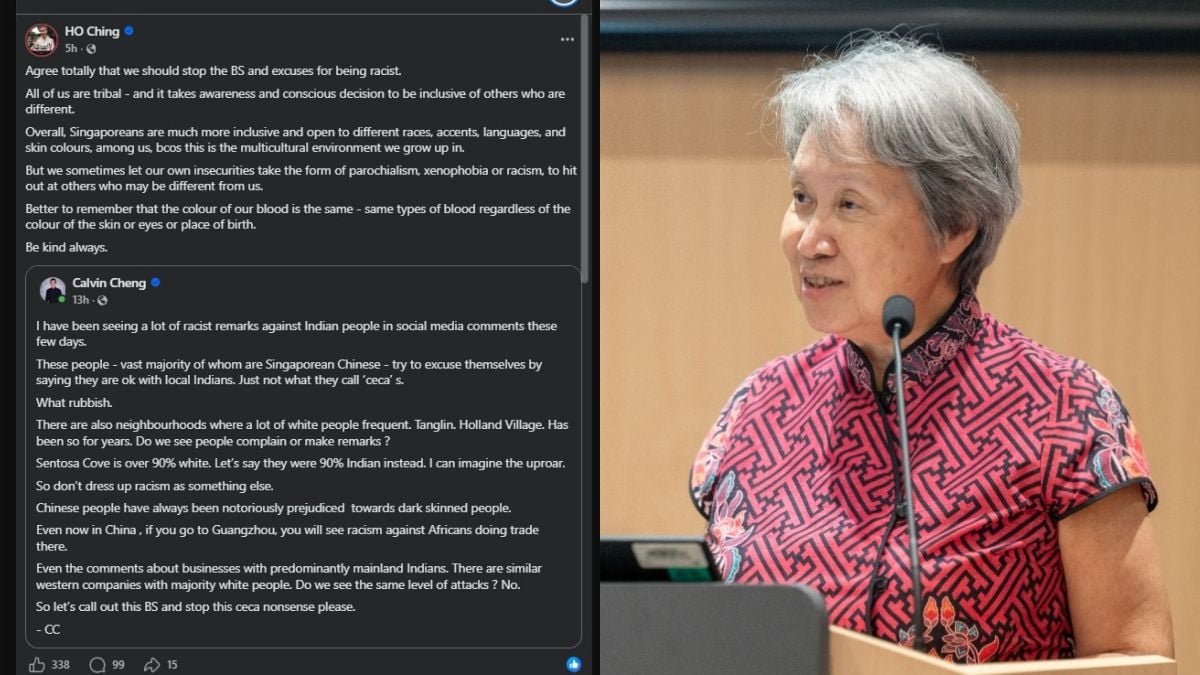
Ho Ching, spouse of former Prime Minister Lee Hsien Loong and former chief executive of Temasek Holdings, posted a public comment on Facebook on 9 June 2026 endorsing a call by Calvin Cheng, a former Nominated Member of Parliament (NMP), to condemn racist remarks targeting the Indian community that had been circulating on social media.
Ho Ching wrote that she agreed "totally" that excuses for racism should stop. She acknowledged that all people carry tribal instincts, but argued that it takes awareness and a conscious decision to be inclusive of those who are different.
She characterised Singaporeans as broadly more inclusive and open to different races, accents, languages and skin colours than people in many other societies, attributing this to the multicultural environment in which they grew up.
Ho Ching wrote that insecurities sometimes manifest as parochialism, xenophobia or racism directed at those perceived as different. She concluded her post with a call to "be kind always."
Her comment was posted in response to an earlier Facebook post by Cheng, published on 8 June, in which he said he had observed a significant volume of racist remarks against Indian people in social media comments over the preceding days.
Cheng characterised those making the remarks as the vast majority being Singaporean Chinese, and said they were attempting to excuse their conduct by distinguishing between local Indians and what they referred to as "cecas" — a term derived from the Comprehensive Economic Cooperation Agreement (CECA) between Singapore and India, which has been used colloquially, and often pejoratively, to refer to Indian nationals working in Singapore.
Cheng rejected that distinction as "rubbish." He drew a comparison with expatriate-heavy neighbourhoods such as Tanglin and Holland Village, asking why no similar complaints were directed at the predominantly white populations frequenting those areas. He noted that Sentosa Cove is over 90 per cent white and said he could "imagine the uproar" if the demographic were reversed.
Cheng also stated that Chinese people had historically been prejudiced towards dark-skinned people, citing racism against African traders in Guangzhou as a contemporary example. He called on the public to stop what he called the "ceca nonsense."
Background: government action on inflammatory posts
The remarks by both Ho Ching and Cheng came after the Ministry of Home Affairs (MHA) announced on 6 June 2026 that the Singapore Police Force had issued Disabling Directions under the Online Criminal Harms Act 2023 to Google, Meta and X, requiring the platforms to disable access by Singapore users to 14 posts.
MHA assessed the posts as likely constituting offences under Section 298A of the Penal Code 1871, which prohibits knowingly promoting enmity, hatred or ill-will between groups on grounds of race.
The content was assessed as originating from a China-based platform before spreading to YouTube, Facebook and X. Law and Second Minister for Home Affairs Edwin Tong stated at a media doorstop on 6 June 2026 that there was no evidence the content formed part of a coordinated state campaign, describing it as likely generated organically by foreign netizens.
Public reaction: immigration policy, not racism, say commenters
The posts by Ho Ching and Cheng drew extensive commentary online, with responses on both Facebook and the Reddit community r/singapore reflecting a sharp divergence between the message the two public figures sought to convey and the concerns of many commenters.
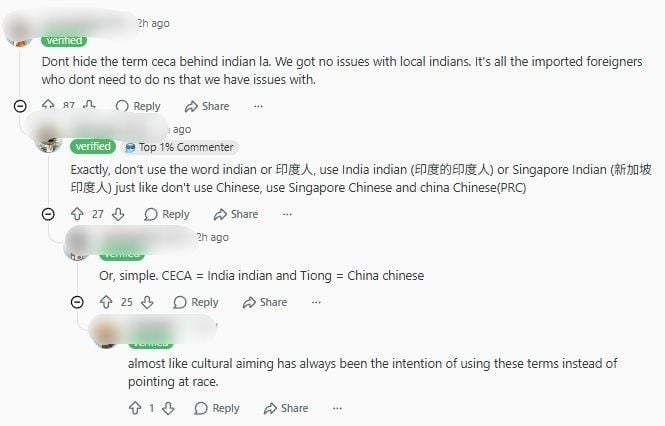
A significant number of respondents rejected the framing of the debate as one about race. Several commenters drew a distinction between local Indians, whom they said they had no issue with, and Indian nationals brought in under CECA, directing their objections specifically at what they characterised as unfair employment practices.
One commenter on Reddit wrote that those raising concerns had "no issues with local Indians" and that the grievances were directed at "imported foreigners who don't need to do NS," referring to National Service, Singapore's mandatory military conscription which applies to male citizens and permanent residents.
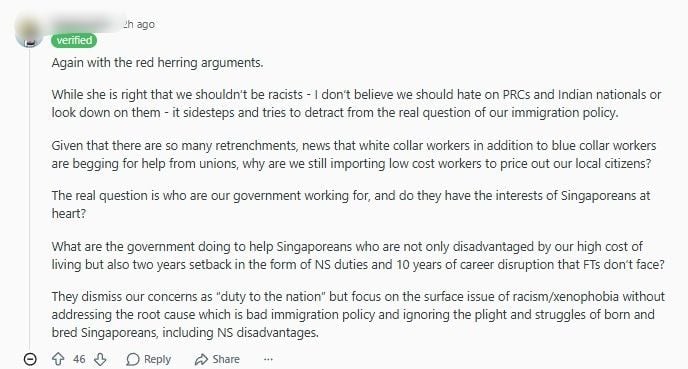
Another commenter, writing at greater length, argued that the substantive question was whether the government was prioritising the interests of Singaporeans, pointing to what they described as retrenchments affecting both white-collar and blue-collar workers while the importation of lower-cost labour continued.
That commenter wrote that the government dismissed such concerns as reflecting a "duty to the nation" while focusing on racism and xenophobia as surface issues, without addressing what they described as the root cause of inadequate immigration policy and the structural disadvantages faced by Singaporeans who had completed National Service.
A separate commenter described sitting in corporate meetings where, in their account, a candidate from a particular country had already been confirmed for hiring, and local candidates were interviewed only to be formally rejected. That commenter said few Singaporeans had access to such meetings and called on unions to take stronger action.
A number of other commenters pushed back against Ho Ching's characterisation of Singapore as a multicultural environment.
One wrote that Singapore had been built on a multiracial, not multicultural, identity, arguing that the country's social compact had historically required different communities to look past their differences for collective benefit. That commenter contended that recent immigration had brought people who formed enclaves and refused to integrate into that shared civic culture.
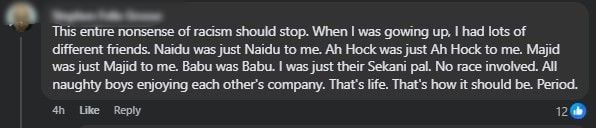
Others were more dismissive of the intervention by Ho Ching and Cheng, with some questioning the standing of either figure to comment on the daily economic pressures faced by ordinary Singaporeans. One commenter wrote that it was "easy to act virtuous" when one was "barely affected," characterising the posts as gaslighting.

Not all public commentary was critical of the two public figures.
Some commenters on Ho Ching's Facebook post agreed that racism and discrimination cut across multiple directions, and that structural and policy solutions rather than blame were the appropriate response.