Cotton On's Asia exit rumour triggers reputational crisis despite swift denial
Australian fashion retailer Cotton On faced a sharp reputational collapse after misleading reports about a Singapore entity's liquidation were wrongly interpreted as a regional market exit, according to industry analysts.

- Cotton On Asia Pte. Ltd. was an inactive holding company; no stores or staff were affected.
- Public sentiment fell from 94.3% to 16.8% positive within hours of misleading reports.
- Communications experts say Cotton On's correction was too slow and lacked transparency.

Australian fashion retailer Cotton On Group experienced a sharp and rapid collapse in public sentiment after misleading reports, stemming from a Singapore Government Gazette notice, wrongly suggested the company was withdrawing from the Asian market.
Despite a prompt clarification, communications analysts say the damage proved difficult to contain.
The crisis originated on 30 March 2026, when two notices appeared in Singapore's Government Gazette announcing that Cotton On Asia Pte. Ltd. had been placed under members' voluntary liquidation. The resolution had been passed at an extraordinary general meeting held by video teleconference on 25 March 2026 at 10:00am Singapore Time.
The notice of resolutions was signed by Ashley Hardwick, acting as corporate representative of Cotton On International Pty. Ltd., identified in the filings as the shareholder of Cotton On Asia Pte. Ltd. Sam Kok Weng and Lie Kok Keong were named as joint and several liquidators, both based at Marina One East Tower in Singapore.
A separate notice to creditors, also published on 30 March 2026, required any creditors to submit particulars of their debts or claims by 20 April 2026.
The Straits Times appears to have been the first outlet to report on the Gazette notices. Mothership's social media post attributed the story directly to that report, characterising Cotton On Asia as being "set to shut down."
AsiaOne subsequently reported that Cotton On was "set to close its business in Singapore." Inside Retail described the entity as having entered creditors' voluntary liquidation — a procedurally distinct and legally different process from the members' voluntary liquidation confirmed by both the Gazette filings and Cotton On's own statement.
Both the originating framing and its subsequent amplifications were factually incorrect.
What the liquidated entity actually was
Cotton On moved to correct the record in a statement to media on 31 March 2026. A company spokesperson, responding to queries from Channel NewsAsia, said the reports were misleading and that Cotton On had no plans to exit the Asia region.
The spokesperson confirmed that Cotton On Asia Pte. Ltd. was an inactive holding company that had never operated any stores, employed any team members, or conducted any business in Singapore or elsewhere. The liquidation formed part of a broader restructuring of the group's corporate structure in Asia, aimed at simplifying its legal arrangements.
"This has no impact on customers, team, stores, suppliers or operations within the Asia region," the statement read.
The members' voluntary liquidation designation is significant. Such a process is initiated by shareholders of a solvent company and is procedurally distinct from a creditors' voluntary liquidation, which arises in the context of insolvency.
Cotton On Group has operated in Singapore since 2007, when it opened its first store at Wisma Atria on Orchard Road. The group currently operates more than 30 stores in Singapore under five brands: Cotton On, Cotton On Body, Cotton On Kids, stationery brand Typo, and shoe brand Rubi.
Globally, the privately held company — founded by Nigel Austin, who continues to control the business — operates eight brands across 20 countries with approximately 1,300 stores and around 20,000 employees worldwide.
Sentiment collapse and public confusion
According to a report by Provoke Media, media intelligence firm Truescope documented a severe deterioration in public sentiment. The company's sentiment rating fell from 94.3% positive to just 16.8% positive following the misleading reports. In post-incident measurements, 83.2% of views recorded were negative.
According to Truescope, the negative conversations were driven by product quality concerns, scepticism towards media reporting, and broader socioeconomic anxieties about the retail climate and regulatory environment in Singapore.
Active public engagement continued after the correction, with 1,263 comments, 52,797 reactions, and 15,312 shares recorded. A larger share of comments was critical, focusing on perceived quality and pricing. A smaller segment expressed loyalty or disappointment over what users had interpreted as an impending closure.
Truescope noted that negative sentiment dominated within six hours of the reports appearing, yet the correction took an entire news cycle to reach parity with the rumour — and even then, the rumour was not fully overtaken, only matched.
The confusion was also visible on Reddit's Singapore community forum, where numerous users expressed surprise and concern.
Several commented that Cotton On stores appeared to be trading normally, and noted that job listings for Cotton On positions had continued to appear on the government-run MyCareersFuture portal throughout the month.
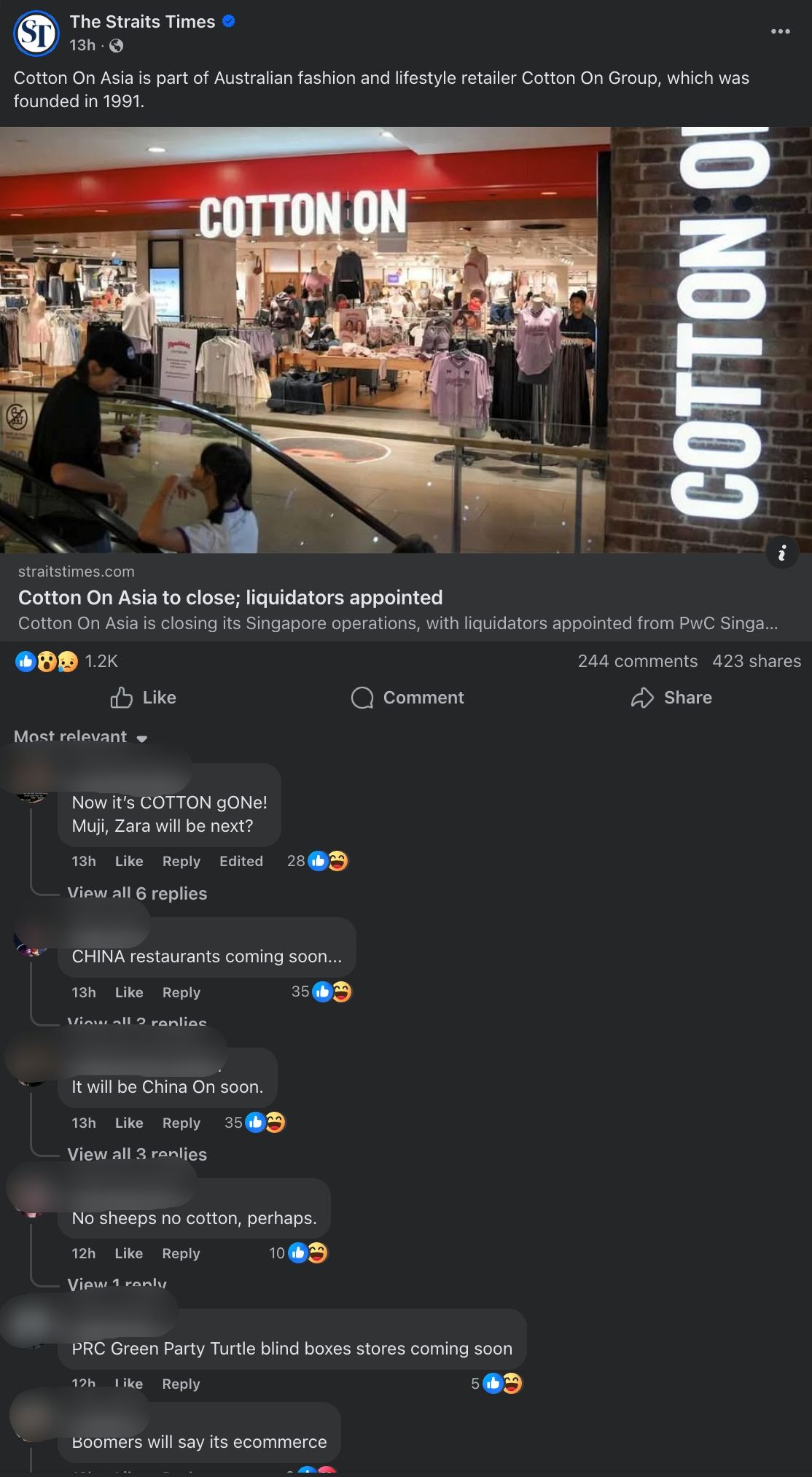
A narrative vacuum filled by speculation
Communications professionals have cited the incident as a textbook example of a narrative vacuum driving misinformation.
In the same report by Provoke Media, Charu Srivastava, co-founder, chief strategy officer and corporate affairs lead at TriOn & Co, said the situation exposed a critical gap between internal corporate developments and public communications. "While the reports were eventually clarified, the initial lag allowed a negative narrative to take root, which can immediately impact employee morale and consumer confidence," Srivastava said, adding that the damage was compounded by the backdrop of high-profile business closures that had already heightened stakeholder anxiety.
Srivastava said Cotton On's media statement lacked a human touch and risked coming across as inauthentic. "While they corrected the liquidation narrative, it left lingering questions on what exactly happened, who is this mysterious liquidated entity and the future of the company as trust has been shaken," she said.
She argued that restoring trust requires more than a one-off denial. Cotton On should prioritise internal and employee communications, humanise its leadership by having a senior figure speak directly to the public rather than issuing statements through a nameless spokesperson, and remain vigilant about any communications issued in its name going forward. "Trust broken once is far more susceptible to be broken again," she said.
Sunny Johar, managing director, Southeast Asia and group head of digital strategy at KRDS, agreed that the incident was a classic case of a narrative vacuum being filled by speculation. "The core issue here is a lack of clarity at a moment when stakeholders needed precision," Johar said. "Ideally, this moment could've been planned for and easily pre-empted through a simple press release, making sure that an administrative action was interpreted as just that."
Johar added that Cotton On has an opportunity to move from reactive clarification to proactive confidence-building by clearly outlining its strategy in Asia and backing it up with visible signals of commitment, including public statements from senior leadership about open positions and growth plans.
Abraham Christopher, regional head of client success at Mutant Communications, stressed that speed of response remains fundamental in public relations practice. "It would definitely have helped clear the air on the situation if they had responded before the initial publish time," he said, urging brands to build strong media relationships so that journalists have a trusted contact to reach before publication.
Kelvin Koh, managing director of Truescope, summarised the lesson: "Once ambiguity appears, the narrative can shift very quickly. The data shows that even after clarification, the issue continued to attract strong engagement. That is why brands must respond with speed and clarity before confusion hardens into perception."