Bloomberg confronts Shanmugam with early drafts bearing no mention of him as AML exchange dominates Day 2
On the second day of cross-examination, defence counsel walked Shanmugam through early article drafts bearing no mention of him, a government spokesman's pre-publication assessment that the ministers' deals were above board, and an extended anti-money laundering exchange drawing on parliamentary Hansard. Shanmugam confirmed the paragraph naming him in the Bloomberg article contained no factual error.


Cross-examination of Home Affairs Minister K. Shanmugam entered its second day on Wednesday, 8 April 2026, in the defamation trial brought by Shanmugam and Manpower Minister Tan See Leng against Bloomberg L.P. and its Singapore reporter Low De Wei.
Senior Counsel Sreenivasan Narayanan, appearing for Bloomberg, opened proceedings by pressing Shanmugam to identify specifically what he meant when he had testified the previous day that documents confirmed Bloomberg had lied to his press secretary Ng Siew Hua.
The session covered the identification of two specific statements alleged to be lies, a sequence of early article drafts, a government spokesman email, a paragraph-by-paragraph review of the published article, an exchange on Singapore's anti-money laundering (AML) framework, and the question of whether Bloomberg's retention of the article after a government correction directive constituted malice.
The trial concerns a Bloomberg article published on 12 December 2024 titled "Singapore Mansion Deals Are Increasingly Shrouded in Secrecy." The ministers allege the article defamed them by suggesting they had exploited legal mechanisms to conduct their property transactions in a non-transparent manner and to avoid scrutiny. Bloomberg and Low maintain the article reported accurately on a matter of public interest and rely on a responsible journalism defence.
The two lies identified
At the start of the hearing, Sreenivasan asked Shanmugam to state clearly, unequivocally, and succinctly what the alleged lies were.
Shanmugam identified two statements made by Bloomberg Singapore Bureau Chief Andrea Tan to Ng in communications of October 2024. The first was that the article was not targeted at him. The second was that his property sale formed part of a broader trend story about Good Class Bungalow (GCB) transactions rather than being the article's focal point.
Shanmugam added that Bloomberg's news employees in Singapore had not been completely transparent with their management outside the country. He stopped short of saying they had lied to overseas management, saying they had not told the complete truth to those asking questions about the article from outside Singapore.
Sreenivasan then took Shanmugam through the 21 October 2024 email in which a Bloomberg colleague had written to Ng stating that Low was working on a feature story about "off-radar" GCB transactions and that there was a plan to include Shanmugam's transaction. Sreenivasan asked whether Shanmugam agreed his press secretary had been told the story would be about off-radar transactions. Shanmugam confirmed she had received the email.
Sreenivasan asked whether Bloomberg had expressly told Shanmugam, through his press secretary, that his transaction would appear in the article. Shanmugam confirmed: "The answer is yes."
Sreenivasan put to Shanmugam that the two alleged lies — that the article was not targeted at him and that it was part of a broader story — were connected, in that if it was part of a broader story it would not by definition be targeted at him. Shanmugam disagreed, saying he could still be a target and be part of a broader story.
Sreenivasan put to Shanmugam that the emails and documents did not show him being targeted in any way. Shanmugam replied: "I disagree completely."
The presiding judge, Justice Audrey Lim asked Shanmugam when he believed the intention to target him had arisen. Shanmugam said: "Sometime in March" 2024, based on the dates of the internal emails.
Sreenivasan referred to a property search document dated 13 September 2024, the day after The Online Citizen published its article on the Astrid Hill transaction, recording that Low had conducted an e-search on Shanmugam's property on that date. Sreenivasan put to Shanmugam that this indicated Low's interest in his property had been followed up on that day. Shanmugam agreed.
The draft history
Sreenivasan produced a document dated 23 August 2024, described by Low in his own affidavit of evidence-in-chief as a first draft of the article. He asked Shanmugam to confirm whether his name appeared anywhere in it.
Shanmugam confirmed: "I don't see any mention of my transaction."
Sreenivasan put to Shanmugam that he had testified the previous day, repeatedly, that the main thrust of the article was his transaction and the rest was a wrap-around story. He asked whether, on that basis, the main thrust as Shanmugam characterised it did not exist in that first document.
Before Shanmugam could answer, Senior Counsel Davinder Singh, appearing for both ministers, interjected.
Singh said the document was not a draft. He described it as a two-page summary of points Low had compiled to persuade a superior, Lulu Chen, to authorise him to write the article. He directed the court to the accompanying email exchange, in which Low had written to Chen: "Just going to work a bit on this mentioned story I have today, wanted to get your two cents first." Chen had replied that she liked the idea.
Sreenivasan noted that Low had referred to the document as a first draft in his own affidavit. He said he would not quibble over the label and would refer to it as a document. He also noted that Bloomberg's system contains 121 versions of the article because every edit generates a new version entry, including edits by persons other than Low.
Singh said he accepted that was what Bloomberg had told the court about their system. He did not accept the document was a draft of the article.
Sreenivasan moved to a second version, also bearing no mention of Shanmugam. He then produced a third version which, under a heading about secretive deals not being confined to Singapore's new rich, included a line that Singapore politicians had also been involved in some, with references to Shanmugam's sale, Dr Tan See Leng's purchase, and a sale by former minister Mah Bow Tan.
Justice Lim intervened and asked Sreenivasan not to take the court through the full sequence of versions, noting the court would not be working through a hundred of them.
Sreenivasan then put a series of propositions to Shanmugam. He put that on the face of the documents and emails, Shanmugam was not shown as being targeted in any way. Shanmugam replied: "I disagree completely."
Sreenivasan put that Shanmugam had in fact been told in advance that his property sale would be mentioned in the article and had been given the opportunity to respond. Shanmugam disagreed, saying this had to be read in the context of what he had said earlier. He said that on the face of the documents alone he would have had questions about whether he was being targeted but would not have reached a conclusion. He said it was having seen the emails that led him to his conclusion.
Sreenivasan further put that none of the venom, nastiness, and animus that Shanmugam had described when reading out the emails on Tuesday were reflected in the final published article. Shanmugam disagreed.
The article paragraph by paragraph
Sreenivasan then moved to the published article itself, and took Shanmugam through the published article paragraph by paragraph.
The opening paragraph, which stated that Singapore's rich were increasingly cloaking their purchases of mansions in secrecy to avoid drawing attention to their wealth and social status, made no reference to Shanmugam. Shanmugam confirmed this. Sreenivasan asked whether the heating up of the GCB market was a newsworthy matter. Shanmugam agreed it was.
Paragraph three reported that close to half of GCB purchases by value in 2024 lacked caveats and therefore did not appear in the Urban Redevelopment Authority (URA) database. It stated that deals without caveats are much harder to track because they do not appear in the URA database and usually become public only through press leads and directed searches of real estate ownership records.
Sreenivasan asked whether Shanmugam agreed that non-caveated deals do not appear in the URA database. Shanmugam agreed. Sreenivasan asked whether a directed search of local real estate ownership records can be done by searching INLIS with a specific property in mind. Shanmugam confirmed it could.
Sreenivasan moved to paragraphs 22 and 23, which referenced anti-money laundering considerations. He confirmed with Shanmugam that those paragraphs related to anti-money laundering content. He then moved to paragraph 25, where Shanmugam is referred to by name, and asked directly whether there was anything in that paragraph that was factually untrue.
Shanmugam replied: "There is nothing there that is factually untrue"
He confirmed the paragraph correctly recorded that the purchase was done on behalf of an entity called the Jasmine Villa Settlement through UBS Trustees and that the article's statement that the ultimate beneficiary's identity could not be established was an accurate statement of what the article said.
When Sreenivasan moved to paragraph 37, which stated the sale had become political fodder, referencing Singapore Democratic Party Secretary-General Chee Soon Juan's questioning of the property's valuation and the identity of the new owner, Shanmugam disputed the characterisation.
He said: "Two politicians who have no seats in parliament, and who have been, if my recollections serve me right, never won a seat in parliament, raising questions, does not make it political fodder."
Sreenivasan referred to an internal Bloomberg email which recorded Ng's own account conveyed to Bloomberg that two opposition politicians were talking the matter up and doing so for political mileage. He asked whether political fodder was an accurate paraphrase of political mileage. Shanmugam said the two expressions did not mean the same thing.
The government spokesman email
Sreenivasan referred to another internal Bloomberg email in which a Bloomberg journalist recorded feedback from a government spokesman ahead of publication.
The email recorded the spokesman's assessment that the ministers' deals were above board. It also recorded the government's concern that Bloomberg might associate the ministers with money launderers, tax avoiders, or paint them as the super elite.
The email further recorded the spokesman noting it was not accurate to say that caveated transactions are not captured in public databases, as they can be found in INLIS or at the SLA.
Sreenivasan put to Shanmugam that, as of that point in time, a government spokesman had been brought up to date about the prospective story. Shanmugam said he had no idea who the government spokesman was, could not confirm the accuracy of what was recorded in the email, and did not know whether the account was reliable.
Anti-money laundering framework
Sreenivasan referred to the Inter-Ministerial Committee (IMC) report on the 2023 money laundering case, which stated that prevention relies primarily on gatekeepers in the private sector, especially financial institutions and DNFBPs. He asked Shanmugam to confirm this was the IMC's description of where primary responsibility for prevention lay. Shanmugam confirmed: "Yes, but in context you must read the whole report and the Hansard as well."
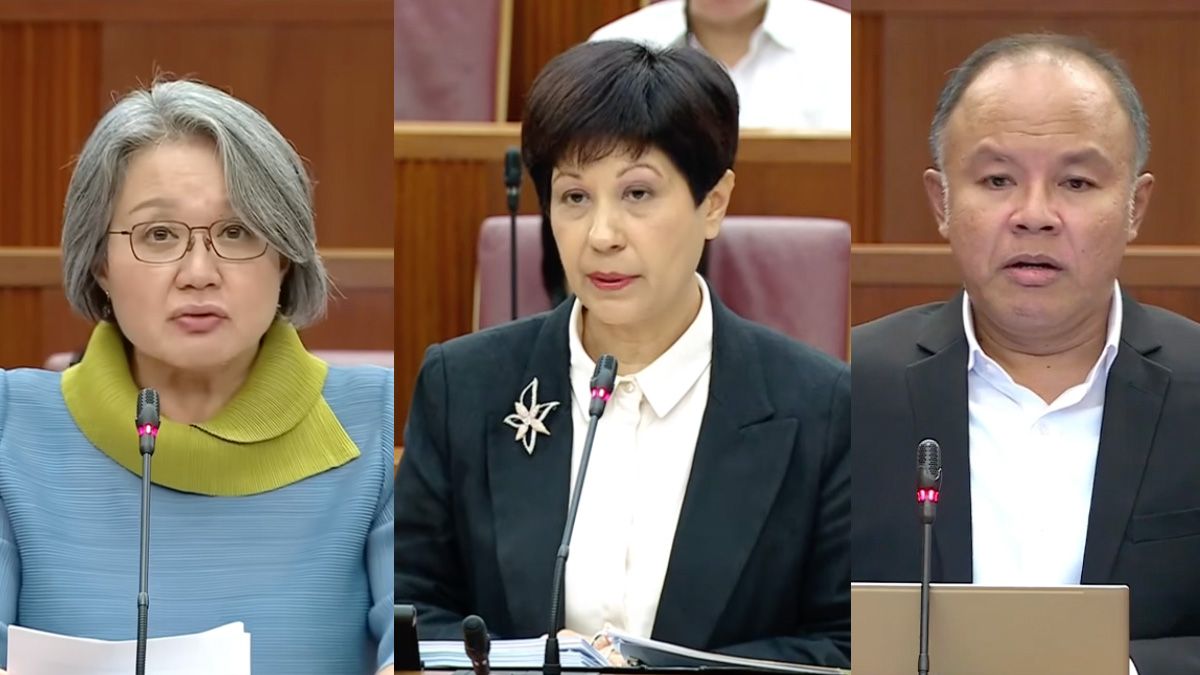
Shanmugam drew on the parliamentary Hansard from the 3 October 2023 ministerial statements on Singapore's anti-money laundering regime. He cited the speech of Second Minister for Home Affairs Josephine Teo, who had described Singapore's AML strategy as having three prongs — prevention, detection, and enforcement — underpinned by a robust legal and regulatory framework.
Shanmugam read into the record the FATF 2016 evaluation finding, cited in the parliamentary handout introduced by Josephine Teo during that sitting, that Singapore has a strong legal and institutional framework to fight money laundering and that its AML coordination is highly sophisticated and inclusive of all relevant competent authorities.
He referred to the Basel Anti-Money Laundering Index 2022, also cited in the parliamentary handout, in which Singapore was ranked 100 out of 128 regions assessed for lowest risk, placing it ahead of the United States, Switzerland, Hong Kong, and Dubai.
He said the primary checks in any property transaction run through financial institutions first, with banks required to conduct customer due diligence and verify sources of funds. Conveyancing lawyers are separately obligated under Designated Non-Financial Business and Professions (DNFBP) frameworks, with property agents coming after those layers.
Sreenivasan also referred to the parliamentary exchange in which Second Minister for Finance and National Development Indranee Rajah had stated, in response to a question from Member of Parliament He Ting Ru, that SLA does not carry out additional AML checks on property transactions because this would duplicate the existing checks already conducted by real estate agents, developers, agencies, conveyancing lawyers, and financial institutions. Indranee Rajah had noted that SLA is not the main interface with parties to purchases and therefore does not conduct AML checks.
Shanmugam later said: "To suggest that they are the primary gatekeepers is to take out of context what was said and what the entire debate was about."
Sreenivasan then put paragraphs 28 and 29 of the published article to Shanmugam together, asking whether Shanmugam agreed they were borne out by the facts.
Paragraph 28 stated that the Singapore Land Authority (SLA), a statutory board under the law ministry, does not collect general data on landed residential properties acquired through trust companies where beneficiaries are Singapore citizens. Sreenivasan noted this was drawn from the parliamentary answer tabled by Edwin Tong, then-Minister for Culture, Community and Youth and Second Minister for Law, on 14 October 2024.
Justice Lim asked Shanmugam directly whether that statement was correct. Shanmugam confirmed it was, adding that SLA probably does not collect such general data on any landed residential properties acquired through trust companies where the beneficiaries are Singapore citizens, not only on GCBs, though he indicated he would verify this with the SLA.
Sreenivasan put to Shanmugam that paragraph 29 states that property agents and other service providers involved in the transactions are primarily responsible for verifying the identities and sources of wealth of buyers.
He then added: "It does not say, and by no conceivable imagination, does it say that these people have the primary responsibility for AML." He asked Shanmugam to agree or disagree. Shanmugam said: "I disagree."
The 10 December phone call
Sreenivasan referred to a phone call on 10 December 2024 between Low and Ng, two days before publication. He read from Low's affidavit, which recorded that Ng had conveyed Shanmugam felt Bloomberg was acting in bad faith, using a general story as an excuse to publish details of what he considered a wholly private transaction and that it was a serious invasion of privacy.
Sreenivasan asked whether Shanmugam had been aware of the call before it took place, after it took place, or at all. Shanmugam said he did not believe he had been informed but undertook to check his emails.
POFMA direction and aggravated damages
Towards the close of the session Sreenivasan addressed Shanmugam's pleaded case that Bloomberg's retention of the article after receiving a POFMA Correction Direction on 23 December 2024 constituted malice warranting aggravated damages.
The direction, issued by Edwin Tong — who was then Second Minister for Law while Shanmugam was the Minister for Law — under the Protection from Online Falsehoods and Manipulation Act (POFMA), required Bloomberg and other outlets to publish corrections to statements the government deemed false. Bloomberg applied a correction notice to the article but did not remove it.
Sreenivasan referred Shanmugam to the specific pleading, which recorded that on or about December 2024 the defendants were informed of falsehoods in the article, including by way of a government Factually article and correction notices, and that despite this the article and social media posts continued to be published.
Sreenivasan asked how this amounted to malice.
Shanmugam said: "You are being told by the government of Singapore that your article contains various falsehoods…. A responsible news organisation which is told it has got all these falsehoods would say — oh ya, let's take it down. Instead of that, despite being told it is false…your client doesn't apply to court to set aside the POFMA order, which they were entitled to up till today."
Sreenivasan asked: "So because Bloomberg took the position that they didn't agree with the basis of the POFMA order, that is evidence of malice?"
Shanmugam replied: "I didn't say that…You have been told that it is false. And despite that, you have chosen to keep it up. And actions speak louder than words."
Sreenivasan sought the assistance of Justice Lim to clarify the specific basis of the pleaded malice particular. Justice Lim directed the question to Shanmugam, asking him to confirm whether the malice pleaded in that specific particular was Bloomberg's decision to leave the article up without correction.
Shanmugam acknowledged Bloomberg had complied with the formal requirement to publish correction notices but said the original article remaining up despite having been told it contained falsehoods was, in his view, one factor demonstrating malicious intent.
The hearing concluded at lunchtime. Sreenivasan indicated he expected to complete cross-examination of Shanmugam during the first half of proceedings on Thursday, 9 April 2026. Tan See Leng has not yet given evidence. The trial is expected to conclude on Friday, 10 April 2026.
Editor's note: The Online Citizen received a POFMA Correction Direction on 23 December 2024 in connection with its coverage of the GCB transactions referenced in this report. The Online Citizen does not agree with the direction.
Court proceedings on 8 April 2026 were attended by a TOC correspondent. This report draws on correspondent notes, reports from mainstream media (CNA & ST), and primary source documents including the official Hansard record. Direct quotes from proceedings are reproduced as accurately as possible from correspondent notes. The substance and context of all quoted exchanges are faithfully represented.