Min Aung Hlaing sworn in as Myanmar president amid criticism of military rule entrenchment
Min Aung Hlaing was sworn in as Myanmar’s president on 10 April 2026 after a junta-backed election, drawing criticism over continued military influence and the exclusion of opposition parties.

- Min Aung Hlaing became president after a junta-organised election excluding opposition parties.
- Critics say the civilian transition masks continued military dominance in government.
- Legal complaints and regional reactions highlight ongoing concerns over legitimacy and human rights.

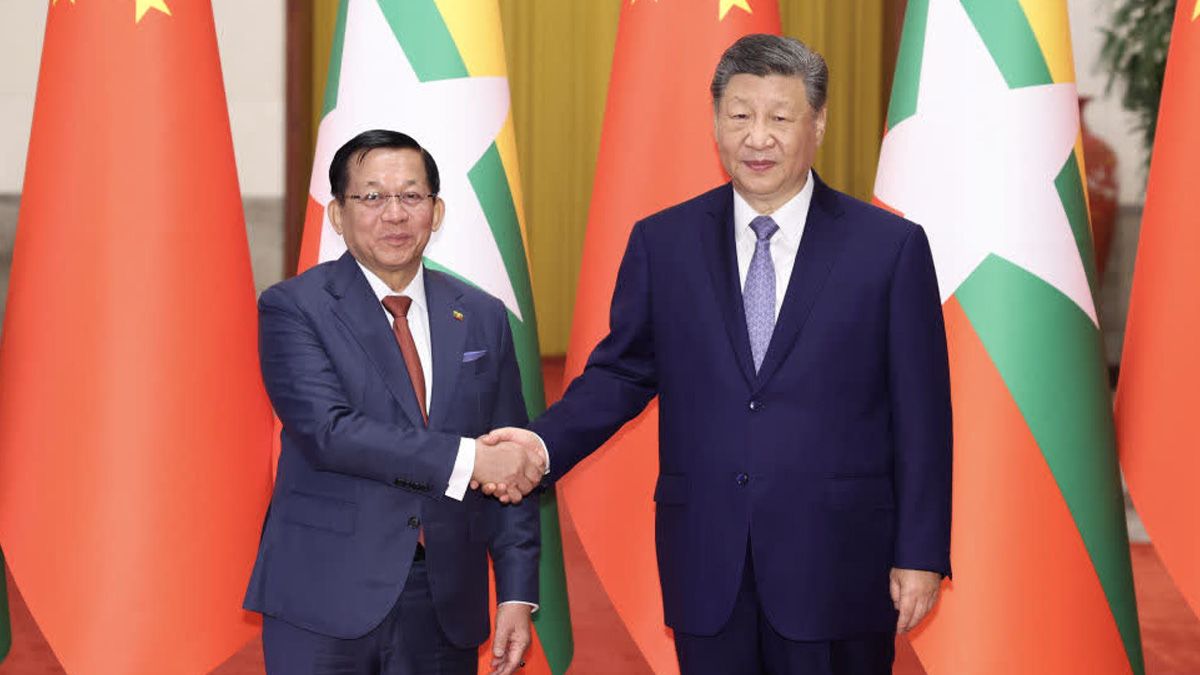
NAYPYIDAW, 10 April 2026: Myanmar junta chief Min Aung Hlaing was sworn in as president, marking a formal shift into a civilian role five years after seizing power in a military coup.
The oath-taking ceremony was held before the Speaker of the Pyidaungsu Hluttaw during the sixth day of the first regular session of the Third Pyidaungsu Hluttaw in Nay Pyi Taw.
Min Aung Hlaing recited the presidential oath, pledging to “strive for further flourishing the eternal principles of justice, liberty and equality”.
“I will dedicate myself to the service of the Republic of the Union of Myanmar,” he said, as he began his five-year term in office.
Vice-presidents and officials sworn in
During the same session, U Nyo Saw and Nan Ni Ni Aye were sworn in as vice-presidents.
A wide range of senior officials also took the oath before the Speaker. These included the Union Chief Justice, judges of the Union Supreme Court, Union Ministers, and the Union Attorney General.
The Chairperson of the Union Election Commission, the Governor and Deputy Governor of the Central Bank of Myanmar, and members of the Anti-Corruption Commission were also sworn in.
Min Aung Hlaing, formerly commander-in-chief of the Defence Services, had been elected president by the Presidential Electoral College on 3 April 2026.
Election follows coup and political upheaval
Min Aung Hlaing led the military takeover in 2021, ousting the elected government of Aung San Suu Kyi and detaining the Nobel Peace Prize laureate.
The coup triggered a nationwide civil war and a prolonged political crisis.
Five years later, the military organised an election that concluded in January 2026. The vote excluded Suu Kyi’s party and enabled military-aligned political groups to secure victory.
The junta described the election as a return of power to the people and an opportunity for reconciliation.
However, observers and democracy watchdogs have disputed that claim, raising concerns over restrictions on participation and the absence of key political parties.
Military influence remains dominant
More than two-thirds of the 30 ministers sworn in alongside the president are either serving or former members of the military.
A similar proportion had previously held positions in the junta leadership following the 2021 coup. More than ten ministers have been subject to international sanctions.
Critics have described the transition as a rebranding of military rule under a civilian structure.
The Asian Network for Free Elections reported that parties which had won more than 90 per cent of parliamentary seats in 2020 were excluded from the re-run.
It also noted that protest or criticism of the election was punishable by prison sentences.
Voting did not take place in large parts of the country controlled by armed groups opposing the military, further undermining the credibility of the outcome, according to rights monitors.
Regional response and diplomatic signals
Representatives from China, India and Thailand attended the swearing-in ceremony in Nay Pyi Taw.
Thailand’s Prime Minister Anutin Charnvirakul sent a congratulatory message, stating that under Min Aung Hlaing’s “able leadership”, relations between the countries would “grow from strength to strength”.
Analysts say China was the largest backer of the election and that discussions are under way to revive stalled infrastructure projects supported by Beijing.
Myanmar remains a member of the Association of South East Asian Nations, although relations with the bloc have been strained since the 2021 coup.
Humanitarian crisis and legal challenge
Myanmar has experienced decades of military rule since independence, with a brief period of civilian governance beginning in 2011.
That period ended with the 2021 coup, which analysts say followed concerns within the military over its declining influence after the 2020 elections.
The ongoing conflict has led to a humanitarian crisis, including the displacement of large numbers of Rohingya Muslims into refugee settlements.
A criminal complaint against Min Aung Hlaing was filed in Indonesia by civil society organisations, accusing him of acts of genocide against the Rohingya.
The complaint was submitted to Indonesia’s Attorney General’s office by Yasmin Ullah, a Rohingya refugee, along with several Indonesian figures, including a former attorney general and the chairman of Muhammadiyah.
According to a joint statement, the group plans to present evidence of forced displacement and killings. They added that the case has been accepted by Indonesian prosecutors.
The allegations relate to a 2017 military offensive that forced at least 730,000 Rohingya to flee to Bangladesh, where survivors reported killings, mass rape and arson.
Rights groups condemn political transition
On 31 March 2026, ASEAN Parliamentarians for Human Rights condemned the move to install Min Aung Hlaing as president.
The group described the development as an “orchestrated power grab” that entrenches military rule and perpetuates impunity.
It warned that recognising his presidency would legitimise alleged atrocities and undermine the rights of people across Myanmar.
The organisation called for international solidarity and coordinated action to support democracy, human rights, and justice in the country.