Singapore tightens school discipline with stricter penalties for bullying and serious misconduct
Singapore introduces tougher, standardised penalties for school bullying and misconduct. Students may face detention, suspension or caning, alongside counselling. The new framework aims for consistency, stronger intervention, and better protection for victims across all schools by 2027.

- Singapore introduces stricter, standardised penalties for bullying and serious student misconduct across all schools.
- Repeat and severe offenders face longer suspensions, poorer conduct grades, and possible caning.
- Framework combines discipline with counselling, safety planning, and structured intervention processes.

SINGAPORE: Students who engage in bullying will face penalties aligned with those imposed for vaping offences under a stricter national framework announced by the Ministry of Education (MOE) on 15 April 2026.
The updated guidelines introduce standardised disciplinary measures for serious and very serious misconduct, aiming to ensure consistency across schools while reinforcing a balance between punishment and rehabilitation.
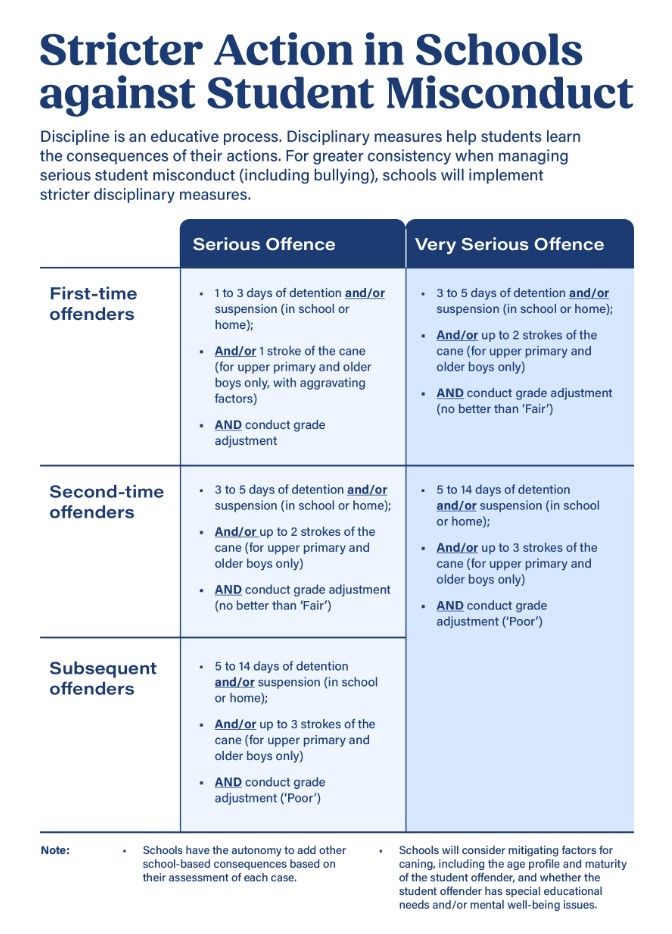
Under the new rules, first-time offenders of serious misconduct may receive one to three days of detention or suspension.
Their conduct grades will be downgraded, and older boys may face one stroke of the cane if aggravating factors are present.
For very serious offences, first-time offenders may face three to five days of detention or suspension.
Their conduct grade will be capped at “Fair”, and boys in upper primary levels and above may receive up to two strokes of the cane.
Repeat offenders face harsher consequences
Students who repeatedly commit very serious offences will face more severe penalties.
These include five to 14 days of detention or suspension, a “Poor” conduct grade, and up to three strokes of the cane for older boys.
MOE stated that these disciplinary measures will be accompanied by a rehabilitative approach, including counselling and structured interventions to address underlying behavioural issues.
Conduct grades are issued each semester and may affect students’ future applications to programmes or schools.
The ministry emphasised that these grades serve as both a disciplinary record and a developmental indicator.
Defining serious and very serious offences
Schools will assess the severity of misconduct based on several factors, including the impact of the behaviour, the student’s intent, whether the acts were repeated, and whether the student is recalcitrant.
Serious offences include fighting, physical assault, and repeated social bullying carried out with clear intent to harm.
Very serious offences involve persistent or defiant behaviour despite prior intervention, as well as cases that may warrant police investigation.
Previously, schools followed a tiered disciplinary system, ranging from reflective exercises for minor offences to detention, suspension, or caning for more serious cases. Police reports could be filed in severe incidents.
However, variations in how schools handled cases prompted concerns about inconsistency. Education Minister Desmond Lee said the new framework aims to establish a more uniform approach nationwide.
Rising trend in reported bullying cases
MOE data showed a slight increase in reported bullying incidents in recent years.
From 2021 to 2025, schools recorded an average of three bullying cases per 1,000 primary school students and eight per 1,000 secondary school students.
This marked an increase from the preceding five-year period, from 2020 to 2024, when the figures stood at approximately two cases per 1,000 primary students and six per 1,000 secondary students.
The ministry clarified that the new framework will apply not only to bullying but also to other forms of misconduct such as theft and vandalism.
It will be implemented across all schools by the start of 2027.
Balancing discipline with rehabilitation
MOE stated that schools will retain discretion to impose additional measures based on individual cases.
Mitigating factors such as a student’s age, maturity, special educational needs, and mental well-being will be considered before caning is administered.
School-based consequences may include reflective writing exercises or requiring students to share lessons learnt with peers.
The ministry stressed that discipline must be complemented by efforts to guide behavioural change and support reintegration into the school community.
The framework follows a comprehensive review of how schools manage bullying and harmful behaviour, prompted by several high-profile incidents that drew public concern.
Recent incidents highlight urgency
In August 2025, three students from Sengkang Green Primary School were suspended after threatening to kill a classmate and her family.
Earlier in the same year, videos circulated online showing teenagers threatening a boy with a knife.
Another incident involved a fight among students from Montfort Secondary School.
MOE distinguishes between “hurtful behaviours” and bullying. Hurtful behaviours include one-off incidents such as insensitive remarks or isolated physical altercations.
Bullying, by contrast, refers to repeated and intentional actions aimed at causing harm.
Enhanced support measures and reporting processes
Beyond disciplinary action, MOE outlined additional measures to strengthen prevention and response efforts.
These include increased funding for manpower and more accessible reporting channels for students.
Schools will also receive clearer operational guidelines covering response timelines, safety planning, counselling, and restorative practices. The aim is to ensure timely and consistent handling of cases.
When bullying occurs, schools will follow a structured response process. Immediate safety measures will be implemented, followed by investigations and appropriate disciplinary actions.
Parents will be kept informed at key stages, and schools will work closely with families to ensure student safety and well-being.
The enhanced measures will be progressively introduced from 2026.
Addressing cyberbullying and online harm
For cyber-related cases, students and teachers affected by online harm will have additional avenues for recourse.
The Online Safety Commission, set to begin operations at the end of June, will handle cases involving harassment, doxxing, and the sharing of intimate images.
Victims are advised to first report harmful content to the relevant social media platform. If no action is taken within 24 hours, they may escalate the matter to the commission.
The commission will have the authority to order the removal of harmful content.
MOE added that schools will continue working with students and families to address inappropriate online behaviour and provide guidance.
MPs earlier urge stronger anti-bullying steps during Sept 2025 Parliamentary sitting
The issue of school bullying has been raised in Parliament, with policymakers calling for more robust measures.
In September 2025, Education Minister Desmond Lee stated that MOE was reviewing its anti-bullying strategies.
Members of the Workers’ Party called for stronger intervention. He Ting Ru urged consultation with child safety and violence-prevention experts, as well as closer collaboration with external agencies.
Louis Chua questioned how schools monitor both victims and perpetrators after incidents are reported. He asked whether safety plans for victims are consistently implemented and whether offenders receive long-term intervention.
Chua also sought clarification on gaps identified in MOE’s review process.
In response, Lee said schools already monitor students following disciplinary action, with interventions tailored to individual needs. Counsellors and external agencies, including REACH, may be involved depending on circumstances.
Lee emphasised that discipline should be “educative and restorative”, stating that students must be guided to reflect, make amends, and reintegrate with appropriate support.
“You can never get it perfect,” Lee said, acknowledging the complexity of managing student behaviour. He added that intervention becomes necessary “when interactions turn toxic or harmful”.
Lee at the time highlighted deeper underlying factors contributing to bullying and misconduct. These include poor role modelling, the influence of social media, special educational needs, and family-related challenges.
He stressed that addressing these root causes is essential for long-term behavioural change, beyond immediate disciplinary action.