Malaysia’s Universiti Malaya draws backlash over student theatre scene criticised as suggestive
Malaysia’s Universiti Malaya has faced online backlash after a student theatre competition scene was criticised for being reportedly suggestive. The incident sparked a divided debate on social media, with users split over artistic expression, cultural boundaries and university standards.

- Universiti Malaya draws online backlash over reportedly suggestive student theatre scene
- Social media reactions divided between criticism and defence of artistic expression
- University says performance breached guidelines and has been disqualified

MALAYSIA: Universiti Malaya (UM), a public university in Malaysia, is facing online backlash after a scene from a student theatre competition drew criticism for being reportedly suggestive.
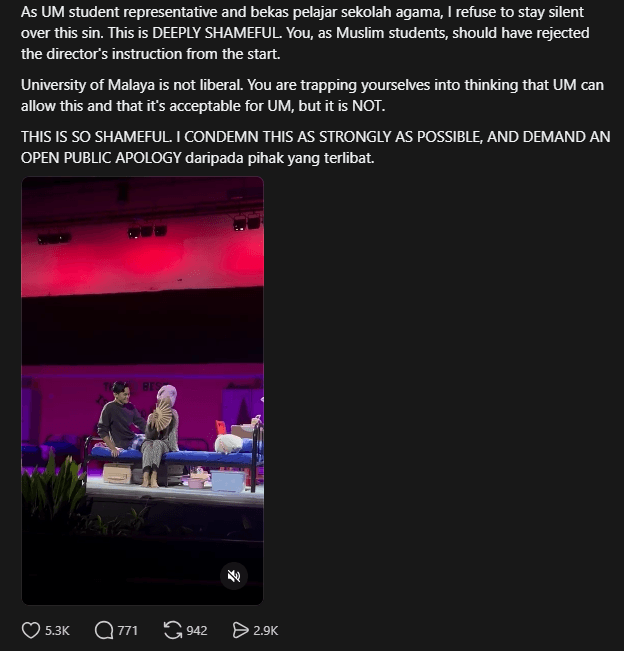
The controversy gained traction on social media platform Threads, where a post condemning the performance — made before the university issued an apology — received more than 5,300 likes and over 770 comments.
The post described the scene as “deeply shameful” and called for a public apology from those involved, while urging students to reject what it characterised as inappropriate direction in the performance.
Mixed reactions online as debate over theatre scene grows
Reactions on the post were divided.
Some users echoed criticism of the scene, questioning its necessity and appropriateness, while others defended it as a form of artistic expression.
A former UM student cited past student activism in support of free expression.
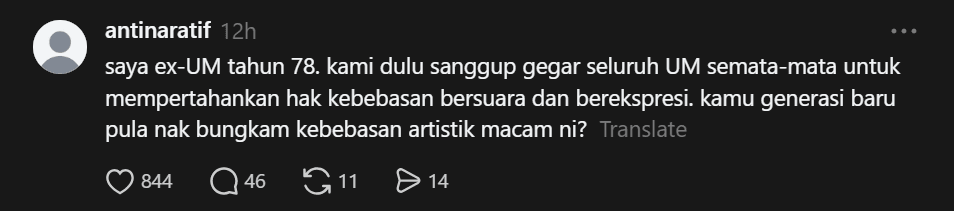
"I am a UM alumnus from 1978. In our time, we were willing to rally across the university to defend freedom of speech and expression. But this new generation seems to be silencing artistic freedom instead?"
Other users questioned the purpose of the scene.

"What is the purpose of a scene like this? Are there no better scenes? Disgusting."
Some commenters argued that the performance lacked artistic justification.
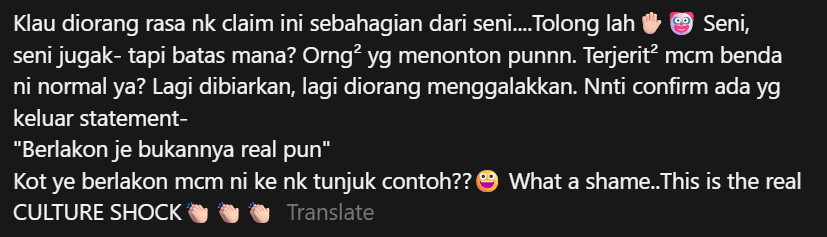
"If they want to claim this is art, please stop. Art still has limits. Even the audience is reacting like this is normal. The more it is allowed, the more it is encouraged. Later people will say “it’s just acting, not real,” but is this really the kind of acting we want to show as an example? What a shame. This is culture shock."
Others took a more permissive stance, describing it as a performance open to interpretation.

"Different people have different perspectives. Everyone is acting like moral police. It’s just a performance."
Another commenter defended the scene against criticism.

"The performance did not even involve nudity. Relax. This is Malaysia, not Taliban Afghanistan."
Some responses raised concerns about normalising such content, linking it to broader social and cultural considerations.
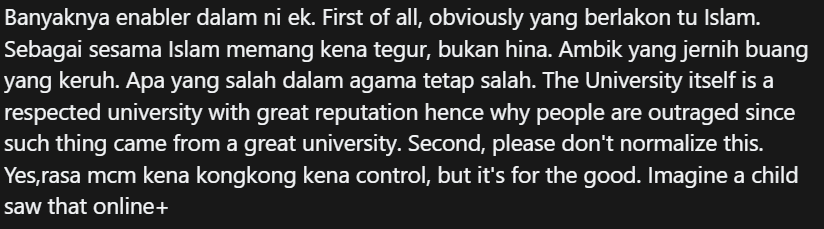
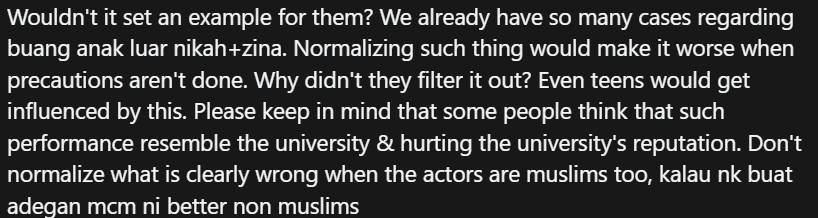
"There are too many enablers here. First, the performers are Muslim, so it should be corrected, not praised. What is wrong remains wrong. The university has a strong reputation, which is why people are upset. Please do not normalise this. If children see this online, it sets an example. We already have many cases related to out-of-wedlock pregnancies. Why was this not filtered out? Even teenagers could be influenced. Do not normalise what is clearly wrong."
Online reactions extend to Reddit discussions
On Reddit, users also debated the incident, with discussions focusing on artistic interpretation, institutional response, and broader cultural standards in Malaysia’s creative scene.
One user, identifying as a Universiti Malaya arts graduate, said the university should not have issued an immediate apology, arguing that it reinforced reactive public pressure rather than encouraging critical engagement with the performance.
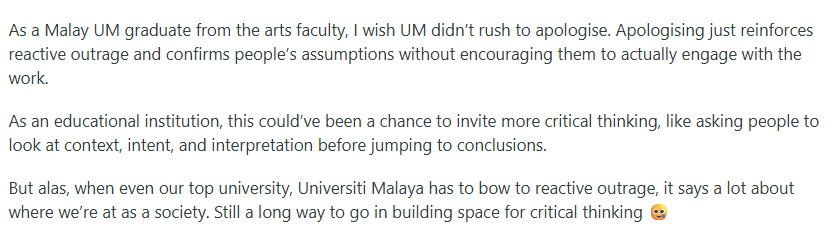
Another user responded that Universiti Malaya and event organisers have historically enforced strict rules on performance content, stating that participants who breach guidelines are typically disqualified, and that responsibility ultimately lies with organisers.
The user replied that the issue was not denial of the rules, but the speed at which public backlash leads to apology responses rather than structured discussion on context or intent.
The user also noted that existing guidelines are broadly defined, allowing performances to be interpreted differently depending on perspective.
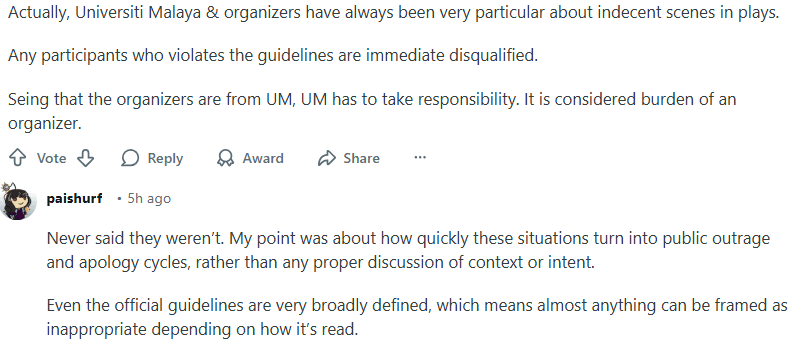
Other Reddit users linked the controversy to broader concerns about the local entertainment industry, suggesting that creative output is often limited to repetitive genres.
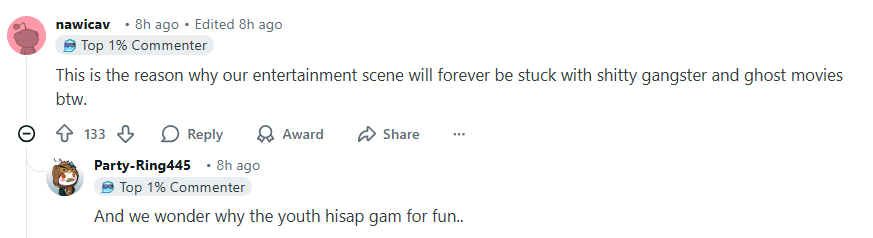
“And we still wonder why some young people abuse inhalants.”
Another thread of discussion focused on perceptions of inconsistency in cultural standards and enforcement.
One user wrote that local productions are often scrutinised more heavily than foreign ones, describing it as a perceived double standard.
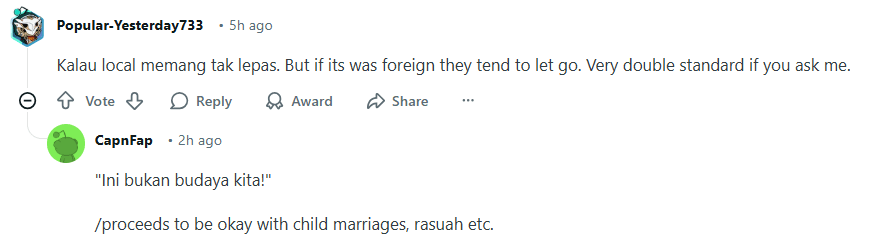
“If locals do it, it is usually not accepted. But if it is done by foreigners, it tends to be allowed. Very double standard, if you ask me.”
“This is not our culture!”
“/proceeds to be okay with child marriages, corruption, etc.”
University response and actions
In a statement posted on Facebook on 16 April, UM said all performances in the competition were required to comply with guidelines prohibiting content deemed negative, provocative, or capable of affecting religious, moral, ethical and cultural values, as well as the institution’s reputation.
The university stated that the controversial scene was not part of the original script that had been reviewed and approved prior to the performance, and that this constituted a breach of competition rules.
UM apologised for the incident and said it would not compromise on violations of established guidelines.
The performance has since been disqualified, and the university said it will strengthen monitoring measures to prevent similar incidents in future.