Hegseth clashes with Senate Democrats over Iran war as War Powers Act deadline looms
Defence Secretary Pete Hegseth faced sharp questioning from Senate Democrats over the stalled Iran war, a record Pentagon budget, and a looming War Powers Act deadline, as Joint Chiefs chairman Gen. Dan Caine confirmed Russian support for Tehran.
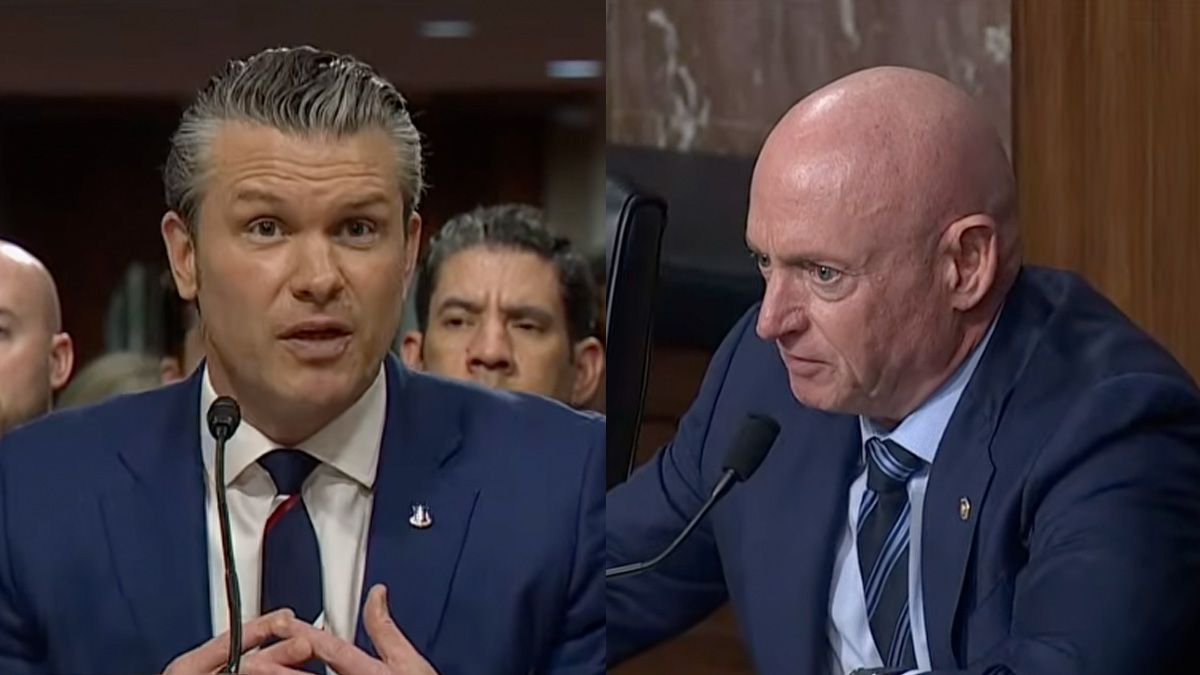

Defence Secretary Pete Hegseth faced a combative second day of congressional testimony on Thursday, clashing repeatedly with Senate Democrats over the conduct and legality of the US war with Iran, as a 60-day deadline under the War Powers Act of 1973 approached the following day.
The hearing before the Senate Armed Services Committee was nominally convened to examine the Pentagon's record budget submission of US$1.45 trillion, the largest in the department's history. In practice, it became a forum for sustained Democratic criticism of the administration's handling of a war now eight weeks old, geographically stalemated, and economically disruptive.
Hegseth and Gen. Dan Caine, chairman of the Joint Chiefs of Staff, appeared alongside Pentagon comptroller Jay Hurst. The session lasted three hours.
War Powers Act dispute
The most immediate legal controversy centred on whether the United States remained in compliance with the War Powers Act of 1973, which requires congressional authorisation for the use of military force and caps presidential discretion at 60 days, with a 30-day extension available if Congress is notified of a drawdown.
The 60-day limit for the Iran war is reached on Friday.
Hegseth told the committee that the current ceasefire suspended the clock. "We are in a ceasefire right now, which our understanding means the 60-day clock pauses or stops in a ceasefire," he said.
Sen. Tim Kaine, Democrat of Virginia, rejected that interpretation. "I do not believe the statute would support that," Kaine said, adding that he had "serious constitutional concerns" about the administration's legal reasoning.
The administration has not sought a congressional authorisation for the use of military force, and the White House has not notified Congress of any drawdown.
Reed: 'Dangerously exaggerated' claims
Sen. Jack Reed, Democrat of Rhode Island and the committee's ranking member, opened proceedings with an extended and pointed criticism of Hegseth personally, accusing him of presenting the president with a false picture of the military situation.
"The problem with your statements, Mr Secretary, is they are dangerously exaggerated," Reed said. "Iran's hard line regime remains in place. It still retains stockpiles of enriched uranium, and its nuclear programme remains viable."
Reed argued that Hegseth had prioritised telling Trump what he wanted to hear rather than what he needed to know. "Bold assurances of success are a disservice to both the commander in chief and the troops who risked their lives based on them," he said. "Our military has performed heroically, but military force without a sound strategy is a path to long-term defeat."
The senator also raised what he described as reckless public statements by Hegseth, including remarks made shortly after a missile strike killed hundreds of Iranian schoolgirls. "Just days after hundreds of Iranian school girls were tragically killed in a missile strike, you have made troubling statements about showing no mercy and no quarter to the Iranians — orders that would constitute war crimes," Reed said.
He accused Hegseth of diverting his attention from the war effort to institutional culture projects, including overhauling the Pentagon's chaplain corps, cancelling flu vaccine requirements, and barring service personnel from attending certain universities. Reed also criticised Hegseth's decision to invite the entertainer Kid Rock to an army base for what the senator described as a "joy ride" on an Apache helicopter.
"You are hollowing out our military defensive experience and highest performing senior officers while making young officers wonder if they should continue to serve," Reed said.
Russia aiding Iran
Gen. Caine confirmed during the hearing that Russian President Vladimir Putin has been providing assistance to Iran's war effort, though he declined to elaborate given the public nature of the session. "There's definitely some action there," Caine said.
Committee chairman Sen. Roger Wicker, Republican of Mississippi, corroborated the assessment. "There's no question that Vladimir Putin's Russia is taking serious action to undermine our efforts for success in Iran," Wicker said.
In his opening statement, Wicker warned of what he described as a coordinated "axis of aggressors" comprising Russia, China, Iran, and North Korea. "Xi Jinping leads not only China, but also an axis of aggressors," Wicker said. "This growing alliance cannot be denied. These four dictatorships support each other's aggressive endeavours. They prop each other up financially, and they scheme to undermine America's objectives."
Civilian deaths and the Strait of Hormuz
Democratic senators also pressed Hegseth on civilian casualties and the administration's dismantling of the office created in 2022 to minimise harm to non-combatants in conflict zones. Hegseth had cut approximately 90 per cent of the office's staff. He did not directly answer questions about the decision.
Sen. Richard Blumenthal, Democrat of Connecticut, asked about the Pentagon's investigation into a Tomahawk cruise missile strike on a girls' elementary school on the first day of the war, which killed 168 people. Hegseth said only that the matter remained under investigation.
Two Republican senators, Mike Rounds of South Dakota and Dan Sullivan of Alaska, asked Hegseth and Caine directly whether US forces had ever deliberately targeted civilians. Both men said no.
The economic fallout from the Strait of Hormuz closure drew sustained Democratic attention. The strait, through which approximately 20 per cent of the world's oil supply passes, has been closed by Iran since early in the conflict.
Sen. Elissa Slotkin, Democrat of Michigan, said the administration could not credibly claim success while the waterway remained shut. "We can try and tell the American people that it's going great and we're killing it, but until the Strait of Hormuz is open, I don't think we can credibly say that with any seriousness," she said.
Reed framed the economic consequences in direct terms. "American families are bearing the cost of a war they wanted nothing to do with and have gained nothing from," he said. "And yet, Secretary Hegseth, you declared victory a month ago."
Public support disputed
Hegseth maintained throughout the hearing that the war enjoyed broad public backing, a claim contradicted by opinion polling showing a majority of Americans oppose the conflict, citing economic consequences and fears of escalation.
Sen. Mark Kelly, Democrat of Arizona, questioned the rationale for a record budget at a moment when the conflict had depleted existing weapons stockpiles. The United States has reportedly struck tens of thousands of targets inside Iran since hostilities began, drawing down reserves of sophisticated munitions.
Hegseth acknowledged to Kelly that replenishing those stocks would take months to years.
Kelly was unsparing in his assessment of the war's outcomes. "The Strait of Hormuz is closed. The Iranian regime is in place. The nuclear material is still in their hands. Americans are being crushed by higher costs. And it is not clear to them at all what the goal of this war is," he said.
Sen. Kirsten Gillibrand, Democrat of New York, said: "I don't know if you fully appreciate how much the American people do not support this war. It's an unauthorised war. Why do you continue to prosecute a war that the American people aren't behind?"
Hegseth replied: "I believe we do have the support of the American people."
Blumenthal pressed the point. "The American people aren't buying it. America never succeeds in war unless the American people are behind it. And if what you're seeing as success now is winning, I would hate to see what losing looks like," he said.
Hegseth later appeared to walk back his claim partially, blaming Democrats and the media for low public support. "The negative nature in which you characterize the incredible and historic effort in Iran is part of the reason, senator, why the American people view it the way they do," he said.
Other disputes
Separate exchanges touched on the role of women in the military, with Gen. Caine declining on three occasions to answer directly whether women who met the same physical fitness standards as men lowered combat effectiveness. Hegseth said the highest male standard for each combat arms position should determine whether women serve in those roles.
Sen. Reed also challenged Hegseth over his removal of women and Black men from senior leadership positions, and questioned his monthly Christian prayer services held in the Pentagon auditorium. "Stressing the need for more Christianity in the military forces doesn't seem like a neutral position in which you tolerate and accept all religions," Reed said.
Hegseth rejected the characterisation. "I am not ashamed of my faith in Jesus Christ," he replied, describing Reed's remarks as a "smear."
Sen. Jacky Rosen, Democrat of Nevada, accused Hegseth of using antisemitic language by comparing congressional critics to the Pharisees. "It's a problematic and weaponised term that casts Jewish communities as hypocritical or morally corrupt," Rosen said. Hegseth defended the comparison and said he stood by it.
Hegseth reprised his characterisation of congressional opponents, first articulated at Wednesday's equivalent hearing before the House Armed Services Committee. "The biggest adversary we face at this point are the reckless naysayers and defeatist words of congressional Democrats and some Republicans," he said.
Protesters briefly interrupted the hearing during Hegseth's opening statement. Shouts of "war criminal" were heard before those responsible were expelled and the session resumed.
The hearing produced one notable moment of cross-party convergence. Sen. Gary Peters, Democrat of Michigan, argued that the United States would be unable to end the war without first securing control of the Strait of Hormuz. Wicker welcomed the observation, saying he appreciated the senator "suggesting ways in which our efforts in Iran could be more successful."