Nvidia posts record US$81.6 billion revenue as global AI infrastructure spending accelerates
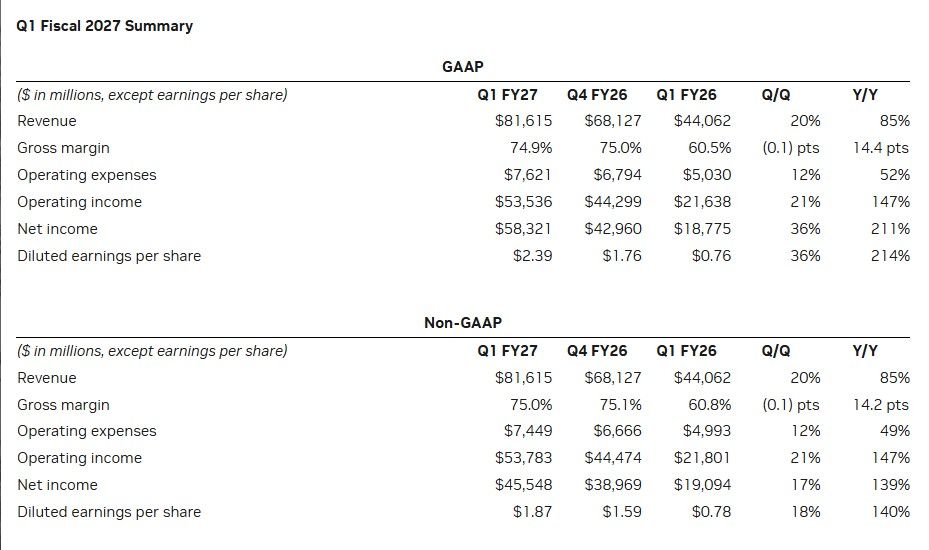
Nvidia posted record quarterly revenue of US$81.6 billion and profit of US$58.3 billion as demand for artificial intelligence infrastructure accelerated globally, with CEO Jensen Huang declaring that “agentic AI has arrived”.
- Nvidia’s quarterly profit surged 211 per cent year-on-year to US$58.3 billion.
- Data centre revenue climbed 92 per cent to US$75.2 billion amid booming AI demand.
- Nvidia forecast second-quarter revenue of US$91 billion, above Wall Street expectations.

UNITED STATES: Nvidia reported record quarterly revenue and profit on 20 May 2026, underscoring the continuing global surge in spending on artificial intelligence infrastructure as technology companies race to expand data centre capacity and deploy increasingly sophisticated AI systems.
The Silicon Valley chipmaker said first-quarter fiscal 2027 revenue reached US$81.6 billion, up 85 per cent from a year earlier and 20 per cent higher than the previous quarter. Net income climbed 211 per cent year-on-year to US$58.3 billion.
The results exceeded Wall Street expectations and reinforced Nvidia’s status as the dominant supplier of processors powering the global AI boom.
According to the company’s earnings announcement, diluted earnings per share reached US$2.39 on a generally accepted accounting principles (GAAP) basis, while adjusted earnings per share stood at US$1.87.
Just three years ago, Nvidia’s quarterly profit was approximately US$2 billion, highlighting the extraordinary pace of growth fuelled by demand for generative and agentic AI systems.
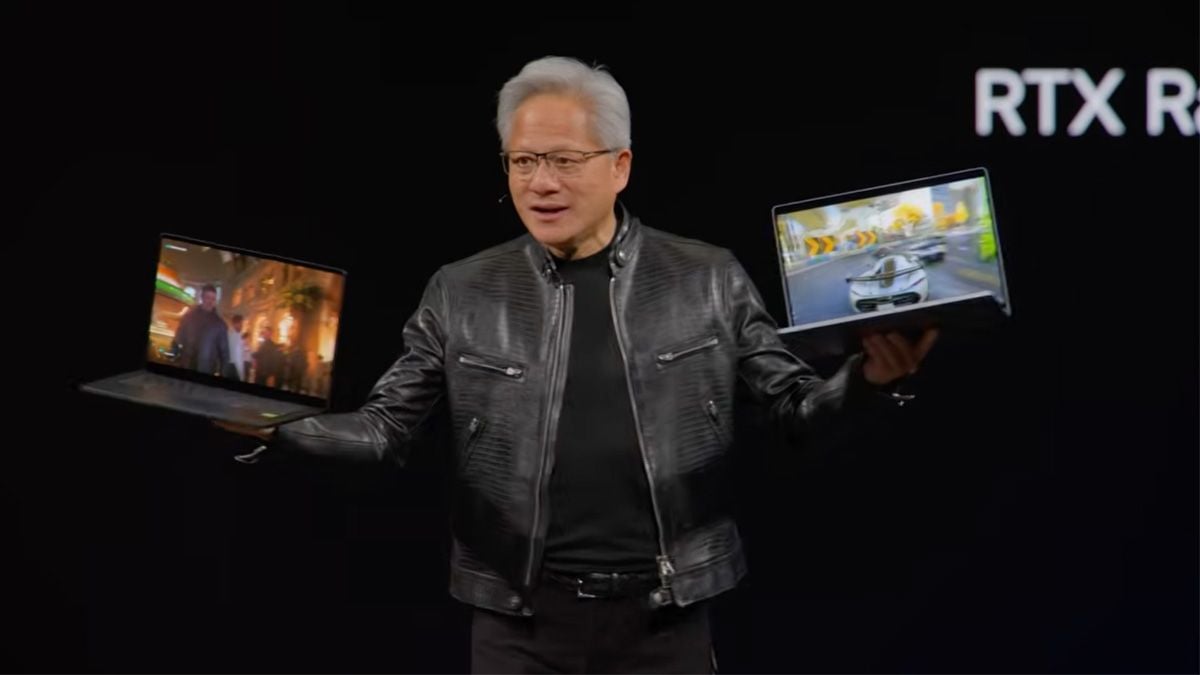
Chief executive Jensen Huang described the latest quarter as a turning point for the industry.
“This was an extraordinary quarter. Demand has gone parabolic,” Huang said during Nvidia’s earnings call with analysts.
“The reason is simple: Agentic AI has arrived.”
Huang also said the construction of AI-focused data centres, which he referred to as “AI factories”, represented “the largest infrastructure expansion in human history”.
“The world is rebuilding computing for agentic AI and robotic physical AI,” he said. “Nvidia sits at the centre of these transitions.”
Data centre business dominates growth
Nvidia’s data centre division continued to account for the overwhelming majority of company revenue.
The company reported data centre revenue of US$75.2 billion for the quarter, up 92 per cent from a year earlier and ahead of analyst estimates compiled by LSEG.
That figure represented nearly all of Nvidia’s quarterly sales, reflecting intense global spending by hyperscalers, cloud providers and enterprise customers building AI infrastructure.
According to Nvidia, data centre compute revenue reached a record US$60.4 billion, while networking revenue climbed to US$14.8 billion.
Technology giants including Google, Amazon, Meta and Microsoft have collectively committed at least US$1 trillion to AI data centre construction projects, many of which rely heavily on Nvidia chips and software.
Huang said Nvidia’s position within the AI ecosystem continued expanding across virtually every major AI platform.
“Nvidia is the only platform that runs every frontier AI model,” he said, referencing companies including OpenAI, Anthropic, Meta and Google’s Gemini models.
He added that Nvidia was supporting “their core data processing and machine learning workloads” while also powering public cloud AI services.
Strong guidance reassures markets
Nvidia also issued stronger-than-expected guidance for the second quarter, projecting revenue of approximately US$91 billion, plus or minus 2 per cent.
The forecast exceeded Wall Street expectations of roughly US$86.84 billion, according to LSEG data.
The company said its outlook did not assume additional data centre compute revenue from China.
Despite the strong results, Nvidia shares slipped about 1 per cent in after-hours trading, surrendering gains made earlier in the day.
Market analysts nevertheless viewed the earnings as confirmation that AI-related capital spending remained robust despite concerns over valuations and the sustainability of the technology sector’s spending spree.
Wedbush Securities analysts said Nvidia’s results showed demand for AI infrastructure remained “far ahead of supply”, while several market observers described the quarter as another indication that large technology firms were not slowing investment plans.
Seaport analyst Jay Goldberg said Nvidia’s disclosure of US$30 billion in cloud computing agreements demonstrated the scale of infrastructure commitments underpinning AI deployment.
In a research note referenced by investors, Goldberg said such agreements likely functioned as “backstops” allowing cloud providers operating Nvidia systems to absorb excess computing capacity.
Expansion beyond traditional AI markets
Nvidia used the earnings release to highlight broader ambitions beyond conventional cloud computing and generative AI.
The company announced the rollout of the NVIDIA Vera Rubin platform, including the Vera central processing unit (CPU), which Huang described as a significant future growth opportunity.
Huang said the CPU business alone represented a potential US$200 billion market opportunity.
The company also expanded initiatives in robotics, autonomous driving and industrial AI systems.
Nvidia announced collaborations involving Hyundai Motor Company, Kia, Uber and multiple telecommunications firms focused on AI-native networks and autonomous vehicle technologies.
Huang said “physical AI” would become the next major phase of AI adoption.
He argued Nvidia’s CUDA software ecosystem gave the company a strategic advantage in robotics, autonomous systems and edge computing applications.
The company additionally announced new products and software platforms including Dynamo 1.0, NemoClaw, OpenShell and Agent Toolkit, all designed to support autonomous AI agents and enterprise AI deployment.
Shareholder returns increase
Nvidia also announced a substantial expansion of shareholder returns.
The company disclosed an additional US$80 billion share repurchase authorisation approved by its board on 18 May 2026.
It also increased its quarterly dividend from US$0.01 per share to US$0.25 per share.
During the quarter, Nvidia returned approximately US$20 billion to shareholders through buybacks and dividends.
As of the end of the quarter, Nvidia held US$13.2 billion in cash and cash equivalents, while total assets stood at US$259.5 billion.
AI spending outlook continues rising
Nvidia said global spending on AI infrastructure could reach between US$3 trillion and US$4 trillion annually by 2030, compared with roughly US$1 trillion today.
The company’s projections reinforced investor belief that artificial intelligence remains the central growth driver for the technology industry.
Analysts broadly described Nvidia’s latest quarter as a key barometer for AI market health because Nvidia hardware powers most advanced AI systems worldwide.
The company’s Blackwell GPUs and associated networking technologies remain critical components for large-scale AI training and inference systems.
Nvidia also said it was restructuring reporting categories into two primary business platforms: Data Center and Edge Computing.
The new framework reflects the company’s growing emphasis on AI factories, sovereign AI clouds, industrial AI infrastructure and edge-based AI systems.
“The buildout of AI factories is accelerating at extraordinary speed,” Huang said in the company’s official earnings release.
“We built it ahead of this moment so that when agentic AI arrived, Nvidia would be ready.”
“It has arrived.”