“No love, no heart”: Singaporeans criticise catered meal standards for migrant workers after taste-test
Singaporeans invited to taste-test catered meals meant for migrant workers described the food as “terrible”, “not appetising” and “not balanced” in a viral Migrant Workers Singapore video posted on 23 May 2026.

- Singaporeans described catered migrant worker meals as cold, oily, salty and nutritionally inadequate.
- Migrant Workers Singapore proposed reforms including communal kitchens and stricter catering oversight.
- The viral video reignited debate over migrant worker welfare, dignity and food safety standards.

Singaporeans invited to taste-test catered meals intended for migrant workers criticised the food as “terrible”, “not appetising” and “not balanced” in a video published by advocacy group Migrant Workers Singapore (MWS) on 23 May 2026.
The video featured members of the public sampling meals supplied by catering companies for migrant workers’ lunches.
Many reviewers expressed shock at the quality, describing the food as overly oily, cold, excessively salty and lacking proper nutrition.
MWS said the meals shown in the video were prepared by catering companies supplying food to migrant workers living in dormitories.
Food quality complaints raised
Several reviewers immediately questioned the appearance and texture of the meals after opening the containers.
One reviewer asked, “Huh, is this dhal?” before commenting that the dish appeared “very watery”.
Another reviewer pointed to the large amount of rice, saying, “It feels a bit hard. I don’t think it’s natural for rice.”
An explainer in the video stated that the food was prepared at midnight before being delivered to dormitories in the morning.
After tasting the meals, reviewers criticised the condition of the food, with one saying the rice had “taken the shape of the packaging already”.
“It’s cold,” the reviewer added. “Can tell it has been left overnight for a very long time.”
Criticism over nutrition and taste
Reviewers also questioned the nutritional balance of the meals and the proportion of rice compared to meat and vegetables.
“I think there’s too much rice as compared to meat or something.”
Another reviewer criticised the dhal dish, saying, “From what I understand, dhal is meant to be curry-ish, right? I think this is just oil.”
The same reviewer added, “I won’t be surprised if they have stomach issues after this.”
Another participant described the meals as lacking care and effort.
“No creativity, no love, no heart,” the reviewer said. “It’s standardised corporate food, not nice.”
One reviewer said the meals were technically edible but still unacceptable.
“The taste is not bad, but a lot of bones,” the reviewer said. “Would I pay for it? I don’t think I’ll take it in the first place.”
Another reviewer reacted more strongly, saying: “This is terrible. It’s not appetising. It’s not balanced.”
“I can boil vegetables and that tastes better than this,” the reviewer added.
Concerns over salt and food safety
Some reviewers raised concerns over excessive salt and possible health effects.
“Right now my whole mouth is just salt,” one reviewer said.
“I can’t taste anything else anymore. Quite sure if you finish this whole thing, I think you’ll be in trouble.”
MWS said most migrant workers pay between S$130 and S$150 monthly for catered meals.
One reviewer expressed disbelief after learning the cost.
“Oh wow,” the reviewer said. “I feel like my taste buds are ruined after this.”
Calls for better treatment
The video also highlighted broader concerns about nutrition standards for migrant workers performing physically demanding labour.
“All Singaporeans know what a nutritious meal looks like, right?” one reviewer said.
“They work with their hands and their bodies the whole day. The minimum you can do is feed them better.”
MWS concluded the video by asking: “Would you eat this food every single day? Then why should migrant workers have to?”
Advocacy group proposes reforms
MWS proposed eight demands aimed at improving food quality and living conditions for migrant workers.
The group called for all dormitories to provide communal kitchens and pantry facilities so workers could prepare their own meals.
It also urged authorities to install safe plug points for induction cookers within dormitories.
Other proposals included allowing workers to choose catering providers directly, introducing stronger transparency requirements across the catering supply chain and establishing anonymous feedback channels.
MWS also called for stricter food labelling rules, including preparation times and expiry windows on packaged meals.
Additional demands included reliable access to clean drinking water, weather-proof dining areas and stricter enforcement by the Singapore Food Agency (SFA) against caterers providing unsafe or nutritionally inadequate meals.
Online reactions and wider debate
The video gained more than 186,000 Instagram views and attracted around 176 comments shortly after publication.
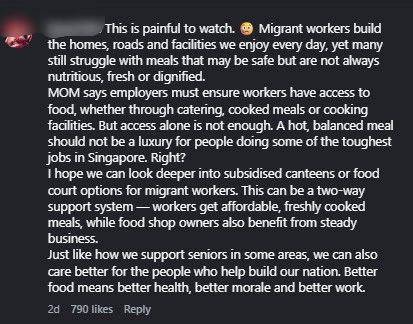
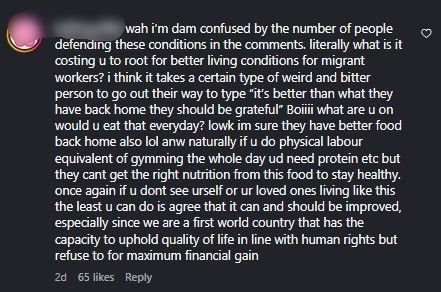
Many comments described reports of spoiled, unhygienic and nutritionally poor meals as unacceptable for workers engaged in physically demanding labour.
Others argued the issue extended beyond cultural food preferences and reflected broader concerns over food safety, dignity and oversight.
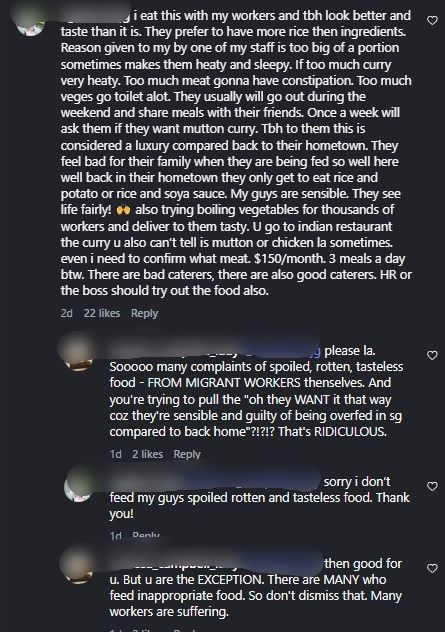
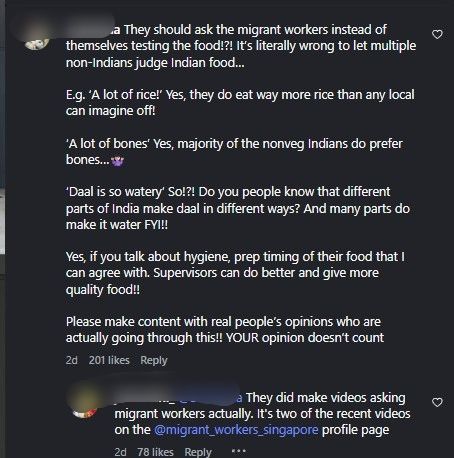
Some comments defended aspects of the meals, saying rice-heavy diets, watery dhal and bone-in meat dishes are common in Indian cuisine.
Others questioned why Singaporeans were chosen to taste-test the meals instead of migrant workers themselves, although some users noted workers had already shared their experiences in previous MWS videos.
The discussion also expanded into wider concerns surrounding low wages, dormitory conditions, inadequate nutrition and the responsibilities of catering companies, employers and regulators.
Workers say poor meals affect their health and work
In March 2026, MWS published separate videos featuring migrant workers criticising catered meals for excessive oil, poor hygiene and inadequate nutrition.
Several workers said the meals caused gastric pain and digestive discomfort.
Others alleged they had discovered cockroaches, stale bread and undercooked food in their meals.
Workers also complained about hard rice, poorly washed vegetables and fish or meat dishes they believed were prepared using old ingredients.
Some said complaints to catering companies resulted only in temporary improvements.
Many workers added that poor food quality affected their physical strength and ability to carry out demanding construction work, while long working hours made independent cooking difficult.
Issue previously raised in Parliament
Concerns about catered food for migrant workers have also been raised in Singapore’s Parliament.
During a parliamentary sitting in October 2024, then-Nee Soon GRC MP Louis Ng Kok Kwang questioned the inspection regime for caterers supplying meals to migrant workers and raised concerns about food safety timelines.
Then-Senior Minister of State Koh Poh Koon said the Singapore Food Agency had conducted about 3,600 inspections of licensed caterers between January 2023 and September 2024 to ensure compliance with food safety standards.
Ng highlighted that workers often began work early and might only consume meals several hours after preparation, potentially exceeding the recommended four-hour window.
Koh said the issue largely involved coordination between employers and caterers, adding that authorities could intervene if specific cases were reported.
Govt earlier affirms stepped-up inspections, SAFE grading & safeguards for central kitchens
Separately, on 3 February 2026, Jurong East-Bukit Batok MP David Hoe questioned the Ministry for Sustainability and the Environment about food safety oversight for central kitchens supplying school meals.
Responding on behalf of the ministry, Senior Parliamentary Secretary Goh Hanyan said central kitchens licensed by the SFA already face “more frequent inspections” because of their large-scale food preparation operations.
She added that SFA had “stepped up checks” on kitchens supplying schools under the Ministry of Education’s Central Kitchen Meal Model programme since August 2025, while operators with repeated food safety lapses would face even stricter surveillance and possible downgrading under the SAFE framework.
Hoe also asked about safeguards covering ingredient suppliers, transportation, operator compliance and checks before food distribution.
In response, Goh said all importers and manufacturers must comply with food safety requirements, while central kitchens are required to maintain proper segregation between raw and ready-to-eat food, identify “critical control points” in food preparation and appoint food hygiene officers.
She noted that foodborne illness outbreaks can arise from multiple factors, including “onsite handling”, transportation and storage processes, requiring coordination between SFA, schools and transport providers to strengthen food safety systems across the supply chain.