Singapore wage growth slows in 2025 as firms turn cautious despite stronger profitability
Singapore workers saw slower nominal wage growth in 2025 as employers adopted a more cautious approach despite stronger profitability. Real wages, however, rose faster as inflation eased, boosting workers’ purchasing power amid continued economic expansion.

- Singapore’s nominal wage growth moderated to 4.9 per cent in 2025 as employers exercised greater caution.
- Real wages increased 4 per cent due to lower inflation, improving purchasing power for workers.
- Wage growth remained positive across all sectors, led by administrative and support services.

Wage growth for Singapore workers slowed in 2025 as employers adopted a more cautious approach to salary adjustments despite stronger profitability and continued economic expansion, according to the Ministry of Manpower’s latest Report on Wage Practices released on 28 May 2026.
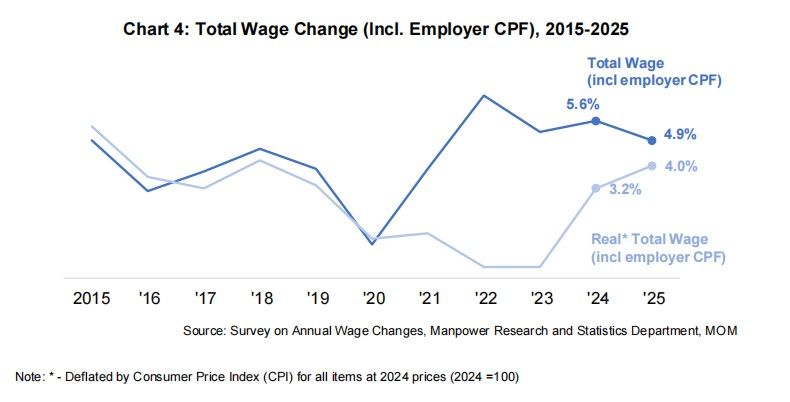
The report found that nominal total wages for full-time resident employees rose 4.9 per cent in 2025, down from 5.6 per cent in 2024.
Total wages include basic pay, annual variable components and employer contributions to the Central Provident Fund.
The ministry attributed the moderation partly to easing inflation, which reduced pressure on employers to raise wages aggressively.
“Nominal total wages continued to grow (4.9%) but at a moderated pace from 2024 (5.6%), in line with easing inflation,” the report stated.
Singapore’s core inflation averaged 0.7 per cent in 2025, significantly lower than the 2.8 per cent recorded in 2024.
After adjusting for inflation, real wages increased by 4 per cent in 2025, up from 3.2 per cent the previous year, reflecting stronger purchasing power for workers.
MOM said the narrower gap between nominal and real wage growth suggested lower inflation had helped support workers’ living standards.
The report added that over the longer term, “real wage growth continues to be supported by real productivity growth”.
More profitable firms but greater caution on pay rises
Despite slower wage growth, business conditions improved in 2025.
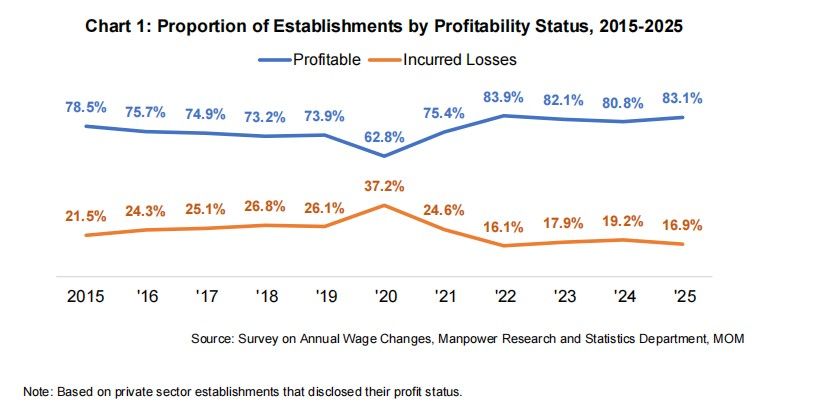
According to MOM’s survey, 83.1 per cent of establishments reported being profitable in 2025, compared with 80.8 per cent in 2024.
Meanwhile, the proportion of firms reporting losses declined to 16.9 per cent from 19.2 per cent a year earlier.
The ministry said 64.1 per cent of firms reported stable or improved profitability, slightly higher than 62.7 per cent in 2024, indicating a growing share of financially stable firms.
However, employers appeared increasingly cautious when adjusting salaries.
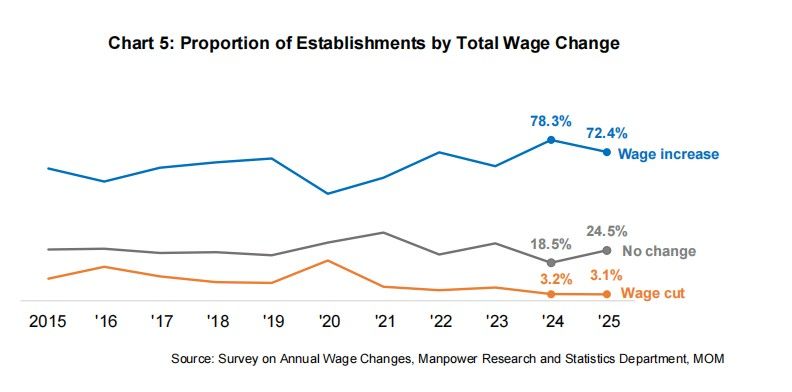
The proportion of establishments granting wage increases fell to 72.4 per cent in 2025 from 78.3 per cent the year before.
At the same time, firms choosing to keep wages unchanged rose to 24.5 per cent from 18.5 per cent previously.
Only 3.1 per cent of establishments implemented wage cuts, broadly unchanged from 3.2 per cent in 2024.
Among firms that raised wages, average increments moderated from 6.6 per cent in 2024 to 5.8 per cent in 2025.
Where firms reduced salaries, the average wage reduction was 3.7 per cent.
MOM said firms that cut wages generally experienced weaker business performance compared with the previous year.
“Employee retention remained the most commonly cited reason” for wage increases, the report noted.
Speaking at a media briefing on Thursday, Ang Boon Heng, director of MOM’s manpower research and statistics department, said some profitable firms chose not to increase wages because they believed salaries were already aligned with market benchmarks.
The National Wages Council had earlier recommended that employers provide “fair and sustainable wage increases” between December 2024 and November 2025 while taking into account long-term productivity growth.
Wage growth narrows across employee groups
Wage growth remained positive across all employee categories in 2025, though increases were more moderate than the previous year.
Rank-and-file employees recorded wage growth of 4.8 per cent, while junior management employees saw wages rise 5.1 per cent. Senior management staff experienced wage growth of 4.9 per cent.
MOM highlighted that differences in wage growth across employee groups narrowed during the year, suggesting gains had become more broad-based.
The report noted that “total wage changes have now become similar across all employee groups”.
Across industries, all sectors recorded positive wage growth, although most experienced slower growth compared with 2024.
Administrative and support services posted the highest wage growth at 7.5 per cent, though this was lower than the 8.7 per cent increase recorded a year earlier.
MOM attributed the strong gains partly to support measures for lower-wage workers, including the Progressive Wage Model and Local Qualifying Salary requirements.
Financial services and insurance services also recorded relatively strong wage growth of 5.9 per cent and 6.6 per cent respectively.
The ministry said these sectors continued to benefit from strong demand for professionals, managers and executives.
“Financial and Insurance Services saw strong wage growth in part reflecting resilient demand for skilled workers,” the report stated.
The accommodation sector saw one of the sharpest moderations in wage growth, with salaries increasing 3.9 per cent in 2025.
MOM said this reflected stabilising labour demand following a hiring surge during Singapore’s post-pandemic tourism recovery between 2022 and 2023.
Flexible wage system adoption continues to decline
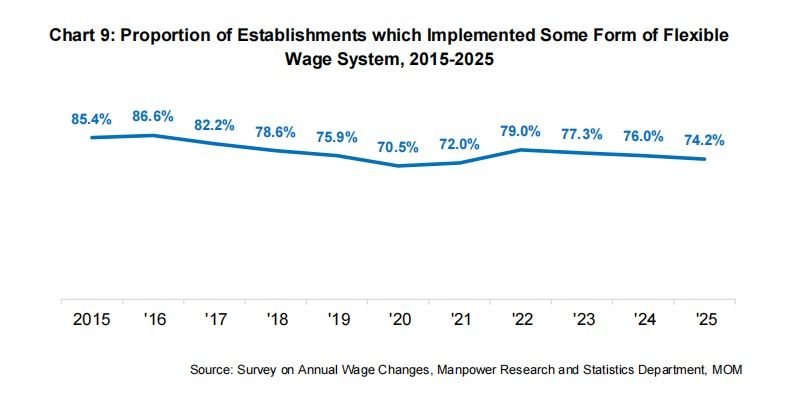
The report also highlighted a continued decline in adoption of Singapore’s Flexible Wage System (FWS), which allows firms to adjust labour costs during economic downturns without resorting to retrenchments.
The proportion of establishments implementing at least one FWS component fell to 74.2 per cent in 2025.
Variable wages accounted for 13 per cent of total private-sector wages, largely unchanged from 13.2 per cent in 2024.
Adoption of the annual variable component remained significantly more common than the monthly variable component.
The ministry said firms that adopted flexible wage components generally recorded stronger wage increases over the past five years than firms that did not.
Outlook for 2026 remains positive but cautious
Looking ahead, MOM said wage growth is expected to remain positive in 2026 as Singapore’s labour market remains tight and productivity continues to improve.
However, employers are expected to become more cautious amid geopolitical tensions, inflation risks and global economic uncertainty.
Ang said external-oriented sectors could face greater pressure due to ongoing tariff tensions and weaker global trade conditions.
The report stated that “wage growth is expected to remain positive in 2026, although firms are likely to be measured in their wage increases amid geopolitical and inflation uncertainties”.
MOM also noted that Singapore’s long-standing approach of aligning wage increases with productivity gains had helped support sustainable wage growth while limiting inflationary pressure and preserving employment stability.
According to the report, “Singapore’s emphasis on aligning wage growth with productivity gains has helped sustainable wage increases, while limiting wage-price pressures and preserving employment.”
The ministry added that sustaining long-term real wage growth would continue to depend on productivity improvements, workforce upgrading and wage-setting practices that remain responsive to changing economic conditions.