Joel Tan's Harvard speech sparks online debate over Singapore's school streaming system
A speech by Harvard PhD graduate Joel Tan recounting his struggles within Singapore's school system has drawn thousands of reactions online, with many sharing similar experiences and others disputing his framing of the curriculum.
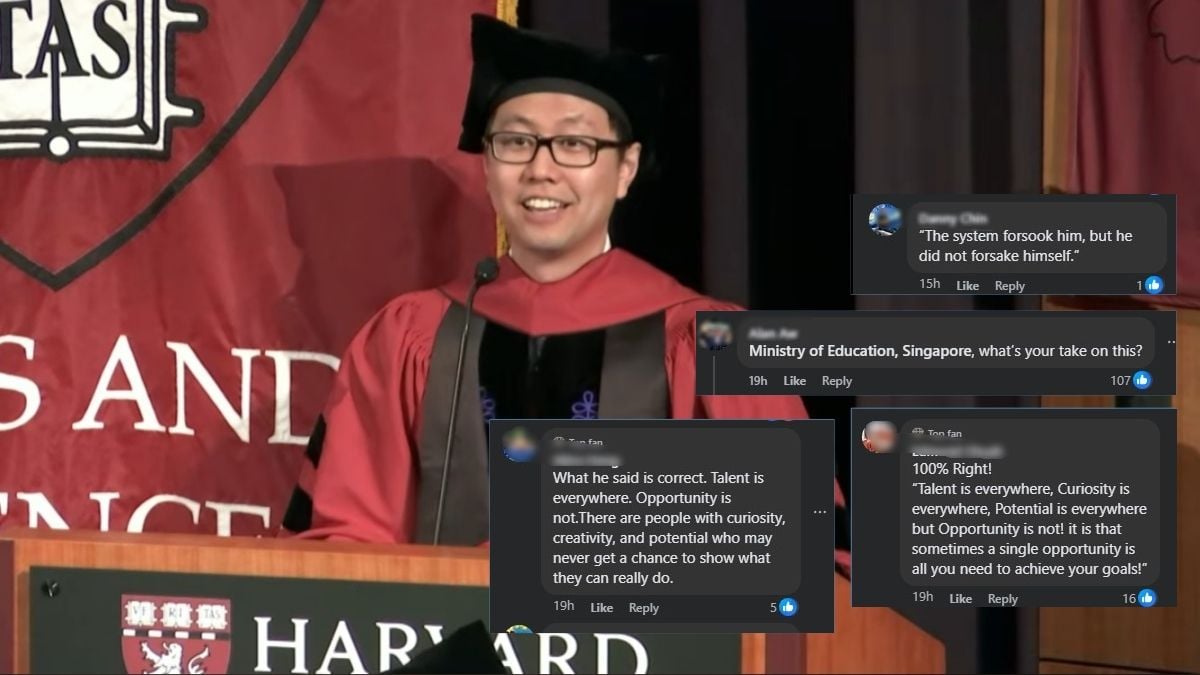
- Tan's Harvard speech drew thousands of comments on Reddit and Mothership's Facebook page.
- Many users described similar experiences of being steered away from preferred subjects.
- Others disputed his "easier sciences" framing and called for an MOE response.

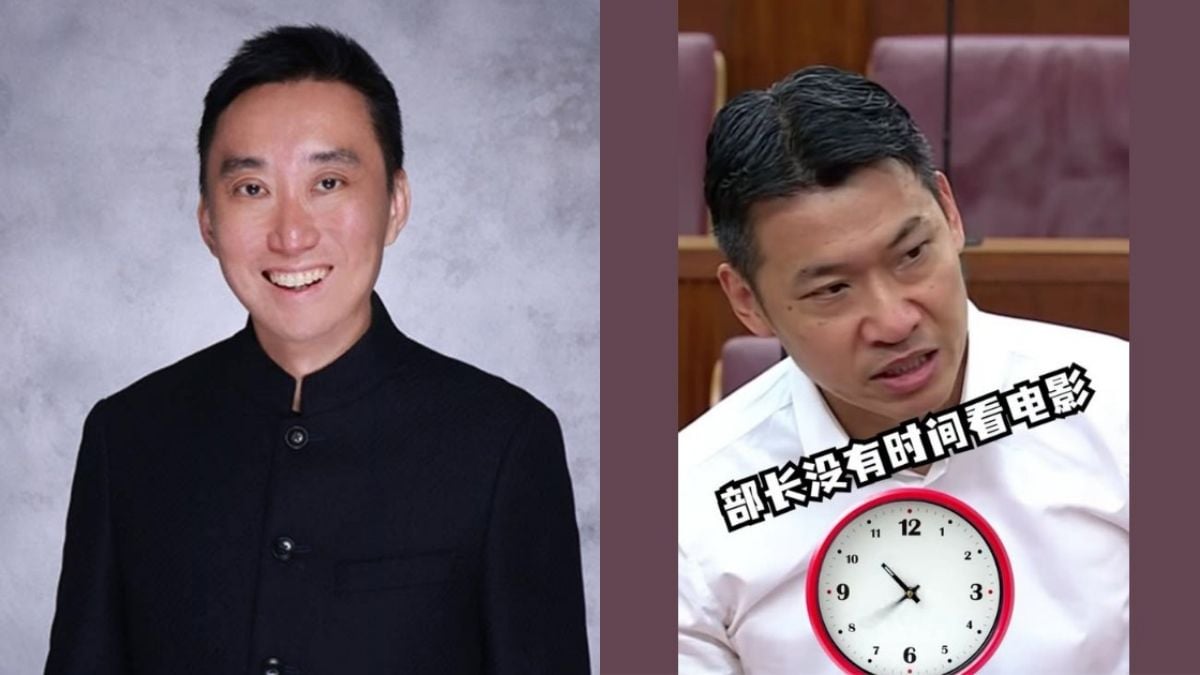
Dr Joel Tan, who grew up in Singapore, graduated with a PhD in Biological and Biomedical Sciences from Harvard, where his research led to the discovery of a new anti-phage defence system in bacteria, which he named "Hai Long". He delivered the student address at Harvard's HMS-Affiliated PhD Programs Hooding Ceremony on 28 May 2026.
In his speech, Tan said that as a teenager in Singapore he had wanted to study Biology, but was told it was "not a realistic path" for him after his middle school grades were deemed too low for biology classes. He said he was placed into Physics and Chemistry instead, and left high school with grades of C and D.
Tan said he failed twice to gain admission to a university in Singapore before being accepted by the University of Toronto, which he said "took a chance" on him and gave him his first biology class, as well as access to mentors and laboratories.
He used the speech to argue that "talent is everywhere, opportunity is not", and urged his fellow graduates to help open similar doors for other students, particularly international students and those from under-represented backgrounds.
A clip of the address has since drawn extensive reaction on social media, including on the discussion forum r/singapore and on a post by Mothership.
A line that resonated
One line from the speech, "talent is everywhere, opportunity is not", was repeated and praised across both platforms, with several commenters describing it as the most accurate summary of their own experience of the education system.
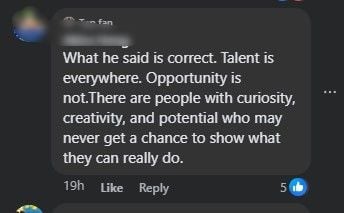
One Mothership commenter wrote simply: "Well said. 'Talent is everywhere. Opportunity is not.'"
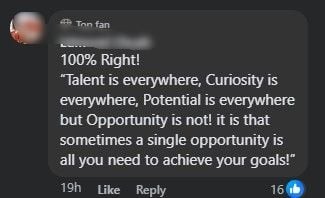
Another quoted a longer passage from the speech approvingly: "There are people with curiosity, creativity, and potential who may never get a chance to show what they can really do."
A further commenter offered their own version of the sentiment, writing: "The system forsook him, but he did not forsake himself."

Others paired the line with Tan's closing remark that "sometimes a single opportunity is all you need to achieve your goals", using both to frame their own accounts of leaving Singapore to study or work overseas.
Echoes of a familiar experience
Several commenters on Reddit and Mothership said they had been through similar processes, describing being moved out of preferred subjects based on streaming decisions made after Secondary 2 or Secondary 3 examinations.
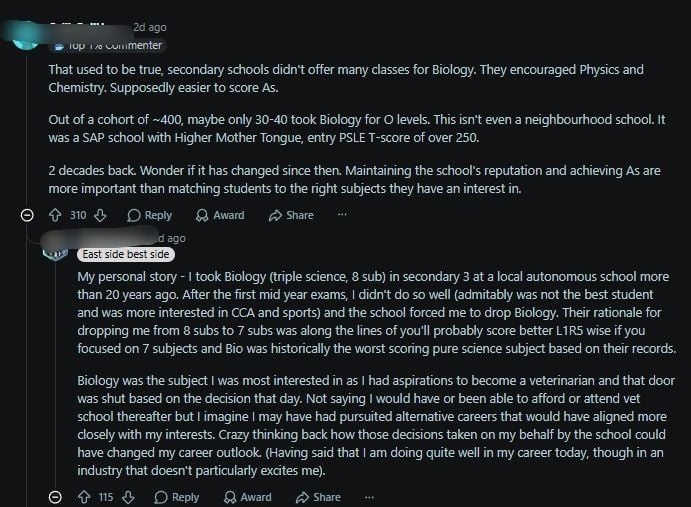
One Reddit user described a Special Assistance Plan (SAP) school where, out of a cohort of around 400 students, only 30 to 40 took Biology for O-levels. They wrote: "Maintaining the school's reputation and achieving As are more important than matching students to the right subjects they have an interest in."
Another Reddit user recalled being moved from eight subjects to seven, including being dropped from Biology, after a school decided this would improve their overall grade average.
The comment wrote: "Biology was the subject I was most interested in as I had aspirations to become a veterinarian and that door was shut based on the decision that day."
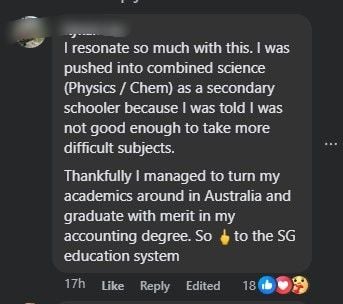
On Mothership, one commenter described being "pushed into combined science (Physics / Chem) as a secondary schooler because I was told I was not good enough to take more difficult subjects", adding that they went on to graduate with merit in an accounting degree overseas.
Another described a separate case: "I know of another man who was told that he was only good at arts and not good in science. He too, left for Toronto. He is now a famous dentist in Canada. He never went back to Singapore."
A further commenter recounted a friend who was rejected from the International Baccalaureate (IB) programme after O-levels and told they would need nine A1 grades to be considered, before going overseas and becoming a doctor in the United Kingdom.
Disputes over the "easier sciences" framing
A significant number of commenters took issue with Tan's characterisation of Physics and Chemistry as "easier sciences" than Biology, saying this did not match their own experience of the curriculum.
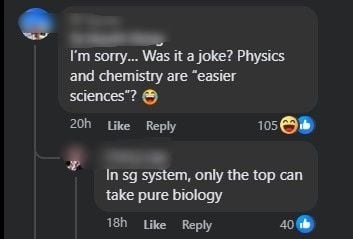
One commenter responded with evident disbelief: "I'm sorry... Was it a joke? Physics and chemistry are 'easier sciences'?"
Another wrote: "Congratulations for your PhD. You can't be serious, Physics and Chemistry are 'easier sciences'."
A more measured response suggested the comment needed context: if Tan had not been placed into the Pure Biology stream and instead took Combined Physics and Chemistry, "then it makes sense why he said Physics/Chemistry are easier options", the commenter wrote, while noting that "more context is needed."
The cost of opportunity
A recurring counterpoint was that the speech did not address the financial cost of studying overseas, which several commenters said placed such opportunities out of reach for many Singaporean families.
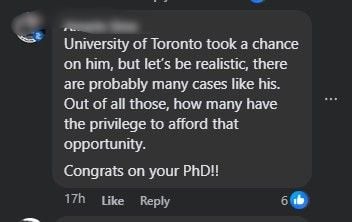
One commenter wrote: "University of Toronto took a chance on him, but let's be realistic, there are probably many cases like his. Out of all those, how many have the privilege to afford that opportunity."
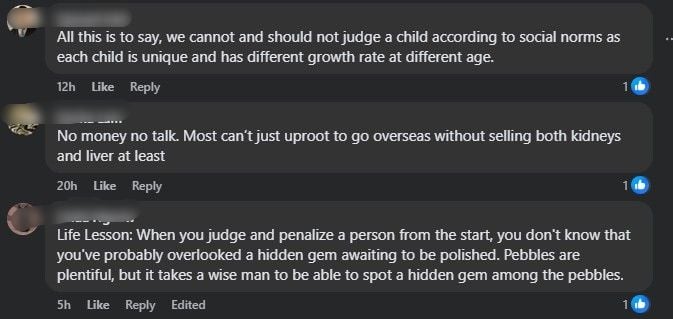
Another was more blunt: "No money no talk. Most can't just uproot to go overseas without selling both kidneys and liver at least."
A further commenter referred to overseas tuition costs directly, writing that the speech omitted "one thing": that "you need to have rich parents willing to fork out 300k 500k for u to go US University... if you don't have, just suck it up and apply to poly or ITE with your poor grades."

One commenter described a personal account of working in healthcare after qualifying overseas, writing that in a Singapore job interview, "the first question" they were asked "was, 'who is your father?'", adding that "this question would be illegal in the US." They said they returned to the United States and worked there for over 30 years.
Talent retention and university admissions
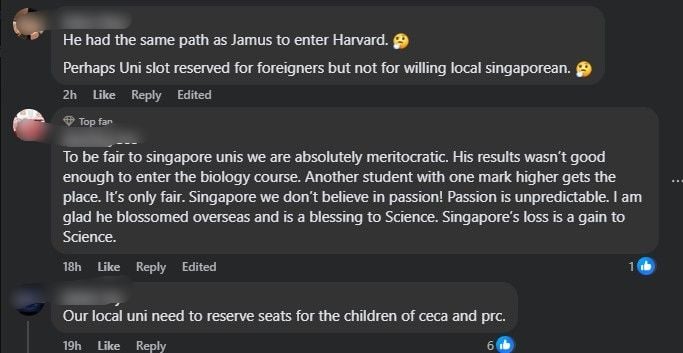
A frequent theme across both platforms was a claim that places at local universities are disproportionately allocated to foreign students on scholarships, with several commenters citing this as the reason local students with strong but imperfect results are turned away.
One commenter wrote: "Local Universities slots are reserved for foreign students on scholarships. Period."

Another framed it as a broader pattern: "We give a lot out to foreigners, both deserving and undeserving."
The overall proportion of international students at NUS and NTU has risen in recent years. According to the Times Higher Education (THE) World University Rankings 2026, international students made up 31 per cent of the student population at both universities, up from 26 per cent at NUS and 29 per cent at NTU the previous year.
However, as TOC reported in October 2025, this overall figure has historically been driven largely by postgraduate rather than undergraduate intake, which is the level most commenters appeared to be referring to.
In a July 2017 parliamentary reply to then-Workers' Party MP Leon Perera, then-Minister for Education (Higher Education and Skills) Ong Ye Kung said international students had made up no more than 15 per cent of undergraduate intake at publicly funded universities over the preceding five years, with the figure at around 10 per cent in 2016, and permanent residents accounting for a further 5 per cent.
For postgraduate programmes, Ong said admissions were not centrally planned by nationality, with international students comprising around 63 per cent of intake on average, against 32 per cent for Singaporeans and 5 per cent for permanent residents.
MOE has also previously rejected the existence of any minimum quota for international students at the autonomous universities. In a now-deleted article on its Factually platform, the ministry stated that there was "no such minimum quota" and that Singapore was "not actively courting foreign students" to meet one.
TOC has not seen a current breakdown of the 31 per cent figure by academic level, so the extent to which it reflects undergraduate versus postgraduate intake cannot be confirmed. The commenters' specific reference to scholarships is also not addressed by this data.
This commenter wrote: "Those who came back mostly do not have money to break bonds... so we are left with the Tier 2, 3, 4 people/talents in various industries/ministries/civil service."
Defences of the system
Not all reaction was critical of the education system. Several commenters argued that university admissions in Singapore are merit-based and that places are necessarily limited, meaning that students who fall short of the cutoff, including Tan, are not admitted regardless of later potential.
One commenter put it directly: "His results wasn't good enough to enter the biology course. Another student with one mark higher gets the place. It's only fair."
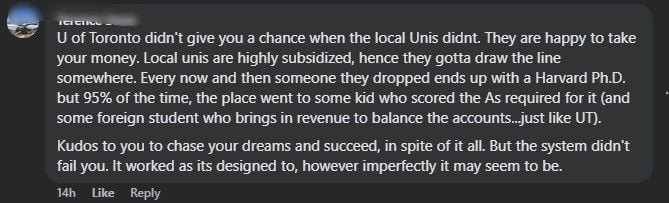
Another argued that the system had not failed Tan at all: "Local unis are highly subsidized, hence they gotta draw the line somewhere... But the system didn't fail you. It worked as its designed, however imperfectly it may seem to be."
A further commenter agreed with the "opportunity" framing but turned it back on Tan's own effort: "Talent is everywhere. Be hungry enough to find your opportunities, which is what you did... You did not sit under a tree to wait for opportunities."
One commenter offered a more sceptical reading of Tan's motives, suggesting he remained "bitter" about his schooling and had used the speech to respond to it, though this view did not attract significant support in the wider discussion.
A number of commenters tagged the Ministry of Education's (MOE) Facebook page directly, asking the ministry to respond to Tan's account of his secondary school experience. One wrote simply: "Ministry of Education, Singapore, what's your take on this?"