Singapore’s jobseekers describe a harsher labour market than headline figures suggest
A widely shared online thread captured what Singapore's first-quarter labour figures do not: serial rejection, the overqualified trap, resentment over foreign hires, and advice to manage the truth on a CV. MOM called the market resilient; jobseekers describe something harder.


A widely shared online discussion this month laid out a version of Singapore's job market that the official statistics do not quite reach: one of serial rejection, dead-end applications, and a quiet loss of faith that effort is still rewarded.
It surfaced days after the Ministry of Manpower (MOM) had described the same labour market, on 15 June, in the language of resilience.
The two accounts are not flatly contradictory. But the contrast between the official framing and the sentiments expressed in the discussion is itself notable.
Unemployment struggles have left me feeling hopeless
by u/FinWhizzard in singapore
What the jobseekers described
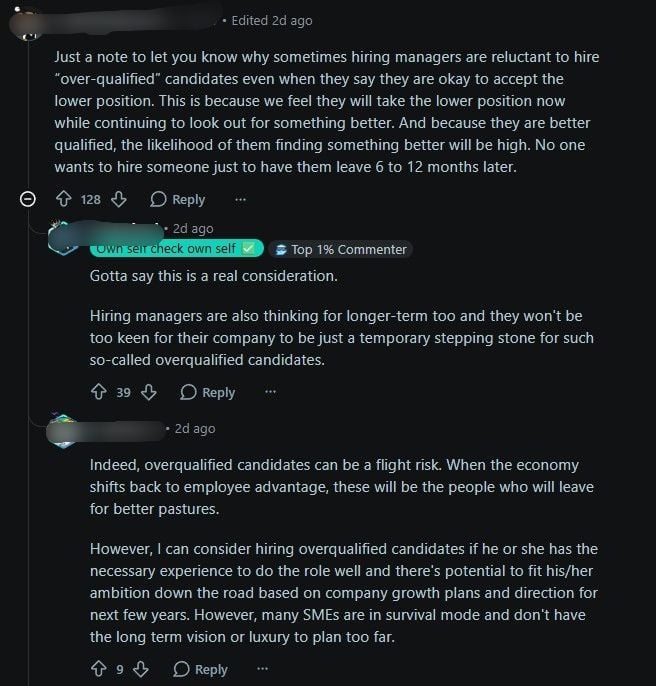
The most consistent grievance was the overqualified trap.
Experienced applicants said they were turned away from junior roles as a presumed flight risk, while finding almost nothing at their own level.
Several said employers assumed they would leave the moment something better appeared, and rejected them on that basis — even when they offered to accept junior pay and said so directly.
Foreign hiring drew sharp resentment.
Commenters alleged that mid- and senior-level roles disproportionately went to foreigners, and that some local vacancies were advertised only to satisfy fair-consideration rules before a foreign candidate was hired.
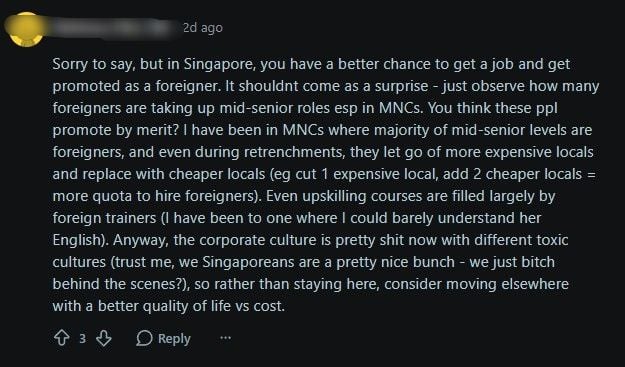
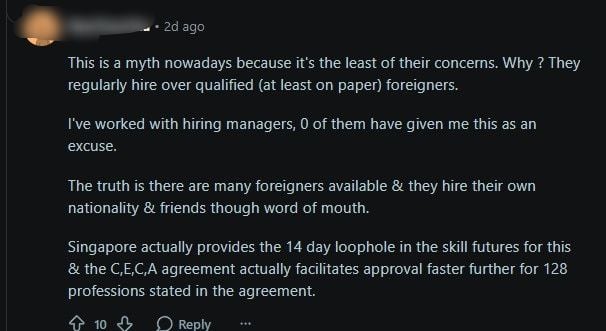
Others framed the dynamic as structural, tied to hiring managers favouring their own nationals through word-of-mouth networks.
Age recurred throughout.

So did the problem of employment gaps — and, strikingly, much of the most-upvoted advice was to manage the truth.
Omit short stints. Disguise a gap as caregiving or travel. Leave qualifications off a CV to avoid looking overqualified.
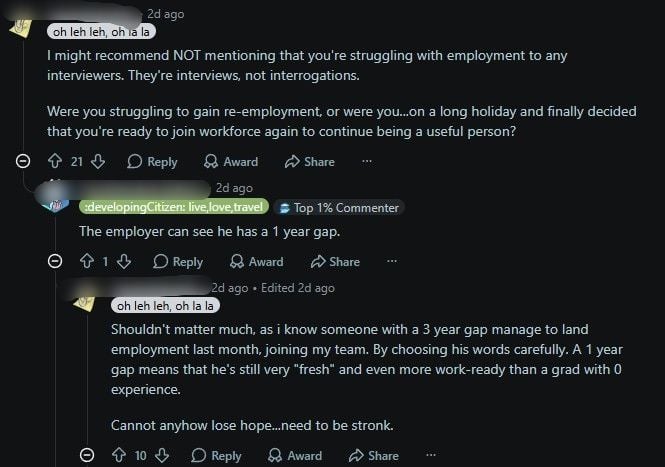

"In this economy make something up," one widely endorsed comment ran.

Whatever its merit, the popularity of that advice suggests many participants perceived the market as one that no longer rewards honesty.
The political edge was explicit in places.
Some attributed the situation to a failure of job creation and economic policy, arguing locals were being displaced and that the remedy lay at the ballot box.
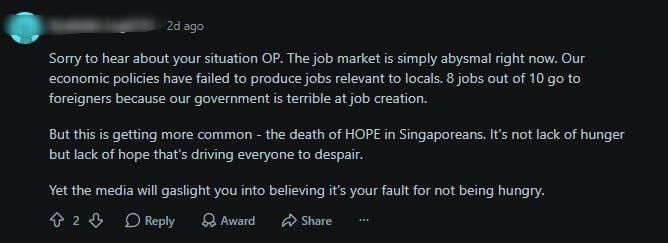
Others rejected that as deflection. The disagreement is itself part of the picture.
The thread is not representative data. It reflects self-selected, unverifiable voices. But as a body of sentiment, it captures experiences that aggregate indicators are not designed to measure.
What the official figures show
MOM's first-quarter data does not contradict the discontent so much as sit at a different altitude.
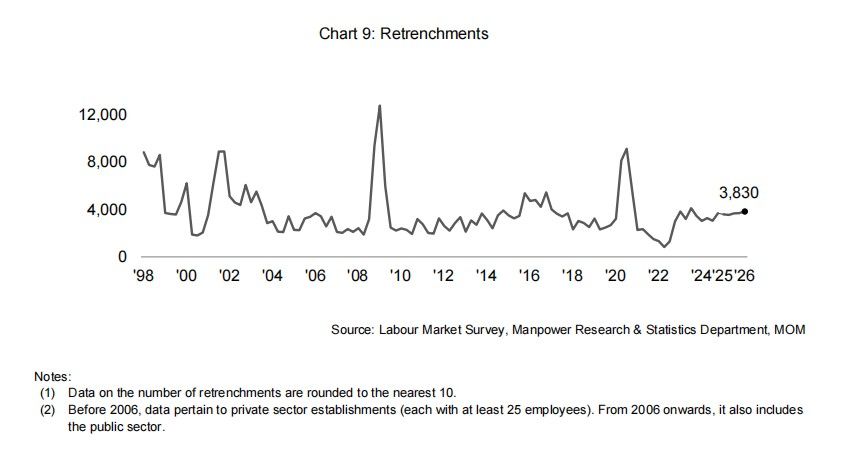
According to its Labour Market Report, 3,830 employees were retrenched between January and March 2026, up from 3,690 the previous quarter. Restructuring accounted for 73.8 per cent of layoffs.
Most retrenchments involved higher-skilled workers. Of those retrenched, roughly 3,320 were Professionals, Managers, Executives and Technicians (PMETs).
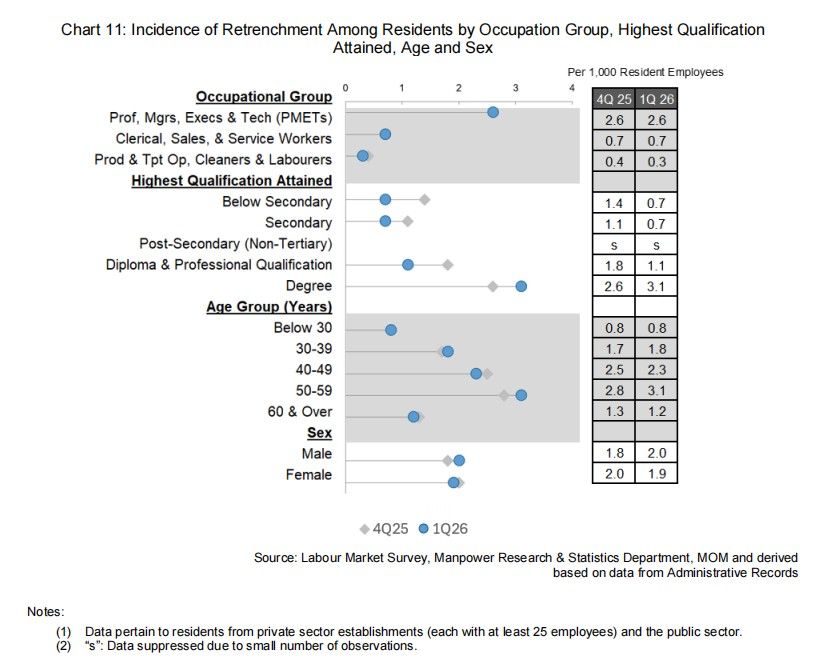
Retrenchment incidence among degree holders rose from 2.6 to 3.1 per 1,000 resident employees — the highest of any qualification group. Among workers aged 50 to 59 it also reached 3.1, the highest of any age group.
Job vacancies fell from 77,700 in December 2025 to 73,300 in March 2026, and the ratio of vacancies to unemployed persons slipped from 1.58 to 1.46.
In other words, the figures do not substantiate every complaint raised in the discussion, but they do point to strain concentrated among the educated, older and higher-skilled workforce — some of the same groups that featured prominently in participants' accounts.
How MOM framed it
The ministry stressed resilience.
Total employment grew for an 18th consecutive quarter, and the share of retrenched residents finding work within six months rose to 60.7 per cent.
Manpower Minister Dr Tan See Leng acknowledged the difficulty for affected workers but pointed to faster re-employment as encouraging.
"Retrenchment is never easy. But what encourages me is that we are seeing more retrenched workers finding their way back to employment quicker," he said.
On artificial intelligence, covered in the quarterly report for the first time, Dr Tan said the technology was reshaping jobs more than replacing them, citing that only 6.2 per cent of AI-adopting firms reported headcount cuts.
The gap between measure and experience
The official indicators count outcomes in aggregate — how many lost work, how many returned, how fast. They are weaker at capturing the quality of that re-employment, or the experience of those the count excludes.
The resident long-term unemployment rate held at 0.9 per cent — low, but a measure that by definition counts only those still actively searching after an extended spell.
Whether the gap between the data and the discontent reflects a limitation of measurement, a failure of communication, or a deeper structural problem is the open question. The official framing, built around aggregate resilience, does not engage with it directly.