Lawyers describe suicidal thoughts, court humiliation and denied medical accommodation in LawSoc sustainability
A four-year study commissioned by the Law Society of Singapore documents lawyers describing suicidal ideation, denied medical and pregnancy accommodation by the courts, and humiliation from the bench. It concludes attrition is driven by structural and cultural conditions, not individual failings, and that current interventions treat symptoms while underlying harm continues.
- Four-year study of 855 lawyers ties attrition to structural and cultural conditions.
- Lawyers described suicidal ideation, a suicide attempt and denied medical accommodation.
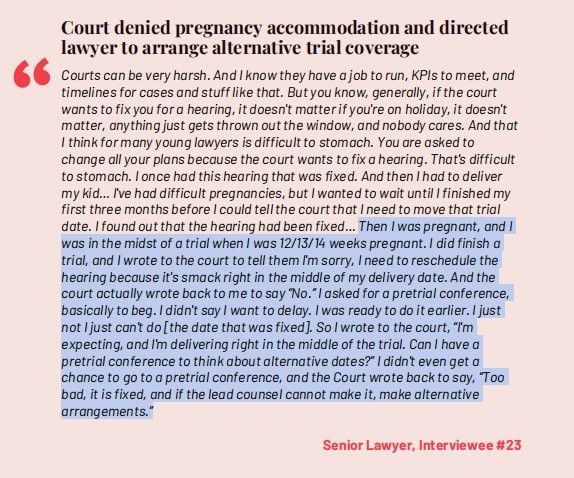
- A senior lawyer said a court refused to move a hearing clashing with her delivery date.
- No safe channel exists to report judicial conduct, the study states.
- Culture explains 24 to 58 per cent of firm-commitment variance, far above pay or firm size.

A four-year study commissioned by the Law Society of Singapore (LawSoc) has documented lawyers describing suicidal ideation, a suicide attempt, denied medical and pregnancy accommodation by the courts, and routine humiliation from the bench.
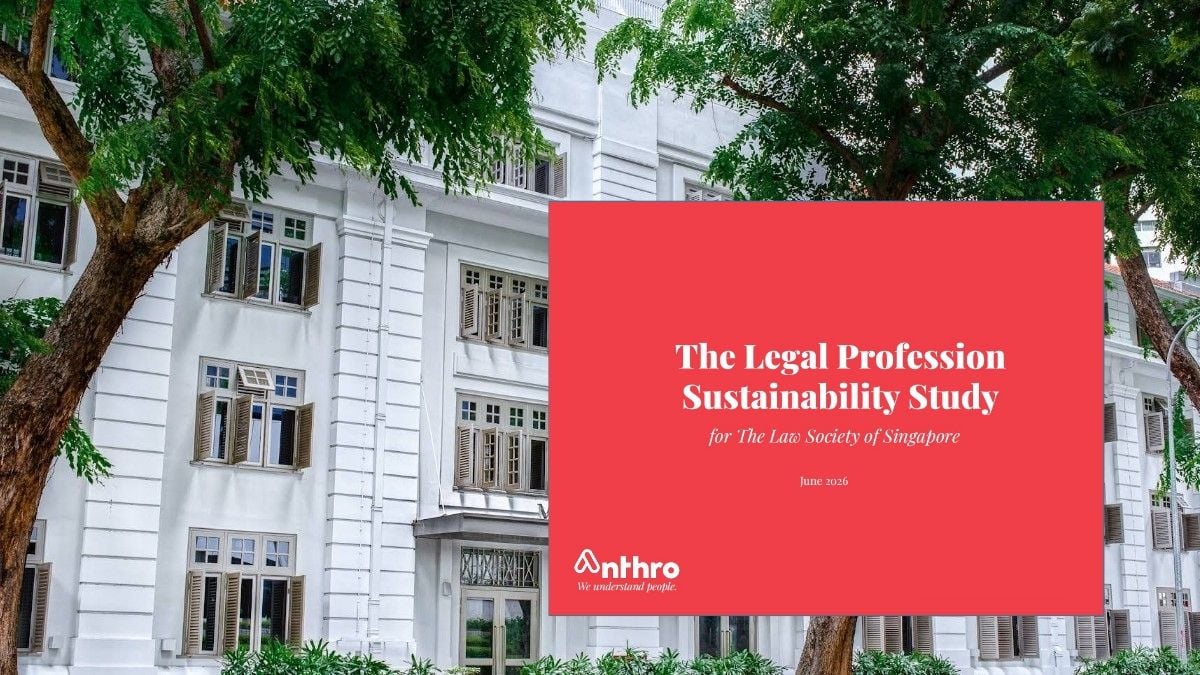
The Anthro–LawSoc Legal Profession Sustainability Study concludes that lawyer attrition stems not from individual failings, but from structural and cultural conditions that, in the report's words, may have remained unchanged for decades.
LawSoc announced the study's key findings in a press release dated 22 June 2026.
The full 231-page report, authored by people-science consultancy Anthro Insights and dated 15 June 2026, sets out the detailed evidence and respondent accounts behind those findings.
The study drew on 855 survey responses from practising and former lawyers and 31 in-depth interviews totalling 38 hours, including former judges, academics, practitioners and lawyers who had left the profession.
It was commissioned by the late LawSoc president Adrian Tan, who warned in his 2022 Opening of the Legal Year address that young lawyers faced a "perfect storm" of record departures and record-low entrants.
Adrian Tan died on 8 July 2023.
The report frames the scale of departure with a specific figure.
In 2021, it states, 538 lawyers did not renew their practising certificates and left private practice, a 30 per cent rise on the year before.
What lawyers told the study
The report reproduces respondent accounts at length, and several go well beyond the workload concerns that have featured in three decades of prior commentary.
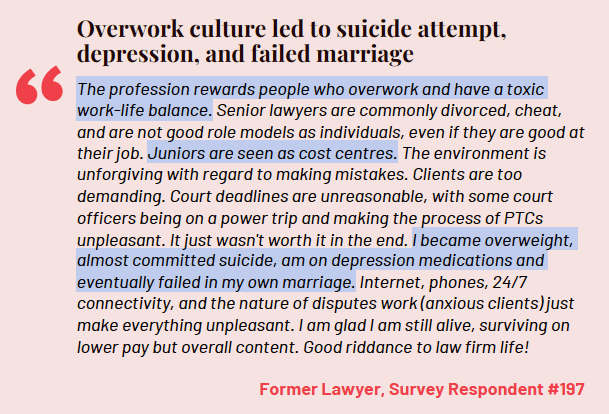
One former lawyer wrote that the profession rewards overwork, describing becoming overweight, attempting suicide, being placed on depression medication and a failed marriage.
"The profession rewards people who overwork and have a toxic work-life balance, " the ex-lawyer wrote, adding that "the environment is unforgiving with regard to making mistakes."
The respondent added being glad to be alive and content with lower pay outside of legal practice.
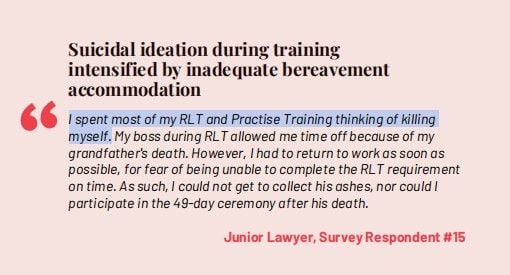
A junior lawyer recounted spending most of their training contemplating suicide.
After a grandfather's death, the respondent said, they returned to work quickly for fear of failing to complete training requirements, missing the collection of ashes and the 49-day ceremony.
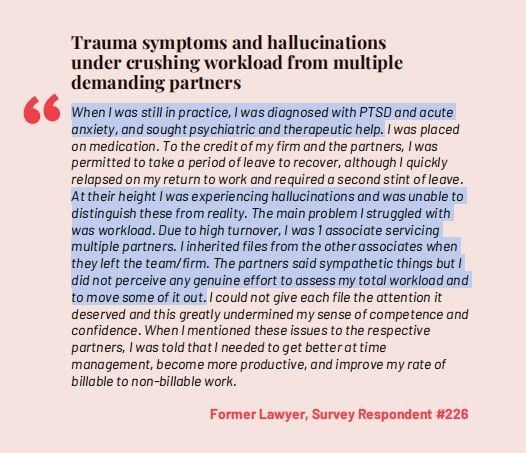
Another former lawyer described being diagnosed with post-traumatic stress disorder and acute anxiety, and experiencing hallucinations that could not be distinguished from reality while servicing multiple partners.
The ex-lawyer said: “The main problem I struggled with was workload. Due to high turnover, I was 1 associate servicing multiple partners… I could not give each file the attention it deserved and this greatly undermined my sense of competence and confidence.”
When the issue was raised, partners advised better time management and a higher ratio of billable work.
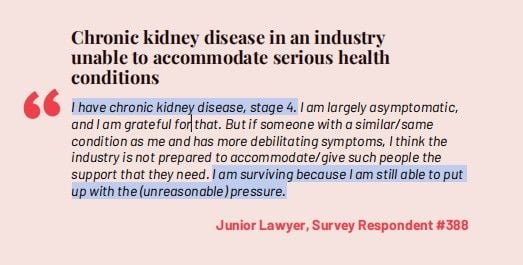
A junior lawyer with stage-4 chronic kidney disease said survival was possible only by continuing to withstand what was described as unreasonable pressure, and that the industry was not prepared to accommodate people with more debilitating symptoms.
These are quoted respondent accounts presented in the report.
They are individual testimonies rather than verified case records, and the report does not name the individuals or firms involved.
The courts as a source of stress
The study devotes a substantial section to the courts, which it treats as part of the working environment shaping lawyer wellbeing.
The accounts it reproduces are pointed.
A senior lawyer interviewed for the study said she had asked a court to reschedule a hearing that fell around her delivery date.
According to her account, the court declined a pre-trial conference and replied that the matter was fixed, and that if lead counsel could not attend, she should make alternative arrangements.
The senior lawywer said court-imposed timelines generally gave no accommodation for illness or medical conditions including pregnancy, and she were guilted out of maternity leave or effectively managed out of firms when they started families.
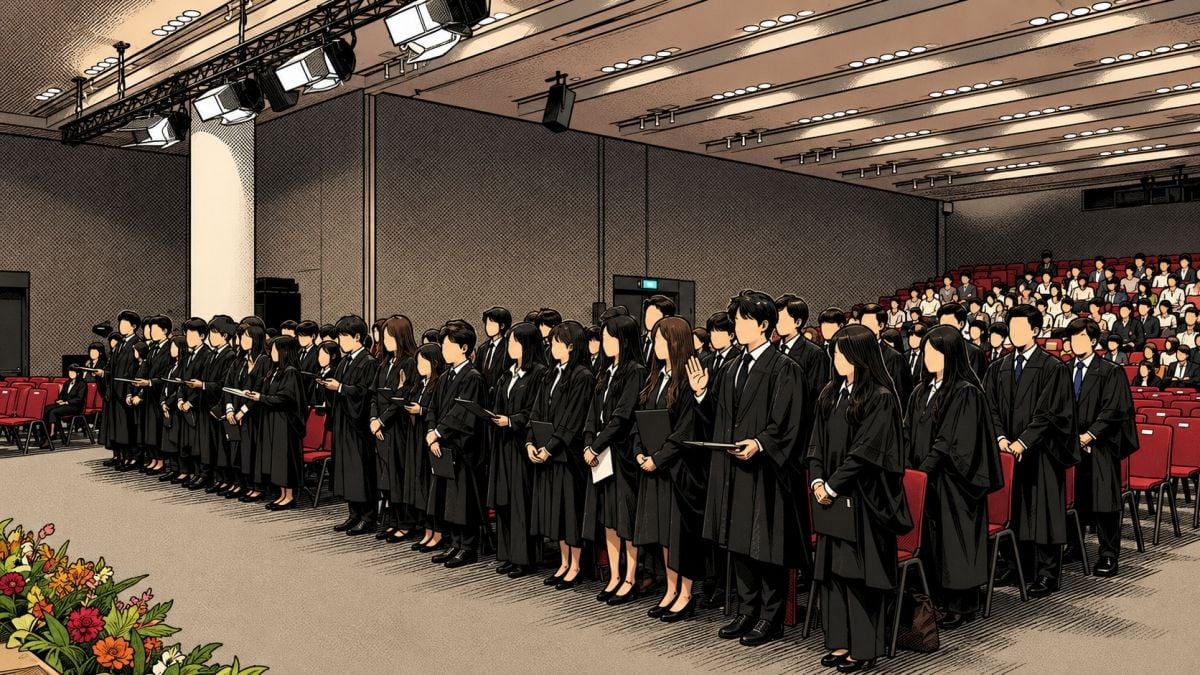
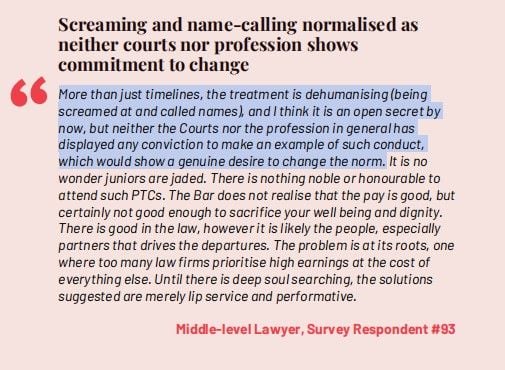
Multiple respondents described being screamed at, ridiculed, put down and called names in court.
One middle-level lawyer called such treatment dehumanising and an open secret, saying neither the courts nor the profession had shown conviction to change it, and that proposed solutions were "lip service and performative".
"It is no wonder juniors are jaded. There is nothing noble or honourable to attend such PTCs. The Bar does not realise that the pay is good, but certainly not good enough to sacrifice your well being and dignity, " the lawyer commented.
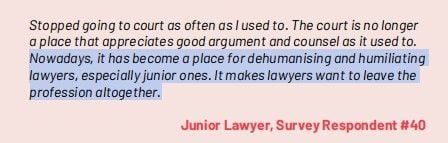
A junior lawyer said they had stopped attending court as often, describing it as no longer a place that appreciated good argument but one for humiliating lawyers, especially junior ones.
Crucially, the report states that no formal mechanism exists for lawyers to provide feedback on judicial conduct or timeline practices without career risk, which it says allows problematic patterns to persist uncorrected.
The report notes that court timelines were introduced in the 1990s to clear case backlogs, and that former judicial officers and practitioners observed timelines now appeared driven by completion targets rather than case complexity.
What the data shows
Beyond the testimony, the report presents regression analysis identifying which factors most strongly track retention.
Workplace culture, it states, uniquely explains between 24 and 58 per cent of variance in firm-level outcomes, with the strongest effect on firm commitment and discretionary effort.
Organisational support was the single strongest predictor of commitment.
By contrast, the report says demographics, firm size and wellbeing each explain far less of firm commitment, and that traditional assumptions about pay and seniority carry weaker weight once culture is accounted for.
The relationship reverses for attachment to the profession itself. Here wellbeing, particularly mental health, becomes the dominant factor, uniquely explaining 22.66 per cent of occupational commitment against culture's 6.75 per cent.
The report interprets this as a pathway: poor culture erodes mental health over time, and damaged wellbeing then leads lawyers to question whether law is worth continuing.
It states clearly that this mediation was not formally tested and would require longitudinal data to confirm.
On the decision not to renew a practising certificate, the clearest formal exit from private practice, the report finds culture dominant, uniquely explaining 31.56 per cent against wellbeing's 7.36 per cent, driven by an accumulation of workload, absent support and low psychological safety.
A baseline wellbeing concern
The study reports concerning baseline wellbeing across its sample.
Fewer than half of lawyers, 44.8 per cent, rated their physical health positively, and roughly three-quarters fell short of basic exercise and sleep guidelines.
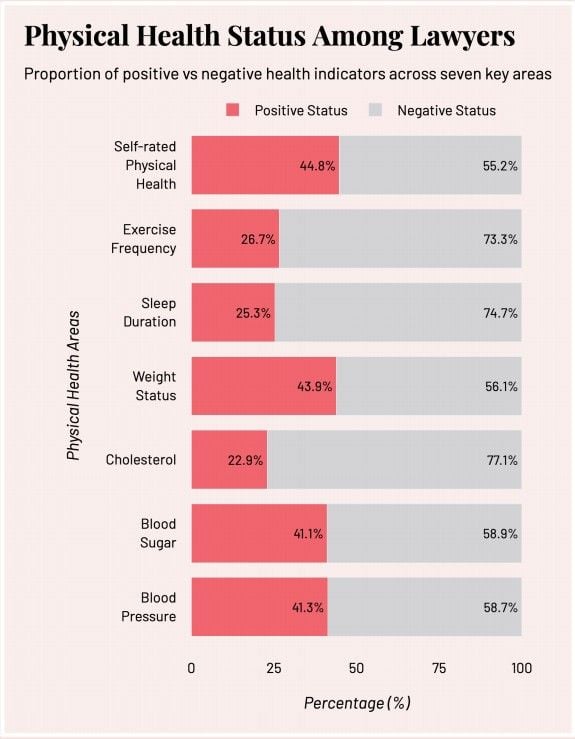
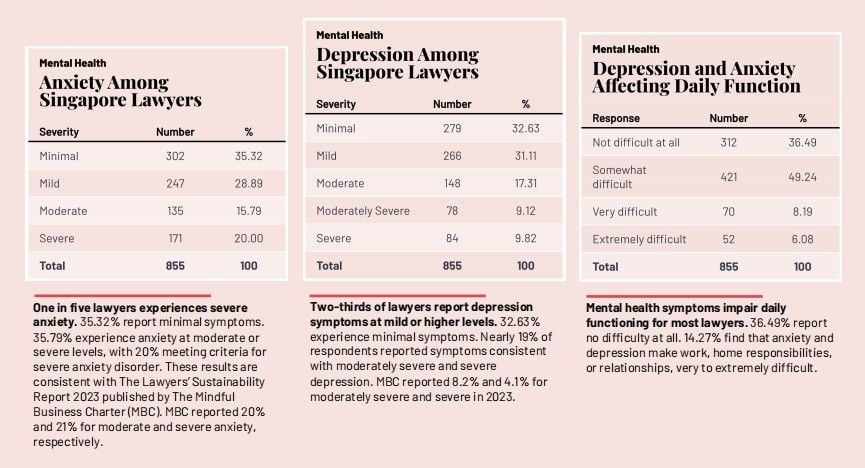
On mental health, 20 per cent met the criteria for severe anxiety, 9.12 per cent for moderately severe depression and 9.82 per cent for severe depression.
The report also identifies a gap between preferred and actual working conditions: 53 per cent said they would be most productive with full freedom to choose office hours, yet only 20 per cent had it. It separately notes that 61 per cent contributed no pro bono hours, suggesting constrained capacity.
Structural, not generational
The study explicitly rejects the view that young lawyers lack resilience. It argues that where every generation criticises the next, the pattern points to structural flaws in early-career roles rather than generational deficiency.
It attributes junior attrition to premature specialisation, excessive dependence on a single supervisor, limited exposure to diverse practice areas and insufficient psychological safety to learn from mistakes.
The report also addresses billable hours, originally a billing tool that became the primary measure of performance, arguing the targets create unhealthy competition in which juniors compete with seniors despite lacking control over work assignments.
It frames the broader stakes around artificial intelligence, arguing that as AI absorbs the routine work on which juniors once learned the craft, legal education may need to rethink its goals.
Responses from the authorities
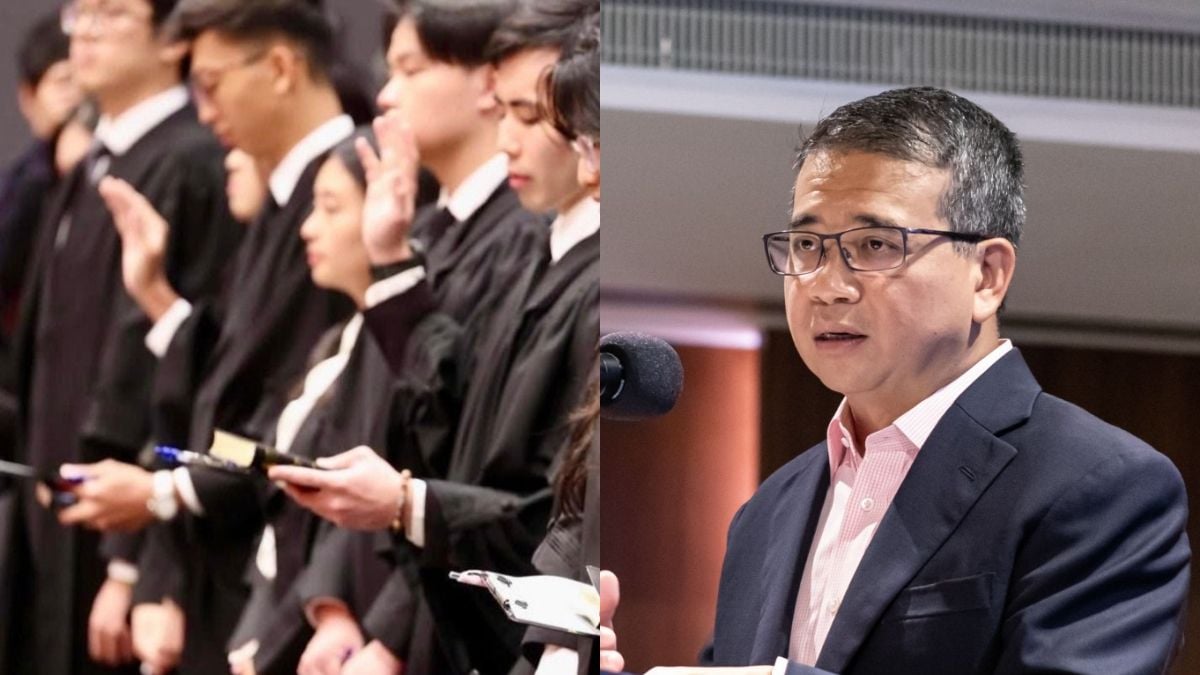
The Ministry of Law (MinLaw) said the findings should be taken seriously and considered carefully, describing Singapore's legal talent as a "precious asset".
Chief Justice Sundaresh Menon, who said in April that one in three new lawyers may quit within three years, responded that courtrooms must remain places of dignity, professionalism and mutual respect, and that the judiciary held all judicial officers to these standards.
A judiciary spokesperson said its independent complaints process remained active, noting two formal conduct complaints in the past three years, both investigated thoroughly. The spokesperson acknowledged the study suggested existing channels had not been sufficiently used at the practitioner level.
The spokesperson said the Singapore Judicial College would review and strengthen its curriculum, with attention to modules on courtroom communication and case management.
LawSoc president Tan Cheng Han said high attrition was not new and that many who leave practice remain in the profession or move into other productive roles, which he described as natural and largely positive. The question, he said, was whether systemic issues caused lawyers to leave and what solutions could sensibly follow.
Next steps
A Judiciary–Law Society Joint Working Committee will be established to address feedback within the courts' purview, co-led by Supreme Court chief executive Juthika Ramanathan and Registrar Jill Tan for the judiciary, alongside LawSoc representatives including Senior Counsel Lok Vi Ming.
LawSoc has convened a Task Force on the Fulfilment and Sustainability of Younger Lawyers, led by Young Lawyers Committee co-chairpersons Charmaine Yap and Darryl Chew. MinLaw said it welcomed both bodies and would continue working through the Future of the Legal Profession Committee, established in December 2025.
The report identifies two priorities for future research: why lawyers stay, and how students are selected to enter the profession. In its conclusion, it frames the issue as a defining choice, warning that leaving the causes of attrition unchanged means the problem will not improve and may worsen.
This report discusses suicide and mental distress. Anyone in Singapore who needs support can contact the Samaritans of Singapore on 1-767 or 1800-221-4444.