Two complaints in three years: the gap between Singapore's judicial-conduct channels and lawyers who will not use them
A judiciary spokesperson says two formal conduct complaints were received in three years. The Law Society's sustainability study reports lawyers across all levels describe being scolded and humiliated by judicial officers. This analysis argues the low figure does not rebut the study — it points to a gap between channels that formally exist and practitioners who experience them as safe and usable.

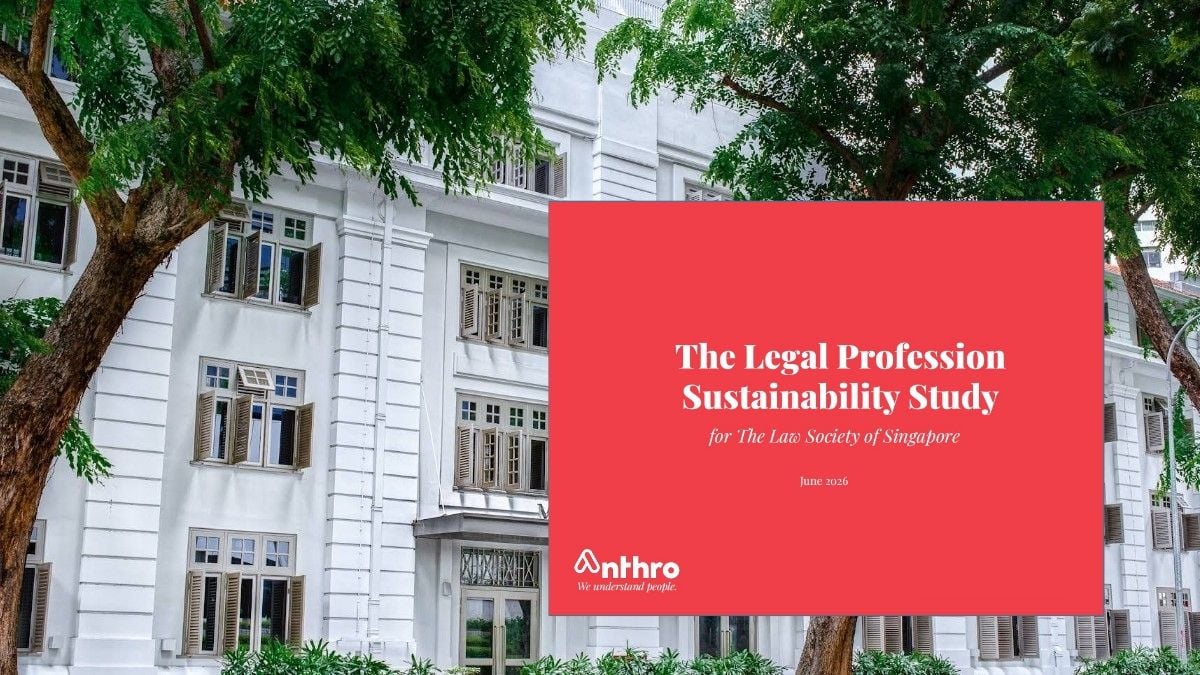
The Legal Profession Sustainability Study, commissioned by the Law Society of Singapore and conducted by Anthro Insights, contains a finding the profession has lived with for decades but rarely sees set down in evidence: many lawyers perceive themselves to have been mistreated by judicial officers, and do not believe there is a safe way to raise concerns about it.
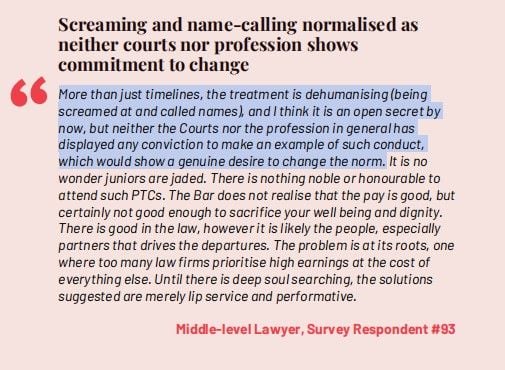
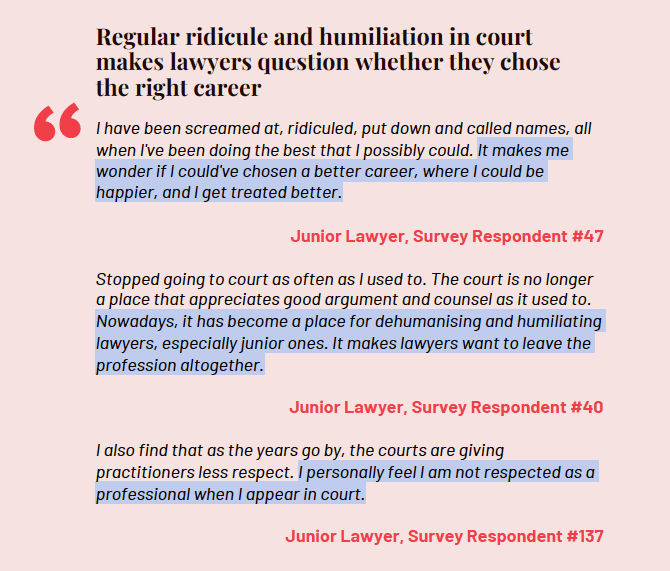
Drawing on 855 survey responses and 31 interviews, the study reports that practitioners ranging from junior to senior described being scolded, screamed at, ridiculed or personally faulted by judicial officers. It describes this as a long-standing pattern rather than an emerging concern.
Against that backdrop sits a single number.
Responding to CNA, a judiciary spokesperson said that "in the past three years, two formal conduct complaints were received, both of which were investigated thoroughly", while acknowledging that the study suggested existing channels had not been sufficiently utilised at the practitioner level, particularly on day-to-day courtroom experience and timeline pressures, and that some concerns may not be comfortably aired through a formal complaints process.
The two figures are offered as reassurance. Read against the study, they raise a harder question. The low complaint rate does not contradict the survey's account of widespread perceived mistreatment.
Read alongside the study, it is also consistent with an alternative explanation: that practitioners perceive the costs and risks of using the formal channels to be high enough that grievances rarely become formal complaints.
The gap, on this reading, is not between complaint and reality, but between the formal existence of complaint channels and practitioners' perception that those channels constitute a safe and meaningful way of raising concerns.
(Graphic: Anthro Insights / Law Society of Singapore)
The contradiction that has to be explained
The study directly records practitioners' reports of mistreatment.
The judiciary reports almost no formal complaints about it. The two are difficult to reconcile unless something sits between the grievance and the channel built to receive it.
A genuine rate of two complaints in three years would suggest the problem barely exists.
The survey, conducted anonymously and carrying no career risk, says it is pervasive enough to drive lawyers out of litigation and, in some accounts, out of the profession. The study records participants repeatedly expressing the view that no safe mechanism exists for lawyers to provide feedback on judicial conduct, and that raising concerns about the bench may carry career consequences.
So the burden flips. The low number is not the thing to be defended. It is the thing to be explained. The gap between expressed grievance and filed complaint is itself the finding — the dog that did not bark.
Why the innocent readings do not hold here
A low complaint rate can normally mean one of several benign things: low incidence, poor awareness of the channel, limited capability to use it, or grievances resolved informally before they escalate. Each explanation, in my assessment, sits uneasily with the specific facts of this profession.
It is difficult to explain solely by low incidence. The study records reports of mistreatment in substantial volume across levels of seniority, and describes the pattern as long-standing rather than emerging.
It is not poor awareness or low capability. This is the one profession that drafts complaints for a living and knows precisely where the channels sit. Its members articulated the grievance at length the moment they were given a route — the survey — that carried no cost.
Informal resolution also appears an incomplete explanation. The study records repeated perceptions that there is no safe way to address such incidents in the moment, little confidence in available channels afterward, and diminishing incentives to pursue a complaint once proceedings have concluded.
Against the study's findings, each of these benign explanations appears incomplete or difficult to reconcile with the profession's own accounts. The alternative readings, in my view, are ultimately unpersuasive.
A structural trap, not a choice
The silence is better understood not as a decision not to complain, but as the absence of any moment at which a lawyer can safely complain.
In the hearing itself, there is ordinarily no obvious procedural mechanism dedicated to challenging the manner in which counsel is being treated by the presiding judicial officer, as distinct from challenging a ruling.
Objecting to a ruling is ordinary advocacy.
Objecting to one's treatment by the judicial officer has no recognised procedural slot, and counsel may reasonably perceive that persisting in a personal confrontation with the bench carries legal and professional risk, including the possibility that the exchange could be characterised as improper conduct or, in an extreme case, stray into contempt territory. Many practitioners may therefore perceive their most realistic immediate option to be to absorb the incident and continue with the hearing.
The only safe window opens after proceedings end.
By then the matter is closed, the sting has dulled, and the lawyer must summon, in cold blood, the will to file an attributable complaint against a bench before which they will appear for the rest of their career. The timing that makes a complaint safe is the timing at which the reason to file one has drained away.
By that point the lawyer has either internalised the treatment as the cost of practice — the cycle the study describes as internalised and perpetuated — or decided to leave, in which case a departing lawyer has even less reason to file. The complaint may appear pointless to the one staying and increasingly irrelevant to the one going.
Two layers of fear
The deterrent is not only institutional. It is socially enforced before any complaint is contemplated.
The direct layer is the repeat-player problem. A judicial officer retains discretion over a lawyer's future matters — timelines, extensions, indulgences, the tenor of hearings. A complaint is lodged against someone with ongoing power over one's work. Even without any actual retaliation, the perception of risk is enough to deter.
The ambient layer is enforced by the profession itself. Lawyers widely perceive — and the survey captures this perception — that a junior who antagonises the bench becomes a liability, that seniors will caution against it, that one will be "marked". This layer is the more powerful precisely because it is self-sustaining: the profession polices itself, and the judiciary need do nothing. It controls the process but not the surrounding perception, and it is the perception that does the suppressing.
I should be precise here. This concerns perceived consequences and shared belief, not documented instances of firms or peers penalising someone. But that is the point. Perception alone is sufficient to produce the silence. One does not need proven retaliation to explain the figure.
The evidentiary difficulty
Even a lawyer willing to bear both risks runs into a question of proof.
The reported conduct often concerns tone, manner and courtroom atmosphere rather than words alone. "Counsel, you should know better" reads as neutral on a transcript and lands as humiliation in the room.
The dimension of the conduct that wounds is frequently the dimension a written record does not capture, and chambers interactions may be documented more sparsely still.
There is also a question that the case law raises directly.
In Law Society of Singapore v Ravi Madasamy [2007] SGHC 20, the Court of Three Judges observed, in relation to section 123 of the Evidence Act then in force — now section 121 of the 2020 Revised Edition — that a judicial officer may not be compellable to give evidence about matters that came to their knowledge in court in the discharge of judicial functions, except upon the special order of the High Court.
The court considered that this reading appeared more consistent with the provision's rationale, though it noted the point was not relevant to the appeal before it and that it had not heard full argument on it.
None of this makes substantiation impossible.
But it may reasonably affect how a practitioner assesses the prospects and costs of pursuing a complaint about an in-court interaction, where much of what is complained of lives in manner rather than words, and where the central witness may not be readily compellable.
A complaints process is meaningful in practice only to the extent its intended users believe a grievance can be substantiated through it.
The competence that might be expected to make lawyers most likely to use the channel may make them less likely to.
They assess merits, evidence, prospects and cost as they would for any client.
A process that appears difficult to navigate on a clear-eyed assessment is likely to attract few users among a profession trained to make exactly that assessment. The two-complaint figure, on this reading, is consistent with professional diligence rather than timidity.
The absence of visible precedent
Any competent lawyer researches precedent first, and here the search returns little to encourage filing.
I have not been able to identify publicly reported examples of conduct complaints by lawyers against judicial officers being determined on their merits. That absence cannot establish that no complaints have succeeded, or that no action has ever been taken; complaint processes may be confidential and their outcomes may not be publicly reported.
But for a practitioner attempting to assess the likely operation of the process from publicly available information, the absence of visible precedent may itself contribute to a perception of uncertainty or futility.
It is worth being careful about the one prominent case in which the complaint route against a judicial officer surfaces in the law reports, because it does not say what it might first appear to say. In Ravi Madasamy, the court did not suggest that lawyers may not complain about judicial conduct. On the contrary, quoting Re Kumaraendran, it expressly acknowledged that a lawyer with a complaint of unfair treatment has recourse to the proper quarters, whether personally or through the appropriate Bar committee — provided the grievance is directed there rather than expressed as a challenge to the court's authority in the courtroom itself.
What is notable is only this: the most prominent reported case in which the complaint route appears arises not from a complaint process operating on its merits, but within wider disciplinary proceedings concerning a lawyer whose conduct towards the court had already become seriously problematic, and whose threat to report the judge featured as part of that conduct. The avenue exists and is recognised. The case simply offers a practitioner no visible example of it being used successfully to vindicate a grievance about treatment.
Who is the system for?
A lawyer mistreated in court looks for an institution oriented toward protecting them, and finds a judiciary that holds the discretion, a regulator whose disciplinary machinery points at the lawyer, and a complaints channel that is attributable and, on the analysis above, ill-fitting — and that the study and the complaint figures together suggest is seldom used.
Under the Legal Profession Act, the Law Society's disciplinary process runs toward the lawyer, and the courts have described its paramount purposes as the protection of the public and confidence in the profession — not the welfare of the individual lawyer. The Society does also perform supportive and representative functions, including practice guidance, wellbeing initiatives, and now the task force and joint working committee convened in response to this study. But none of those amounts to protection against a judicial officer.
The defensible claim is narrow and, I think, sound: no institution in the structure appears expressly constituted to protect an individual lawyer against perceived adverse treatment by the bench, and the lawyer's own regulator is the body that would discipline them for reacting to it. The junior lawyer who feels no one is in their corner is, structurally and in that specific confrontation, in an understandable position.
It took an individual to ask
The study traces to the late Adrian Tan, who commissioned it as Law Society president and who warned in 2022 of a "perfect storm" of record departures and record-low entrants, highlighting the exit of 538 lawyers in 2021. He died on 8 July 2023, before the four-year study reported.
The study says the problem is not new, locating its causes in structural and cultural conditions that may have remained unchanged for decades. The grievances did not need discovering. They needed acknowledging. It took an individual president's initiative, rather than a standing institutional process, to produce systematic evidence of something the profession had lived with for a generation.
In fairness, this is a claim about lateness and trigger, not about inaction. The Chief Justice has publicly expressed concern about lawyer attrition and referred to survey findings suggesting substantial numbers of young lawyers are considering leaving practice. The Future of the Legal Profession Committee was established in December 2025, and the Law Society has now convened its task force.
The line that holds
This is not a profession with nothing to say about the bench. It is a profession with a great deal to say, almost none of which reaches the one channel built to receive it — because, on the account the study assembles, there is no moment at which saying it feels safe, little evidence with which to prove it, no visible precedent suggesting it works, and no institution expressly constituted to protect the speaker.
The judiciary points to an existing complaints avenue, and the case law itself affirms that such an avenue exists. The question raised by the study is not whether the door is there in the abstract. It is whether a channel that its intended users repeatedly describe as unsafe can meaningfully perform the function it was designed to serve.
The profession's own accounts suggest that, despite the formal existence of a complaints process, many practitioners do not experience it as a safe or practically usable mechanism for raising concerns about judicial conduct.
The study warns that leaving the causes of attrition unchanged means the problem will not improve, and may worsen. Whether the channel is redesigned so a lawyer can raise judicial conduct without career risk is the test of whether that warning has been heard.