Edwin Tong says lawyers' wellbeing must match Singapore's ambitions as a global legal hub
Law Minister Edwin Tong says he understands concerns raised in the Law Society's sustainability study, pledging continued engagement with the profession as Singapore seeks to remain a leading legal hub while ensuring lawyers can build meaningful, sustainable and fulfilling careers.
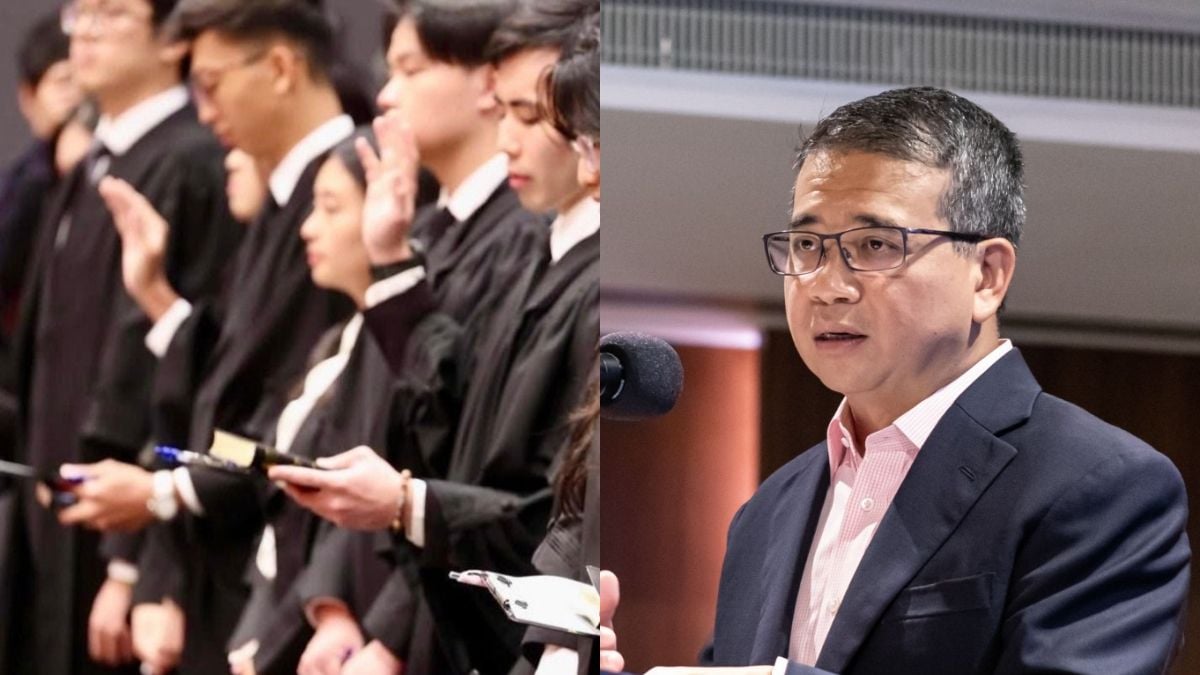
- Edwin Tong said he personally understands concerns raised by lawyers and pledged continued engagement with the profession.
- The Law Society study documented widespread concerns over burnout, mental health and workplace culture across Singapore's legal profession.
- Lawyers and legal counsel urged reforms to improve mentorship, reduce workplace pressures and address structural causes of attrition.

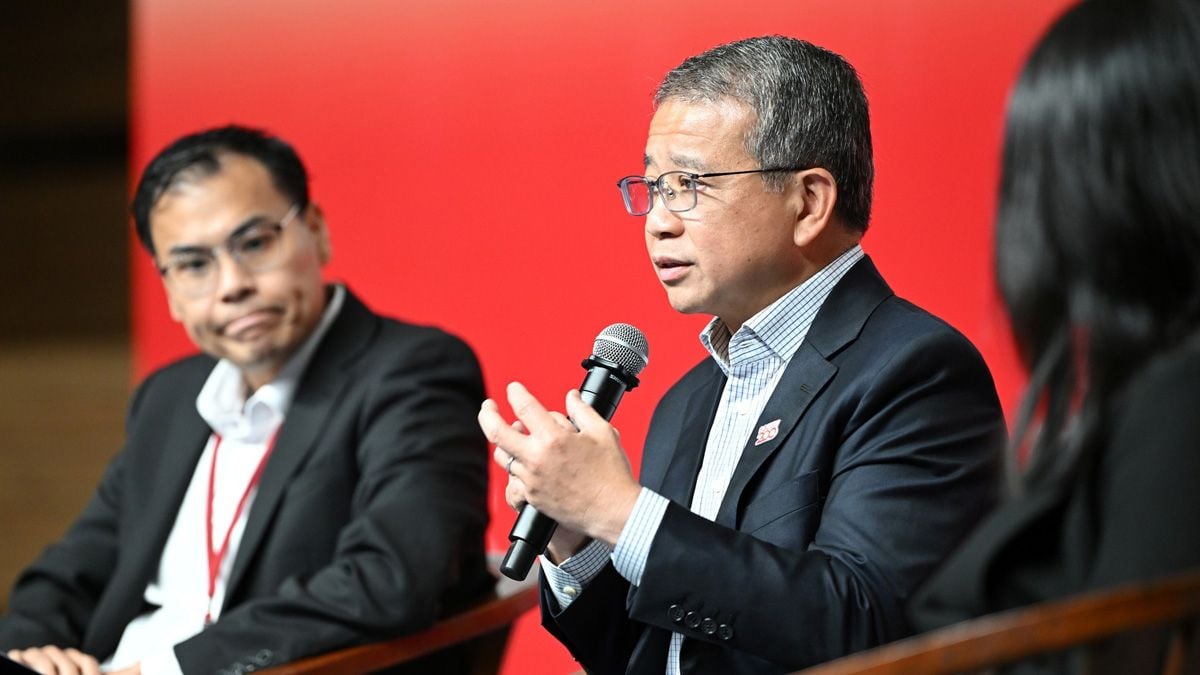
Law and Second Minister for Home Affairs Edwin Tong said he personally understands many of the concerns raised in the Law Society of Singapore's Legal Profession Sustainability Study, assuring lawyers that the Ministry of Law remains committed to continuing discussions aimed at strengthening both the profession and Singapore's position as a leading international legal centre.
Responding to widespread discussion generated by the study, Tong said the findings reflected genuine experiences shared by members of the legal profession rather than merely survey data.
Drawing on his own 25 years in practice before entering government, he said many of the issues described resonated with experiences familiar to lawyers across different generations.
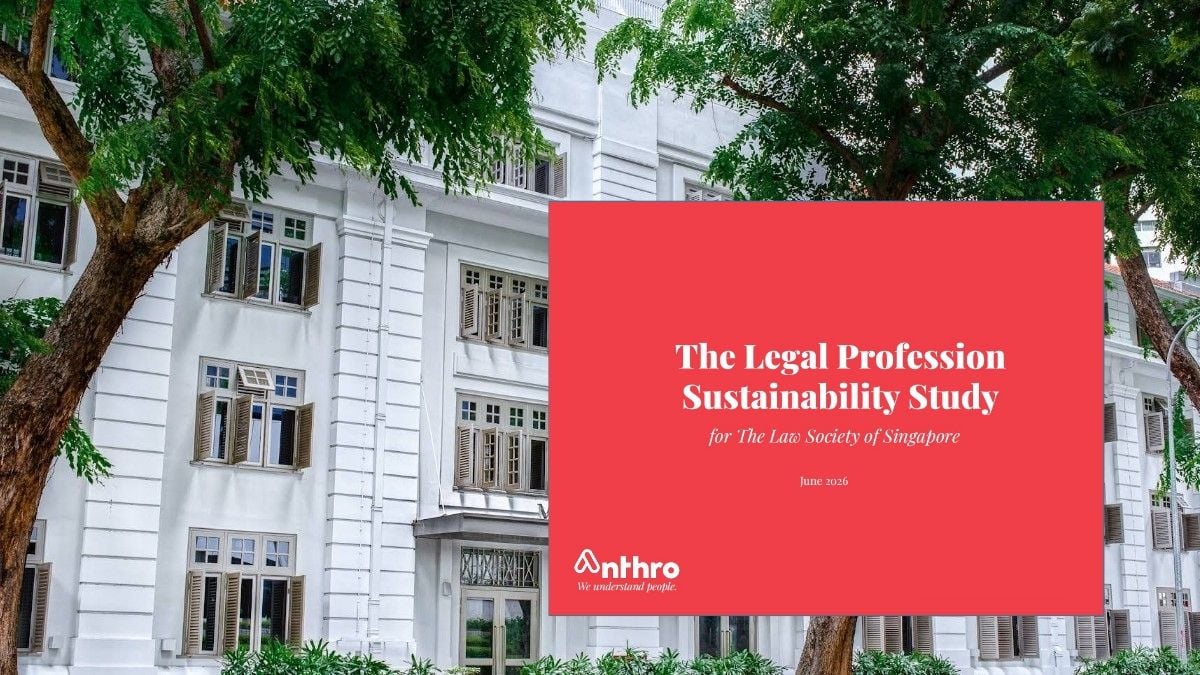
His comments came four days after the release of the four-year Legal Profession Sustainability Study commissioned by the Law Society of Singapore and conducted by Anthro Insights.
The report documented accounts of suicidal ideation, a suicide attempt, denied medical and pregnancy accommodation by the courts and routine humiliation from the bench, prompting extensive discussion throughout Singapore's legal community.
The study surveyed 855 lawyers and included 31 in-depth interviews.
It concluded that attrition from legal practice stems primarily from structural and cultural conditions rather than a lack of resilience among younger lawyers.
The report also found that fewer than half of respondents rated their physical health positively, while one in five lawyers met the criteria for severe anxiety.
It further stated that no formal mechanism exists for lawyers to raise concerns about judicial conduct without risking their careers.
Tong says lawyers' experiences deserve serious attention
In a LinkedIn post published on 26 June 2026, Tong acknowledged that many of the personal accounts contained in the study were difficult to read.
"Some of the accounts in the report are difficult to read. They speak of long hours, pressure, uncertainty, difficult workplace experiences including in the courtroom, struggles with family responsibilities, and questions about whether a long-term career in practice is sustainable," he wrote.
Tong stressed that the findings should not be viewed as abstract statistics.
"We will take the findings seriously, because they are not merely abstract statistics or survey results. They reflect the lived experiences of people we know and care about, our colleagues, friends, mentors and juniors."
He added that many within the profession would recognise elements of themselves or people they had worked alongside in the stories documented by the report.
Personal experience shapes policy approach
Tong said his own legal career continues to influence how he approaches legal policymaking.
"I know the long hours, the demanding clients, the difficult cases and tough arguments in court, the moments of self-doubt, and the constant challenge of balancing professional commitments with personal responsibilities."
He recalled beginning his career as a young lawyer and working alongside many junior practitioners who later became respected members of the profession.
"I was once a young lawyer too, although it feels increasingly long ago, and over the years, I have had the privilege of working alongside many young lawyers who have gone on to become outstanding practitioners and leaders in the profession."
Tong said he hopes Singapore's legal profession continues renewing itself by attracting and retaining talented lawyers.
Ministry to continue engaging stakeholders
Tong said the MinLaw has spent considerable time engaging lawyers from across the profession over recent years through formal dialogues, small group discussions and individual conversations.
Those discussions, he said, consistently highlighted common aspirations despite differing personal experiences.
Among the recurring themes were the desire for meaningful work, opportunities for professional development and mentorship, a sense of purpose, and the challenge of building careers that are both professionally rewarding and personally sustainable.
Tong noted that concerns over attrition and sustainability have existed across multiple generations of lawyers.
However, he said the longevity of those issues should not breed complacency.
"If anything, it underscores the need to understand them more deeply and address them more effectively."
He acknowledged that heavy workloads, stress and work-life pressures have long been recognised as significant challenges within legal practice.
At the same time, Tong said legal practice will inevitably involve substantial pressure because lawyers are entrusted with advocating for clients facing significant legal issues under demanding deadlines.
He argued that a more important question is how professional culture, supervision, training, workplace practices and career pathways can be improved over time to shape healthier and more sustainable careers.
Technology reshaping legal practice
Tong also pointed to rapid technological change as another factor transforming legal practice.
He said client expectations have evolved considerably while generative artificial intelligence and other emerging technologies are changing how legal services are delivered at a pace that would have been difficult to imagine only a decade ago.
According to Tong, these developments have implications not only for lawyers' day-to-day work but also for how future generations are trained, supervised and mentored throughout their careers.
He cautioned against assuming today's lawyers experience the profession in exactly the same way as previous generations.
Instead, he said policymakers and industry leaders must continue listening carefully to lawyers' experiences and respond thoughtfully to changing realities.
Shared responsibility across the profession
Tong said many of these issues were already discussed during the Ministry of Law's industry-wide conversation, The Next Charter: Shaping Singapore's Legal Future Together, held in March.
Those discussions reinforced his belief that while the challenges facing the profession are complex, there remains a genuine willingness among stakeholders to work collaboratively towards solutions.
"There are no easy answers, and no single stakeholder can address these challenges alone."
Tong said law firms, lawyers, the Law Society, the Judiciary, law schools and the Government all have important roles to play in strengthening the profession.
He added that lawyers who had shared their experiences openly deserved to be heard.
"We at the Ministry of Law remain committed to continuing these conversations and working closely with stakeholders across the legal ecosystem to explore what more can be done."
Tong said Singapore must pursue two objectives simultaneously.
The first is strengthening Singapore as a globally respected legal and dispute resolution hub with a capable, internationally recognised profession.
The second is ensuring lawyers themselves can build careers that are sustainable, meaningful and fulfilling.
"These goals are not in tension. In the long run, one depends on the other."
Lawyers call for reforms
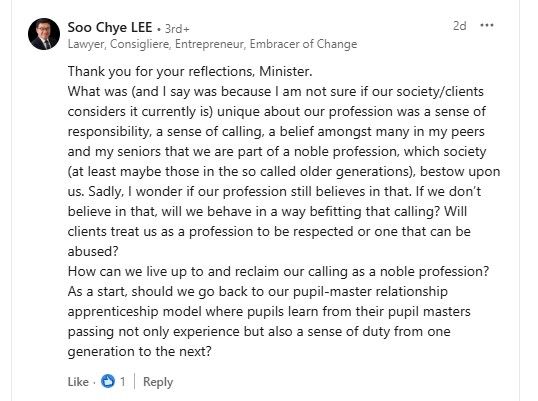
In the comments section, lawyer Lee Soo Chye said the legal profession had traditionally been regarded as a noble profession founded on responsibility, duty and public respect.
However, Lee questioned whether those values continue to define legal practice today.
He warned that if lawyers themselves no longer viewed their work as a calling, clients might increasingly regard them simply as professionals who could be abused rather than respected.
Lee suggested reviving a stronger pupil-master apprenticeship model to allow experienced practitioners to pass on not only legal knowledge but also a stronger sense of professional responsibility to younger lawyers.
Former lawyer Lara Quie described an increasingly demanding workplace culture in which lawyers remain constantly accessible through multiple communication platforms.
She said clients and colleagues frequently contacted lawyers at all hours expecting immediate responses.
Quie added that she knew lawyers suffering from burnout and motor neurone disease, arguing that lawyers should be able to protect their right to obtain sufficient sleep.
Lawyer Luo Ling Ling similarly recounted receiving repeated calls from one client throughout the early hours of the morning, including at 1am, 2am, 3am and 4am. She said activating the "do not disturb" function before bedtime helped prevent those interruptions.

Calls for faster action
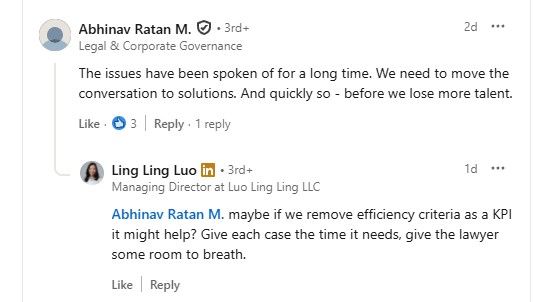
A legal counsel said the profession has discussed many of these concerns for years and argued that the time had come to move beyond discussion towards practical reforms before more talent leaves legal practice.
Luo also proposed removing efficiency criteria as a key performance indicator, suggesting lawyers should be given more time for each case and greater flexibility to manage increasingly demanding workloads.
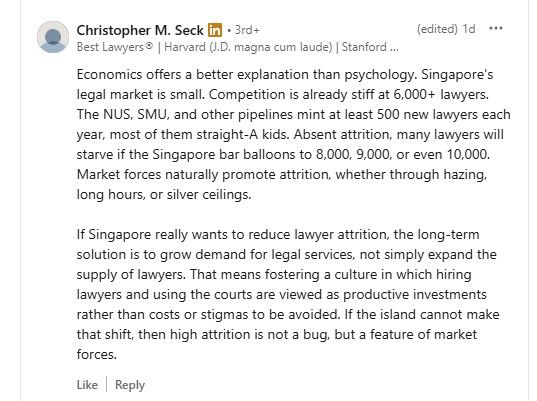
Lawyer Christopher M. Seck argued that economics provides a stronger explanation for attrition than psychology alone.
He noted that Singapore has more than 6,000 practising lawyers with around 500 new entrants joining annually through the National University of Singapore, Singapore Management University and other pathways.
According to Seck, increasing the size of the legal profession to between 8,000 and 10,000 lawyers could intensify competition and leave many struggling to establish sustainable careers.
He argued that long-term solutions should focus on expanding demand for legal services and changing public perceptions so legal advice is viewed as a productive investment rather than merely an unavoidable cost.
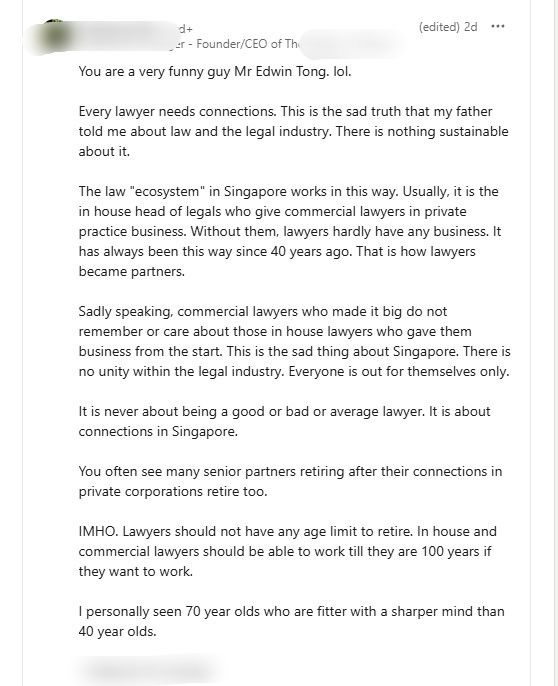
Another commenter argued that career progression within Singapore's legal profession continues to depend heavily on professional connections rather than merit alone.
The commenter claimed in-house legal leaders often influence the distribution of work to private practice firms, shaping career progression and partnership opportunities over many years.
The same comment also criticised what was described as a lack of unity within parts of the profession and suggested lawyers should not face a fixed retirement age because many experienced practitioners continue contributing valuable expertise well into later stages of their careers.