Trump administration seeks US$87.6 billion in Congress for Iran war and domestic priorities
The White House has formally requested US$87.6 billion in supplemental spending from Congress, the bulk of it to fund Operation Epic Fury in Iran, even as both chambers pass a war powers resolution directing Trump to halt military action.
- White House requests US$87.6 billion, with US$67 billion for the Iran war under Operation Epic Fury.
- Both chambers pass war powers resolution rebuking Trump; Senate vote prompts confrontation on Capitol Hill.
- Democrats and some Republicans resist; midterm vulnerability complicates GOP support for supplemental.

The White House formally requested US$87.6 billion in supplemental spending from Congress on 24 June 2026, with the bulk of the funds directed at covering the operational costs of the United States military campaign against Iran, now entering its fourth month.
The request, transmitted by White House Office of Management and Budget Director Russell Vought in a letter to House Speaker Mike Johnson, states that "most of this request will address urgent needs related to Operation Epic Fury," the official designation for the Iran war that began on 28 February 2026.
The request arrives one day after the Senate passed a war powers resolution directing Trump to halt military action against Iran, following a similar vote in the House weeks earlier.
The war powers measure passed with near-unanimous Democratic support and the backing of a handful of Republicans in both chambers, representing the first congressional resolution of its kind to clear both houses since the War Powers Resolution of 1973 was enacted.
Breakdown of the funding request
Of the total request, US$67.15 billion is earmarked for the Department of Defense. This is in addition to approximately US$1 trillion appropriated in the prior fiscal year and a further US$1.5 trillion Trump has sought for the next year.
The Defense Department allocation includes US$21 billion for munitions procurement, strengthening the US industrial base and supporting critical capabilities. A further US$17.3 billion is designated for operational costs, US$12.1 billion for classified programmes, and US$768 million for the Department of Energy for nuclear and energy security.
The White House said the funds are needed to cover military personnel and readiness costs, rebuild weapons stockpiles depleted during the conflict, and sustain classified programmes. Washington and Tehran are currently observing a ceasefire, but the Pentagon's inventory of munitions has been significantly drawn down.
Defence Secretary Pete Hegseth had indicated as early as March 2026 that the Pentagon might seek as much as US$200 billion to fund the campaign; Wednesday's supplemental represents a substantially smaller figure.
Non-defence components of the request
The supplemental package includes several items unrelated to the Iran conflict.
The administration is seeking US$1.4 billion to respond to an Ebola outbreak in Central Africa, comprising US$800 million in international humanitarian assistance and US$500 million for global health security. The White House stated the funding is "critical to protect Americans and stop the spread to the United States." The request comes after the administration made steep cuts to the US Agency for International Development and to African public health programmes prior to the outbreak.
The package also includes US$11.1 billion — reduced from the US$10 billion figure cited in some versions of the request — to support US farmers who have faced mounting pressures in part due to Trump's trade policies over the past year and a half.
Additional items include US$1 billion to shore up the pensions of workers formerly employed by Delphi, the General Motors auto parts subsidiary whose pension entitlements were cut during GM's 2009 bankruptcy restructuring. The administration is also requesting US$500 million for construction and restoration projects in and around Washington and US$1 billion toward the renovation of Penn Station in New York City.
Immediate congressional resistance
The request met with immediate opposition from Democratic lawmakers and expressions of scepticism from within Republican ranks.
Senate Appropriations Committee's senior Democrat, Patty Murray of Washington state, said she would review the request to ensure servicemembers are taken care of, but added: "I will not rubber-stamp tens of billions more for this disastrous war of choice."
Murray also noted that the Pentagon already holds a historically large annual budget and retains more than US$100 billion in unspent funding allocated through the 2025 Republican tax and spending legislation, known as the One Big Beautiful Bill.
Senate Democratic Leader Chuck Schumer posted on social media platform X that Congress should be "lowering costs for the American people, not writing another blank check for Trump."
House Appropriations Committee Chair Tom Cole of Oklahoma and Defence Appropriations Subcommittee Chair Ken Calvert of California issued a joint statement saying Congress has "a constitutional obligation to provide for the common defence," framing their response in terms of principle rather than signalling a clear commitment to the specific request.
Republican divisions and Capitol Hill confrontation
The path to passage is further complicated by Republican political vulnerability ahead of the November 2026 midterm elections, in which control of both chambers of Congress will be at stake. The Iran war has polled as broadly unpopular with the US electorate, placing members from competitive districts in a difficult position.
Trump's Republican majorities in both the House and Senate are narrow, meaning that appropriations measures typically require some Democratic support to pass.
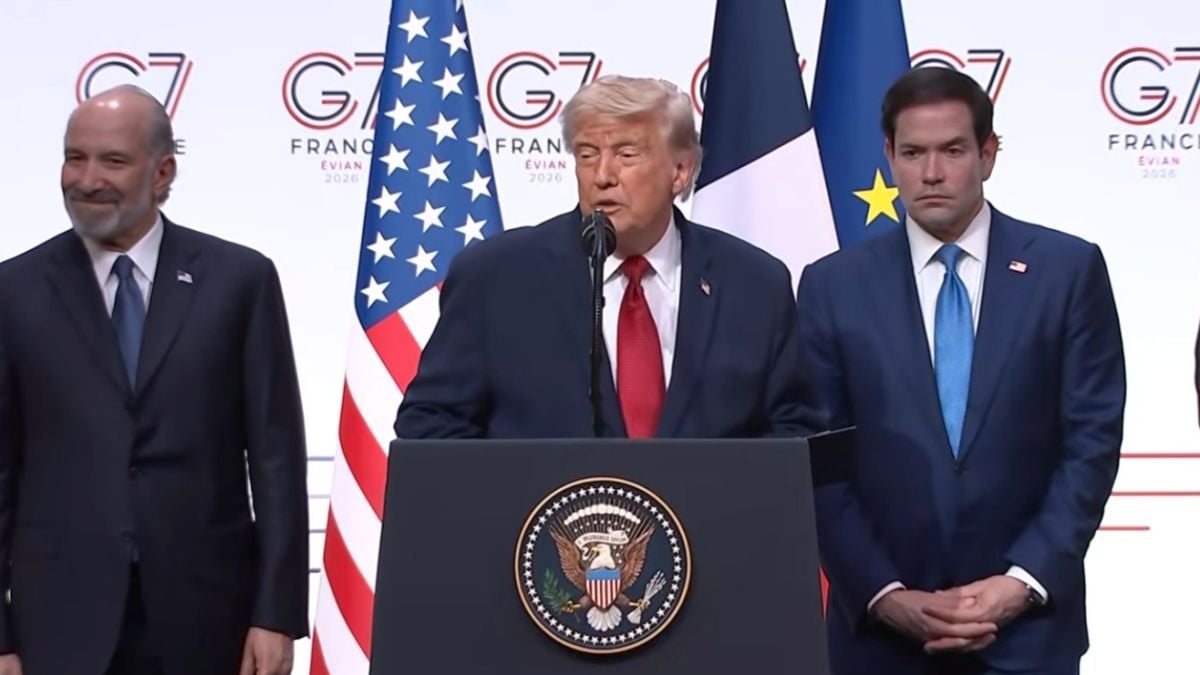
On 24 June, Trump held what reports describe as a tense lunch with Senate Republicans on Capitol Hill, during which he reportedly complained about the previous day's war powers vote. During the session, Trump engaged in a confrontation with Senator Bill Cassidy of Louisiana — one of the Republicans who voted in favour of the war powers resolution.
The meeting followed Trump's abrupt cancellation of a signing ceremony for a bipartisan housing bill earlier in the day.
Multiple lawmakers across party lines have raised concerns that the Trump administration has not kept Congress adequately informed about the conflict, its scope, or the administration's plans. They have additionally cited the constitutional principle that the authority to commit the United States to war rests with Congress, not the executive branch.
Vought's letter urged Congress "to take action on these important and urgent requests as soon as possible." It remains unclear whether the administration has secured sufficient Republican unity to advance the supplemental package, or whether Democratic cooperation can be obtained on any portion of it.