MinLaw defers call for official judicial conduct channel, audit to new joint committee
Minister for Law Edwin Tong declined to commit directly to an official channel for feedback on judicial conduct or an independent audit of Bench-Bar interactions, saying these were matters for the new Judiciary-Law Society joint committee to review.
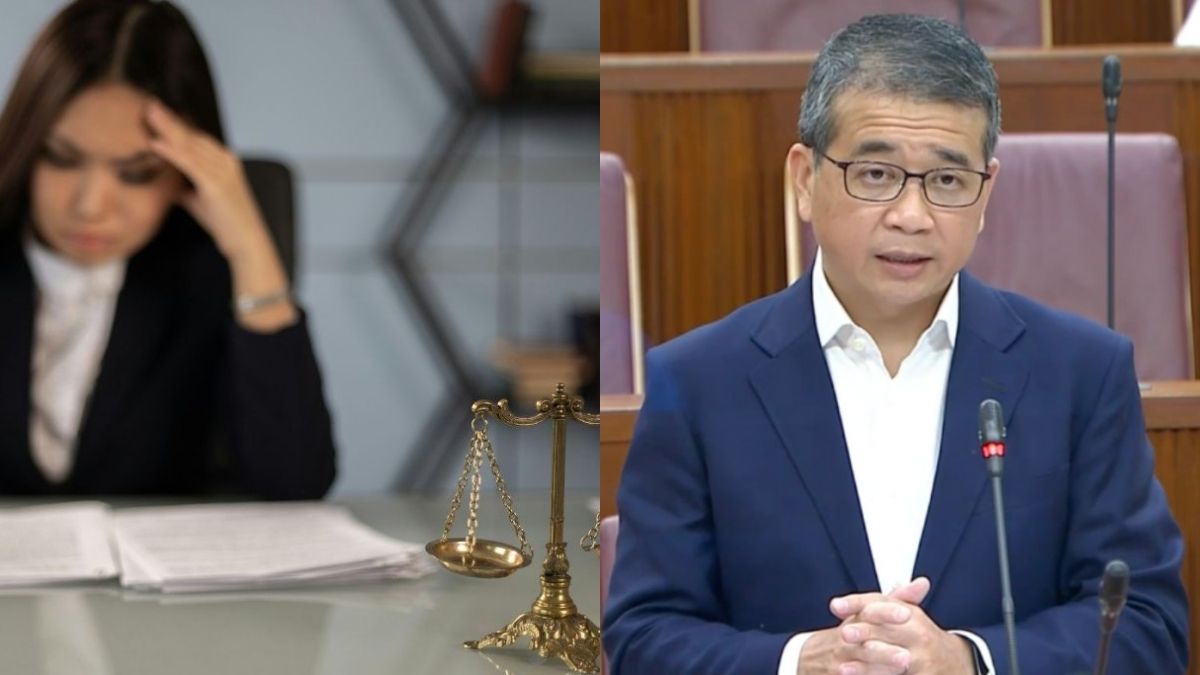

MinLaw will leave the design of any formal channel for lawyers to flag judicial conduct entirely to a new Judiciary-Law Society committee, Minister for Law Edwin Tong Chun Fai confirmed in a written Parliamentary reply, stopping short of committing to either an independent channel or an audit of Bench-Bar interactions sought by MPs following the Legal Profession Sustainability Study.
The written reply, tabled on 7 July, jointly addressed questions from Members of Parliament Dr Wan Rizal, Christopher de Souza, Vikram Nair and Hany Soh, as well as two related written questions from Diana Pang and Dr Wan Rizal.
The Study, conducted by consultancy Anthro Insights and released on 22 June, drew on 855 survey responses and 31 in-depth interviews with practising and former lawyers, judges and academics, documenting excessive workload, toxic workplace culture and harsh courtroom conduct within the profession. It found that workplace culture explained up to 58 per cent of variance in firm-level retention outcomes.
Judicial feedback channels under review
Tong noted that the Judiciary and the Law Society had "responded swiftly" and established a joint committee to review existing dialogue mechanisms and feedback channels, and to examine whether case management practices and timeline expectations are calibrated to the realities of practice today.
On calls from Dr Wan Rizal and Hany Soh for an official channel on judicial conduct and an independent audit of Bench-Bar interactions, the Minister said the Judiciary was an independent institution responsible for managing its own procedure, and noted it had previously set up a Judicial Complaints Process which lawyers could use.
The Minister did not provide the requested data on how frequently the Judicial Complaints Process has been used or its assessed effectiveness, saying instead that "the efficacy of this channel can be something which the committee reviews."
A judiciary spokesperson had earlier disclosed to CNA, in response to the Study's release, that two formal conduct complaints were received in the past three years, both of which were investigated thoroughly, while acknowledging that existing channels "have not been sufficiently utilised at the practitioner level."
Study highlights risks of unreported concerns
The Study itself found that "no formal mechanism currently exists for lawyers to provide feedback on judicial conduct or timeline practices without career risk," warning that "this absence of accountability allows problematic patterns to persist uncorrected."
It traced rigid court timelines to a system introduced in the 1990s to clear case backlogs, with former judicial officers and practising lawyers observing that timelines now appeared driven by completion targets rather than case complexity.
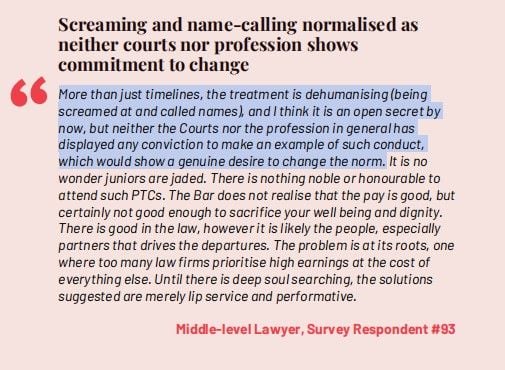
One junior lawyer quoted in the Study said the court had become "no longer a place that appreciates good argument and counsel as it used to," but rather "a place for dehumanising and humiliating lawyers, especially junior ones," and said they had stopped attending court as often as before.
The judiciary spokesperson said informal channels also existed alongside the formal complaints process, and that the new Joint Working Committee would consider "how the feedback channels can be strengthened" and review awareness of available channels among practitioners.
MinLaw points to harassment safeguards and future reforms
Addressing concerns from Dr Wan Rizal, Vikram Nair and Hany Soh about toxic workplace culture and bullying, Tong stated plainly that "workplace harassment will not be tolerated," pointing to the Tripartite Advisory on Managing Workplace Harassment and the incoming Workplace Fairness Act, which takes effect in 2027.
He also cited the Law Society's Guidance Note and Toolkit on Workplace Harassment and Bullying Prevention, issued in October 2025, and said MinLaw would continue working with the Law Society "to consider whether additional options may allow lawyers to raise concerns without fear of professional repercussions."
The Minister acknowledged a more specific concern in the Study — that junior lawyers in particular "may feel unable to raise concerns about harmful conduct in workplaces or in court without putting their careers at risk," and that formal frameworks alone do not address this practical reality.
He cited Chief Justice Sundaresh Menon's exhortation that "the conduct of leaders, the expectations they set, and the culture they foster will play a decisive role in shaping how lawyers experience practice, how they develop, and whether they remain in the profession."
Retention challenges linked to culture, workload and career pressures
On retention, raised by Diana Pang and Christopher de Souza, Tong reiterated that attrition from legal practice "has remained stable over the last decade," attributing departures to workload, workplace culture, inadequate supervision or mentorship, and more attractive opportunities elsewhere.
He said legal practice was inherently demanding by nature, given lawyers hold "someone's livelihood, liberty, or future in your hands." The policy question, he added, was not how to make the profession easier but how to make it sustainable, so that "those who are drawn to it for the right reasons are not driven out by the wrong ones."
The Minister pointed to existing support schemes, including LIFT for AI adoption and change management, and study awards for civil law, alongside exchange programmes and international networks intended to help lawyers compete for cross-border work.
These, he said, complemented existing wellbeing initiatives run by the Law Society and the Singapore Academy of Law.
AI adoption raises questions over legal work sustainability
Responding to Christopher de Souza's question on whether artificial intelligence would increase or ease stress on lawyers, Tong said AI could reduce the burden of routine tasks but also risked raising client expectations and compressing timelines.
"If not managed thoughtfully, efficiency gains could be absorbed entirely by increased demands, nullifying any potential upside that AI could bring to improving the sustainability of legal work," he said.
MinLaw was examining whether legal training "from law school through practice" needed to evolve for this shift. The Minister added that the Ministry was also studying billing practices, noting that the traditional billable-hour model, raised separately by Associate Professor Kenneth Goh, "may well have to evolve further in response to shifting market demands."
Tong said the Future of the Legal Profession Committee, established in December 2025, would continue examining how legal work is organised, how lawyers are developed and supported, and how sustainable careers can be built, alongside the new Judiciary-Law Society committee's review of feedback channels raised by the Study.
Study found workplace culture key driver of retention
The Study found that in 2021, 538 lawyers did not renew their practising certificates and left private practice, a 30 per cent rise on the year before.
It was commissioned by the late Law Society president Adrian Tan, who had warned in his 2022 Opening of the Legal Year address that young lawyers faced a "perfect storm" of record departures and record-low entrants.
Its regression analysis found workplace culture uniquely explained between 24 and 58 per cent of variance in firm-level retention outcomes, the strongest predictor of firm commitment.
For attachment to the profession itself, wellbeing proved dominant instead, explaining 22.66 per cent of occupational commitment against culture's 6.75 per cent. On the decision not to renew a practising certificate, culture again led, explaining 31.56 per cent of variance against wellbeing's 7.36 per cent.
Wellbeing concerns remain significant among lawyers
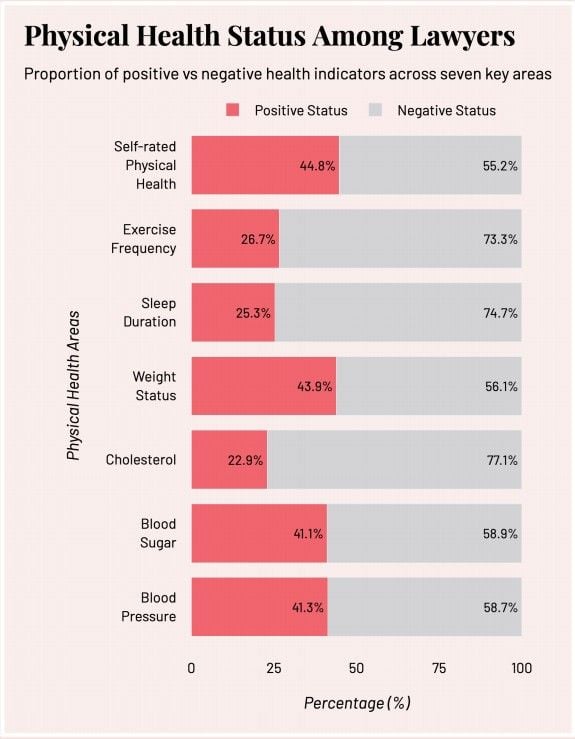
The Study also reported concerning baseline wellbeing among respondents: only 44.8 per cent rated their physical health positively, while 20 per cent met criteria for severe anxiety, 9.12 per cent for moderately severe depression and 9.82 per cent for severe depression.
Separately, 53 per cent said they would be most productive with full freedom over office hours, yet only 20 per cent had it, and 61 per cent contributed no pro bono hours.
The report explicitly rejected the view that junior lawyers lack resilience, arguing instead that the pattern of each generation criticising the next points to structural flaws in early-career roles rather than generational deficiency.