When showing up is not enough: the lesson from PPP’s fight against walkovers
PPP's founding principle was that no party should ever let the PAP win a walkover. But Goh Meng Seng's own resignation letter, WP's calculated retreat from Marine Parade-Braddell Heights, and PPP's dismal Tampines result all suggest that showing up on a ballot isn't the same as giving voters a real choice.
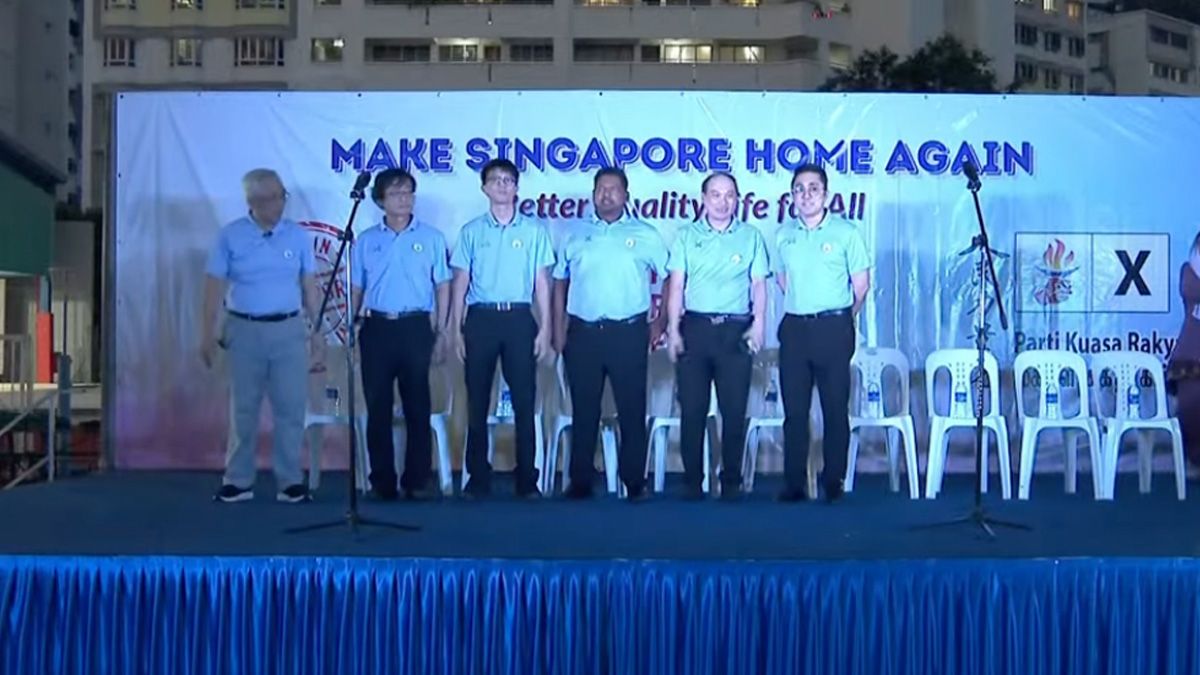

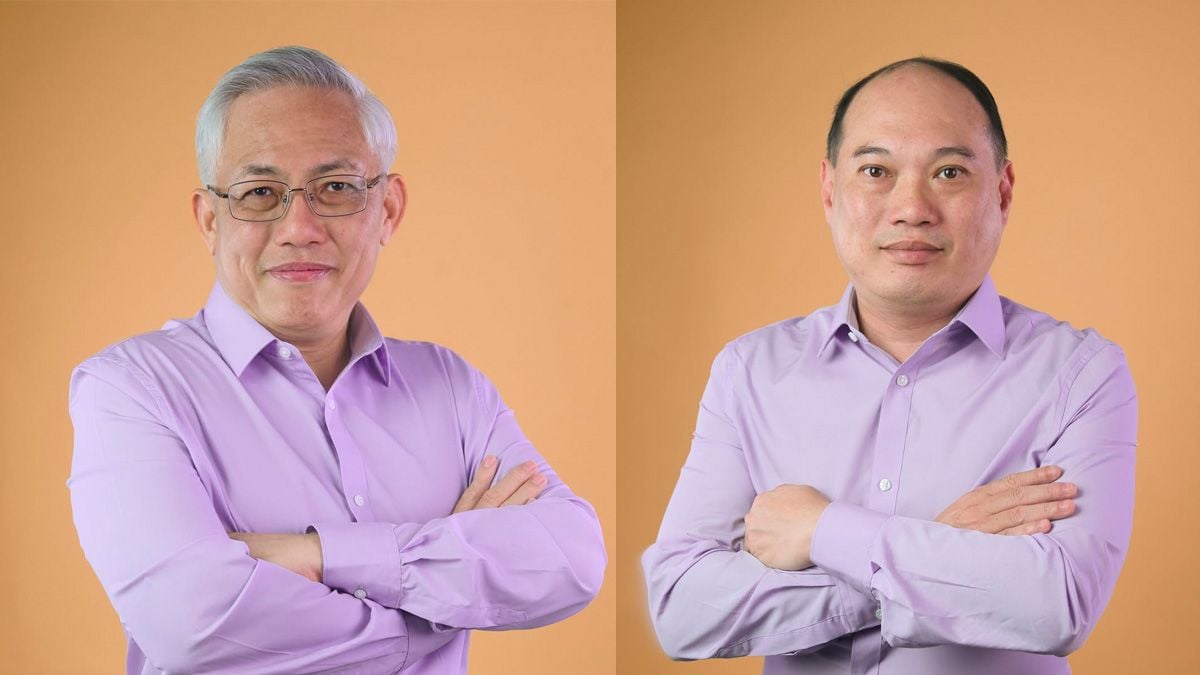
When William Lim Lian Chin used his first Facebook post as People's Power Party (PPP) secretary-general to pledge no walkovers and no unnecessary multi-cornered fights, he was not announcing a new idea. He was inheriting one. It belonged to Goh Meng Seng, the man he has just replaced, and it is worth asking, now that Goh has stepped back, whether the idea was ever sound in the first place.
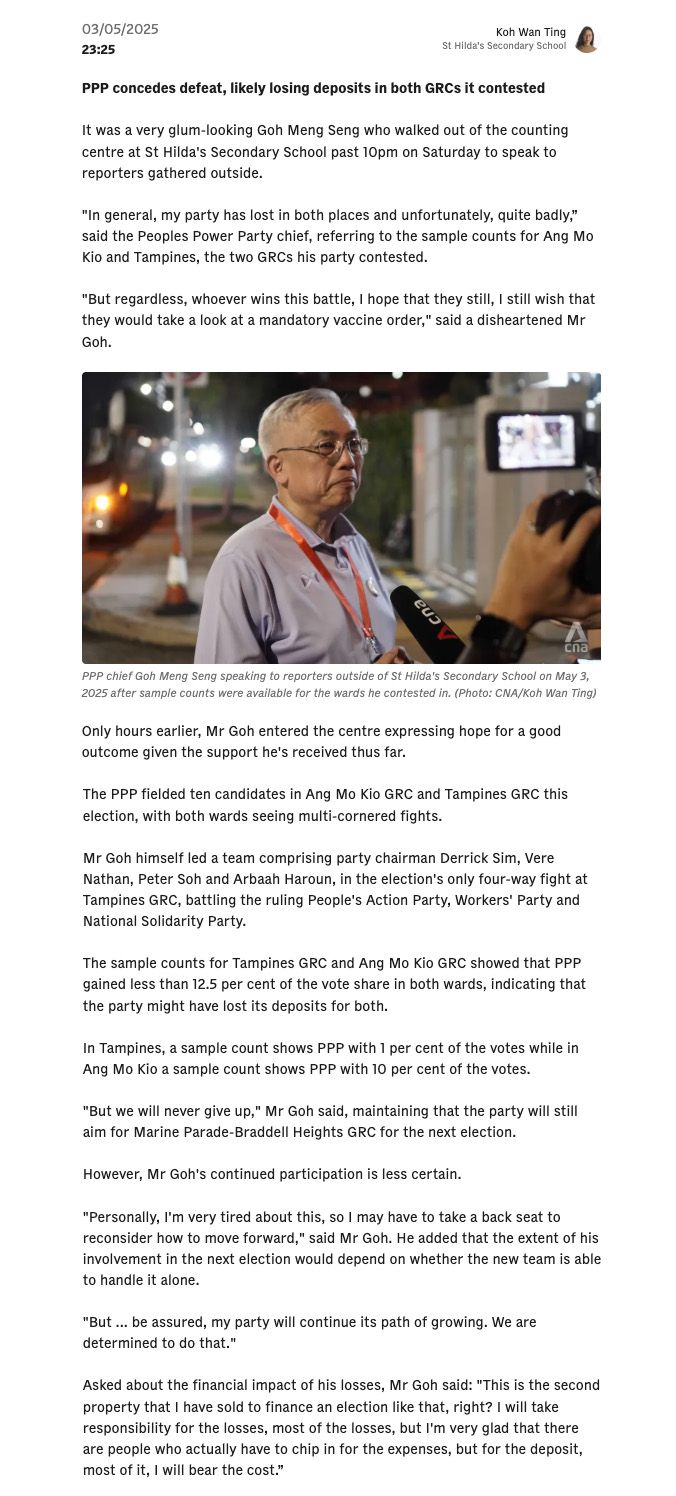
Go back to 24 April 2025. At a rally in Tampines, Goh was visibly upset, accusing the Workers' Party (WP) of "betraying" 130,000 voters by not fielding a team in Marine Parade-Braddell Heights GRC.
He called the decision "purely irresponsible," said WP's slogan of "working for Singapore" rang hollow if it meant "you deprive 130,000 voters [of] their right to vote," and dismissed WP as a "last-minute spoiler party".
Weeks later, he went further, declaring PPP itself would contest the seat at the next election, as if to prove a point WP had supposedly failed to grasp.
It was not the first time Goh had made this exact accusation. In 2011, as then secretary-general of the National Solidarity Party (NSP), he criticised WP for pulling out of Marine Parade-Braddell Heights GRC at the last minute, handing the PAP another walkover there, while Goh himself led NSP into a first contest of its own in Tampines GRC. Same seat, same complaint, same choice of Tampines as his personal battleground, fourteen years apart and under two different parties.
That fixation did not stay in 2011, or in April 2025. It resurfaced this week in the PPP's Central Executive Committee statement announcing Goh and former chairman Derrick Sim's departure, and again in Lim's own inaugural message, both promising to avoid the very outcome Goh had spent over a year condemning WP for choosing.
The irony is that Goh's own resignation post, "A New Chapter", undercuts the principle he is bequeathing to his successor.
In that post, Goh described himself as "old fashioned," attached to assumptions that had shaped his politics for decades. Chief among them: that no party in the opposition camp would allow the PAP an uncontested walkover if it had the resources to contest, and that Singaporean voters ultimately rewarded parties for showing up.
He now says both assumptions were wrong. What he did not say, but what the record shows, is that the Marine Parade walkover he attacked so bitterly was the clearest evidence of that error, not an aberration from it.
Start with what WP actually gave up and gained. Marine Parade-Braddell Heights GRC absorbed Tin Pei Ling's MacPherson SMC in the 2025 boundary review, folding a personal vote she had built since 2011 into a five-member team alongside established incumbents Tan See Leng and Seah Kian Peng.
It is the same mechanism that helped deliver Punggol GRC to the PAP with 55.17 per cent of the vote that year, after Sun Xueling's Punggol West following was merged into a new four-member team under Gan Kim Yong. Pritam Singh called the boundary changes a reset of "the playing board."
That is a description of ground where the incumbent had just been handed reinforcements, not ground being abandoned out of cowardice. Even with no opponent on the ballot, the PAP team still declared S$388,756 in election expenses for the walkover, comparable to what several contested GRCs spent that year. That is not the spending pattern of a seat anyone treated as a formality, contested or not.
WP was not short of money to make the point Goh wanted it to make. It was GE2025's biggest opposition spender by a wide margin, declaring S$1.64 million in expenses, roughly 70 per cent of it on ground and advertising. It chose not to spend that money reinforcing a seat freshly stacked in the incumbent's favour, and instead concentrated it where the return was highest: Tampines GRC, where it came within five points of winning outright.
That is not the profile of a party dodging a fight it could afford. The question was never whether WP could have improved its vote share in Marine Parade; Punggol's 55.17 per cent shows a merged incumbent vote is not unbeatable. It was whether the same manpower, candidates and money produced a better chance of a breakthrough elsewhere, and Tampines answered that.
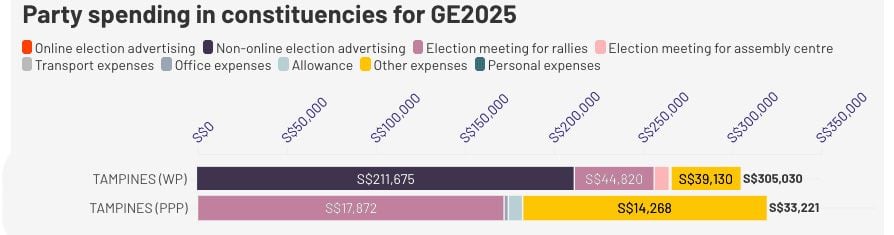
Compare that with what happened in the seat Goh chose to make his stand in. PPP's own campaign in Tampines cost S$33,221, roughly a ninth of the S$305,030 WP spent contesting the same GRC, and still returned 0.43 per cent of the vote against a S$67,500 deposit the team went on to forfeit.
NSP, which had held that seat alone for two elections prior on a slowly rising vote share, collapsed to 0.18 per cent the moment voters had a credible alternative. Between them, PPP and NSP's combined vote in Tampines came to well under one per cent, nowhere near enough to have changed WP's result even had it all gone to WP instead.
The multi-cornered fight Goh's principles demanded cost two small parties their deposits and cost the electorate nothing in genuine choice, because the choice had already been made before the ballots were printed, regardless of how much of that S$33,221 went into trying to change it.
That is the case against Goh's crusade in a sentence: he treated the willingness to contest as itself a form of service to voters, when the record he is now leaving behind shows the opposite is at least as often true.
A seat contested without groundwork, funding or a realistic path to winning does not offer voters a choice. It offers them a name on a ballot they will mostly ignore in favour of whichever option looks credible, and it costs the party making the gesture money it did not have to spare. WP's Marine Parade decision withheld exactly that kind of gesture, and its Tampines result is the strongest evidence available that the withholding was the more serious act of politics, not the less.
Whether PPP's new secretary-general has absorbed that lesson, or simply inherited his predecessor's slogan along with his old title, is the question the party's own founder has just handed him. Answering it requires PPP to work out where it actually goes from here, because the two seats it has just contested have both closed off.
Tampines has become WP's opposition ground in every sense that matters after 47.37 per cent and an NCMP seat. Ang Mo Kio offers only a repeat of the same three-way arithmetic against the Singapore United Party that produced 10.21 per cent for PPP and 10.84 per cent for SUP in 2025, two small parties splitting the same narrow sliver of protest vote with nothing to show either party has built anything the other hasn't. A party with no seat left to profitably lose again has to decide whether it wants to build one, and that means starting smaller, not bigger.
The obvious answer is a single SMC, contested repeatedly until the name becomes familiar. But Singapore's own recent history is a warning against treating that as a complete strategy.
Dr Chee Soon Juan, Secretary-General of the Singapore Democratic Party, spent nine years building exactly that kind of local presence in Bukit Batok SMC, lifting his vote share from 38.77 per cent in the 2016 by-election to a personal best of 45.2 per cent in 2020.
The 2025 boundary review folded Bukit Batok into Jurong East-Bukit Batok GRC anyway, and none of that accumulated local capital transferred with it. Dr Chee had to start again in a newly created seat, Sembawang West SMC, posting 46.82 per cent there on what looks like his own travelling reputation rather than anything specific to nine years of Bukit Batok groundwork, none of which survived the redraw.
The lesson isn't that single-seat investment is worthless, it's that a single, isolated seat is a lease the Electoral Boundaries Review Committee (EBRC) can terminate without a written explanation behind the rational for the redrawing of boundaries. The model that survives a redraw is a contiguous bloc, several adjacent wards held or contested by the same party, so that any new boundary line still falls inside territory the party already occupies.
SDP's Sembawang GRC, Marsiling-Yew Tee GRC and Sembawang West SMC form exactly that kind of connected patch in the north, which is presumably why Chee's relocation cost him so little in vote share. WP's Aljunied GRC, Hougang SMC and Sengkang GRC do the same on a larger scale for their electoral contests in the northeast. PPP, after a decade spent moving through Chua Chu Kang, MacPherson, Tampines again and Ang Mo Kio, has never held a single square kilometre of that kind of connected ground anywhere.
Building one from nothing would mean picking one unglamorous seat, treating the next two or three elections there as pure infrastructure rather than results to be judged individually, and only then expanding outward into whatever's adjacent. That is a multi-election commitment few of PPP's past campaigns suggest the party has the patience for.
It also assumes PPP wants to be that kind of party at all, which is its own open question. Derrick Sim was explicit that his own entry into politics was driven chiefly by concerns over vaccine safety and alleged vaccine injury, a cause with real, motivated support from a small base of donors but no sign of mattering to the mass electorate the way housing, wages and cost of living do.
Parties exist to aggregate voter interests into a governing alternative; advocacy groups exist to advance a specific cause. Confusing the two produces both a weak party and inefficient advocacy, and forfeiting a deposit every five years to make the same point a campaign group could make year-round is that confusion in practice.
That is the choice William Lim now faces under a slogan he did not write: commit PPP to years of unglamorous, single-seat groundwork it has never once attempted, or accept that the party's real asset was always the issue rather than the electoral vehicle carrying it, and stop paying deposits to make that point.
However, that choice may not be his to make. On the night of 3 May 2025, hours after Tampines had confirmed his own defeat, Goh told reporters outside a counting centre that "whatever the results come out for this election, we will work to build our party, and we will contest in Marine Parade-Braddell Heights in the next election."
That was not a stray remark, it was the same pledge behind his "130,000 voters betrayed" attack on WP, made on the record and never publicly withdrawn. Goh's resignation covers only his post as secretary-general and his CEC seat. If PPP honours it, the more likely outcome is not the restored choice Goh promised voters, but a multi-cornered fight with WP itself, should WP decide to reclaim the seat it walked over rather than leave it to a party that never contested there before.
PPP's case for entering would rest entirely on having refused to let 2025's walkover stand unanswered, a moral claim that costs it nothing to make and voters nothing to hear. Tampines already showed what that claim is worth in practice: NSP and PPP's combined vote there came to under one per cent, nowhere near enough to have changed WP's result even had it all gone to WP instead.
A repeat in Marine Parade-Braddell Heights would not meaningfully weaken WP's chances of reclaiming the seat; it would simply cost PPP another deposit to prove a point that changes nothing on the ballot. Goh would be handing his successor the chance to re-run Tampines' result in Marine Parade-Braddell Heights, in the name of the very principle his own exit letter says he got wrong.