Typhoon Bavi triggers mass evacuations and widespread flooding across China
More than 260,000 people were evacuated in northeast China as Typhoon Bavi brought torrential rain, flood warnings and major transport disruptions, while Taiwan reported injuries, power outages and agricultural losses after the storm moved north.
- More than 260,000 people were evacuated in Liaoning Province as Typhoon Bavi triggered severe flooding risks.
- Heavy rain disrupted transport, closed schools and businesses, and prompted flood emergencies across several Chinese provinces.
- Taiwan reported injuries, power outages and NT$22.71 million (US$706,000) in agricultural losses before the storm moved away.

More than 260,000 people were relocated to safety in northeast China's Liaoning Province on Monday as Typhoon Bavi moved northward, bringing torrential rain, flooding risks and widespread transport disruptions across several regions of the country, Xinhua reported.
Provincial authorities said most evacuees were from the city of Fushun, while emergency measures were intensified across Liaoning as heavy rainfall continued to batter the province.
According to official data, average rainfall across Liaoning reached 33.1 millimetres between 6am and 4pm on Monday. The highest cumulative rainfall, 207.2 millimetres, and the highest hourly rainfall, 66 millimetres, were both recorded in the provincial capital, Shenyang.
The Liaoning Provincial Meteorological Observatory warned that heavy rain would continue from Monday through Tuesday, with some areas expected to experience extreme downpours.
Flood warnings and emergency measures in northeast China
Five prefecture-level cities in Liaoning suspended work, classes and business activities. In Shenyang, authorities ordered all schools, kindergartens and training institutions to halt classes. Outdoor group activities and large gatherings were banned, while construction sites, tourist attractions and night markets were closed.
Continuous rainfall caused water levels to rise significantly in major rivers, including the Liaohe, Hunhe, Taizi and Puhe rivers. Liaoning's flood control and drought relief headquarters convened emergency meetings and coordinated disaster response operations, focusing on river systems, reservoirs and other vulnerable locations.
The provincial water resources department also deployed expert teams to monitor inflows, assess flood discharge capacity and strengthen forecasting and early-warning systems.
Shenyang issued a red flood alert on Monday and raised its flood-control emergency response to the highest level. Meteorological authorities forecast cumulative rainfall of between 60 and 160 millimetres in the city through Tuesday.
Heavy rain led to waterlogging across several urban districts in Shenyang, while entrances to some metro stations were temporarily closed for safety reasons.
A storm surge of between 40 and 80 centimetres and waves reaching up to four metres were forecast along the coast of Dalian and the northern Yellow Sea from Monday afternoon through Tuesday.
Dalian raised its marine emergency response to Level II, prohibiting fishing vessels from leaving port and ordering offshore aquaculture workers ashore. Fishing boats were instructed to remain secured in harbour.
Rail and transport services disrupted
Rail services across northeastern China were significantly affected by the severe weather.
China Railway Shenyang Group adjusted train schedules and suspended numerous services between Sunday evening and Monday morning. Authorities advised passengers to check station announcements and updates through the official 12306 ticketing platform.
In neighbouring Jilin Province, heavy rain prompted multiple cities to suspend school attendance and restrict transport services. Railway operations were also disrupted, with high-speed train services at Jilin City station expected to resume on Thursday, while regular services will be restored gradually.
China's Ministry of Water Resources raised its flood emergency response to Level III in both Liaoning and Jilin provinces, warning of heightened risks from mountain torrents and flash floods.
Red and orange alerts were issued for several localities where forecast rainfall is expected to coincide with already flood-prone areas.
Further north, Heilongjiang Province issued geological disaster, flash flood and river flood warnings ranging from orange to blue levels as some areas were forecast to receive between 100 and 130 millimetres of rain from Monday to Wednesday.
In northwest China's Gansu Province, meteorological authorities warned of another round of heavy rain affecting Lanzhou and Linxia Hui Autonomous Prefecture, with local rainfall accumulations forecast at between 60 and 100 millimetres. Authorities issued flood and geological disaster warnings as risks of flash flooding and urban inundation increased.
Anhui evacuates thousands as reservoir levels rise
In eastern China's Anhui Province, Typhoon Bavi brought persistent rainfall from Sunday, causing flooding, landslides and rising reservoir levels.
In Qingyang County, Chizhou City, the area's largest reservoir exceeded its flood-control threshold. Local authorities reported flash floods, inundated roads and landslides across parts of the county.
More than 14,000 residents had been evacuated by Monday morning as emergency response teams were deployed to affected areas.
Officials from the Niuqiao Reservoir Management Office said reservoir water levels rose by approximately three metres following the rainfall, adding around three million cubic metres of water storage.
The Qingyang County Water Resources Bureau activated a Level II emergency response for flood and drought prevention, while all ports and terminals along the Qingtong River suspended operations and vessels were ordered to remain in designated mooring areas.
Villages cut off in Hebei
Elsewhere in northern China, severe flooding affected parts of Hebei Province.
In Kuancheng County, Chengde, floodwaters damaged roads and cut off access to nine villages, leaving more than 1,800 residents stranded.
Emergency teams, firefighters and police personnel were dispatched with rescue equipment including kayaks, large drones and loaders. Authorities said evacuations and relief operations were continuing and affected residents were being moved to designated safe locations.
Taiwan hit by injuries, evacuations and power outages
Before Typhoon Bavi moved away from Taiwan, the storm caused widespread disruption across the island, injuring at least 113 people and forcing the evacuation of more than 14,600 residents, as reported by the Taipei Times.
According to Taiwan's Central Emergency Operations Center (CEOC), most injuries were linked to strong winds and slippery conditions, including people falling from motorcycles and bicycles, while others occurred during storm preparation efforts. No fatalities or severe injuries were reported.
Authorities evacuated 14,605 residents from areas facing flood and landslide risks.
Hualien County recorded the largest number of evacuations with 5,182 people relocated, followed by Taichung with 2,096, New Taipei City with 1,700, Kaohsiung with 1,671 and Hsinchu County with 1,496. A further 763 people were awaiting evacuation late on Sunday.
Heavy rain triggered extensive landslide and debris-flow warnings. Taiwan's Agency of Rural Development and Soil and Water Conservation issued the highest-level red alerts for 45 locations, including areas in Hsinchu County, Taoyuan, Miaoli, Yunlin and Chiayi. Large-scale landslide warnings were also issued for locations in Hsinchu County and Taoyuan.
Yellow debris-flow alerts were issued for 214 streams across New Taipei City, Taoyuan, Yilan County, Hsinchu County, Miaoli County, Yunlin County and Chiayi County. Flooding and landslides disrupted transport in several mountainous regions, while roads in parts of Miaoli County were inundated or blocked by debris.
The storm also caused extensive infrastructure damage. Taiwan Power Company reported that 234,481 households lost electricity during the typhoon. By Sunday evening, power had been restored to about 96 per cent of affected customers, although more than 8,000 households remained without electricity, primarily in Hsinchu and Taoyuan.
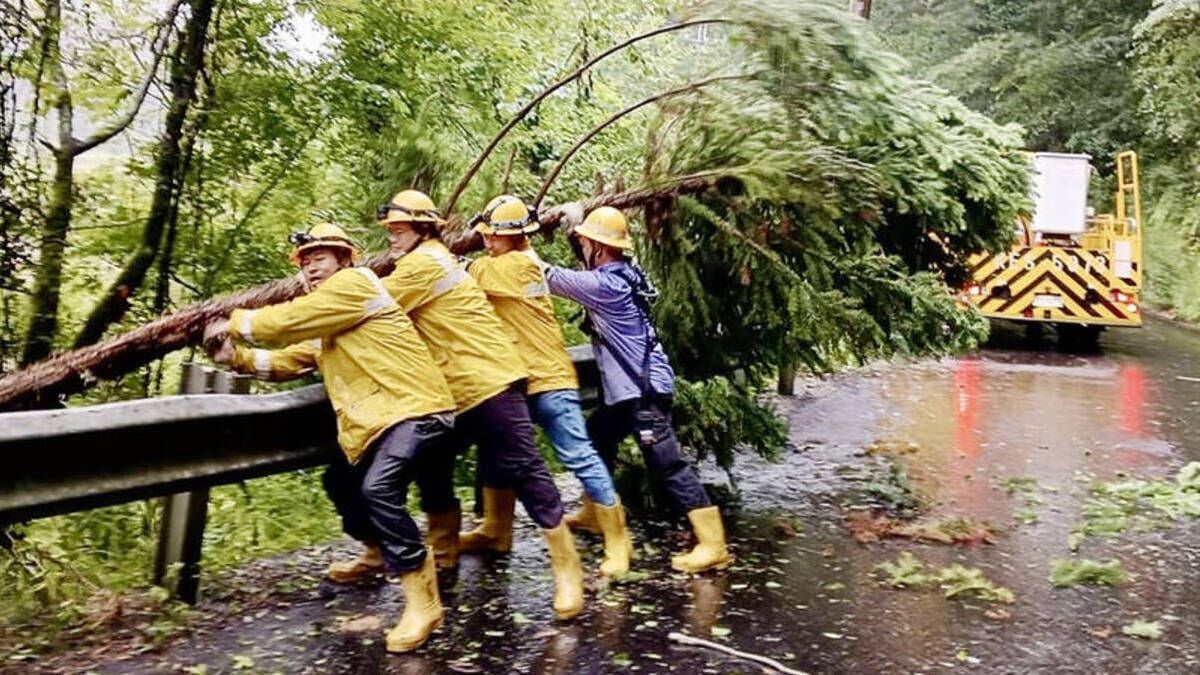
The CEOC received 2,156 reports of fallen trees, damaged infrastructure and property losses, particularly in Taipei and Taichung. Nearly 500 incidents had yet to be cleared by Sunday evening.
Although the storm weakened as it moved northward, authorities maintained school and workplace closures in several mountainous and remote districts due to ongoing rainfall, landslide risks and damaged infrastructure. The outlying Matsu Islands also suspended work and classes.
Taiwan lifts typhoon warnings
Taiwan's Central Weather Administration lifted all land and sea warnings for Typhoon Bavi on Monday morning as the storm weakened and moved away from the island.
The land warning was removed at 5:30am, followed by the sea warning three hours later. As of 8am, the centre of the storm was located about 410 kilometres north of the Matsu Islands and moving northwest.
Forecasters said the heaviest rainfall had occurred across western Taiwan and mountainous regions, particularly in northern areas. Cumulative rainfall reached 770.5 millimetres in Miaoli County, 743 millimetres in Hsinchu County and 608 millimetres in Taichung.
According to Taiwan's Central Emergency Operations Center, 134 people were injured during the storm, including six foreign nationals. More than 247,000 households experienced power outages, while over 4,200 households temporarily lost water supplies. Most services had been restored by Monday afternoon.
Agricultural losses reported in Taiwan
Taiwan's Ministry of Agriculture estimated nationwide agricultural losses from Typhoon Bavi at NT$22.71 million (US$706,000) as of Monday morning.
Miaoli County accounted for nearly 70 per cent of the losses, followed by New Taipei City, Hsinchu County, Taichung and Taoyuan.
Crop damage totalled NT$20.33 million, with persimmons suffering the largest losses at NT$12.55 million. Jujubes, first-crop rice, bitter melons and tomatoes were also affected.
Authorities reported damage across 226 hectares of farmland, with approximately 50 hectares rendered unharvestable. Additional losses included washed-away farmland, buried agricultural land and damage to greenhouse facilities.
Typhoon Bavi, the ninth typhoon of the year, made landfall twice along the coast of Zhejiang Province late on Saturday before moving inland. It followed Typhoon Maysak, which caused severe flooding and damage in southern China earlier this month.