The carrier and the credibility gap: how America's war on Iran is breaking the system it built
In the Persian Gulf, the enforcer’s bluff is being called by arithmetic. As the U.S. prosecutes a war with Iran, it has been forced to quietly grant sanctions relief to its own enemies just to cap petrol prices at home. When the "security umbrella" generates a crisis that the "petrodollar" cannot absorb, the system isn't just failing—it is breaking the very architecture it was built to protect.


There is a moment in every protection arrangement when the enforcer's bluff gets called. Not necessarily by a rival, but by arithmetic.
That moment appears to be unfolding in the Persian Gulf.
In the space of weeks, the United States has found itself simultaneously entering sustained direct military confrontation with Iran, watching oil prices surge toward levels not seen in years, and — as official Treasury documents now confirm — issuing sanctions relief on both Russian and Iranian oil exports to prevent American consumers from bearing the full cost of a conflict their own government initiated.
Meanwhile, the Strait of Hormuz remains contested. Houthi forces in Yemen have not yet made their next decisive move. And the Gulf Arab states that have spent decades anchoring themselves to America's security architecture are watching all of this and doing a calculation they have never had to do so openly before.
The question they appear to be asking is the same one that should eventually be asked of any security arrangement: Is the promise worth what we are paying for it?
The Three-Legged Stool
To understand why this moment matters beyond the immediate theatre of conflict, it helps to understand what the United States actually constructed over the past half-century — and why it required all three of its components to function together.
The first leg is the security umbrella. Aircraft carrier strike groups — the United States operates eleven of them, each costing upward of thirteen billion dollars to build and tens of millions a day to operate — are not primarily weapons platforms. They are instruments of presence and credibility.
Their message is not simply "we will destroy you." It is "we are already here, and the cost of challenging this order is certain." When a carrier group positions itself in the Persian Gulf or the South China Sea, it is communicating something to every actor watching: the framework is ours, and the commitment to enforce it is continuous.
The second leg is the petrodollar. In the early 1970s, the United States brokered an arrangement with Saudi Arabia and eventually the broader OPEC bloc: oil would be priced and traded in US dollars. Since every major economy needs oil, and oil requires dollars, every central bank in the world became permanently obligated to hold dollar reserves.
This creates sustained structural demand for American currency, allowing the United States to run deficits that would destabilise any other nation's economy. The carriers protect the oil. The oil sustains the dollar. The dollar funds the carriers. The loop is self-reinforcing — as long as all three components hold.
The third leg is the financial network — SWIFT, dollar-denominated correspondent banking, the institutional capacity to exclude any nation from the global payments system through a political decision in Washington.
This is the silent instrument. A country that defies the rules does not just face military consequences; it faces economic isolation. Its banks cannot transact internationally. Its importers cannot pay. Its exporters cannot receive. The sanctions regimes applied to Iran, Russia, and others represent this leg in operation.
What makes the architecture powerful is not any single component but their interdependence. Each leg reinforces the others. Weaken one under sustained pressure, and the credibility of the remaining two becomes a question rather than an assumption.
A War Every Previous President Declined
There is a reason every American administration from Clinton to Biden looked at Iran and reached for different instruments — sanctions, cyber operations, proxy pressure, targeted strikes on specific actors — rather than direct military confrontation at scale. It was not lack of capability. It was recognition of exactly the feedback dynamics that now appear to be unfolding.
The current administration appears to have entered this conflict drawing on a different model: the Venezuela template, where financial isolation combined with oil dependency created concentrated leverage that produced rapid political movement at manageable cost.
Iran is structurally incomparable. It has distributed military capacity across multiple proxy networks spanning Lebanon, Yemen, Iraq and Gaza. It holds direct leverage over the world's most consequential shipping chokepoint. And its economy, while severely damaged by decades of sanctions, has partially adapted to operating outside dollar clearing channels — a structural adjustment that prolonged pressure paradoxically accelerated.
The variables that made Venezuela a manageable pressure campaign are precisely the variables Iran does not share. A small shop and a regional kingpin require different approaches; confusing the two is not a tactical error but a strategic one.
It is worth noting, in this context, that Trump publicly framed the Venezuela operation partly in terms of restoring American oil company access to the country's energy infrastructure. In remarks reported by CNN, he characterised Venezuela's nationalisation of oil assets as "the greatest theft in the history of America," adding that US companies would "go in and rebuild their system."
Venezuela holds roughly a fifth of the world's proven oil reserves, and its heavy crude is particularly compatible with US Gulf Coast refineries that were configured over decades to process it. The policy language therefore reflected not only political objectives but also structural energy considerations. Resource access has always been intertwined with security architecture.
That framing does not sit in isolation. It illustrates what the security umbrella has consistently been organised around: not abstract rules-based order, but access to resources on terms compatible with American industrial and strategic requirements. Iran, which sits astride the world's most critical oil transit chokepoint and has resisted American terms for decades, represents the same logic operating at a different scale. The pattern is structural, not incidental — and structural patterns tend to repeat until the system that produces them changes.
Successive administrations recognised this asymmetry. The decision to move toward direct military confrontation did not reflect new intelligence or a fundamentally changed strategic environment. It reflected a commander-in-chief who appears not to have fully modelled what those administrations had quietly concluded: that the costs of open war with Iran — measured in economic feedback to American consumers, regional destabilisation, and damage to the extended deterrence architecture — exceed the costs of managing Iran through instruments short of direct conflict.
The system is now absorbing that miscalculation.
The Contradiction at the Centre
What is becoming visible in the Gulf is not primarily a military setback. It is a systemic contradiction made public.
Markets have demonstrated acute sensitivity to the conflict's energy dimension, with oil prices tracking toward levels that translate immediately into fuel costs that voters feel at every petrol station. The policy response is now on the public record.
On March 19, 2026, the US Treasury's Office of Foreign Assets Control issued General License 134A, authorising the sale and delivery of Russian-origin crude oil loaded on vessels through April 11. The following day, March 20, OFAC issued General License U, authorising the sale, delivery, and — explicitly — the importation into the United States of Iranian-origin crude oil loaded on vessels through April 19.
In the space of 24 hours, the administration granted sanctions relief to both of the adversaries its military posture is nominally designed to contain.
The structure of this cannot be overstated. The financial enforcement leg of the system — the instrument that is supposed to make defiance costly — was partially suspended for both Russia and Iran simultaneously, not by diplomatic settlement or strategic concession, but by the domestic political arithmetic of petrol prices. The three-legged stool did not require an external actor to kick out a leg. The enforcer removed it himself.
What makes this more consequential than a temporary carve-out is the provenance problem buried in both licenses. Each instrument authorises transactions for oil "loaded on vessels on or before" a specific cutoff date — a formulation designed to look like a narrow emergency measure rather than a broad opening. But it functions as something closer to the latter, because verifying the provenance and loading date of crude oil in real time is not practically possible.
The shadow fleet that Iran and Russia have operated for years to circumvent sanctions exists precisely to defeat that verification. Ship-to-ship transfers in international waters, flag changes mid-voyage, falsified bills of lading, cargoes blended across origins — these are standard operational practice for sanctioned oil, and the traders, intermediary banks, and refineries handling it have spent years building the institutional knowledge to do so with plausible deniability.
Iranian oil never actually stopped moving during the sanctions regime. What sanctions imposed was friction and legal risk — compliance costs for banks, insurance exposure for intermediaries, reputational and enforcement risk for refineries. That friction never stopped the trade; it priced it at a discount and pushed it through less transparent channels.
GL U does not merely create a 30-day window for legitimate cargoes to clear. It temporarily removes the legal exposure that made the friction costly. And once oil of uncertain provenance moves through a licensed transaction — payment settled, documentation filed, cargo delivered — it cannot be re-contaminated. The chain is clean.
The practical consequence is that any crude cargo that can be credibly described as Iranian-origin loaded before March 20 now trades freely, and with the shadow fleet's documentation infrastructure, that description is available for almost any cargo a motivated trader wants to move. The burden of proof has shifted: it is now OFAC's obligation to disprove a loading date claim, a process that requires months of vessel-tracking analysis long after the transaction has settled and the money has moved.
Iranian oil sanctions have not been suspended on paper. They have been effectively ended in practice for any operator willing to use the evasion infrastructure that was already mature before this license was issued. The administration has maintained the form of the weapon while quietly discharging its function.
Let that structure sit for a moment. A war conducted partly under the rationale of containing Iranian and Russian influence appears to have generated economic consequences that are forcing sanctions relief toward both. The military leg of the system has produced a crisis that the domestic political base cannot absorb — and the resolution requires partially disarming the financial enforcement leg. All three components stressed simultaneously by a single strategic decision.
This is not a failure of execution. It is a design vulnerability becoming visible under conditions of simultaneous pressure — the kind of vulnerability that only reveals itself when the system is actually used at scale.
The architecture was built for an era in which American economic and energy dominance meant sanctions were a one-directional weapon with limited domestic blowback. What the trajectory of this conflict suggests is that the world's continued dependence on Gulf energy creates a feedback loop that runs directly back into American consumer prices and therefore American electoral politics. Iran, by contesting the Strait of Hormuz, appears to have found the precise pressure point where the cost of escalation falls on American households rather than on American adversaries.
The Escalation the Markets Are Not Pricing
There is a next phase to this conflict that mainstream commentary has not yet adequately accounted for.
Houthi forces in Yemen have already entered the theatre, demonstrating that Iran's network of aligned actors is prepared to operate in coordination across multiple fronts. Their most consequential remaining option is not continued missile strikes. It is a comprehensive interdiction of the Bab el-Mandeb strait and the Red Sea corridor.
The Strait of Hormuz carries approximately one-fifth of the world's oil supply. The Red Sea and Suez Canal corridor carries an additional ten to twelve percent of global oil flow, along with a substantial share of liquefied natural gas and container shipping. These are not independent chokepoints. They are sequential vulnerabilities in the same supply chain.
The combined effect would be multiplicative rather than additive. Hormuz disruption produces a price shock. Red Sea interdiction produces a logistics shock. Together, they generate a third effect that is often overlooked: an insurance crisis. Lloyd's of London and the global maritime insurance market price risk continuously.
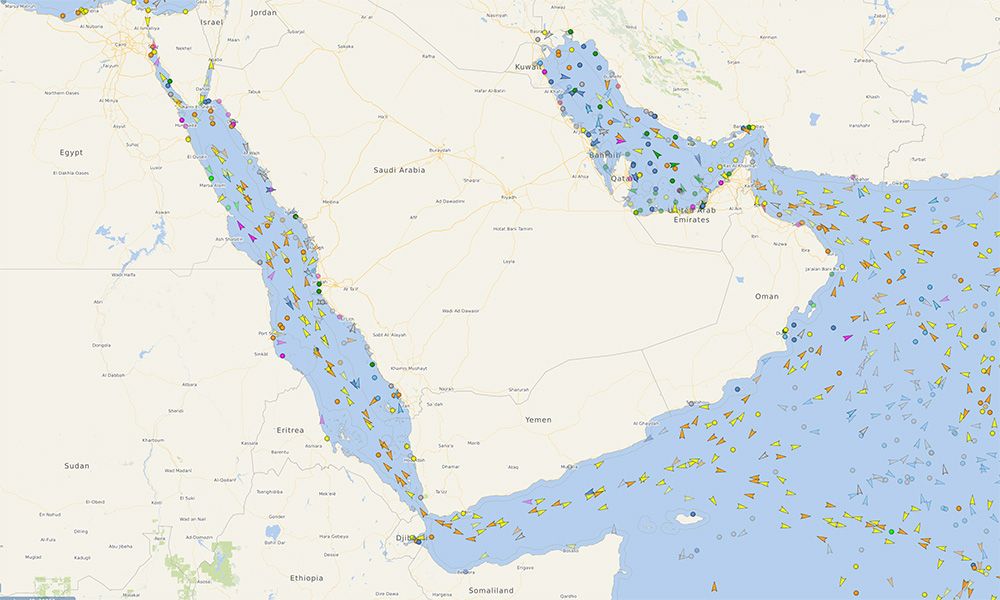
(AIS vessel tracking data, March 31, 2026. The thinning of traffic through the Bab el-Mandeb strait (bottom centre, near Djibouti) and clustering of vessels at anchor in the Persian Gulf (upper right) reflects the insurance and routing disruption the article describes — the invisible chokepoint operating independently of military presence.)
Even if a carrier strike group is physically present in a contested waterway, if underwriters determine that the risk of operating there is commercially uninsurable, the oil does not move. The carrier cannot compel a commercial insurer to cover a voyage it has assessed as unacceptably dangerous. This is the invisible chokepoint — not military but actuarial — and it operates independently of whatever the fleet is doing.
Tankers forced to reroute around the Cape of Good Hope add weeks to delivery times and substantially increase operating costs on top of the price and insurance effects. At the threshold where both chokepoints are simultaneously contested and the insurance market has effectively closed, no policy lever available to Washington substitutes for physical access.
Iran retains mutual vulnerability here — sustained Hormuz closure damages Iranian export capacity alongside everyone else's. But the pain tolerance on each side is not equivalent. For Iran, extended economic disruption is a continuation of the sanctions-era damage it has been absorbing for decades. For the United States, it is a new and politically acute domestic crisis arriving during an active electoral cycle. Regional actors appear increasingly aware of this asymmetry and are preparing their positions accordingly.
The Arithmetic of the Bluff
There is a second dimension to the carrier's credibility problem that is playing out in real time and that the cost figures alone do not fully capture.
A modern carrier strike group operating in a threat environment saturated with cheap precision munitions — Iranian ballistic missiles, Houthi-operated drones, cruise missiles derived from Chinese and Russian designs — must dedicate a substantial and growing share of its capacity to layered self-defence. Aegis combat systems, electronic warfare suites, submarine screening, and distributed fleet positioning are all designed to protect the carrier itself. Each intercept of an incoming threat involves an asymmetric expenditure: a two-million-dollar missile fired to neutralise a twenty-thousand-dollar drone.
The arithmetic of attrition runs in one direction only. A fleet that is increasingly absorbed in managing its own survivability is not projecting power at full capacity — it is demonstrating, with every intercept, the upper bound of what cheap munitions can impose on expensive platforms. The carrier is not obsolete. Its deterrent signalling value remains real. But its operational envelope has contracted, and adversaries have now mapped that contraction through direct observation rather than theoretical modelling.
This is not the story that carrier proponents tell. It is the story that the operational record of this conflict is writing.
The Clients Are Recalculating
Perhaps the most consequential development in this conflict is not happening on any battlefield. It is happening in the foreign ministries of Abu Dhabi, Riyadh, and Doha.
The Gulf states have paid into the American extended deterrence architecture for decades — not just financially, through arms purchases and dollar reserve accumulation, but politically, through alignment with American regional policy at domestic political cost. The implicit contract was clear: in exchange, the monarchies received protection from external threats, regime security, and privileged access to American political and financial systems.
What they are observing now is Iranian ballistic missiles striking Gulf infrastructure, intercepts over major cities, and a United States that appears to be struggling to resolve a conflict it initiated, threatening escalation that would devastate regional infrastructure, and demonstrating through apparent sanctions relief that its financial enforcement tools have domestic limits it had not previously disclosed.
The second signal is quieter and more consequential. While Al Kaabi's column was circulating in English, UAE Foreign Minister Sheikh Abdullah bin Zayed Al Nahyan was on the phone — in Arabic, through formal diplomatic channels — with counterparts in Kenya, Iraq, Angola and Afghanistan.
The readout described discussions of "ways to strengthen international cooperation" and "joint efforts to consolidate security and stability at the regional and international levels."
Read plainly: the UAE Foreign Minister was not calling Washington. He was building his own coalition. A client that is assembling alternative diplomatic infrastructure while its security provider is still managing the crisis is not waiting for the guarantee to be delivered. It is already hedging against the possibility that it will not be.
Saudi Arabia, which has been quietly expanding engagement with China and signalling openness to non-dollar settlement experimentation within the BRICS+ framework, now has sharply renewed evidence that American security guarantees carry fine print. That fine print, as now revealed, appears to read: we will protect you as long as protecting you does not generate unacceptable domestic political costs, and we reserve the right to conduct military operations in your neighbourhood that increase your vulnerability without your prior consent.
That is not a security guarantee. It is a conditional service arrangement — with the conditions defined unilaterally by the provider, and the provider visibly constrained by its own terms.
What the Carrier Actually Promised
The aircraft carrier's strategic value was never purely about its capacity to project violence. It was about the credibility of the commitment it embodied — the belief, maintained continuously in the minds of allies and adversaries alike, that American enforcement was certain, sustained, and not subject to domestic political override.
That credibility rested on three assumptions now simultaneously under pressure.
The first was that the carrier strike group maintains a credible deterrent across the full spectrum of regional threats. As discussed above, the cost of dominance has materially increased. The operational envelope has visibly contracted.
The second was that the United States has the domestic political will to absorb the costs of continuous enforcement. The trajectory of sanctions policy in this conflict suggests that it does not — at least not when those costs appear at the petrol station during an electoral cycle. This is the constraint that previous administrations managed by staying below the threshold of direct confrontation. Once crossed, it is difficult to manage from above.
The third was that the rules the carrier enforces are predictable and consistent. When military strikes occur during active diplomatic talks — the pattern observers have noted in the current conflict — it communicates that the rules are instrumentalised rather than principled. The violation of Turkish NATO airspace by Iranian ballistic missiles on at least four occasions, with no collective Article 5 response triggered, adds a further dimension: the alliance framework itself is being stress-tested and found to have thresholds that adversaries are now mapping in real time. Clients and adversaries who understood this intellectually are now watching it demonstrated operationally. The effect on credibility is gradual but cumulative, and it compounds with each iteration.
The hardware has not changed. What has changed is the perception of what the hardware actually guarantees — and perceptions, in extended deterrence architecture, are the mechanism by which the hardware functions.
The Reckoning
The United States built a system in which military presence, monetary primacy, and financial network control were mutually reinforcing. For decades, this system was resilient because its components were not simultaneously stressed. Military action was contained. Sanctions were applied to states too economically isolated to generate systemic feedback. The dollar faced no credible alternative infrastructure at scale.
What the trajectory of the Iran conflict suggests is what happens when those feedback loops reverse under simultaneous pressure. Military action raises energy prices, which stresses the domestic political base, which constrains military options, which reduces the credibility of the security commitment, which causes clients to recalculate their arrangements, which weakens the petrodollar logic, which reduces the leverage that financial enforcement depends on.
This is not a sudden collapse. Hegemonic systems demonstrate path dependence and institutional inertia. The dollar will not be replaced next quarter. The carriers will not be recalled. The Gulf states will not publicly terminate their security relationships. Structural shifts of this kind move through gradual redistribution — currency diversification, procurement hedging, parallel payment infrastructure, selective decoupling — rather than dramatic discontinuity.
But gradual is not the same as reversible. The historical pattern when mutually reinforcing systems face simultaneous stress — the gold standard under the pressures of the First World War, Bretton Woods in the early 1970s, the institutional frameworks tested in 2008 — is that they do not return to their pre-stress configuration. They adapt into something different. And the actors who begin repositioning earliest tend to capture the most of whatever emerges.
Saudi Arabia is watching. The UAE is watching. China is watching. What they are all observing is an enforcer whose domestic constraints have been made visible, whose rules have been revealed as contingent, and whose credibility — the credibility on which the system depends — has been partially called into question.
The carrier is still sailing. The commitment is still formally in place. But the neighbourhood is starting to wonder whether the protection payment is due for renewal — and on what terms.
The Online Citizen is an independent media platform based in Taiwan. This piece reflects the editorial analysis of the author.