Singapore replaces PES status with medical exemptions in biggest NS overhaul since 2009
Singapore will replace its decades-old Physical Employment Standard grading system with personalised medical exemptions for national servicemen enlisting from October 2027, allowing around 1,200 servicemen annually to access vocations previously denied to them.

- PES grading replaced by individual medical exemptions for enlistees from October 2027
- Around 1,200 servicemen annually will gain access to previously ineligible vocations
- Three new basic training programmes will be assigned based on each recruit's exemptions

Singapore will replace its decades-old Physical Employment Standard (PES) grading system for national servicemen with a set of personalised medical exemptions, the Ministry of Defence (MINDEF) and Ministry of Home Affairs (MHA) announced on 13 April 2026.
The change, described as the most consequential update to the Medical Classification System (MCS) since 2009, will apply to Singapore Armed Forces (SAF) pre-enlistees enlisting from October 2027 and Home Team (HT) pre-enlistees from November 2027. Medical screening for these cohorts will begin from end-June 2026.
Around 1,200 servicemen annually are expected to gain deployment in vocations and roles they would previously have been ineligible for under the existing framework.
Minister for Defence Chan Chun Sing said the refresh was designed to let servicemen best fulfil their potential while ensuring that the safety of full-time national servicemen (NSFs) and operationally ready national servicemen (NSmen) is never compromised.
"Today, actually, there are many forms of what we call combat fitness – it's not just the usual muscular activities that you can do in the past that matter," Chan said, noting that changes in the nature of warfare had rendered earlier distinctions between combat-fit and non-combat-fit, and frontline and rear, increasingly outdated.
"Technology has enabled many of our people to do more and to do better, so [these changes] allow our people to fulfil their potential and to do what they are most suited for."
From PES grades to medical exemptions
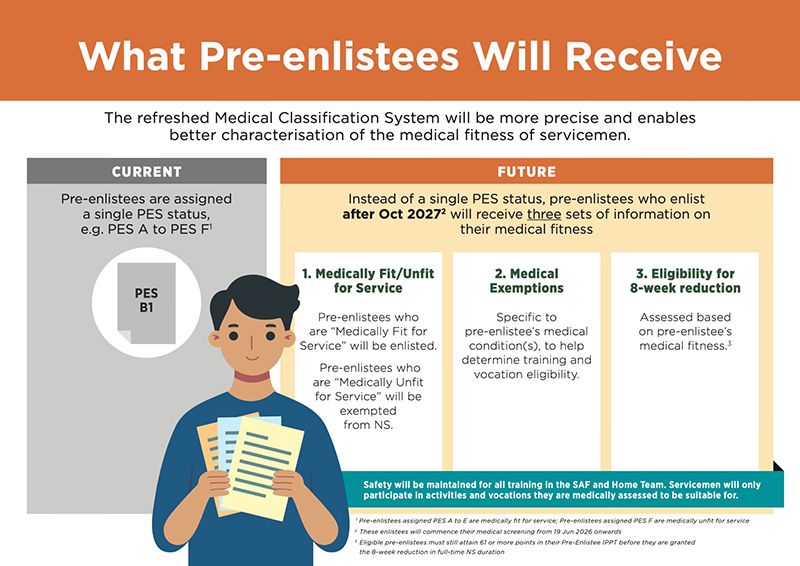
Under the existing MCS, which has been in use since the 1970s, each serviceman is assigned a PES status that broadly determines whether they are fit or unfit for combat roles. That aggregated status will be replaced for new enlistees by three specific categories of information.
Pre-enlistees will first be informed whether they are medically fit or unfit for service. Those assessed as medically fit will proceed to enlist; those deemed medically unfit will be exempted from national service (NS).
Eligible servicemen will then receive specific medical exemptions corresponding to their individual medical conditions and functional abilities, rather than a broad PES classification. These exemptions will determine which activities and vocations they may undertake during their NS journey.
They will also be told whether they qualify for an eight-week reduction in their full-time NS duration. To receive this reduction, a pre-enlistee must attain 61 points or more in their pre-enlistee Individual Physical Proficiency Test (IPPT), with at least one point at each station.
Pre-enlistees will be able to view their medical fitness results on the OneNS platform approximately two months after their screening appointment.
Existing NSFs and NSmen will retain their PES status unless their personal medical conditions change. MINDEF and MHA said the current PES system remains robust and safe for determining training and deployment eligibilities for those already serving.
Three training programmes to replace single track
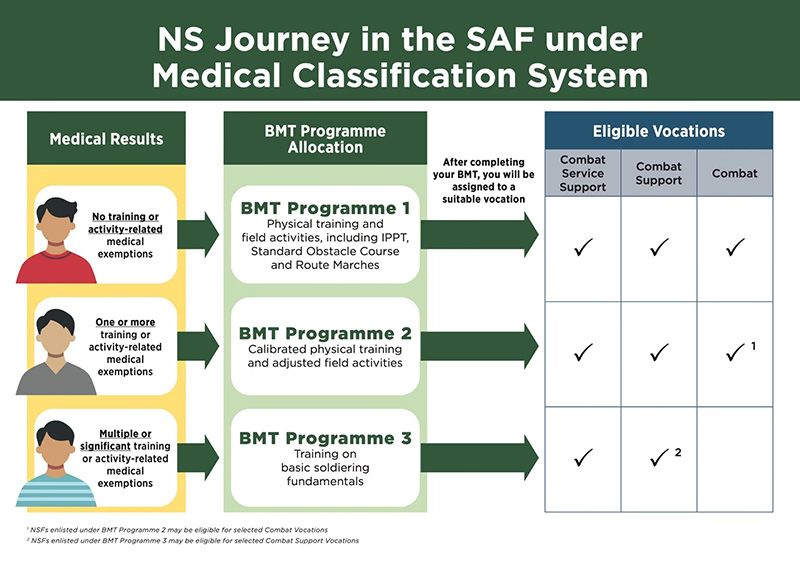
Alongside the classification change, the basic military training (BMT) regime will be restructured. Recruits will be assigned to one of three programmes depending on their medical exemptions.
Programme 1 will cater to pre-enlistees with no training or activity-related medical exemptions. They will undergo full physical training, including the IPPT, Standard Obstacle Course (SOC), route marches and field training, over a 17-week duration. They will be eligible for all vocations, including combat roles such as infantry and guards.
Programme 2 will be for pre-enlistees with one or more training or activity-related exemptions. It involves calibrated physical training and adjusted field activities over nine weeks. Participants will be eligible for combat support and combat service support vocations, and some combat vocations.
Programme 3, also nine weeks in duration, will apply to those with multiple or significant training or activity-related exemptions. It focuses on basic soldiering fundamentals, with eligibility restricted to combat service support roles and some combat support vocations such as signal operators and medics.
The Singapore Civil Defence Force (SCDF) will apply the same three-programme structure to its Basic Rescue Training (BRT), and the Singapore Police Force (SPF) will do likewise for its Police Officers Basic Course (POBC), from November 2027.
Obese pre-enlistees, assessed as having a Body Mass Index (BMI) above 27.0, will follow existing protocols and serve longer BMT durations to build physical fitness progressively.
Wider vocational access illustrated
The potential impact of the change is illustrated by an example cited in the fact sheet accompanying the announcement. An enlistee who has recovered from a torn anterior cruciate ligament (ACL) would, under the refreshed MCS, be eligible for combat vocations such as commandos and naval divers. Under the current system, such a person would be assigned PES B2 and remain ineligible for SOC training.
BMT Centre Head of Training and Learning Development, Major Dean Amir Singh, said training under the refreshed MCS would remain largely the same, with calibrations allowing recruits with certain exemptions to perform modified versions of activities.
"We want to try to reduce the pool of people who do not participate at all," Major Singh said.
He gave the example of lower limb injuries, where under the current system a recruit might be omitted entirely from physical circuit training. Under the updated MCS, the same recruit would do exercises that do not involve the injured area.
Training will be guided by a standardised list of medical exemptions, with clear guidelines for commanders and trainers on permissible and restricted activities. MINDEF said safety would remain a top priority for all training and deployment.
Commander of the Army Training and Doctrine Command, Brigadier-General Pang Lead Shuan, said the SAF was rolling out initiatives to assist trainers, including town hall sessions and train-the-trainer programmes.
SAF trials and operational context
The SAF conducted trials of the new approach in 2023 and 2024, covering BMT and other units, to assess whether training and administrative activities could be carried out effectively without relying on PES grades.
"The trials found that commanders and trainers were confident in using medical exemptions to guide training participation and conduct training safely," MINDEF said.
The operational rationale for the refresh was also rooted in the expanding range of roles across the SAF and HT. The establishment of the Digital and Intelligence Service within the SAF has introduced vocations such as cyberoperators. The Home Team has similarly added cybercrime operators, many of whom are NSFs.
Since 2021, the SAF has redesigned 2,000 roles across 25 vocations — including combat medics, infantry platform operators and army technicians — enabling more than 1,800 NSFs to be deployed in a wider range of operational roles than they were previously eligible for.
The decision was not driven by manpower shortfalls, Chan clarified. He noted that because the SAF knows the number of people who will enlist 18 years ahead of time, it designs operational concepts and fighting units accordingly.
"That is why it is not about addressing the here-and-now manpower needs," Chan said. "It is actually about planning forward, and how we best deploy our people."
In a parliamentary reply on 12 February 2026, Chan noted that an average of 21,300 NSFs were enlisted annually across the SAF and Home Team between 2021 and 2025, down from an annual average of 23,400 in the preceding five years. Around 10 per cent of each cohort enlisted into the police force, 8 per cent into the SCDF, and the remainder into the SAF.
In 2013, MINDEF data showed that 27 per cent of soldiers were PES A, 58 per cent PES B, 8 per cent PES C and 7 per cent PES E, with 2.5 per cent assigned to clerical or administrative roles. The current PES system was introduced in the early 1970s and has been incrementally refined over the decades, with the last major update in 2009, when the SAF introduced new BMT programmes for PES B2, PES C and obese enlistees.
In 2025, three out of four appeals by pre-enlistees seeking a review of their PES status were requests for an upgrade, according to MINDEF's fact sheet, indicating widespread demand for wider vocational access.
The refreshed MCS will apply to all regulars — both existing and future — from 2028.