Downtown Line reliability dips while Circle Line improves in March performance report
Singapore’s Downtown Line saw a decline in reliability in March, while the Circle Line improved, as overall MRT network performance remained stable, according to Land Transport Authority data released on 17 April 2026.

- MRT network reliability remained stable and above targets despite mixed line performance.
- Downtown Line declined while Circle Line improved; North East Line remained most reliable.
- LRT reliability fell and overall punctuality dipped slightly across most MRT lines.

Singapore’s MRT network maintained stable reliability levels in March, despite a dip in performance on the Downtown Line (DTL), according to data released by the Land Transport Authority (LTA) on 17 April 2026.
Overall network reliability remained unchanged from February, even as individual lines recorded mixed results.
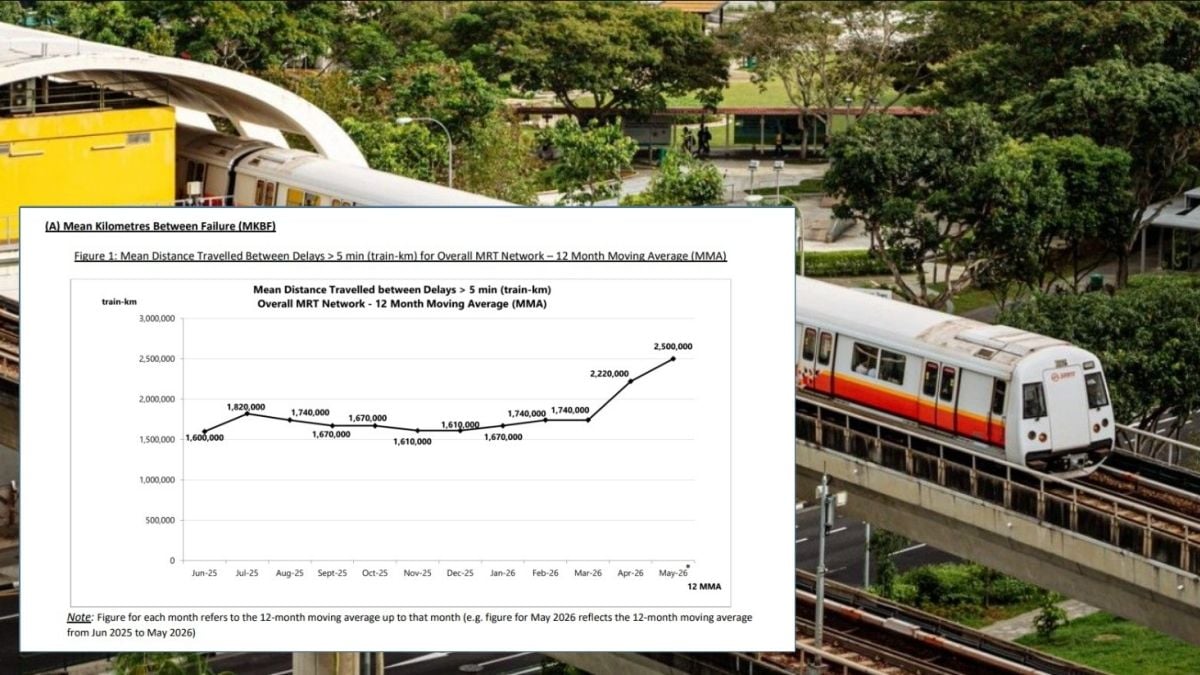
Reliability is measured using mean kilometres between failure (MKBF), which tracks the average distance travelled before a delay exceeding five minutes occurs.
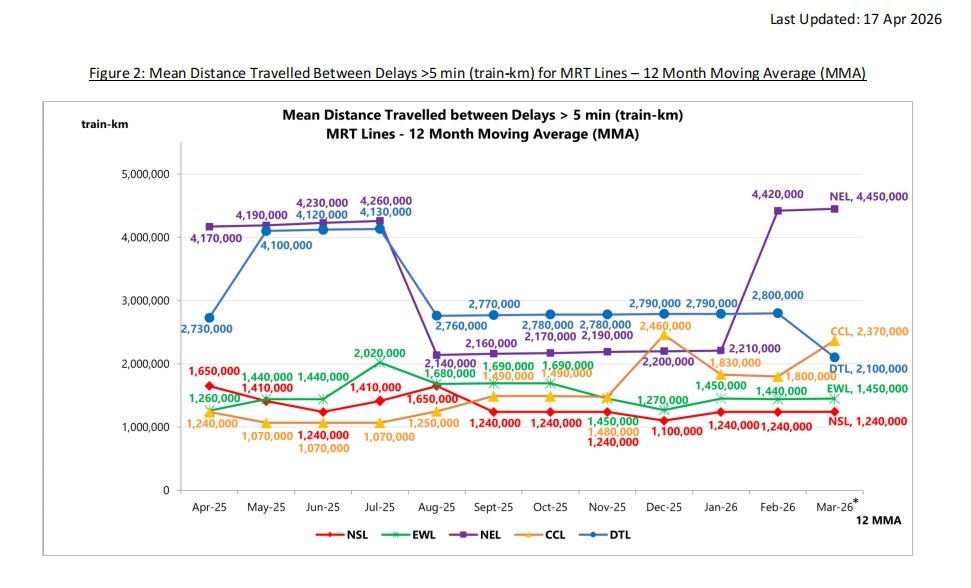
Between April 2025 and March 2026, MRT trains averaged 1.74 million train-kilometres between delays exceeding five minutes.
This figure surpasses Singapore’s rail reliability target of one million train-kilometres, indicating that the network continues to perform above baseline expectations.
The MKBF metric is widely used in engineering to assess system reliability, reflecting how far trains can travel before encountering significant disruptions.
North East Line leads reliability rankings
The North East Line (NEL), operated by SBS Transit, remained the most reliable line.
Its performance improved slightly to 4.45 million train-kilometres, up from 4.42 million in February.
The Circle Line (CCL), operated by SMRT, ranked second and recorded the most notable improvement.
It averaged 2.37 million train-kilometres between delays, rising from 1.8 million the previous month.
Downtown Line records decline
The Downtown Line (DTL), also operated by SBS Transit, slipped to third place after its reliability dropped.
Its MKBF fell from 2.8 million train-kilometres in February to 2.1 million in March, following a delay exceeding five minutes.
The East-West Line (EWL) and North-South Line (NSL), Singapore’s oldest rail lines and operated by SMRT, ranked fourth and fifth respectively.
EWL recorded a slight improvement to 1.45 million train-kilometres, while NSL remained unchanged at 1.24 million train-kilometres.
Thomson-East Coast Line still stabilising
The Thomson-East Coast Line (TEL), Singapore’s newest MRT line, recorded a drop in performance due to three delays exceeding five minutes in March.
Its MKBF declined from 415,000 train-kilometres to 374,000 train-kilometres.
However, LTA noted that TEL’s performance is not included in overall network reliability figures.
“MRT lines in their early stages… tend to see significantly lower mileage due to relatively low ridership and trains not running at typical frequencies,” LTA stated.
The line is still being rolled out in phases, with its fifth and final stage — including Bedok South and Sungei Bedok stations — scheduled to open in the second half of 2026.
LTA added that meaningful comparisons with other lines can only be made once the line is fully operational and stabilised.
Punctuality dips slightly
Train punctuality across five MRT lines declined marginally in March.
The proportion of trips completed within two minutes of schedule slipped from 99.46 per cent to 99.434 per cent.
Despite the overall dip, both EWL and NSL recorded improvements.
EWL rose from 99.17 per cent to 99.54 per cent, while NSL improved from 99.27 per cent to 99.35 per cent.
The remaining lines saw slight declines in punctuality.
TEL, which is excluded from overall punctuality calculations, recorded a rate of 99.22 per cent, down from 99.37 per cent in February.
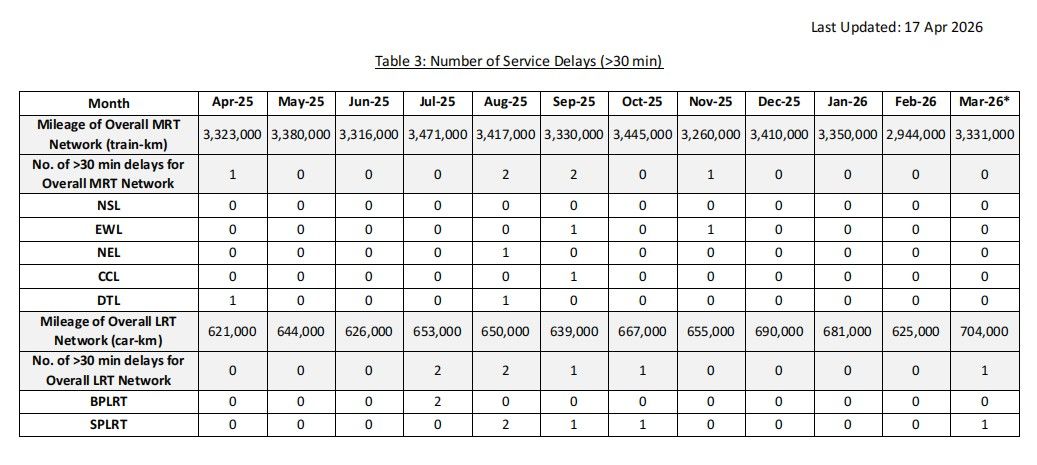
Across the MRT network, no delays exceeding 30 minutes were recorded in March.
This indicates a continued absence of major service disruptions across the rail system.
LRT network sees decline
In contrast, the Light Rail Transit (LRT) network recorded a decline in reliability.
There was one major delay exceeding 30 minutes on the Sengkang-Punggol LRT system, operated by SBS Transit.
Its reliability dropped to 749,000 car-kilometres between delays, from 860,000 the previous month.
The Bukit Panjang LRT, managed by SMRT, also saw a decrease from 200,000 to 186,000 car-kilometres.
Overall, the LRT network’s reliability fell from 410,000 car-kilometres in February to 374,000 car-kilometres in March.
Monthly updates introduced after disruptions
LTA has been issuing monthly reliability updates since August 2025 to provide commuters with greater transparency on the rail network.
Prior to this change, reliability statistics had been released on a quarterly basis.
The shift followed a series of rail disruptions that increased public scrutiny of Singapore’s train system.