Singapore blocks six suspected foreign-linked websites posing as local news outlets
Singapore has blocked six websites posing as local news outlets, citing risks of hostile information campaigns by foreign actors, though authorities say exposure among users remained low.
- Six spoofed news websites were blocked under the Broadcasting Act over potential misuse.
- Authorities found links to foreign misinformation networks and coordinated site development patterns.
- No active hostile campaigns detected, but preventive action was deemed necessary.

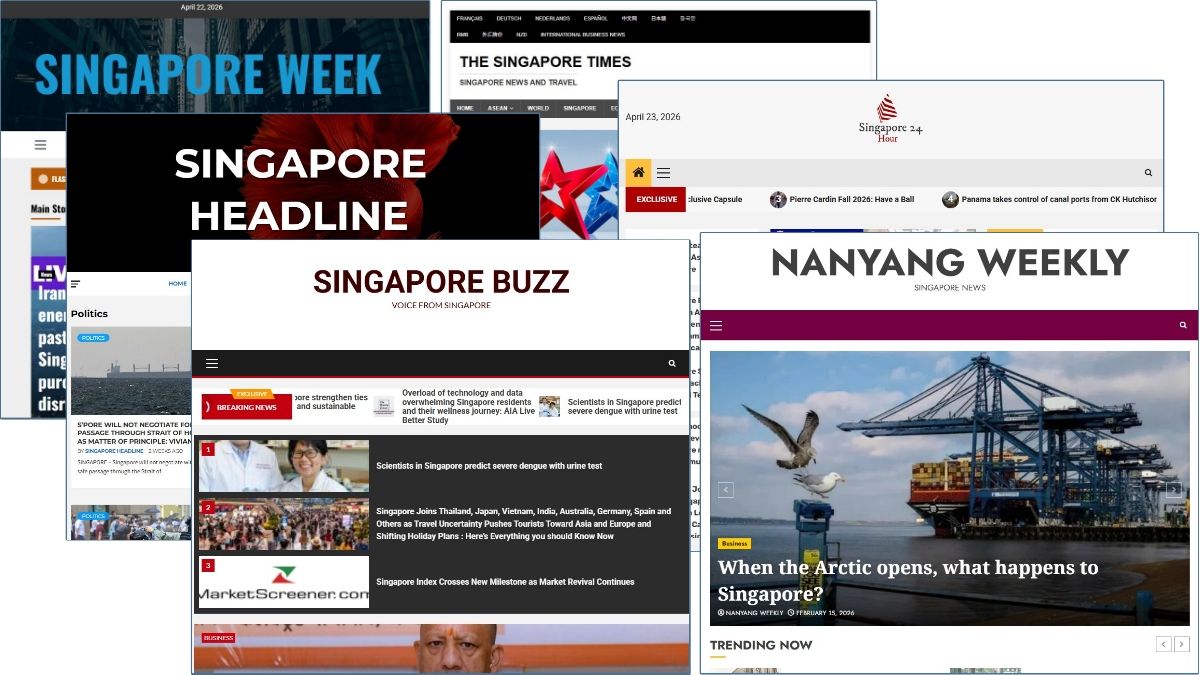
SINGAPORE: Singapore authorities have blocked six websites suspected of being set up by foreign actors to mimic local news outlets and potentially support hostile information campaigns.
The Ministry of Home Affairs (MHA) and the Infocomm Media Development Authority (IMDA) said the sites were designed to appear credible to local audiences while masking their origins.
The websites – singaporeheadline.com, singaporeweek.com, singapore24hour.com, nanyangweekly.com, singaporebuzz.com and sgtimes.com – used Singapore-associated names and carried local content to build legitimacy.
Authorities described this approach as a common tactic used by malicious foreign actors.
“These websites masquerade as Singapore news outlets by spoofing or using Singapore-associated terms in their domain names and carrying local content,” the agencies said.
Common tactic in misinformation campaigns
Authorities noted that building seemingly credible platforms is often the first step in broader disinformation efforts.
Such platforms can later be used to “mount hostile information campaigns” aimed at influencing public opinion.
Overseas examples have demonstrated how inauthentic news websites have been deployed to spread false narratives and sway public sentiment.
Officials warned that such campaigns could have serious consequences.
Hostile information campaigns can manipulate elections, undermine trust in public institutions and exploit societal fault lines.
Blocking access deemed in public interest
The six websites were blocked under directions issued through the Broadcasting Act.
Authorities said disabling access for users in Singapore was necessary to safeguard the public interest.
The same legislation was previously used in October 2024 to block 10 similar inauthentic websites linked to foreign actors.
Investigations into the latest six websites began earlier.
MHA said the sites were identified between 2024 and 2025 through routine monitoring.
“We are only taking action now as time was needed to thoroughly investigate these websites and their networks,” the ministry said.
The investigations assessed both the origins of the sites and their potential impact on Singapore.
Limited exposure but coordinated behaviour detected
Authorities said none of the six websites had been used in an active hostile information campaign targeting Singapore.
Exposure among local users was also assessed to be low.
Given this, there was no immediate need for urgent intervention while investigations were ongoing.
Instead, authorities developed a coordinated response plan after completing their assessment.
Despite limited exposure, deeper analysis revealed concerning patterns.
Five of the six websites were linked to networks previously flagged by cybersecurity researchers for misinformation activities.
These links were identified by Google’s Threat Analysis Group and cybersecurity firm Mandiant.
The five websites were created on the same date in 2021.
They were also revamped within a similar timeframe in June 2025, receiving comparable interface upgrades.
Authorities said these updates were designed to make the sites resemble legitimate news platforms.
Suspicious registration details and content reuse
Further indicators raised concerns about the authenticity of the websites.
The five sites listed identical terms and conditions last updated on 1 December 2020.
These terms stated that the websites were governed by United States law.
Each site provided a support or administrative email contact.
One listed a headquarters address at 123 Orchard Road #10-01 Singapore 238888, which authorities said did not correspond to a valid address.
The domains were last updated on 26 February 2026 and are set to expire on 28 March 2027.
They appear to be registered in the Cayman Islands.
Content analysis showed that much of the Singapore-related material on these sites was taken from established outlets.
These included CNA, The Straits Times and Mothership, as well as international media such as Bloomberg and Business Insider.
However, the content was attributed to the sites themselves.
Authorities warned this could mislead readers.
“Such acts can mislead readers into believing that these are legitimate Singapore-related news websites and that the content published is reflective of official positions or local sentiments,” they said.
Election-related activity observed
Four of the five websites carried General Election-related content during the 10-day campaign period for the 2025 election.
Prior to the issuance of the writ of election, most of the sites had been largely inactive.
This pattern raised concerns about their potential use during sensitive political periods.
The sixth website, sgtimes.com, displayed similar characteristics.
It presented itself as a mainstream Singapore news outlet and carried predominantly local content.
Its subheader described it as covering “Singapore News and Travel”.
In July 2025, the site published an article claiming it was among Singapore’s mainstream media platforms with “high monthly visits”.
Authorities urged Singaporeans to remain cautious when consuming online content.
They highlighted the risks posed by inauthentic websites that imitate legitimate news sources.
“Singaporeans should continue to remain vigilant when accessing online content and be alert to such inauthentic websites and the threat they pose,” the agencies said.