Dear You to be dubbed in Mandarin for general release in Singapore as Teochew tickets sell out
The Infocomm Media Development Authority says Teochew-dialect blockbuster Dear You will be dubbed into Mandarin for its general cinema release in Singapore, with the original version limited to niche screenings. All 4,800 Teochew tickets sold out within two hours, prompting public criticism of the bilingual policy.
- Dear You will be dubbed into Mandarin for general release; original Teochew cut limited to niche screenings.
- All 4,800 tickets for eight Teochew sessions sold out within two hours.
- IMDA cites the bilingual policy promoting Mandarin among Chinese Singaporeans.

The Chinese blockbuster Dear You (2026), filmed almost entirely in the Teochew dialect, will be dubbed into Mandarin for its general cinema release in Singapore, the Infocomm Media Development Authority (IMDA) has said.
Responding to media queries, an IMDA spokesperson said on Monday, 16 June 2026 that the Teochew version of the independent film would still be screened at its premiere, and would also be made available for subsequent festival and niche screenings.
The authority said the approach was consistent with current practice, under which full dialect films may be screened at festival or niche events to provide access for those who wish to view such content in its original language.
IMDA added that this continued to support the bilingual policy, which it said aims to promote Mandarin as the main language among Chinese Singaporeans. Films featuring dialect content are permitted only on a case-by-case basis.
The update followed an announcement on Sunday, 15 June 2026 by cinema operator Golden Village and Singapore distributor Clover Films, who said on social media that limited screenings of the film in its original Teochew dialect would be held at VivoCity.
IMDA's response came ahead of the film's general release in cinemas on Wednesday, 18 June 2026, ending days of online speculation among fans over whether it would be available in Teochew. Some had said they would travel to Johor Bahru to watch the original cut instead.
According to The Straits Times, all 4,800 tickets for the eight sessions of the Teochew version sold out within two hours of their launch on 16 June 2026. The screenings are scheduled from 18 to 21 June 2026 at VivoCity's GVMax.
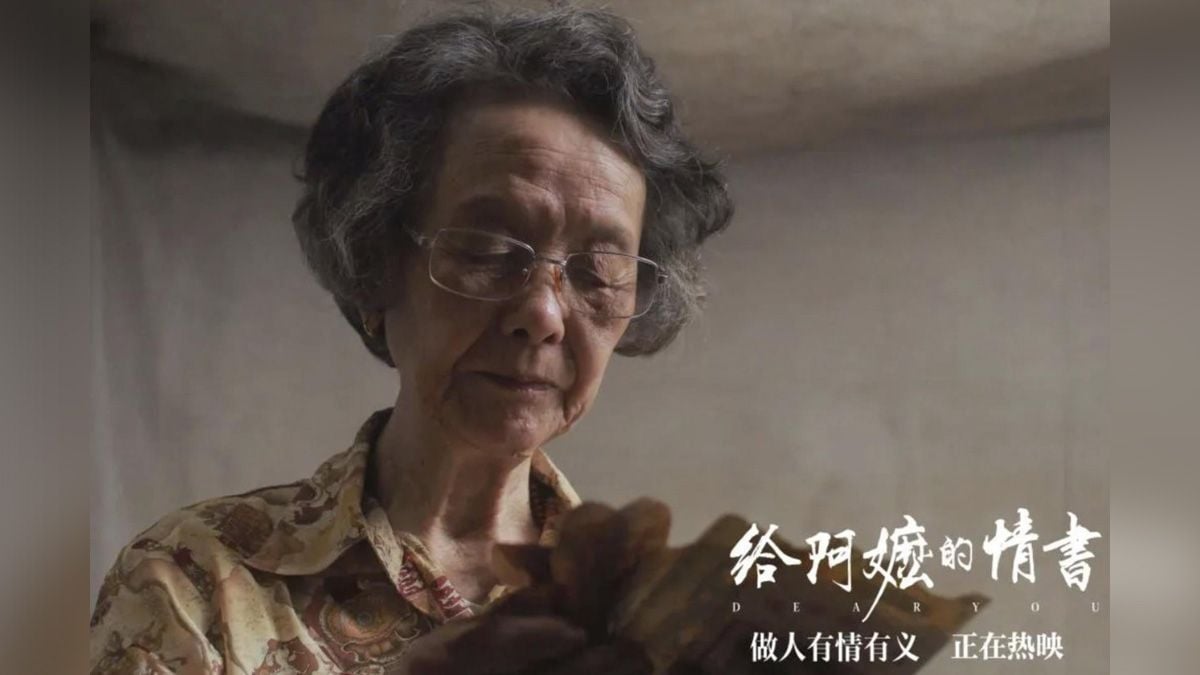
Dear You, also rendered as Grandmother's Love Letters, has become a critically acclaimed phenomenon in Chinese cinema. Despite a modest budget and a largely non-professional cast, the migration-themed drama has dominated China's box office, grossing more than 1.6 billion yuan (S$303.5 million).
Directed by Lan Hongchun, the film is set against the history of migration from the Chaoshan region in south-eastern China to South-east Asia, known as "going down to Nanyang." Its dialogue is primarily in Teochew, a dialect of that region, and it uses the cross-border system of qiaopi — remittance letters — as its narrative thread.
The story follows a Chaoshan grandmother, Ye Shurou, whose quiet later years are upended by her grandson, Xiaowei. He travels to Thailand in search of the wealthy grandfather of family legend, but returns with news that shocks the family: the grandfather had died long ago.
The correspondent who had exchanged loving letters with the grandmother for years was, in fact, a Thai-Chinese woman, Xie Nanzhi. As the truth emerges, a half-century of concealed letters and emotional ties comes to light, portraying an older generation's sense of duty, sacrifice and devotion.
The film marks Lan's third such feature. To ensure historical accuracy, he and his team interviewed more than 120 seniors in the Chaoshan region who had experienced migration to South-east Asia.
Restrictions on dialect use date back to 1979, when the Speak Mandarin Campaign was introduced to encourage Mandarin as a common language among Chinese Singaporeans. The campaign restricted the use of Chinese dialects in film, television and radio.
According to The Straits Times, the proportion of households using Chinese dialects as their main language fell from 76 per cent in 1980 to 8.7 per cent in 2020.
In recent years, authorities have incorporated dialects into more campaigns. In 2014, the government released videos in several dialects explaining the Pioneer Generation package.
Since May 2022, public announcements in Hokkien, Teochew and Cantonese have also been introduced at selected train stations, reminding commuters to hold the rails for their safety.
The policy was reiterated in Parliament on Wednesday, 10 January 2023. Responding to a question from Workers' Party Member of Parliament Dennis Tan Lip Fong on whether more dialect programmes could be aired to preserve heritage, the Minister for Communications and Information, Josephine Teo, said dialect content on free-to-air radio and television was limited to support the prevailing policy of Mandarin as one of the four official languages.
Teo said the Government nonetheless recognised the value of dialect programmes for conveying information to elderly Singaporeans conversant only in dialect, noting Mediacorp's Friday dialect belt on Channel 8 and dialect news bulletins on Capital 95.8FM.
In a written parliamentary answer on Tuesday, 9 January 2024, Teo addressed a question from Member of Parliament Yip Hon Weng on whether the restrictions should be fully lifted, given the elderly's limited access to pay television and the internet. She said free-to-air services were required to offer Chinese-language content in Mandarin.
Teo cited a 2023 ministry study which she said found that almost seven in 10 respondents chose Mandarin as the language they could read or listen in, while a very small number chose dialect exclusively. More than half of respondents across all age groups felt dialect content on free-to-air platforms should remain at the current level.
She said there were no plans to allow more dialect programmes on those platforms, but that the Government would continue to monitor public views and was prepared to lift restrictions when the need arose, as it had during the COVID-19 pandemic to disseminate health information.
In a separate written answer on Tuesday, 15 October 2024, responding to Workers' Party Member of Parliament Louis Chua Kheng Wee, Teo quantified the extent of dialect content. She said Mediacorp's Channel 8 carried a dedicated two-hour belt of dialect programmes every Friday late morning.
This amounted to more than 90 hours a year, or about 1 per cent of the channel's total annual transmission hours — a proportion she said had remained constant over the years. Teo added that the breakdown by individual dialect was not tracked, as programmes often used a mix.
Public response:
The decision drew sustained criticism across social media and online forums, much of it questioning the consistency, effectiveness and continued relevance of the policy.
The most common objection was that foreign-language films screen in their original languages with subtitles, while a Chinese dialect must be dubbed. One commenter asked why Korean, Thai, Japanese and French films were exempt, adding that some Japanese and Korean pronunciations derive from dialects such as Hokkien and Cantonese. Another noted that French and Japanese films screen in Singapore with only English subtitles.
A minority took the contrary view, defending the decision. One commenter said dubbing into Mandarin opened the film to a wider audience, citing a 65-year-old friend who speaks Mandarin, Cantonese and Hakka but not Teochew, and who planned to see the film only because of the Mandarin option.
Several questioned whether a single film could undermine Mandarin. One wrote that those proficient in dialects "are already strong bilingually," arguing that dialects are part of heritage rather than a threat to it. Another asked how dialects could still endanger Mandarin "when the younger generation can no longer speak them."
A recurring argument was that the policy had not achieved its stated aim. One commenter observed that dialects had been kept off mainstream media for decades, "but the proficiency of Mandarin among our young has nosedived," concluding that dialects were not the cause of falling standards. Another wrote on a forum: "Mandarin is already dead in the younger generations. The gov can promote all they want but if your peers don't speaks mandarin anymore, it's effectively dead."
Some pointed to apparent inconsistencies in the policy. Commenters noted that public train-station announcements are already made in Hokkien, Teochew and Cantonese, and that locally produced films such as Jack Neo's work and the dialect-heavy Wonderland had been permitted. One forum user wrote: "We acknowledge that there is a group of people that culturally speak dialects... but when it comes to entertainment we just pretend these people do not exist."
The contrast with China itself was raised repeatedly. Commenters noted that the film screened in its original Teochew as a general release across China, with one writing that Singapore had "managed to be less friendly to dialects than the Chinese government."
Several framed the matter as one of heritage and identity. One wrote that the treatment of dialects made them feel "like it's something shameful to be hidden," asserting that southern Chinese Singaporeans had a right to defend their traditions. Another, who said they spoke to their late grandparents in Teochew, called the dubbing decision "sad."
The disconnect between dialect and elderly relatives featured prominently. One forum user described how Mandarin could not bridge the gap with their grandmother, who has dementia and understands only Hokkien: speaking Mandarin would leave her "staring at you, perplexed."
Others recounted an elderly Hokkien-only speaker who became lost at a bus interchange, eventually helped by a Hokkien-speaking Malay man rather than Mandarin-speaking youths.
There was some debate over whether Mandarin remains useful for communicating with the elderly. One commenter argued that many older Singaporeans speak Mandarin reasonably well and that improving one's Mandarin "actually would help with talking to grandma for most people." Others disputed this, contending that dialects remain more useful and that Mandarin was "merely the least bad option."
A separate strand questioned the framing of Teochew as a "dialect" at all, with several arguing that the lack of mutual intelligibility with Mandarin made it a language. One wrote that the Chinese term 方言 was better rendered as "regional language" than "dialect."
Many cited the brisk ticket sales as evidence of genuine demand, and called for cinema operators to be allowed to add Teochew sessions and let audiences choose. Several said they would watch the original version in Johor Bahru or online instead, warning of lost revenue for local cinemas.
One forum user summarised the perceived outcome bluntly: "Sinkies go to JB to watch the movie, while local cinemas continue to lose money. Really shooting ourselves in the foot."