About 12% of SAF NSFs are stay-out personnel, says Chan Chun Sing
Coordinating Minister for Public Services and Minister for Defence Chan Chun Sing has disclosed that only about 12% of SAF full-time national servicemen are in stay-out postings without lodging, with transport costs factored into monthly NS allowances.


About 12 per cent of full-time national servicemen (NSFs) in the Singapore Armed Forces are in stay-out roles without lodging provided — a figure disclosed in Parliament on Tuesday (5 May) as part of a written reply to questions over whether the current S$81 monthly transport concession pass is adequate for servicemen earning S$790 a month.
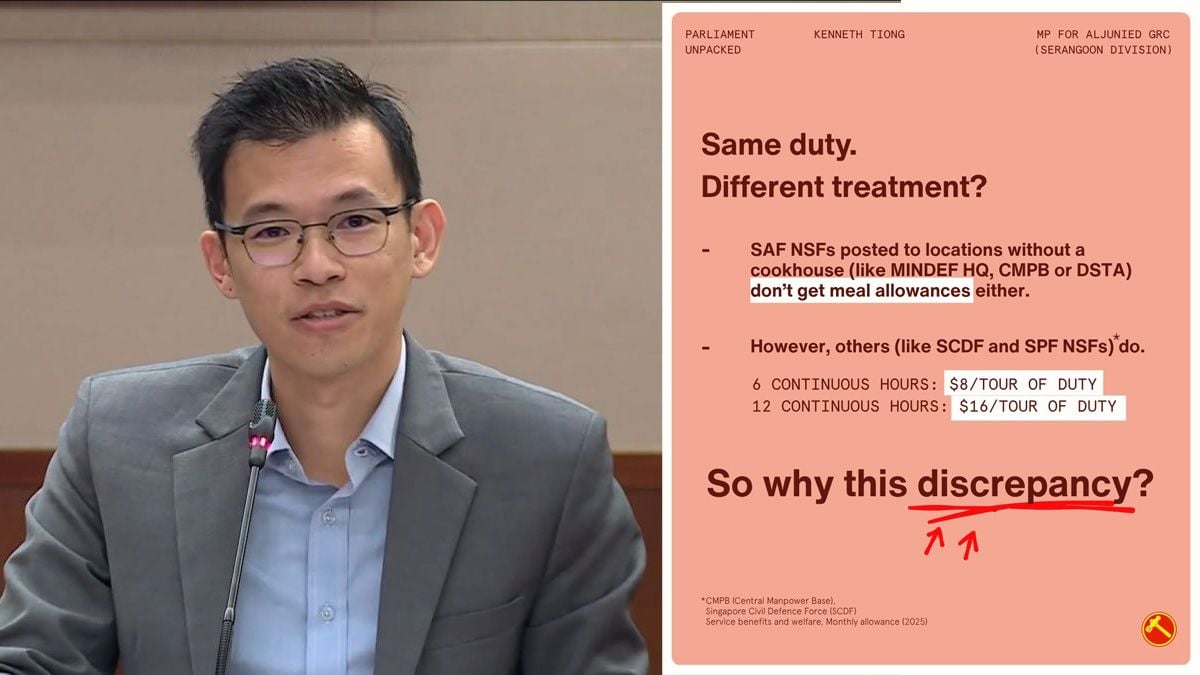
The disclosure came in a written reply by Coordinating Minister for Public Services and Minister for Defence Chan Chun Sing to Workers' Party MP Kenneth Tiong Boon Kiat, Aljunied GRC, who asked what proportion of NSFs are in stay-out postings without lodging or meals, whether the Ministry considers the transport pass adequate, and whether Singapore would extend free public transport to NSFs as Austria does for its conscripts.
Chan Chun Sing confirmed that "the vast majority" of SAF NSFs are deployed to roles where lodging and meals are provided. Stay-out personnel — those not given lodging — account for around 12 per cent of the SAF's NSF population. The minister did not provide the requested breakdown of whether stay-out NSFs also forgo subsidised meals.
On the question of adequacy, Chan Chun Sing said that all NSFs, including stay-out personnel, receive the same monthly base allowance, which is "sized for their basic personal upkeep." He stated that the transportation needs of NSFs have been considered in calibrating that allowance, including the cost of the public transport concession card.
Turning to the comparison with Austria's practice of providing conscripts a national travel pass, Chan Chun Sing acknowledged that some countries have adopted that model, but drew a clear distinction in how Singapore approaches the same underlying cost.
"The cost of providing free transport for NSFs would need to be cross-subsidised by other commuters through higher fares, or by taxpayers," he said.
He maintained that Singapore has instead folded the cost of public transport directly into NSF allowances, making the distinction one of mechanism rather than fiscal burden: "Either way, the costs are funded by the Government, and ultimately, by taxpayers."
The minister also set out the philosophy underpinning the allowance-based approach. "We choose to take care of our NSFs by providing them with cash through their monthly NS allowance, rather than directly prescribing specific provisions for them," he said. "In this way, we give NSFs the agency to purchase items according to their needs."
Tuesday's written reply is the latest episode in a sustained push by Kenneth Tiong on NSF compensation. At the Ministry of Defence's Committee of Supply debate on 27 February 2026, he had argued that second-year NSF allowances should be raised to S$1,800 a month — the new Local Qualifying Salary (LQS) — with CPF contributions included.
Tiong noted that a second-year corporal in a combat vocation earns about S$1,035 monthly with no CPF contributions, and contended that by their second year, NSFs are "fully trained and operationally deployed, manning posts and running day-to-day operations alongside regulars."
He estimated the cost of raising allowances to the LQS at between $150 million and $200 million annually, or under one per cent of the $25 billion defence budget.
The Government's response in February set out the philosophical position that has since framed subsequent exchanges. Senior Minister of State for Defence Zaqy Mohammad said the LQS is "an administrative tool" for determining work permit and S Pass quota entitlements, and "not a minimum wage or general salary benchmark for all forms of service in Singapore."
Chan Chun Sing went further, cautioning against framing NS as an employment relationship. "Those of us who have served in national service will be very careful to not use the word compensate," he said at the time.
"In truth, no amount of monetary compensation can be equated with the contributions of our NS men."
He appealed to members not to "conflate duty with transaction."