Lawrence Wong calls on youth to adapt rule of law for future challenges
Prime Minister Lawrence Wong told participants at the SGLaw 200 Youth Forum on 13 May that Singapore's rule of law must evolve to meet emerging challenges while retaining core principles of pragmatism and social compact.
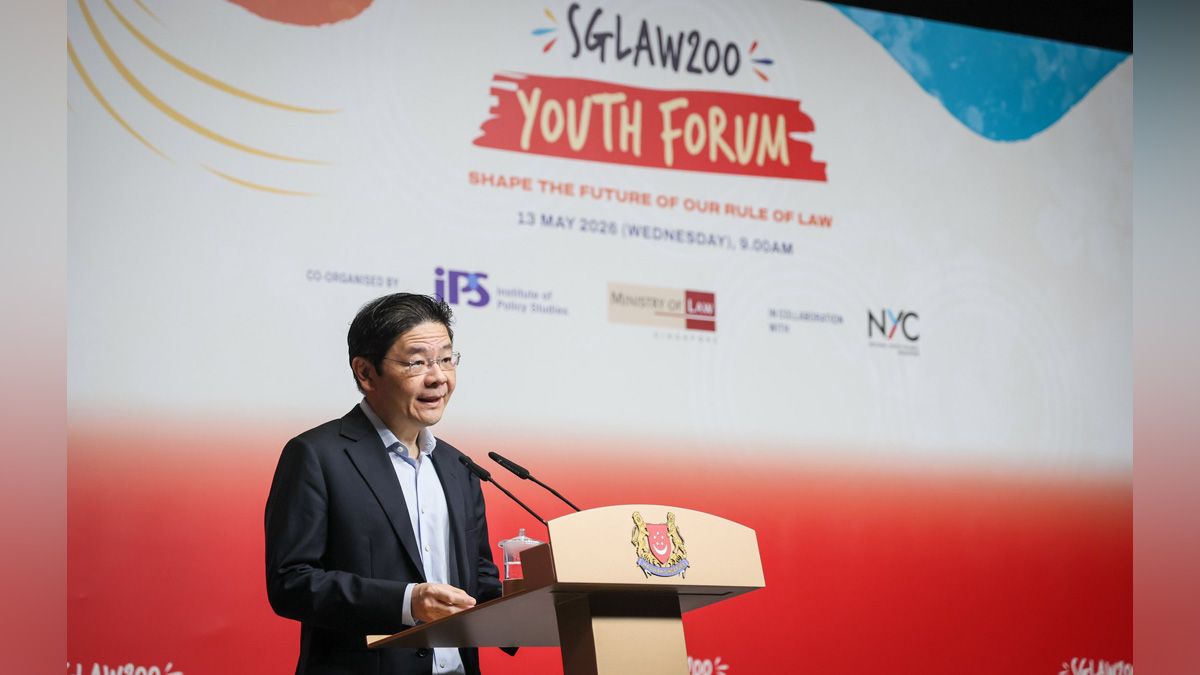

Prime Minister Lawrence Wong has called on Singapore's youth to adapt and strengthen the rule of law, warning that public trust in institutions forms the foundation of the country's stability and must not be allowed to erode.
Wong made these remarks at the SGLaw 200 Youth Forum on 13 May 2026, held at the Singapore Management University's (SMU) Yong Pung How School of Law. The forum was organised jointly by the Ministry of Law (MinLaw) and the Institute of Policy Studies (IPS).
The event forms part of a series of activities commemorating the 200th anniversary of Singapore's legal system, and is intended to spotlight the role of young people in shaping the future of rule-of-law governance.
Rule of law is about legitimacy, not just order
In his opening address, Wong asked participants to reflect on what the rule of law means and how it operates in everyday life.
Invoking 17th-century French philosopher Blaise Pascal, who argued that justice without force is powerless while force without justice is tyrannical, Wong drew a distinction between order, efficiency and legitimacy.
"People must believe that the system is fair — that it treats them with dignity, and that justice is not only done, but seen to be done," Wong said. "Without that belief, even the strongest laws will not hold."
Stability as an existential necessity
Turning to Singapore's particular circumstances as a small, multi-racial and multi-religious society, Wong stressed that harmony has historically proven fragile.
"That's why for us, stability is not just a preference. It is an existential necessity. Without stability, there can be no security, no progress, and ultimately, no Singapore," he said.
Wong argued that the rule of law cannot remain an abstract principle. It must form part of citizens' lived experiences — in the safety they enjoy, the fairness they expect, and the confidence they place in public institutions.
Singapore's legal framework in practice
Wong used several examples to illustrate how the rule of law shapes Singapore society today. These include the country's zero-tolerance approach to corruption, its strict stance on drug trafficking, and legislation prohibiting speech that incites racial or religious hatred.
He also referenced laws designed to counter the spread of online falsehoods, framing these as expressions of how legal frameworks can respond to emerging social challenges.
At the same time, Wong highlighted existing safeguards within the system. In capital drug trafficking cases, he said, every matter proceeds through a full investigation and trial before an independent judge.
Every death penalty verdict is also automatically reviewed by the Court of Appeal, regardless of whether the convicted person files an appeal.
Wong stated that Singapore's approach has, on the whole, delivered good outcomes. "Singapore today is one of the safest and least corrupt countries in the world. Public trust in our institutions remains high. People have confidence that the rules are applied fairly, contracts are upheld, and disputes are resolved impartially."
Adapting without losing fundamentals
Even as the rule of law continues to evolve in response to challenges posed by technology and access to justice, Wong cautioned that certain fundamentals must be preserved.
These include pragmatism — defined as delivering real outcomes for ordinary people — and the social compact underpinning the relationship between the state and its citizens.
"Once people lose faith in the system, the whole foundation starts to weaken," Wong said.
A global dimension
Wong broadened his remarks beyond Singapore's borders, noting that the rule of law carries particular weight at a time when international rules are increasingly being disregarded.
"When strength replaces right, the system begins to fray. And it is always the smaller and more vulnerable nations that feel the impact first," he said.
As a trading nation dependent on open and secure sea lanes, Singapore has a direct stake in the continued observance of international legal frameworks, including the law of the sea, Wong observed.
He described the rule of law as one of Singapore's most valuable assets in navigating global turbulence. "The rule of law is what keeps our society stable, even when the world around us feels more unsettled. It is why Singapore is trusted when trust is increasingly hard to come by."
A call to the next generation
Closing his address, Wong urged forum participants to take ownership of the challenge ahead — not merely to uphold existing legal frameworks, but to continuously renew them.
"If we continue to do this well, Singapore will not just be a place where the rule of law is upheld, but a society defined by fairness, justice and trust," he said. "And that is the kind of Singapore we must continue to build together."