“Your choice, your problem”: What Singaporeans told the next generation of parents
A father asked if handing his toddler across an MRT gantry needed to be a fare transaction. The agency wouldn't say. The public's answer was louder: "entitled," "shouldn't breed," "you're on your own." If that's the welcome awaiting parents who simply ask for clarity, Singapore's "fertility reset" has already failed its easiest test.
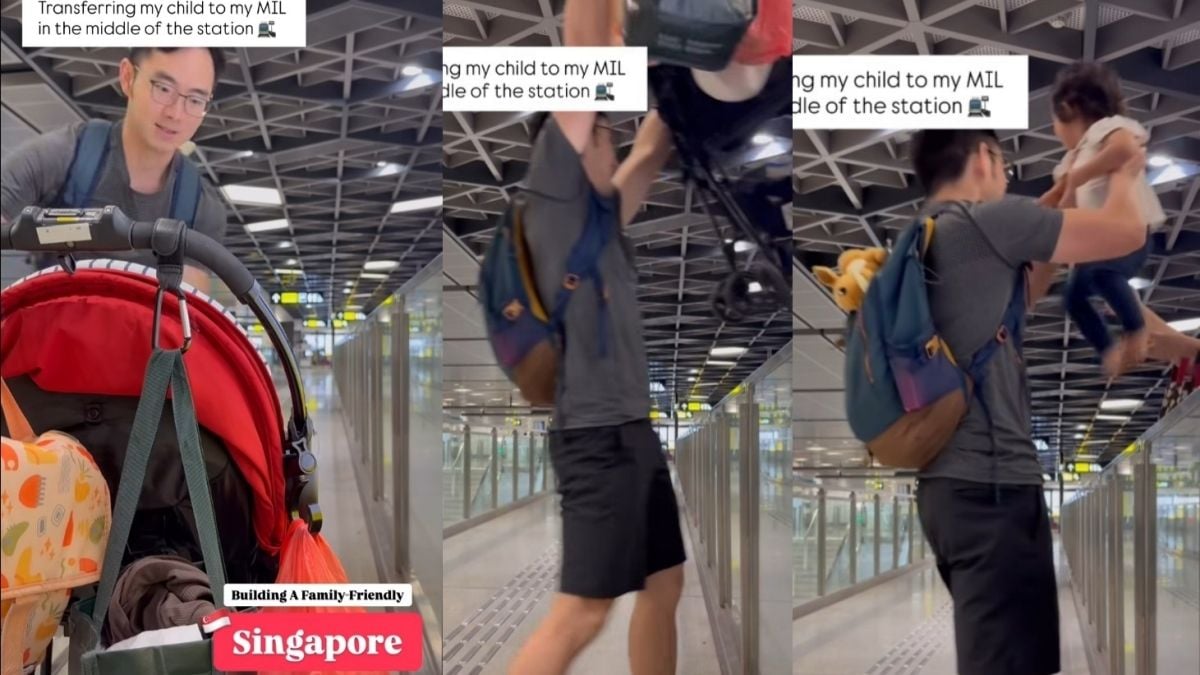

A father takes the MRT to meet his mother-in-law at a station gantry on a Saturday morning. He pushes his toddler's pram through the side gate, hands the child over for the day's babysitting, and continues to work — a small, unglamorous piece of choreography that lets two working parents and a grandparent make a Saturday function.
On 14 March, a station manager decided this was a security matter. The father, Daniel Chow, was told to tap out, pay a fare, hand over his now-crying child, tap back in, and pay again to resume his journey — for a child who rides the MRT for free regardless.
Chow wrote an open letter to Acting Transport Minister Jeffery Siow about it three months later.
The response — from the relevant agency, and from the public — landed less than four months after Deputy Prime Minister and Minister for Trade and Industry Gan Kim Yong told Parliament that Singapore's resident fertility rate had fallen to a historic low of 0.87, with Minister Indranee Rajah following up to call for a "society-wide reset" in how marriage and parenthood are viewed.
Read together, the two episodes suggest the reset, whatever it eventually contains, is arriving into an environment that has already told would-be parents exactly what to expect — and the message isn't encouraging.
A reset aimed at the wrong variable
Indranee's framing was careful: not pushing a single "correct" life path, but enabling people to see marriage and parenthood "positively rather than through fear and anxiety." A new work group would consult widely and produce "concrete plans." The Marriage and Parenthood Survey would be enhanced to better understand how attitudes have shifted.
The online response to that framing was almost uniformly sceptical. One widely-upvoted Reddit comment dismissed the idea of a mindset reset by noting their bank account could barely support a reset of lunch options.
Facebook commenters told people to walk through the diaper aisle and "do your maths." The substance of that scepticism was: people are not confused about whether parenthood is hard. They have done the arithmetic, and the arithmetic is the problem. A "reset" of attitudes, without a reset of the underlying conditions those attitudes are tracking, is being read as an attempt to change the answer without changing the inputs.
What the 2021 survey already showed
This scepticism isn't new, and it isn't only about money. the government's own Marriage and Parenthood Survey 2021 — the same survey now being "enhanced" as part of the reset — already documented it. Among singles who don't want children, the proportion citing "lack of time and/or energy to take care of children" as an important consideration jumped from 68% in 2016 to 81% in 2021.
The proportion unsure of their "ability to provide a proper upbringing" rose from 61% to 77%. Among married couples deciding whether to have another child, "feeling able to cope with both work and family commitments" rose from 28% to 31% as a determining factor.
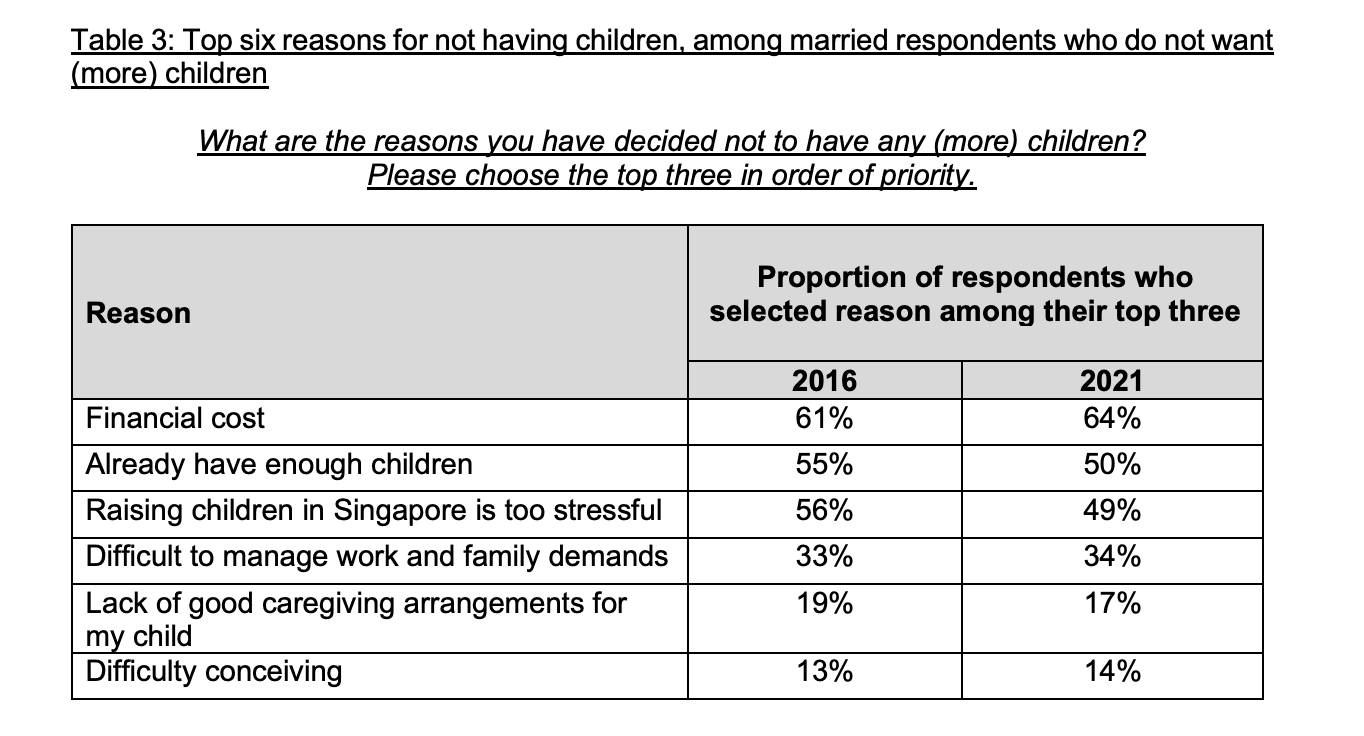
What these numbers describe is apprehension — a growing sense, among exactly the people the reset is aimed at, that parenting itself will be harder, lonelier, and less supported than it should be. That apprehension is precisely what a "society-wide reset" needs to address. And it's precisely what an episode like Chow's — and the response to it — confirms, in real time, to anyone watching.
The MRT episode as the reset's first test case
LTA's eventual statement did not give a straight answer to what was, at its core, a simple yes-or-no question addressed to Minister Siow: is a parent required to tap out in order to pass a child across the fare gate, or not?
Instead, the statement spoke of staff "discretion" and "kindness," pointed to a free concession card as an alternative, and noted that Chow had declined a private chat. Whatever one makes of the underlying rule, the question itself — asked plainly, of the ministry responsible for the system — went unanswered.
But the institutional response, on its own, is the more familiar half of this story. The more revealing half is what happened next.
The crowd wasn't really defending the rule
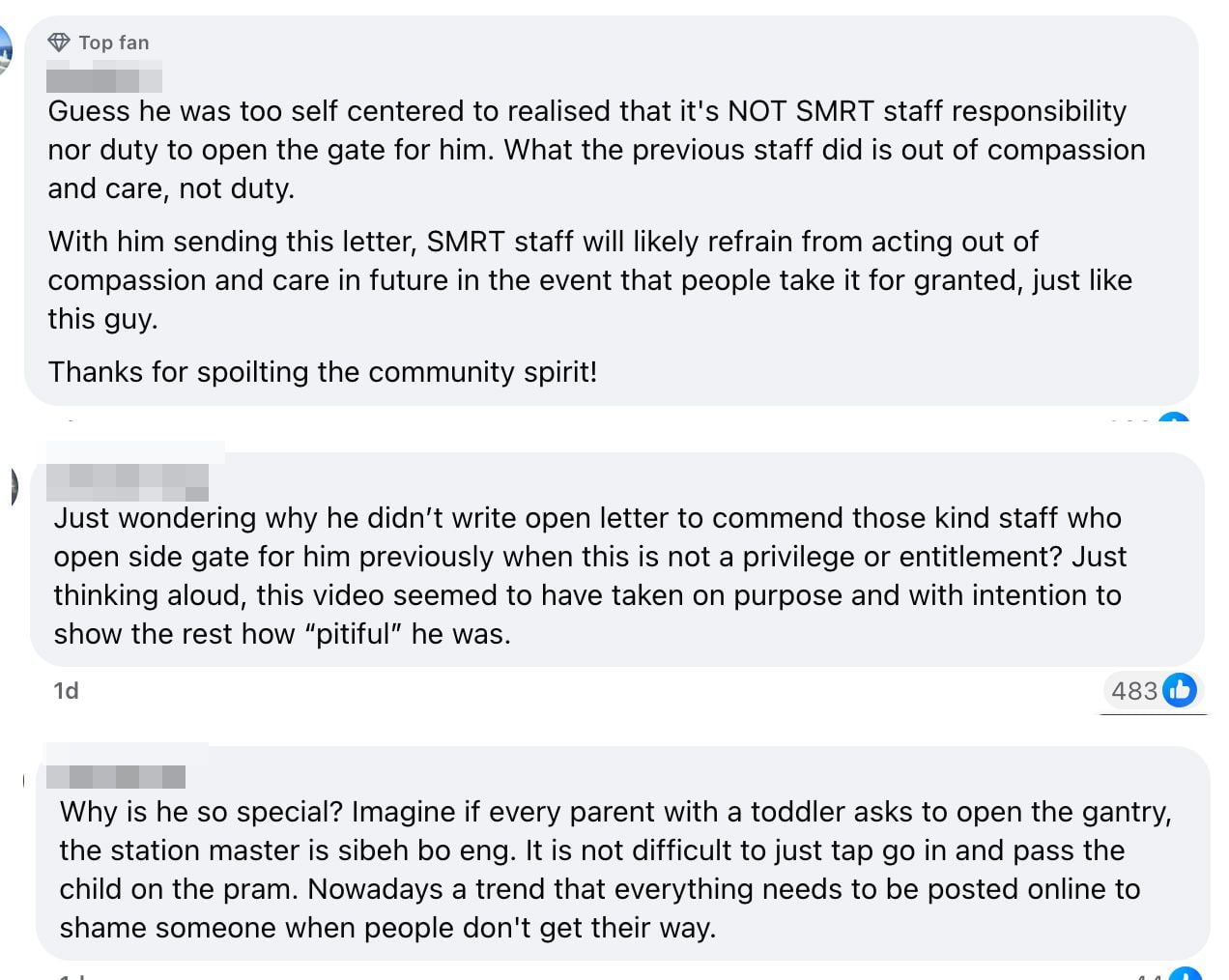
Read closely, the hundreds of comments under Mothership's Facebook post on this story are not, for the most part, a defence of the fare-gate policy.
A fair number of commenters openly conceded the rule itself was clunky — some explicitly called for a grace period, a short tap-out/tap-in window, or a more sensible policy overall. The rule, as a rule, had defenders and critics in roughly the proportions you'd expect for any minor transport regulation.
What was overwhelming, and far more uniform, was something else: the rejection of Chow's standing to complain at all. Not "the rule is fine," but "you shouldn't be saying this." Not "you're wrong about the policy," but "you're entitled for raising it." The vocabulary recurred relentlessly — entitled, privilege, the world doesn't owe you, concierge service, royalty, special treatment — applied not to a specific unreasonable demand, but to the act of voicing frustration itself.
That's a different thing from a policy debate, and it's worth naming precisely: it's a question about social permission. Whether or not Singapore's transport rules are well-designed, a sizeable share of the public response was about whether parents are allowed to say, out loud, that something about parenting here is harder than it needs to be — without that statement itself being treated as the offence.
"Consider that you're really on your own"
One comment, almost in passing, said more than most of the angrier ones combined: that the rule itself was probably unnecessary, but that "Singaporeans don't really care about children, so if you're having a child in SG, consider that you're really on your own."
That sentence does three things at once. It concedes the friction is real and avoidable. It accepts that nothing will be done about it regardless. And it presents parental self-reliance — total, unsupported, ask-for-nothing self-reliance — as simply the deal on offer, the baseline a parent should expect and not question.
It's not an angry comment. It reads almost as helpful advice. Which is precisely what makes it so revealing: it's a description of the social contract from inside it, offered without apparent objection to the contract's terms.
"Your choice, your problem"
Underneath a lot of the harsher language was a single recurring premise, made explicit in various comments: having children was your choice, and choices have consequences, and therefore the consequences — all of them, including the ones that could easily be reduced — are yours to bear alone.
Several commenters generalised this well beyond Chow specifically: that parents "automatically transform into entitled babies," that "entitled parents raise entitled kids," that people with one or two kids "behave like the world owes them." These weren't all about one man and one gantry. They were about parents as a category, and about what parents are entitled to ask for, which — per this framework — is nothing.
It's worth sitting with what that premise actually says to someone deciding whether to have a child, because it isn't subtle: you are choosing this, so don't expect anything to be made easier for you, and if you ask, you will be the one who looks bad for asking.
For a person already weighing the costs the 2021 survey describes — the time, the energy, the uncertainty about coping — that's not a neutral data point. It's a preview of what happens to your voice, specifically, the moment you become a parent and something doesn't work. Not "the system might not help you" — that's a known, factored-in cost.
But "the people around you will treat your asking for help as the problem" is a different, and arguably heavier, cost. It converts every future grievance — however small, however reasonable — into evidence against your own character.
And that's where the logic curdles into something close to self-defeating. If having a child means surrendering the standing to ask that anything be made easier — if "you chose this" forecloses even the mildest request for clarity or accommodation — then the rational response to that deal, for someone who hasn't yet made the choice, is not to make it.
Not out of selfishness, but because the terms as described are: full responsibility, zero accommodation, and reputational punishment for noticing the gap. Framed that way, choosing not to have children isn't a failure to "step up." It's simply declining to sign a contract whose terms were just demonstrated, in public, by the people who'd be enforcing them.
What accommodation actually means
Successful pro-natalist policies generally rest on a fairly simple premise: that raising children is not solely a private matter, and that some degree of accommodation — practical, small, often nearly costless — is socially justified. Not because parents are owed luxury, but because a society that wants more of its members to have children has an obvious interest in making the ordinary mechanics of doing so marginally less punishing.
The comment section under the Chow story was, in aggregate, advancing something close to the reverse of that premise: children are your choice, therefore your problem, and any request for the burden to be shared — even a request as small as "can this $2 logistical snag be clarified" — gets read as overreach.
That's not a policy position the government has taken. It's a position a large number of ordinary Singaporeans took, voluntarily, in public, in response to a government minister's own call for a "reset" toward viewing parenthood more positively.
The protest that doesn't need to be organised
In China, a phenomenon known as "tang ping" — literally "lying flat" — describes a generation responding to a punishing combination of housing costs, education competition, and gruelling work culture not with organised protest, but with quiet, individual withdrawal: opting out of marriage, career striving, and childbearing altogether, because the system stopped holding up its end of the bargain. No manifesto, no movement — just millions of separate decisions not to participate.
Singapore's fertility numbers — falling for years, now at a historic low — describe something that looks, in aggregate, remarkably similar, just channelled through the single most consequential household decision there is. Nobody needs to organise anything. They simply don't have the child.
What the Chow episode and its aftermath add to that picture is a glimpse of the terms themselves, stated plainly, by the public rather than the government: have the child if you want, but don't expect anything to be easier, and don't expect sympathy if you say so.
For someone who hasn't yet decided, that's not an abstract policy debate to weigh against housing prices and childcare costs. It's a live demonstration — with a real name, a real video, and a real comment count — of what your voice is worth, the moment you're the one asking.
If the lesson anyone takes from this episode is "this parent was unreasonable," rather than "this is what we just told every person still deciding whether to have a child" — then the reset, whatever form it eventually takes, will have already failed its first and easiest test, not at the level of policy, but at the level of permission: whether parents in Singapore are allowed to ask, without being told that asking is itself the problem.