Linguist says dialect film buzz reflects grief and nostalgia over fading languages as netizens questions loss of heritage language
The public response to Teochew-language film Dear You reflects deeper grief and nostalgia over fading heritage languages, according to linguist Dr Tan Ying Ying. Netizens echoed concerns over dialect loss, cultural identity and whether Singapore’s language policies should allow more space for dialects.

- Linguist Dr Tan Ying Ying says Dear You’s popularity reflects grief over fading dialects rather than rejection of language policy.
- Netizens debate dialect preservation, cultural identity and the long-term impact of Singapore’s language policies.
- Views remain divided between protecting heritage languages and supporting Mandarin and English for social cohesion.

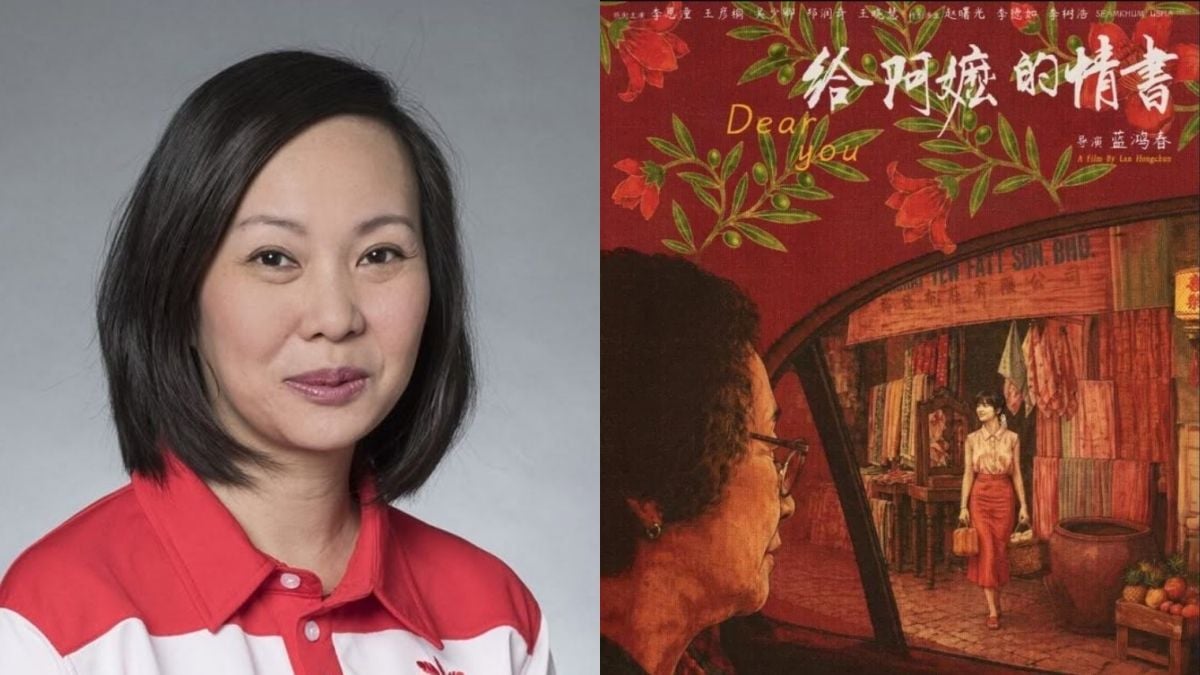
On 25 June 2026, Dr Tan Ying Ying, Associate Professor of Linguistics and Multilingual Studies at the School of Humanities in Nanyang Technological University, penned a commentary in CNA examining the public reaction to the Teochew-language film Dear You.
In the commentary, she argued that the buzz surrounding dialect films reflects not policy disagreement but a deeper sense of grief and nostalgia over the steady loss of heritage languages in Singapore, a trend intensified by decades of language shift under the Speak Mandarin Campaign.
Netizens responding to her views largely echoed these sentiments, with many expressing sadness over declining dialect use across generations, while others questioned whether current language policies remain relevant and debated whether dialects should be given greater space in media and cultural life.
Teochew film frenzy reflects emotional loss of heritage language, says linguist
Dr Tan argued that the reaction was not primarily a rejection of Singapore’s language policy, but something more emotional and personal.
“At its heart, the fervour around the Teochew-language film is not about disagreement with Singapore’s language policy. It is grief for a dying language,” she wrote.
She noted that the rapid sell-out of screenings — with 8,000 tickets across multiple sessions snapped up within hours — suggested a demand that went beyond conventional cinema interest. Some viewers even travelled to Johor Bahru to watch the film in its original language.
The Infocomm Media Development Authority (IMDA) had earlier approved only a Mandarin-dubbed version for general release, while limiting the Teochew version to festival and niche screenings.
However, on 22 June, amid strong public demand, the Ministry of Digital Development and Information (MDDI) signalled that IMDA would adopt a more flexible approach when considering applications for dialect films to be screened in cinemas.
The ministry said it remained open to facilitating and supporting further Teochew screenings of Dear You if the distributor applied, citing public interest in the film.
Following the statement, Singapore distributor Clover Films applied for approval to hold up to 50 Teochew-language screenings in Singapore.
‘Grief for a dying language’
Dr Tan argued that the reaction should not be understood primarily as a backlash against language policy.
“At its heart, the fervour around the Teochew-language film is not about disagreement with Singapore’s language policy. It is grief for a dying language,” she wrote.
She pointed to rapid language shift in Singapore, noting that only 1.4 per cent of Chinese aged between 5 and 34 spoke a Chinese “dialect” most frequently at home in the 2020 census, compared with 31.6 per cent among those aged 60 and above.
According to Dr Tan, many cinema-goers are not fluent speakers but individuals reconnecting with a language they have largely lost. She suggested that the appeal lies in hearing a language that has become increasingly rare in everyday life.
Language loss beyond the cinema
Dr Tan also argued that decades of restricting dialects in mainstream media have unintentionally increased their emotional and symbolic weight.
By limiting their public presence, she said, dialects have acquired a sense of rarity and transgression that strengthens nostalgia when they reappear on screen.
“In trying to reduce the significance of Chinese ‘dialects’, the policy may have inadvertently increased their mystique,” she wrote.
However, she cautioned that public enthusiasm should not be mistaken for language revival, noting that sold-out screenings do not necessarily reflect linguistic vitality.
“We do not queue for something we have in abundance. We queue for something we fear we are about to lose,” she added.
Netizens reflect on loss of dialects, identity and language policy
In response to Dr Tan’s commentary on the Teochew-language film Dear You, comments on CNA’s Facebook page showed that many netizens echoed her view that the reaction reflected emotional loss and nostalgia over fading heritage languages in Singapore.
Several users argued that dialects remain living languages and should be given more space in media, while some suggested that the role of the Promote Mandarin Council should be reviewed.
One commenter said: “If international shows can have their languages used on TV in full original force, then dialects should be allowed,” adding that dialects are still used by locals and should not be sidelined.

Dialects described as cultural roots
Others focused on the cultural and emotional value of dialects, describing them as “roots and treasures” that must be preserved.
One netizen wrote that losing dialects meant losing ancestral heritage, warning that “once you lost your roots you lost your ancestors’ treasure”.
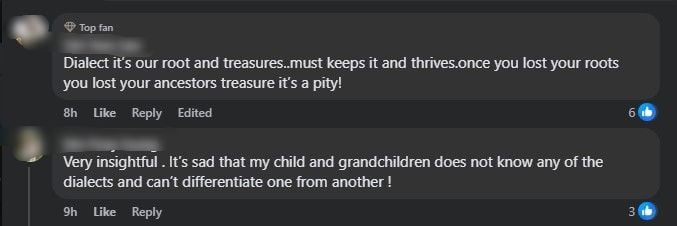
Some also expressed personal regret over generational language loss, noting that younger family members can no longer speak or understand dialects.
“It’s sad that my child and grandchildren does not know any of the dialects,” one comment read.
Dialect loss seen as erosion of cultural identity and ancestral connection
One comment noted that dialects carry “cultural DNA that Mandarin alone can’t preserve”, saying older generations “didn’t just speak differently; they thought differently”, with proverbs, humour and expressions that “simply don’t translate”.
The user argued that what Dr Tan described as “grief” was also “loss of lineage”, as dialects connect people to ancestral villages, while Mandarin provides unity without the same connection to identity.
The comment added that Singapore’s modernisation had replaced a living heritage with nostalgia, asking whether people could truly understand who they are if they “can’t even understand the words their own ancestors spoke”.
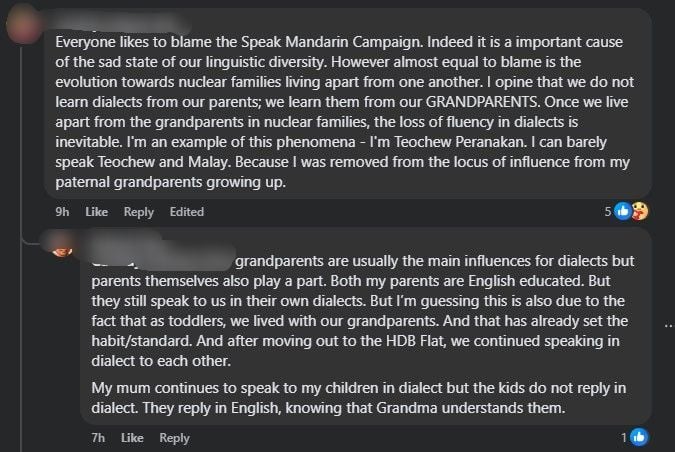
Family structure, not just policy, seen as key factor in dialect decline
One comment said the Speak Mandarin Campaign was “an important cause” of declining linguistic diversity, but argued that changes in family structures had also played a major role.
It added that dialects are often learned from grandparents, and that separation from older generations makes fluency “inevitably” fade.
One comment linked higher ticket prices for Dear You screenings to the Speak Mandarin Campaign, saying it placed Teochew-language films “out of reach of the common heartland Teochew pioneers” and calling for more affordable community screenings.

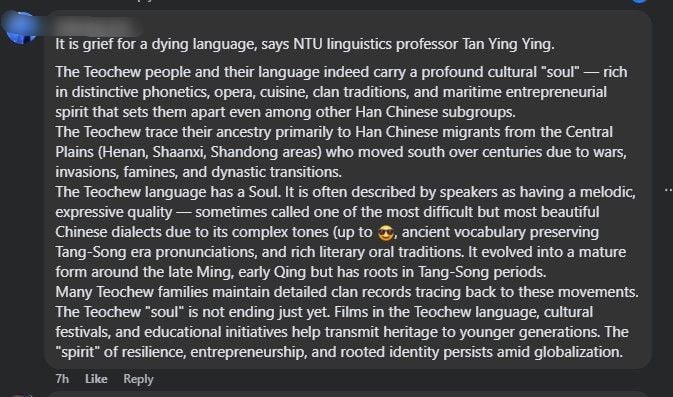
Another highlighted Teochew as carrying a cultural “soul”, describing its heritage through language, cuisine and clan traditions, while noting its deep historical roots and expressive linguistic qualities.
It added that while Teochew is “a dying language”, its “spirit” continues through films, festivals and education efforts.
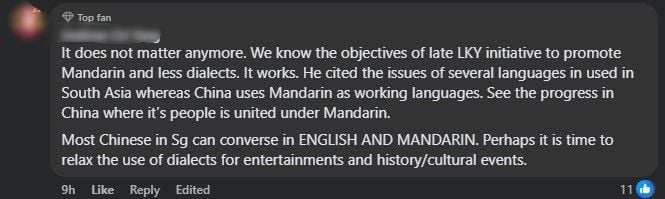
A number of users linked the issue to the Speak Mandarin Campaign, saying it had successfully unified communication but also contributed to reduced dialect use.
One comment suggested it may now be time to “relax the use of dialects for entertainments and history/cultural events”.
Comparisons were also drawn with Malaysia, where dialect use remains more common alongside Mandarin, Malay and English, with some pointing to it as an example of multilingual coexistence.

Support for existing language direction
At the same time, others defended Singapore’s language approach, noting that Mandarin and English have helped facilitate communication and national cohesion.
Some said the current linguistic environment reflected long-term policy outcomes rather than cultural loss.
Some also downplayed the emotional reaction, saying the film should be viewed simply as entertainment rather than a cultural statement, while others cautioned against over-interpreting its impact.
A smaller group highlighted that dialects are disappearing globally regardless of policy, describing the trend as a natural linguistic shift that is difficult to reverse.