Anwar Ibrahim retains highest approval rating at 52% as Rafizi and Nik Nazmi quit PKR for Bersama, Merdeka Center poll shows
A Merdeka Center survey of 1,209 Malaysians found Prime Minister Anwar Ibrahim leading approval ratings at 52%, while Rafizi Ramli — who has since quit PKR to lead Parti Bersama Malaysia — recorded 32% satisfaction.

- Anwar Ibrahim leads all political figures at 52% approval; Ahmad Zahid Hamidi records the lowest at 24%.
- Half of Malaysians believe the country is on the wrong track, driven overwhelmingly by economic anxiety.
- Rafizi Ramli, who recorded 32% approval in the poll, has since resigned from PKR alongside Nik Nazmi to lead Parti Bersama Malaysia.

KUALA LUMPUR, MALAYSIA: Prime Minister Anwar Ibrahim has retained the highest approval rating among Malaysia's leading political figures at 52%, according to a Merdeka Center public opinion survey conducted between 12 March and 9 April 2026.
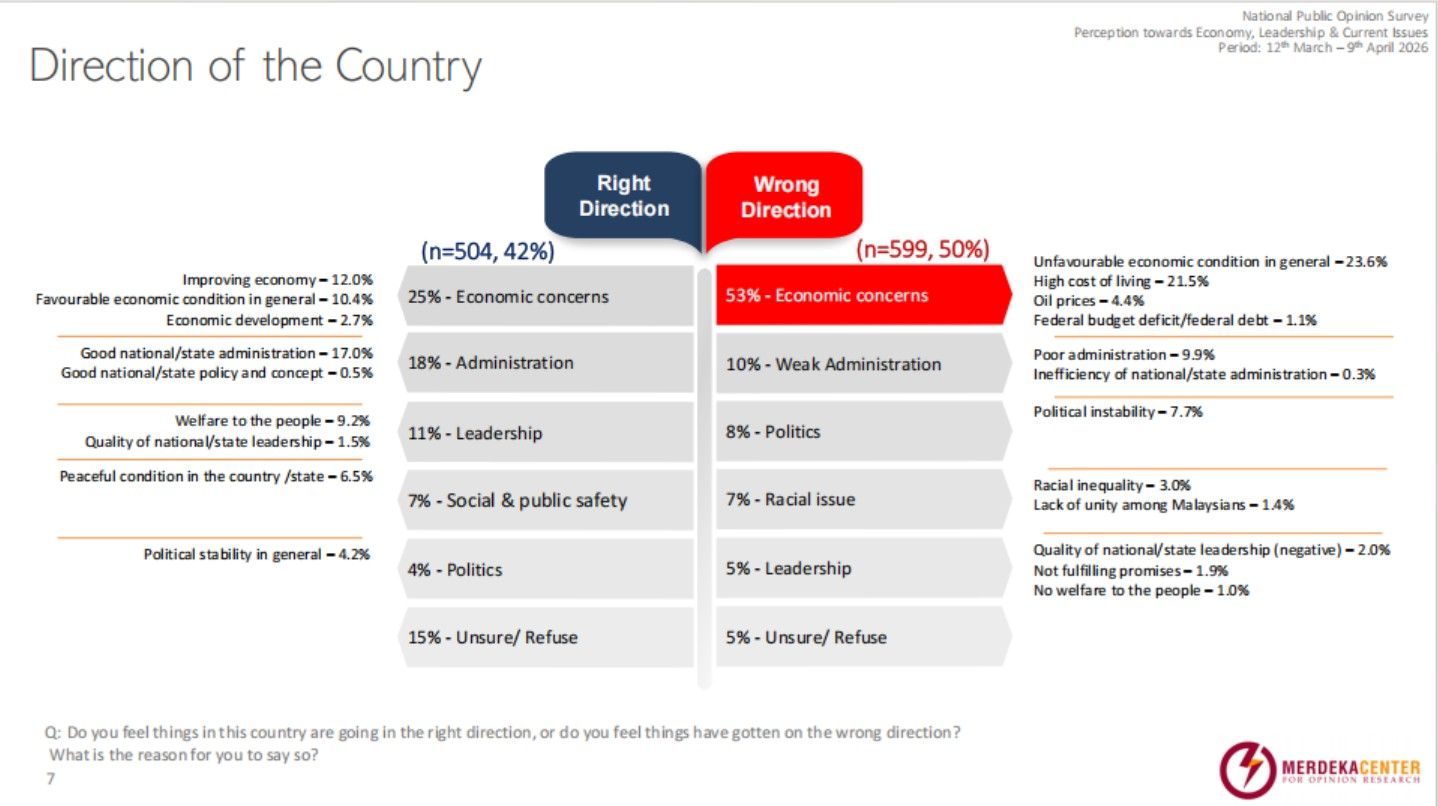
The poll of 1,209 registered voters, drawn from all 14 states and across 222 parliamentary constituencies, found that half of respondents — 50% — believe the country is heading in the wrong direction.
A steady 42% said Malaysia is moving in the right direction, a figure unchanged from December 2025 and February 2026.
The survey carries a margin of error of plus or minus 2.82%.
The results arrive as a significant political realignment unfolds within Pakatan Harapan (PH).
Former Economy Minister Rafizi Ramli, who recorded 32% satisfaction in the poll, has announced his resignation from Parti Keadilan Rakyat (PKR) in May, alongside former Natural Resources and Environmental Sustainability Minister Nik Nazmi Nik Ahmad to take over Parti Bersama Malaysia.
Both leaders have also officially vacated their parliamentary seats for Pandan and Setiawangsa respectively.
Economic concerns dominate public sentiment
Economic anxiety remains the defining issue for Malaysian voters.
Among respondents who said the country is on the wrong track, 53% cited economic concerns as their primary reason, including the general cost of living, fuel prices, and unfavourable economic conditions.
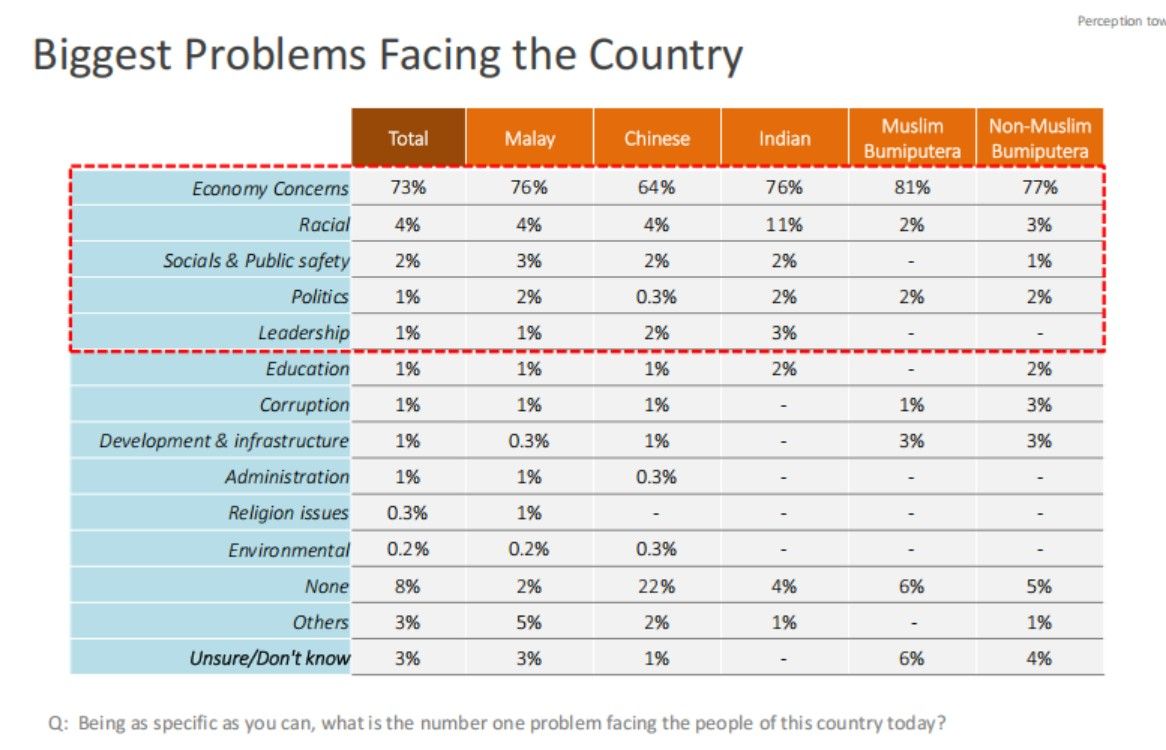
When asked to identify the single biggest problem facing Malaysians today, 73% pointed to economic matters — a figure consistent across all ethnic groups.
The top five economic concerns, in descending order, were: the high cost of living, minimum income adequacy, high fuel prices, unemployment, and generally unfavourable economic conditions.
Political instability, welfare concerns, and corruption in general ranked as the leading political concerns among that subset of respondents, while racial inequality and lack of unity among Malaysians were the two most cited racial issues.
Dissatisfaction with economic management eases slightly
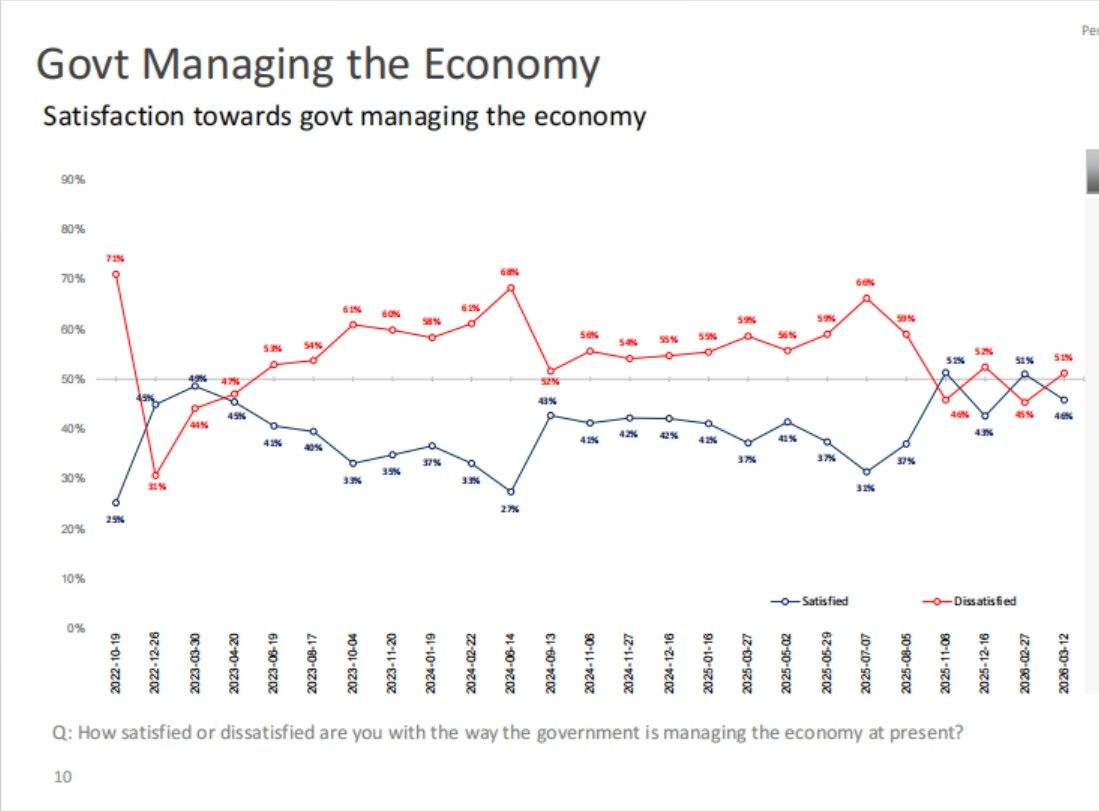
Satisfaction with the government's handling of the economy remained negative, with 51% of respondents expressing dissatisfaction compared to 46% who were satisfied.
However, Merdeka Center's longitudinal data indicates that dissatisfaction has eased from levels recorded across much of 2025, when the gap between satisfied and dissatisfied respondents was consistently wider.
Overall satisfaction with the federal government's performance stood at 50% satisfied against 48% dissatisfied.
Among ethnic groups, Bumiputera respondents from Sabah and Sarawak recorded the highest satisfaction at 68%, followed by Chinese respondents at 53%. Malay and Indian respondents reported satisfaction rates of 44% and 46% respectively.
By age group, the 21 to 30 cohort returned the highest satisfaction rate at 55%, while the 31 to 40 cohort was the only age group where dissatisfied respondents outnumbered satisfied ones, at 64% dissatisfied.
By party affiliation, respondents identifying with PH returned a satisfaction rate of 69% for the federal government's overall performance, while Perikatan Nasional (PN)-aligned respondents reported 73% dissatisfaction.
Leaders' approval ratings
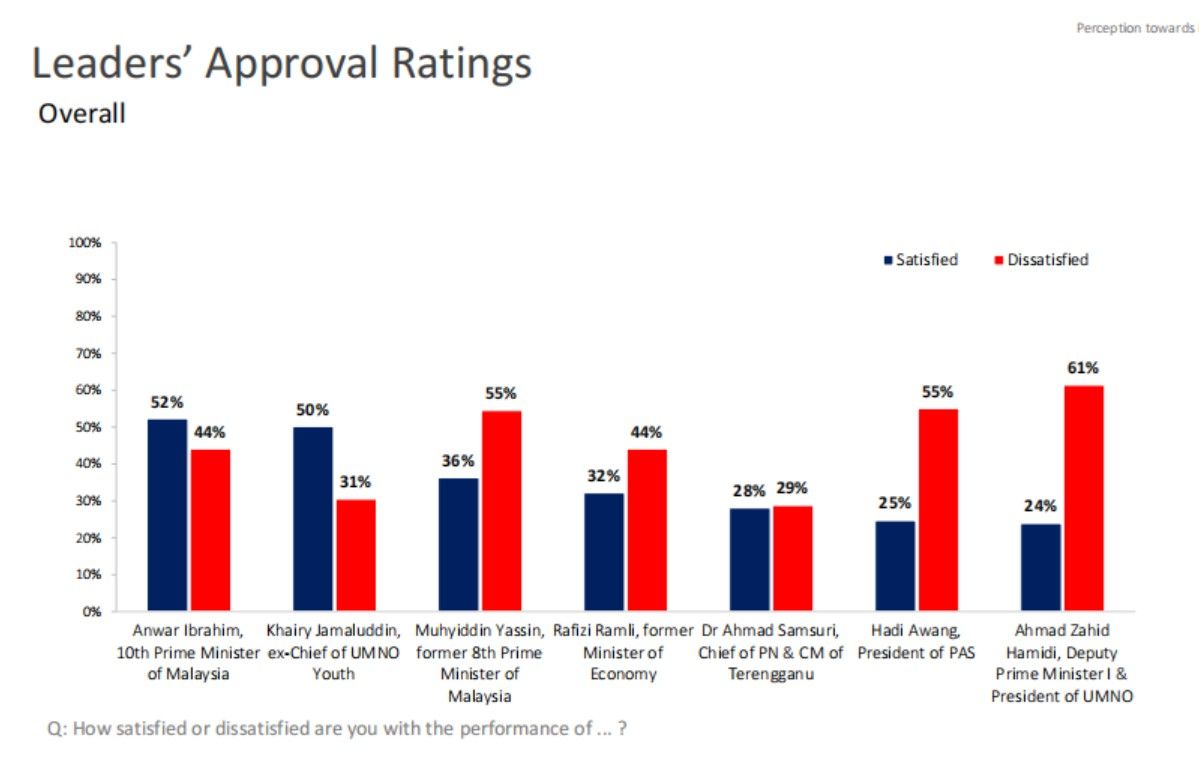
Among the seven political figures rated in the survey, Anwar Ibrahim led with 52% satisfaction and 44% dissatisfaction. Former United Malays National Organisation (UMNO) Youth chief Khairy Jamaluddin followed at 50% satisfied, 31% dissatisfied.
Among opposition figures, former Prime Minister Muhyiddin Yassin recorded 36% satisfaction against 55% dissatisfaction overall. Rafizi recorded 32% satisfaction and 44% dissatisfaction at the time of polling — before his public break with PKR.
PN chairman and Terengganu Chief Minister Ahmad Samsuri Mokhtar and PAS president Abdul Hadi Awang both recorded low overall satisfaction figures of 28% and 25% respectively, with dissatisfaction rates of 29% and 55%.
Deputy Prime Minister and UMNO president Ahmad Zahid Hamidi recorded the lowest satisfaction rating of the group at 24%, against a dissatisfaction rate of 61%.
Ethnic divergence in leadership ratings
The survey reveals a pronounced ethnic divergence in how leaders are perceived.
Among Malay respondents, Khairy Jamaluddin led with 62% satisfaction, followed by Muhyiddin Yassin at 49%. Anwar Ibrahim recorded 45% satisfaction among Malay respondents, against 51% dissatisfaction.
Ahmad Zahid Hamidi recorded 31% satisfaction among Malay respondents but 60% dissatisfaction — the lowest satisfaction and highest dissatisfaction within that cohort.
Among non-Malay respondents, Anwar Ibrahim led by a significant margin at 59% satisfaction and 40% dissatisfaction. Khairy Jamaluddin was second among non-Malays at 31% satisfaction.
Abdul Hadi Awang recorded 4% satisfaction among non-Malay respondents, against 81% dissatisfaction — the starkest divergence in the dataset.
Rafizi and Nik Nazmi resign from PKR, vacate seats
The poll results land against the backdrop of a significant rupture within PH.
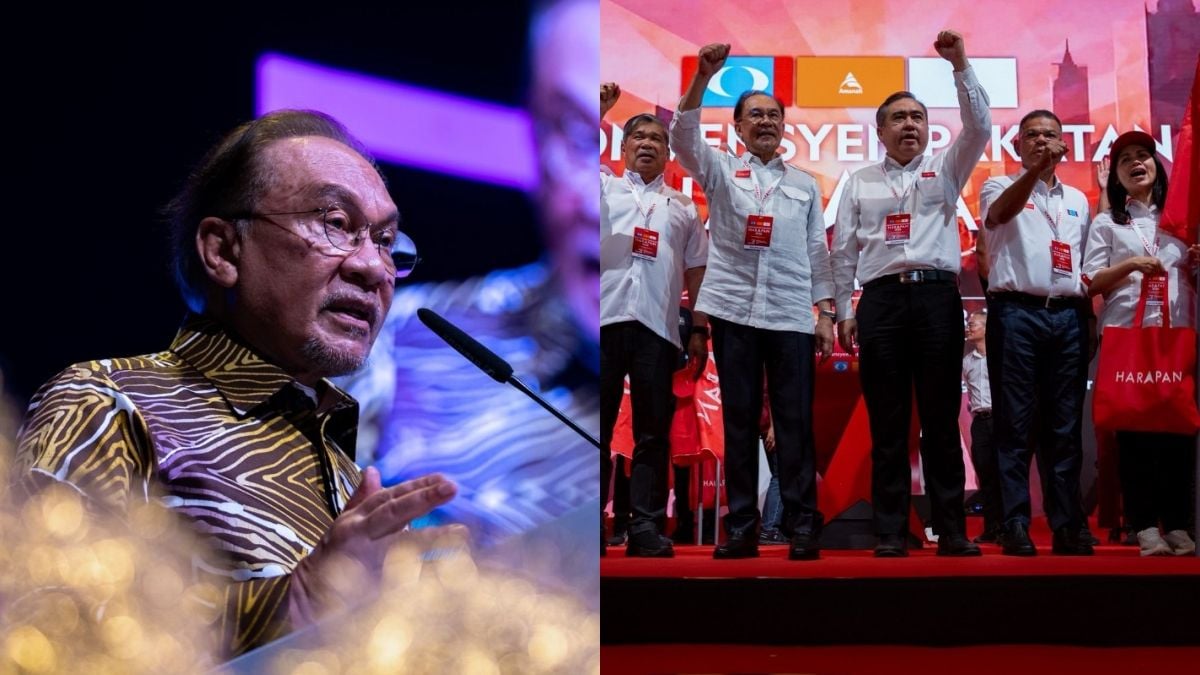
Rafizi and Nik Nazmi announced at a public event that they would formally write to Dewan Rakyat Speaker Johari Abdul to resign as Members of Parliament for Pandan and Setiawangsa respectively, before submitting their resignation letters to PKR secretary-general Fuziah Salleh.
Rafizi said the move to Parti Bersama Malaysia would only become official upon submission of those resignation letters to PKR, and that he intended to contest the Pandan seat under a Bersama ticket at the next general election. Nik Nazmi confirmed he would seek re-election in Setiawangsa.
Also present at the announcement were PKR Members of Parliament Wong Chen, Muhammad Bakhtiar Wan Chik, Rodziah Ismail, Zahir Hassan, and Lee Chean Chung.
Both leaders rejected characterisations of their move as political party-hopping, arguing that by voluntarily surrendering their parliamentary mandates before joining another party, they were not bound by the Anti-Hopping Law or PKR's financial bond provisions, which Rafizi said applied only to MPs who leave the party while retaining their seats.
Fuziah said in a statement that the memberships of Rafizi and Nik Nazmi had been automatically terminated under PKR's constitution following their public announcement, and that PKR would refer the matter to the Dewan Rakyat Speaker to determine the constitutional status of the two vacated seats under Article 49A(1)(a)(ii) of the Federal Constitution. She added that PKR would also review the status of other party members who attended the announcement event.
Rafizi further stated that Bersama would not enter into any political coalition ahead of the general election, describing the party's position as independent in deciding where to field candidates.
Strong cross-ethnic support for institutional reforms
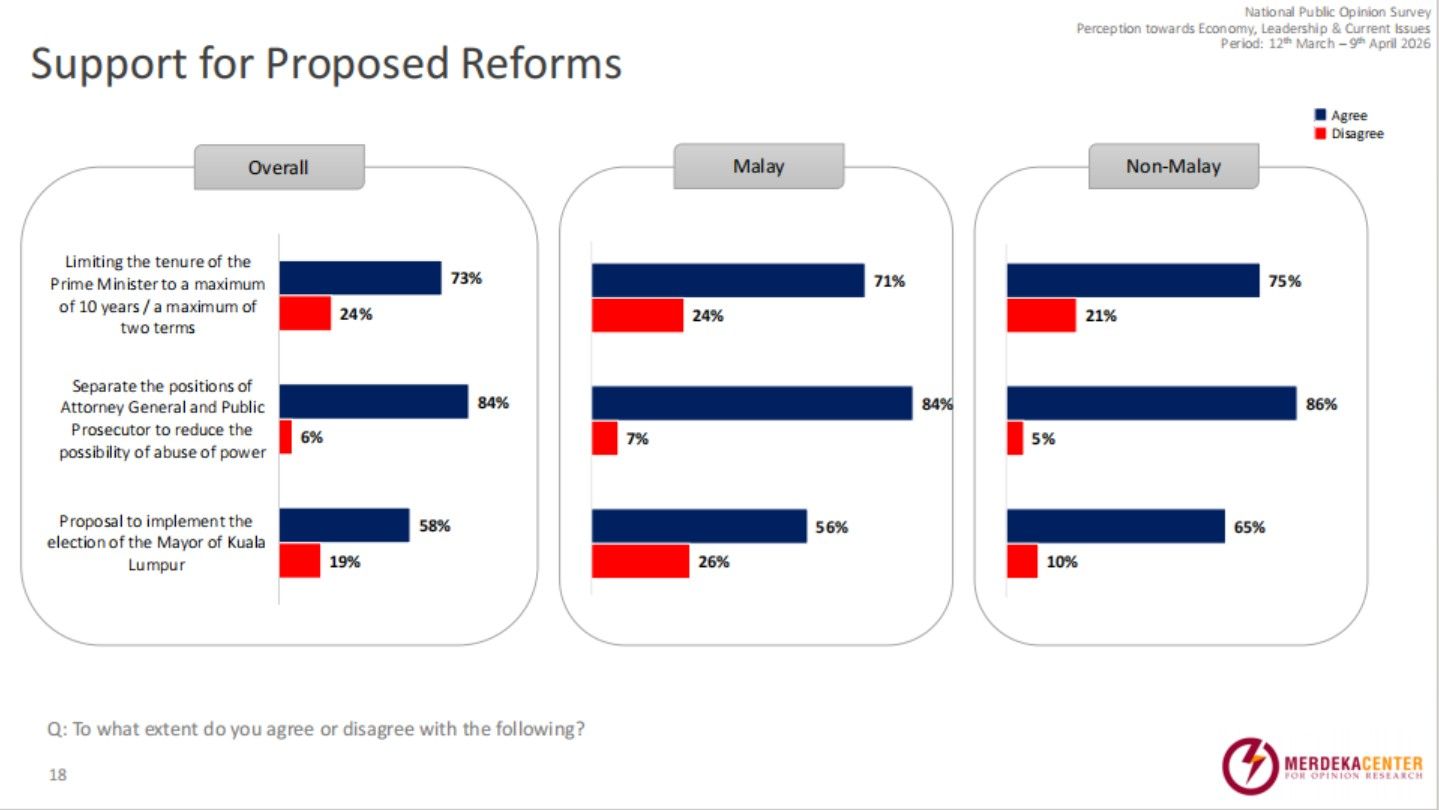
The Merdeka Center survey also tested public attitudes toward three proposed governance reforms, finding strong support across ethnic lines.
Separating the roles of Attorney General and Public Prosecutor to reduce the possibility of abuse of power received the highest support of the three proposals, at 84% overall — 84% among Malay respondents and 86% among non-Malay respondents.
Limiting the Prime Minister's tenure to a maximum of ten years or two terms was supported by 73% of all respondents — 71% of Malays and 75% of non-Malays.
The proposal to hold elections for the Mayor of Kuala Lumpur received support from 58% of all respondents, though support was notably higher among non-Malay respondents at 65% compared to 56% among Malays.
The Merdeka Center survey was conducted by telephone using mobile lines between 12 March and 9 April 2026.
A total of 1,209 respondents aged 18 and above were interviewed through random stratified sampling, with the sample proportional to population across all 222 parliamentary constituencies.
Respondents were interviewed in their preferred language. The margin of error is estimated at plus or minus 2.82%.