Singapore to review COE categorisation system amid price convergence concerns
Singapore's Land Transport Authority is reviewing its certificate of entitlement system after Category A and Category B car premiums converged, raising concerns over affordability and the system's original intent.

- LTA will review COE categorisation after Category A and B premiums converged in February 2025.
- The review, gathering views from motorists and industry, aims to conclude by end of 2026.
- Separately, LTA is exploring AI-based traffic management and expects cross-border motorcycle volumes to fall.

Singapore's Land Transport Authority (LTA) has announced a review of the certificate of entitlement (COE) system, focusing on how cars are categorised, following concerns that the two main passenger vehicle categories have converged in price.
Acting Minister for Transport Jeffrey Siow made the announcement on 4 March 2026 during the parliamentary debate on his ministry's budget. He was responding to Members of Parliament who called for a re-examination of a system they said was no longer fulfilling its original purpose.
The LTA will gather views from motorists, vehicle dealers, car manufacturers, and academics as part of the review. Siow said work would begin immediately, with the aim of completing the process by the end of the year.
Background to the COE price anomaly
The COE system divides passenger cars into two broad categories. Category A covers cars with an engine capacity of up to 1,600cc and a maximum power output of 130 brake horsepower (bhp), as well as electric vehicles (EVs) with a maximum power output of 110 kilowatts (kW). Category B covers larger, more powerful cars and higher-output EVs.
At the second tender exercise in February, the Category A COE premium closed at S$106,501 — S$1,500 above the Category B premium of S$105,001. This was an unusual reversal, given that Category B vehicles are typically more expensive and thus attract higher premiums.
At the latest tender, which closed on 4 March 2026, Category B premiums recovered, rising 8.6 per cent to S$114,002. Category A premiums also increased, climbing 1.6 per cent to S$108,220, returning the categories to their more conventional order.
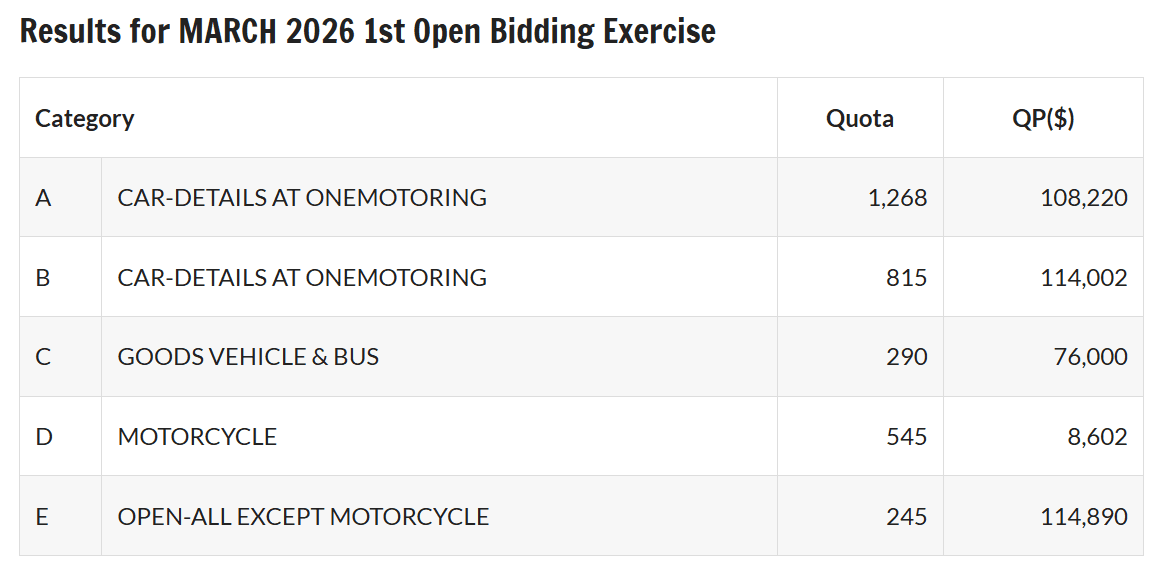
MPs raise concerns over market distortions
Edward Chia (Holland-Bukit Timah GRC) and Ang Wei Neng (West Coast-Jurong West GRC) flagged the premium convergence as a sign that the system had drifted from its original intent.
Ang said the trend may have been driven by market developments. He noted that it has become increasingly easy for EVs to be tuned to meet Category A criteria, and that more high-end internal combustion engine vehicles now feature lower engine capacities that also qualify them for Category A. He argued that having largely similar prices across the two categories ran contrary to the purpose of maintaining distinct classifications.
Ang stressed that the Category A COE was designed to reserve a portion of Singapore's vehicle quota for mass-market cars, thereby supporting accessibility and affordability for the general population.
Chia echoed this concern, noting that manufacturers had been tailoring vehicle specifications to fall within Category A requirements, effectively circumventing the intended distinction.
Proposals put forward by MPs
Chia proposed introducing discounts for vehicles with lower open market values and surcharges for more expensive ones. He said this would improve accessibility for lower- and middle-income families. The open market value of a car refers to its cost upon arrival in Singapore, before taxes, charges, and the COE are factored in.
Chia also suggested doing away with separate Category A and Category B COEs altogether, proposing instead that the two be merged into a single bidding pool.
In response, Siow said the LTA would consider the suggestions but indicated that there remained merit in preserving some form of distinction between mass-market and higher-end categories. He said the review would need to determine a categorisation structure that was more stable over the longer term.
Siow acknowledged the significance of the issue for Singaporeans. "I know this matters to you. It also matters to us," he told Parliament.
The LTA, in a social media post, said it was "timely to review how the system can better reflect current trends." The authority stressed that there would be no immediate changes to the COE system and urged motorists to continue bidding prudently.
Siow also noted that premiums for both categories were likely to "converge for some time," given that the COE supply for Category A had peaked in 2025, while supply for Category B was set to continue increasing through 2026.
Traffic congestion and cross-border motorcycle volumes
Also during the debate, Liang Eng Hwa (Bukit Panjang) raised the issue of worsening traffic congestion in Singapore and offered several suggestions for addressing it.
Liang proposed smarter traffic light management through artificial intelligence (AI) and better coordination of logistics vehicles, including the introduction of off-peak delivery windows in densely commercial districts.
He also highlighted data showing that an average of 69,000 Malaysian-registered motorcycles entered Singapore daily in 2025, contributing to congestion along expressways including the Bukit Timah Expressway (BKE) and Pan Island Expressway (PIE) during peak periods.
Siow said the Government expected the volume of foreign motorcyclists to decrease following two developments: the increase in the Vehicle Entry Permit (VEP) fee from S$4 to S$7 per day, and the anticipated opening of the cross-border Rapid Transit Systems (RTS) Link from 2027.
On AI-assisted traffic management, Siow confirmed that the LTA was actively exploring its use. He said the authority was developing a new system that would apply AI predictive capabilities to improve overall traffic management across the network.
On logistics, Siow said his ministry and the Ministry of Trade and Industry had been collaborating to develop a more coherent national logistics strategy, and that an update would be provided in due course.