KMT chairwoman lays wreath at Sun Yat-sen mausoleum, urges cross-strait reconciliation
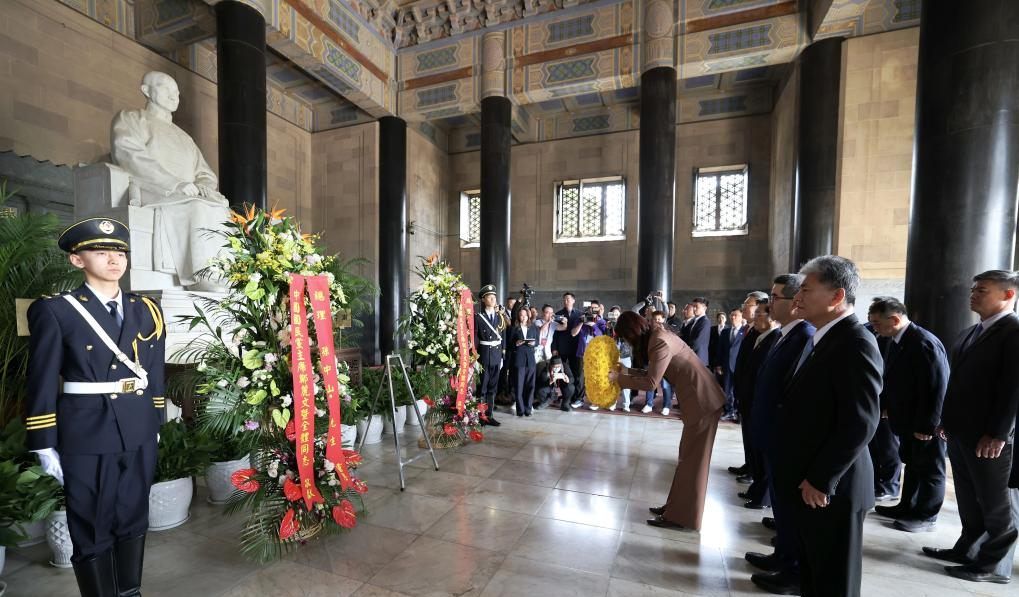
Chinese Nationalist Party Chairwoman Cheng Li-wun laid a wreath at Sun Yat-sen's mausoleum in Nanjing on Wednesday, calling for cross-strait unity as Taiwan's government warned of Chinese military intimidation and demanded legal scrutiny of the visit.

- Cheng laid a wreath at Sun Yat-sen's mausoleum in Nanjing, calling for cross-strait reconciliation.
- Taiwan's premier called for stronger legal oversight of political leaders' contacts with Beijing.
- Taiwan's security chief warned China uses military pressure to divide Taiwanese society internally.

Chinese Nationalist Party (KMT) Chairwoman Cheng Li-wun on Wednesday laid a wreath at the mausoleum of party founder Sun Yat-sen in Nanjing, invoking his founding ideals of equality and unity to call for reconciliation across the Taiwan Strait.
The visit, which began on Tuesday when Cheng arrived at Shanghai's Hongqiao International Airport under tight security before travelling by train to Nanjing, is framed by the KMT as a mission for peace. It comes amid heightened Chinese military pressure on Taiwan and a potential meeting with Chinese President Xi Jinping.
Speaking at the mausoleum on her first full day in China, Cheng said Sun's founding principles centred on equality, inclusiveness and unity. "We should work together to promote reconciliation and unity across the Strait and create regional prosperity and peace," she said, in footage broadcast live on Taiwanese television.
Cheng acknowledged that the KMT had eventually honoured Sun's founding vision by building Taiwan into a free and democratic society, though she also referenced the island's 38 years of martial law — the so-called "white terror" — which lasted until 1987. She added that the mainland had also seen progress and development that exceeded expectations.
Sun Yat-sen overthrew the last imperial dynasty and founded the Republic of China in 1912. He died of cancer in 1925 and is venerated in Taiwan as the republic's founder. China's Communist Party has also claimed him as a national hero, with Mao Zedong calling him the "great revolutionary forerunner."
Nanjing served as the capital of the KMT-led Republic of China government before it retreated to Taiwan in 1949 following defeat in the civil war against Mao Zedong's communist forces.
Context of the visit
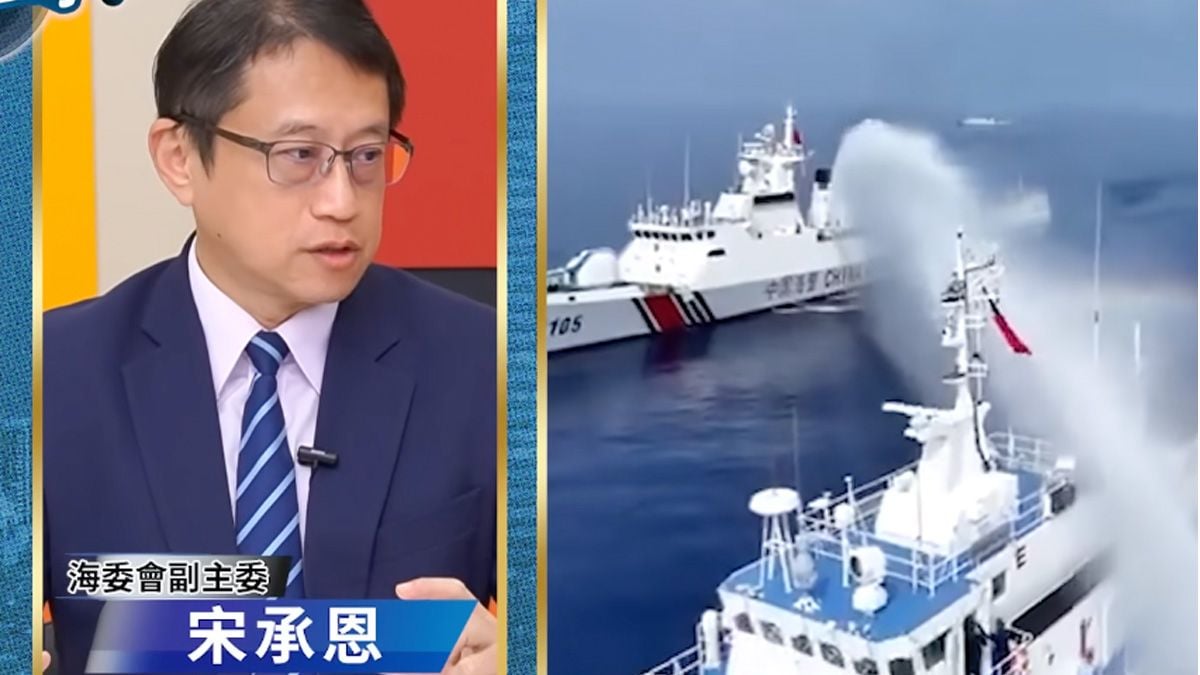
Cheng's trip takes place at a moment of acute cross-strait tension. Ocean Affairs Council Minister Kuan Bi-ling disclosed late on Monday that five Chinese warships were deployed around Taiwan — two off the east coast, and one each to the north, northwest and southwest.
Kuan told reporters that China's military has referred to Taiwan's planned "T-Dome" air defence system as a "Taiwan cage," an allusion she used to describe the context in which Cheng was departing.
The visit also comes as the opposition-dominated Legislative Yuan continues to stall a government proposal for an additional US$40 billion in defence spending.
Before departing, Cheng told reporters she was embarking on a "historic journey for peace," acknowledging that some felt uneasy about the trip. "If you truly love Taiwan, you will seize even the slightest chance, every possible opportunity, to keep Taiwan from being ravaged by war," she said.
She added: "I would rather believe that all Taiwanese hope this trip will succeed, because we can transform the most dangerous place in the world into the safest place in the world."
Government criticism and proposed legal changes
Taiwan's ruling government responded with pointed criticism. Premier Cho Jung-tai, speaking at a legislative plenary session on Wednesday, said Taiwanese political leaders must not surrender to China through nonresistance or inaction.
Cho called for amendments to laws governing exchanges between Taiwanese political leaders and China, arguing that stronger legal safeguards were necessary to protect national security. The Executive Yuan has proposed amendments to the Act Governing Relations Between the People of the Taiwan Area and the Mainland Area that would require lawmakers to disclose information and contacts with Chinese political and military figures.
Mainland Affairs Council Minister Chiu Chui-cheng, addressing the same session, said Cheng should use the visit to demand that Beijing halt military aircraft and warship deployments around Taiwan, and to directly confront the reality of the Republic of China's existence, democratic values and way of life.
Chiu warned that Cheng should not allow herself to become an instrument of the Chinese Communist Party's (CCP) "united front" tactics, and cautioned against following what he described as the CCP's political script to divide Taiwan.
Security bureau warns of Chinese pressure tactics
Taiwan's National Security Bureau Director-General Tsai Ming-yen told reporters at parliament in Taipei on Wednesday that China employs a carrot-and-stick approach in its dealings with Taiwan.
Tsai said China uses military intimidation and harassment to generate an atmosphere of rising danger and instability across the Taiwan Strait. "This is intended to make Taiwan's society and public feel the psychological pressure and anxiety of a possible conflict," he said.
He added that the strategy aims to fracture Taiwanese society internally, amplify the visibility of pro-China positions, and obstruct efforts to advance United States arms procurement agreements.
China's government refuses to engage with Taiwan President Lai Ching-te, whom Beijing describes as a "separatist." Lai has said only Taiwan's people can determine their own future. Neither government formally recognises the other.
Supporters and sceptics
Within the KMT, senior figures have framed the trip in strategic terms. KMT Vice Chairman Chang Rong-kung told Bloomberg News that Cheng's visit was intended to buy time and space for Taiwan by persuading Beijing that segments of Taiwanese society still favour closer cross-strait ties. "That reduces the need for Xi to resort to military means for now," he said.
Academic observers were more cautious. Tunghai University political science professor Chang Chun-hao said Beijing would likely use any meeting to signal to the international community that significant numbers of Taiwanese support the "one China" principle. "She could become a useful tool or pawn for Beijing in conveying messages to the international community," he said.
Chong Ja Ian, an associate professor at the National University of Singapore (NUS), speaking to CNA, said Beijing's message to Taiwan's opposition was unambiguous: accepting Beijing's terms brings prominence and opportunities, while demonstrating that China can work around Taiwan's elected government through opposition parties and other actors.
Beijing could also dangle reduced military pressure or economic benefits, Chong said, but only under conditions it retains the authority to alter or withdraw at any time.
Chong suggested the visit may also serve Beijing's interests ahead of a meeting between Chinese President Xi Jinping and United States President Donald Trump. If the Chinese Communist Party (CCP) could get Cheng and the KMT to adopt Beijing's preferred framing in exchange for concessions, Xi could then argue to Trump that further military arms sales to Taiwan were unnecessary.
"If the CPC can get Cheng and the KMT to accept their language in exchange for Beijing's largesse and an easing of military pressure towards Taiwan, Xi can turn to Trump before their meeting to indicate that further military sales to Taiwan are unnecessary," Chong said.
That dynamic, Chong added, could also hand the KMT a domestic political shield — allowing the party to reframe its resistance to defence spending not as opposition to Taiwan's security, but as a question of whether Washington remains willing or capable of delivering the weapons Taiwan seeks.
Chong warned that security-focused officials and politicians would likely be alarmed by any Xi-Cheng arrangement, cautioning that it could weaken Taiwan's defensive capacity and ripple outward to affect Washington's posture in the Western Pacific and its support for regional allies including Japan, South Korea, the Philippines and Australia.
He also noted that views within Washington may not be uniform. Those more aligned with Trump's political priorities, Chong said, may be more receptive to any arrangement that generates the appearance of a successful Trump-Xi summit.
On Taiwan's domestic front, Chong assessed the strategy as a calculated risk. An appeal to the People's Republic of China (PRC) resonates with an important segment of the KMT's base and could help mobilise supporters ahead of local elections later this year. But he cautioned the bet could also misfire.
"Of course, the bet could go wrong and lead to counter mobilisation among voters who are wary of the KMT," Chong said. He added that getting too close to Beijing risked eroding the KMT's credibility in Washington, while offering too little to Beijing could diminish the party's usefulness to China as well.