DPM Gan urges fans over air-conditioning; public fires back with calls for ministers to lead by example
Deputy Prime Minister Gan Kim Yong urged Singaporeans on 7 April to use fans instead of air-conditioning and take public transport to manage rising energy costs — advice that drew over 1,300 public comments demanding ministers demonstrate the same behaviours, before the government directed all public agencies to adopt conservation measures the following day.

- Singapore expects slower economic growth and higher inflation due to global energy disruptions.
- Energy-intensive sectors and consumer costs will be most affected in coming quarters.
- Public response highlights concerns over fairness and leadership example in policy messaging.

Singapore's government has ordered all ministries, departments, organs of state, and statutory boards to reduce electricity consumption, issuing a coordinated national directive on 8 April 2026 — one day after Deputy Prime Minister Gan Kim Yong warned Parliament that rising energy costs linked to the Middle East conflict would strain the economy for quarters to come.
The joint media release from the Ministry of Sustainability and Environment (MSE) and the National Environment Agency (NEA) came as public reaction to Gan's remarks was still generating significant online commentary, with more than 1,300 comments on CNA's Facebook page and over 100 on Reddit — the vast majority demanding that political leaders demonstrate the conservation behaviours they were recommending to the public.
The sequencing is significant: the government's directive to lead by example through concrete institutional measures followed, rather than preceded, Gan's public messaging to households.
PM Wong sets the tone from 2 April
The national effort had been framed at the top level earlier in the month.
In a video message on 2 April 2026, Prime Minister and Minister for Finance Lawrence Wong called on businesses and households to conserve energy and contribute to Singapore's energy resilience in light of the continuing Middle East situation.
MSE and NEA said the government intended to take the lead in that national effort and would provide support to help Singaporeans save energy.
DPM Gan's parliamentary statement
In his ministerial statement to Parliament on 7 April, Gan warned of broader economic consequences from global energy disruptions.
While first-quarter GDP growth was described as resilient, he cautioned that "these sectoral impacts will weigh on economic activities in the coming quarters," citing rising fuel costs, supply chain disruptions, and weakening global demand.
Inflation is expected to exceed the government's earlier forecast of 1 to 2 per cent for 2026.
Rising oil and natural gas prices are expected to translate into a sharper increase in the regulated electricity tariff in the next quarter.
"The crisis is unlikely to be over anytime soon, and we must be prepared for its effect to persist for some time," Gan said.
Gan also noted that lower-income households would be disproportionately affected, as a greater share of their spending goes toward essentials.
He advised Singaporeans to use fans in place of air-conditioning and to take public transport rather than drive.
A crisis committee led by Coordinating Minister for National Security K Shanmugam has been convened to secure energy supplies and provide support for affected businesses and households.
Public sector directed to adopt conservation measures
The following day, MSE and NEA issued the directive formalising public sector obligations.
All government agencies have been told to implement Go 25 protocols — setting air-conditioning temperatures to 25°C or higher — alongside active management of operating hours for air-conditioning, lighting, and lifts.
Agencies have been directed to unplug or switch off non-essential equipment when not in use, and to accelerate the installation of energy-efficient infrastructure including LED lighting and smart sensors.
Existing electrical equipment is to be replaced with more energy-efficient alternatives, prioritising those with the highest tick ratings under Singapore's energy efficiency labelling scheme.
All public officers have been advised to adopt conservation habits personally, including switching off lights, monitors, air-conditioning, and other equipment when not in use.
MSE and NEA stated that the measures complement existing requirements under the GreenGov.SG framework and demonstrate the government's commitment to leading by example.
Five steps for households
The government is calling on households to adopt five conservation measures.
First, use fans in place of air-conditioning where possible. Second, where air-conditioning is used, adopt the Go 25 standard — MSE and NEA noted that each degree raised reduces energy consumption by around 10 per cent.
Third, switch off appliances at the power socket when not in use, as standby devices including televisions, routers, and computers continue to draw power. Fourth, choose appliances with higher tick ratings.
Fifth, walk, cycle, or take public transport to reduce fuel and energy use.
Eligible households can claim up to S$400 in Climate Vouchers under the enhanced Climate Friendly Households Programme (CFHP) to fund more energy-efficient appliances.
Businesses can draw on the Energy Efficiency Grant (EEG) and the Resource Efficiency Grant for Emissions (REG(E)) for investment in energy-efficient equipment.
Public reaction: 1,300 Facebook comments and a single demand
Gan's parliamentary remarks had already generated a sharp public response before the government directive was issued.
The CNA Facebook post summarising his advice drew more than 1,300 comments within 24 hours, with the dominant theme centred on a single demand: that ministers demonstrate the same conservation behaviours before asking the public to follow.
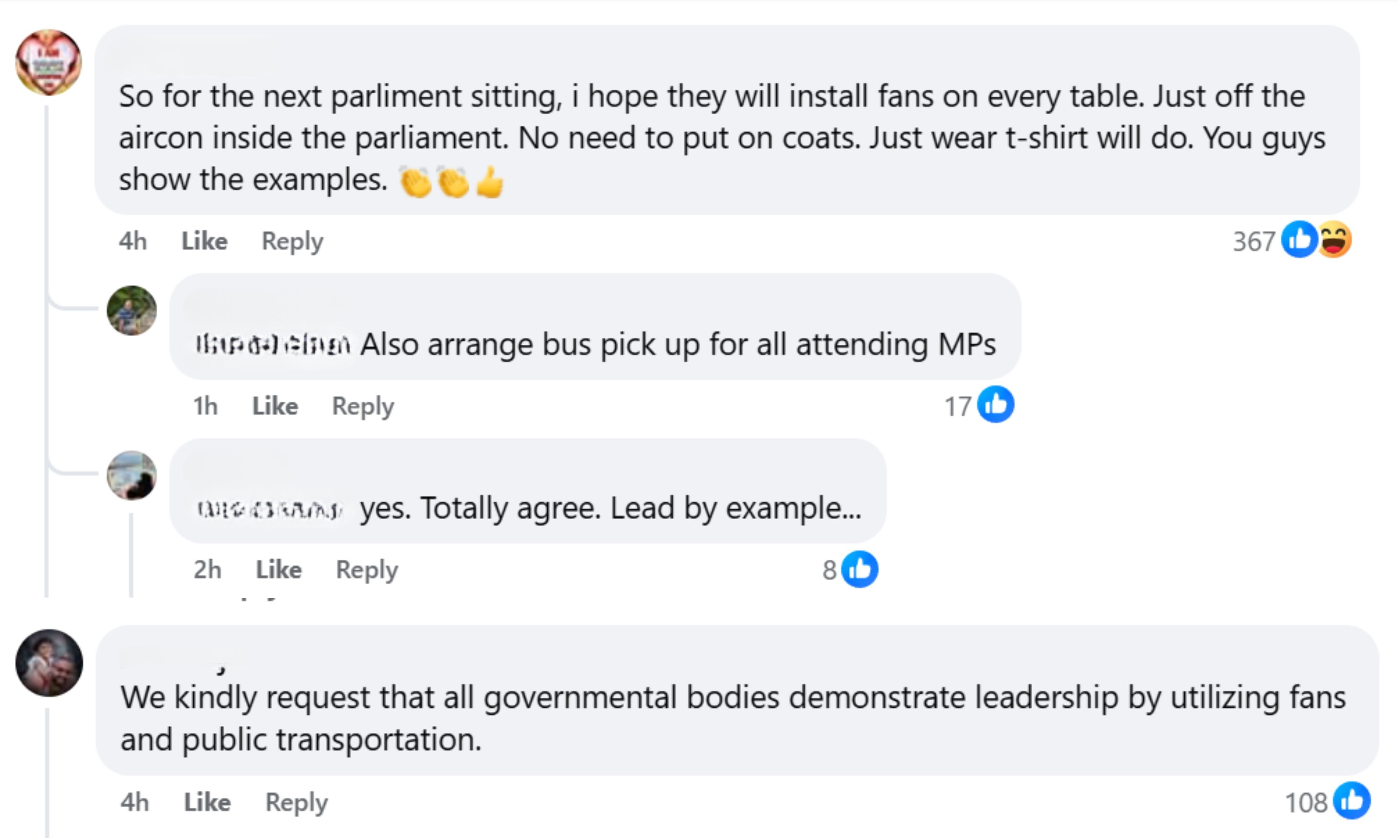
"So for the next parliament sitting, I hope they will install fans on every table. Just off the aircon inside the parliament. No need to put on coats. Just wear t-shirt will do. You guys show the examples," one commenter wrote.
Another added: "We kindly request that all governmental bodies demonstrate leadership by utilizing fans and public transportation."
A third comment, drawing dozens of replies, stated simply: "I don't see any fans in parliament."
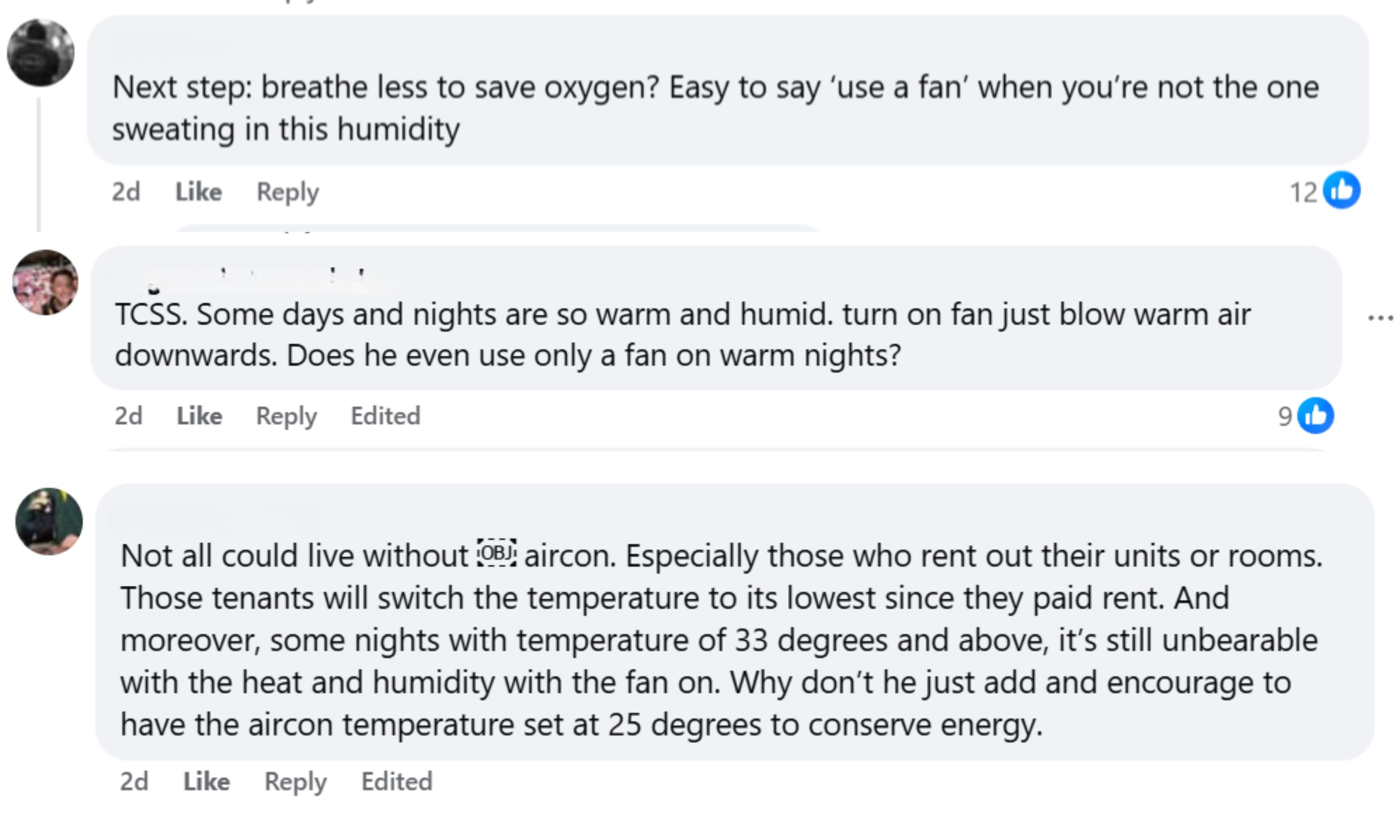
Several comments questioned the practical viability of the advice in Singapore's tropical climate.
"Easy to say 'use a fan' when you're not the one sweating in this humidity," one user wrote. Another noted that fans merely circulate warm air on nights when temperatures exceed 33 degrees Celsius.
Satirical suggestions proliferate
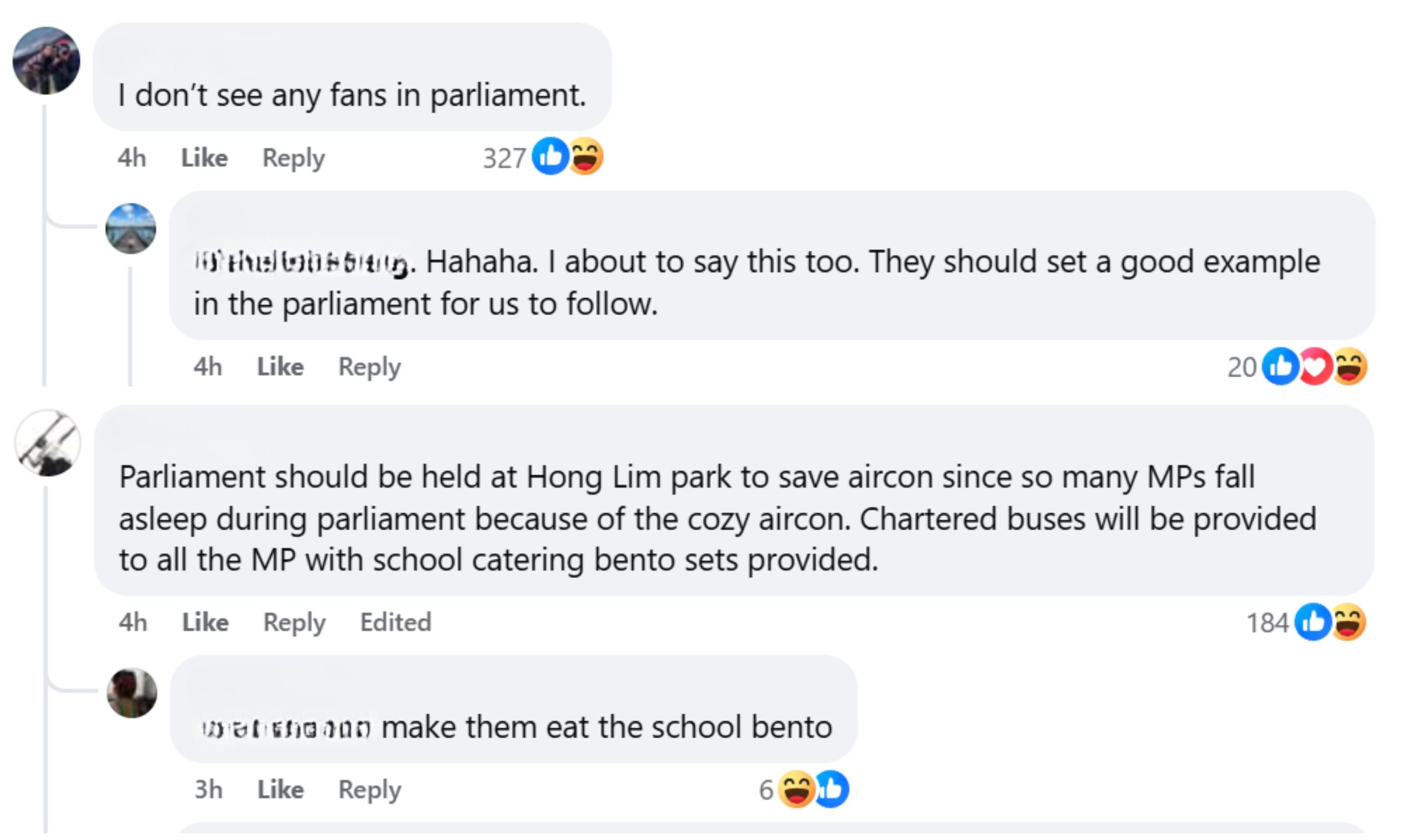
A significant proportion of the more than 1,300 comments took a satirical tone while reflecting the same underlying critique.
One user proposed that "Parliament should be held at Hong Lim Park to save aircon... Chartered buses will be provided to all the MP with school catering bento sets provided," drawing endorsements and suggestions that ministers be made to eat school canteen bento sets as well.
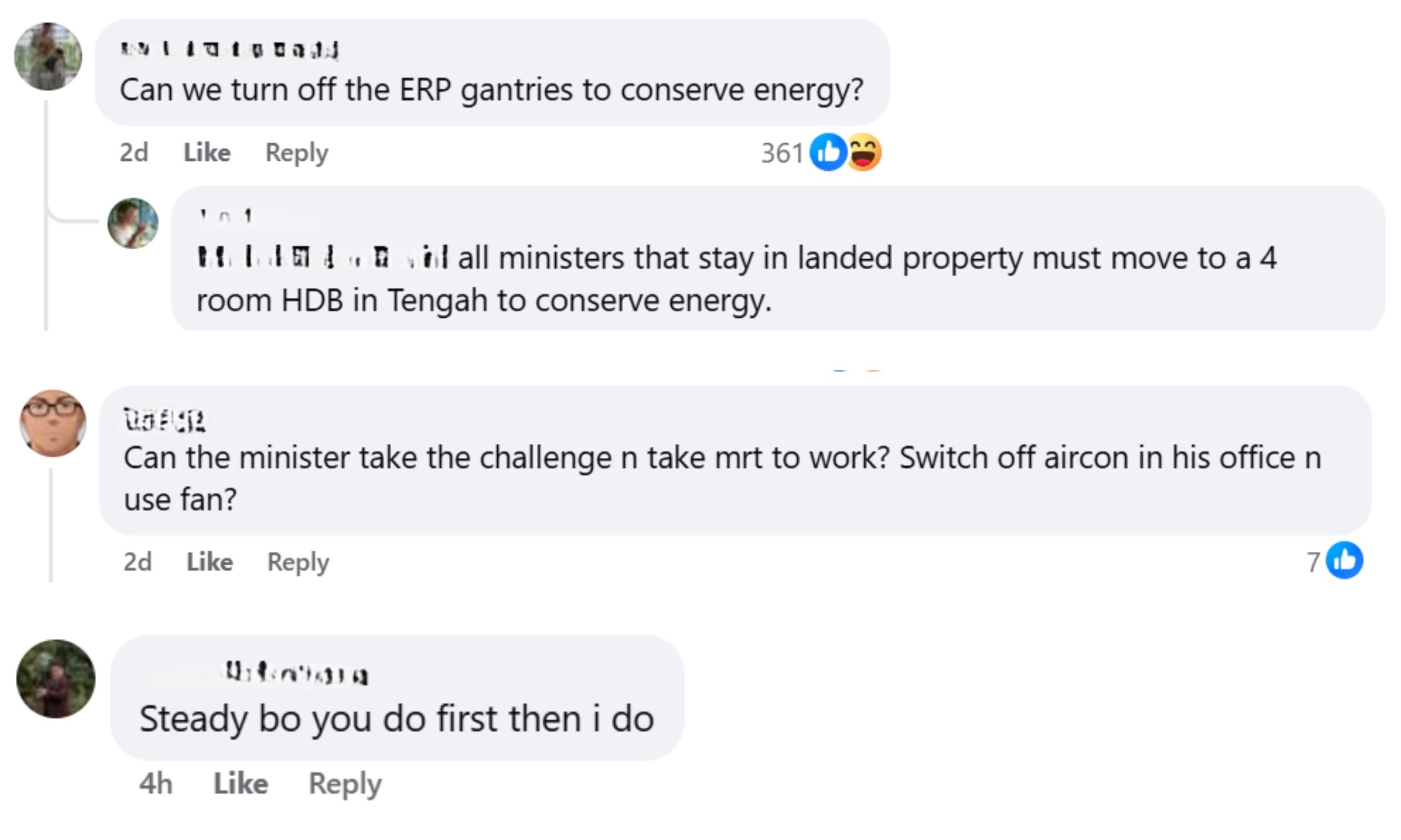
Others suggested turning off Electronic Road Pricing (ERP) gantries, moving ministerial constituency meet-the-people sessions to void decks rather than air-conditioned offices, and requiring Members of Parliament (MPs) to carpool to Parliament House by bus.
One commenter proposed a direct challenge: "Can the minister take the challenge and take the MRT to work? Switch off aircon in his office and use fan?" Another wrote simply: "You do then we do."
Reddit: systemic critique and specific examples
On Reddit, where the story drew more than 100 comments, the criticism was more pointed and drew on specific documented examples of perceived inconsistency.
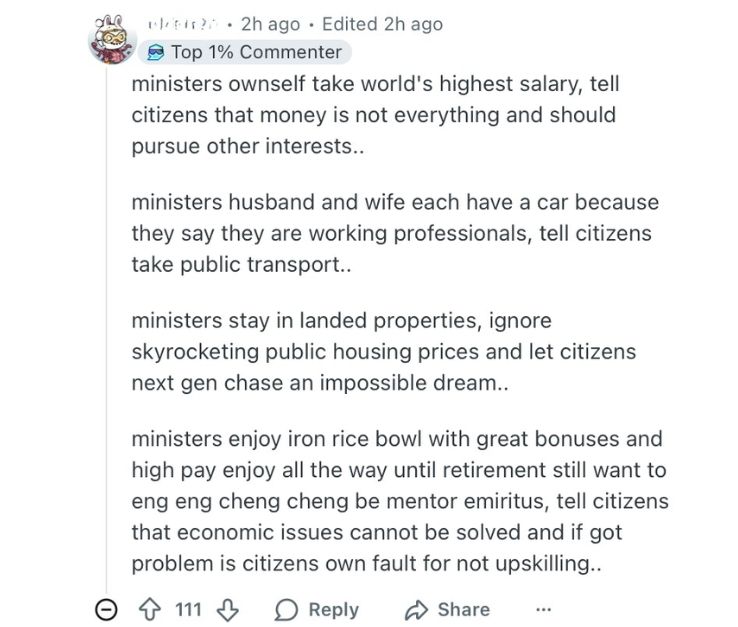
One widely upvoted comment laid out the perceived contradictions directly: "Ministers ownself take world's highest salary, tell citizens that money is not everything and should pursue other interests. Ministers husband and wife each have a car because they say they are working professionals, tell citizens take public transport."
The remark was an apparent reference to statements previously attributed to Senior Minister of State Koh Poh Koon, who had said publicly that he and his wife each owned a car because they were working professionals who needed to travel.
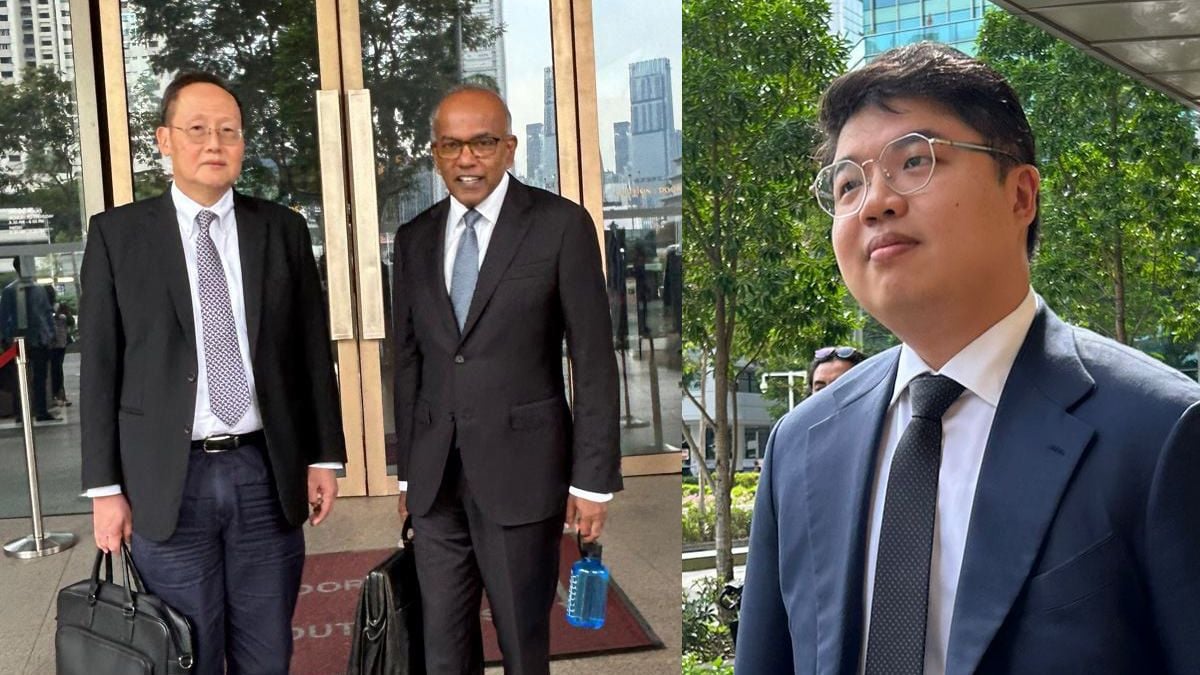
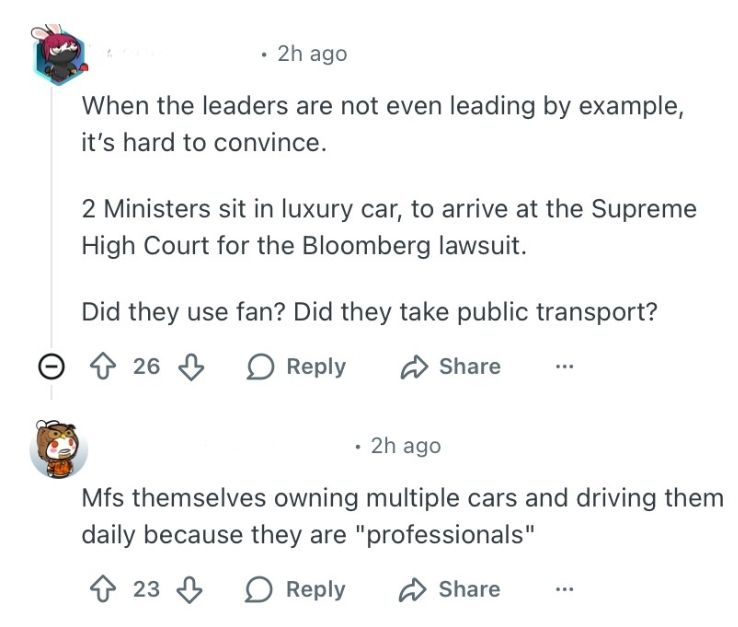
Another commenter linked the transport question to a recent legal proceeding: "When the leaders are not even leading by example, it's hard to convince. 2 Ministers sit in luxury car, to arrive at the Supreme High Court for the Bloomberg lawsuit. Did they use fan? Did they take public transport?"
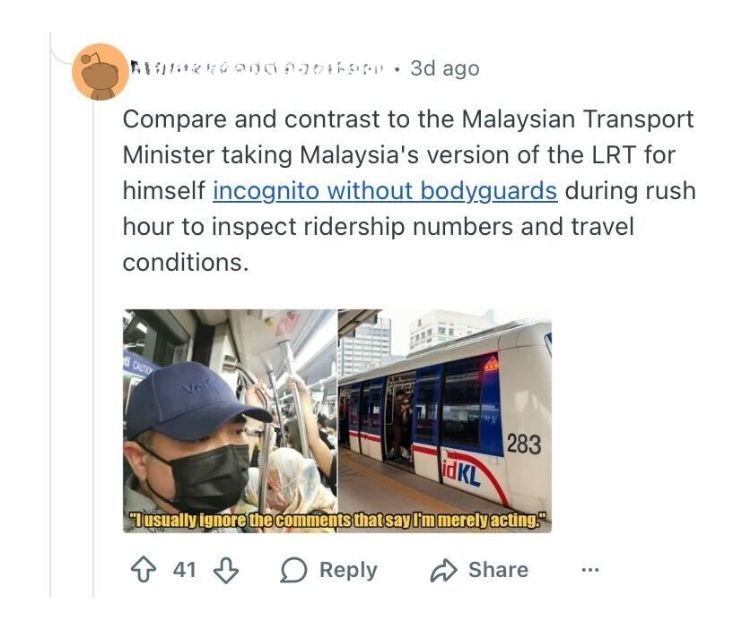
A photograph circulated on Reddit showing Malaysia's transport minister riding the country's rapid transit system incognito during peak hours to inspect conditions firsthand. The implicit contrast with Singapore's ministerial transport practices attracted significant upvotes.
Across both platforms, a recurring formulation captured the dominant sentiment: "Rules for thee but not for me."

Substantive policy alternatives proposed
Beyond the satirical commentary, both platforms produced a range of substantive counter-proposals.
Suggestions included energy rebates for households keeping consumption below threshold levels, work-from-home mandates for the public sector, temperature caps on air-conditioning in all government buildings, and the temporary suspension of ministerial pay increments for the duration of the crisis.
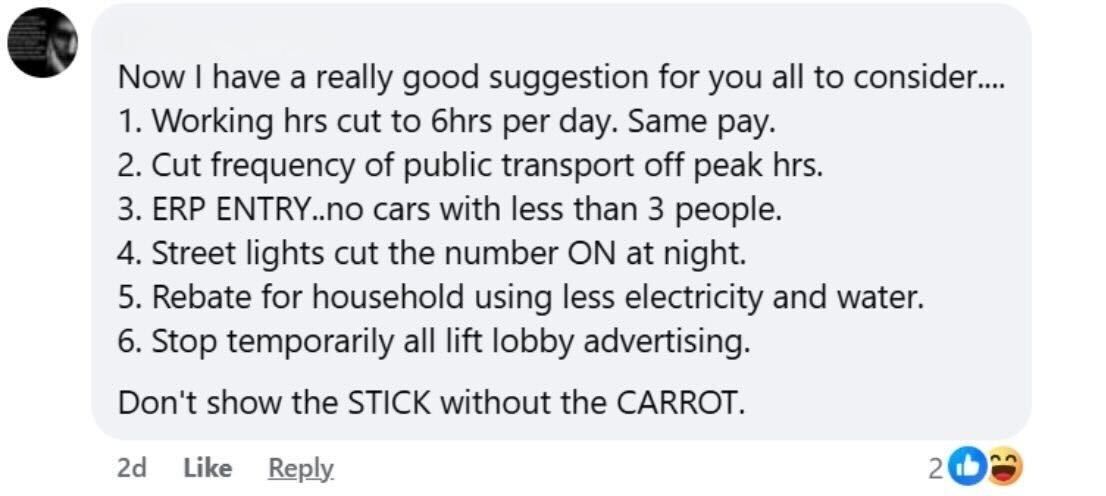
One Facebook commenter proposed a structured package: "Working hours cut to 6 hours per day at same pay. Cut frequency of public transport off-peak hours. Rebate for households using less electricity and water. Don't show the stick without the carrot."
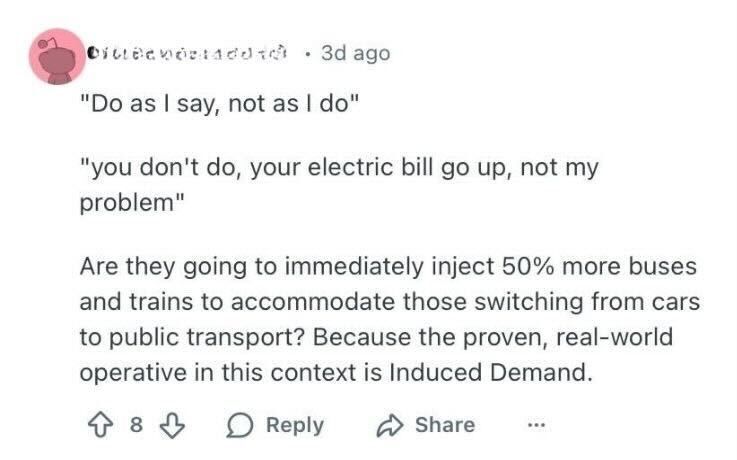
A Reddit commenter identified a structural constraint in the transport advice: "Are they going to immediately inject 50 per cent more buses and trains to accommodate those switching from cars to public transport? Because the proven, real-world operative in this context is Induced Demand."
The government's directive on 8 April, explicitly framing the public sector as leading by example, addresses a portion of that criticism.
Whether it will prove sufficient to shift public sentiment — given that it followed rather than preceded Gan's household-level messaging — remains to be seen as the energy crisis enters its second month.