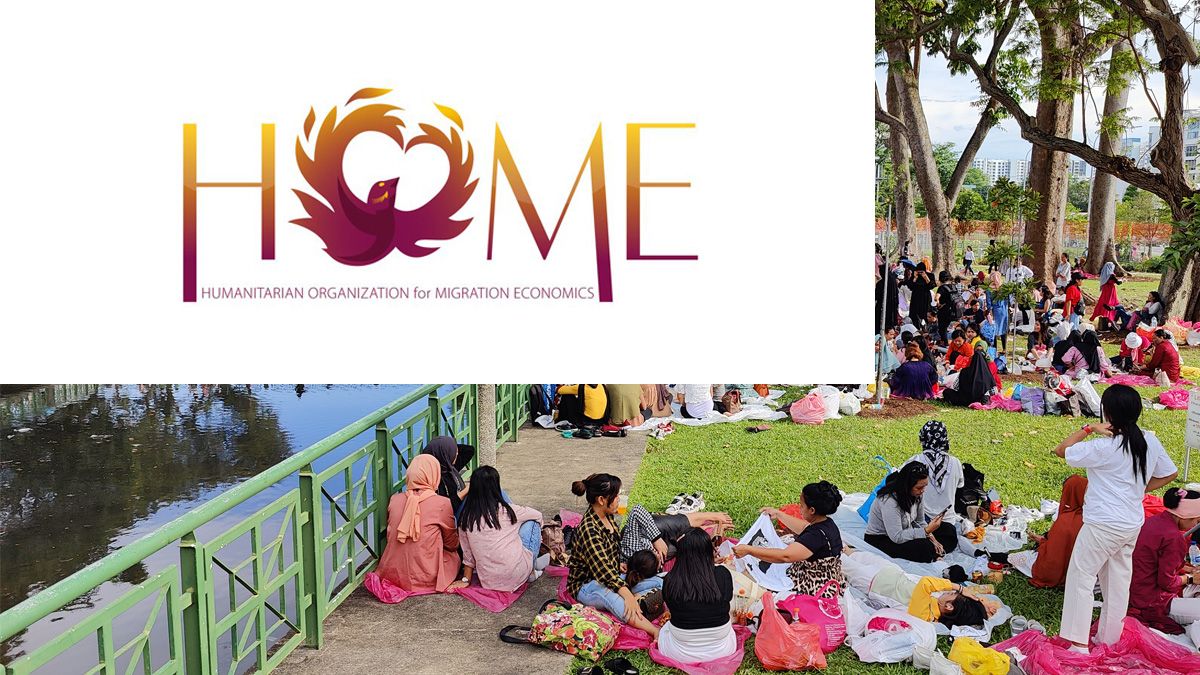
'Rest is a right': HOME renews call for legally mandated weekly 24-hour rest for migrant domestic workers
Singapore labour group HOME has renewed its call for a legally enforced 24-hour weekly rest day for migrant domestic workers, citing gaps in current guidelines and power imbalances.

- HOME is urging Singapore to mandate uninterrupted 24-hour weekly rest days for migrant domestic workers.
- The group says current guidelines allow rest days to be fragmented and influenced by employer demands.
- Survey data shows gaps between employer awareness of rest needs and actual practices.

Singapore-based labour rights group Humanitarian Organisation for Migration Economics (HOME) has renewed its call for the government to mandate a legally protected, uninterrupted 24-hour weekly rest day for migrant domestic workers (MDWs), arguing that current frameworks leave workers vulnerable to inconsistent and inadequate rest.
The appeal follows a petition submitted on 3 March 2026 to the Ministry of Manpower (MOM), carrying more than 1,100 physical signatures from MDWs and members of the public.
The petition calls for rest to be recognised as an enforceable right, supported by legal protections, fair wages, and accessible support systems.
Under existing regulations, MDWs in Singapore are entitled to one rest day per week, with the specific day to be mutually agreed between employer and worker.
According to MOM's website, if an MDW agrees to work on a rest day, she must be compensated with at least one day’s salary, separate from her basic pay. However, employers must still ensure at least one non-compensable rest day each month, failing which enforcement action may be taken.
HOME argued that the practical definition of a “rest day” remains unclear and insufficiently enforced.
Ambiguity in current rest day guidelines
According to guidance shared through MOM’s WhatsApp channel for MDWs, rest days can be taken flexibly, including as an eight-hour day or two four-hour half-days, subject to agreement with employers.
HOME contended that this flexibility undermines the intent of rest provisions.
The group stated that such arrangements allow rest periods to be fragmented, interrupted, or structured around employer needs rather than the worker’s well-being.
The organisation cited cases in which MDWs are expected to complete household chores before leaving for their rest period or after returning home.
Others reportedly face curfews requiring them to return by dinner time or earlier, effectively limiting their autonomy during time off.
By HOME’s account, these practices demonstrate that rest days are not consistently experienced as genuine breaks from work.
Call for alignment with international standards
HOME argued that establishing a continuous 24-hour weekly rest period would align Singapore with benchmarks set by the International Labour Organisation (ILO).
The group described such a policy as neither radical nor unprecedented, pointing to jurisdictions such as Hong Kong, where labour laws clearly define a weekly 24-hour rest day under the Employment Ordinance.
According to Hong Kong’s Labour Department, employers are prohibited from compelling workers to work on rest days except in emergencies. Violations can result in prosecution and financial penalties.
HOME stated that adopting a similarly clear and enforceable standard would ensure that rest days are respected in practice rather than left to informal negotiation.
Rest as a multidimensional need
The organisation emphasised that rest extends beyond time away from work, outlining several functions of a guaranteed weekly break.
These include physical and mental recovery after extended hours of live-in domestic work, as well as opportunities for social reconnection with friends, community, and religious networks.
HOME also highlighted the importance of recreation, allowing workers to pursue leisure and personal development, and access to support services, particularly for those facing abuse, exploitation, or isolation.
The group argued that without a continuous rest period, many of these needs remain unmet.
Power imbalance limits “mutual agreement”
While acknowledging MOM’s emphasis on mutual agreement between employers and MDWs in determining rest arrangements, HOME argued that such agreements do not occur on equal footing.
The group stated that MDWs may fear negative consequences if they assert their entitlement to rest, including being perceived as difficult, losing their job, or being repatriated.
“When there is a power imbalance, rights cannot be left to chance,” the organisation stated.
HOME further noted that some workers forgo rest days due to financial pressures, as wages remain low and compensation for working on rest days can be financially significant.
The group argued that enforcing a weekly rest day must be accompanied by fair wage adjustments to prevent workers from having to choose between rest and income.
Support systems for households
HOME also addressed concerns from employers, particularly households with caregiving responsibilities.
The organisation stated that families require support when domestic workers take rest days, especially in cases involving eldercare or intensive care needs.
It called on the government to expand accessible caregiving and respite care options, including enhanced subsidies, to help households make alternative arrangements.
Such measures, HOME argued, would enable compliance with rest day requirements without placing undue strain on families.
Policy recommendations
In its latest appeal, HOME outlined several recommendations aimed at strengthening protections for MDWs.
These include mandating a weekly 24-hour uninterrupted rest period, ensuring that rest days are free from work-related expectations, and recognising standby or on-call time as labour subject to limits and compensation.
The group also called for clearer contractual protections and stronger enforcement mechanisms to hold employers accountable.
“Rest is a right,” the organisation stated, adding that meaningful change requires structural support rather than reliance on goodwill.
View this post on Instagram
Student-led survey finds 1 in 3 FDW employers do not regularly provide weekly rest days
HOME’s renewed advocacy comes amid broader concerns about working conditions for MDWs in Singapore.
In February 2026, a survey of 105 employers conducted by Maid of Honour, a student-led initiative by four final-year undergraduates from Nanyang Technological University (NTU), found that one in three employers do not regularly provide their domestic workers with a weekly rest day.
The survey also reported that around half of MDWs work more than nine hours daily, raising questions about work-life balance in live-in domestic employment arrangements.
Despite these findings, the survey indicated that employers generally recognise the importance of worker well-being.
According to the results, 81.9 per cent of respondents agreed that weekly rest days are important for the mental and physical health of FDWs. Additionally, 76 per cent supported the need for privacy in sleep and personal time.
However, the discrepancy between stated beliefs and actual practices points to gaps in the implementation of existing guidelines.
HOME stated that it will continue to push for reforms despite the current system’s emphasis on flexibility and mutual agreement.
The organisation maintains that without legally enforceable standards, rest remains contingent on employer discretion, leaving many workers without adequate protection.