Thomson-East Coast Line disrupted for hours after signalling fault
A signalling fault halted train services across Singapore's Thomson-East Coast Line on the morning of 3 May, stranding commuters for hours and drawing criticism over delayed public announcements and inadequate bridging arrangements.

Train services on Singapore's Thomson-East Coast Line (TEL) were disrupted for several hours on Sunday, 3 May 2026, following a signalling fault that developed in the early morning after overnight maintenance tests carried out by the line's original equipment manufacturer, ALSTOM.
Services were progressively restored and bridging buses stood down by 1.14pm, when SMRT confirmed in a post on X that the line was returning to normal operations.
The signalling fault occurred at 6.55am, said Lam Sheau Kai, President of SMRT Trains, in a Facebook update at 11.10am. The fault followed signalling tests conducted the previous night by ALSTOM.
"While we reset the system, some trains were held at affected platforms. As a result, there were no train services between Caldecott and Orchard stations. Our engineers are working with ALSTOM engineers to restore service as quickly as possible," Lam said.
Slow escalation of disruption alerts
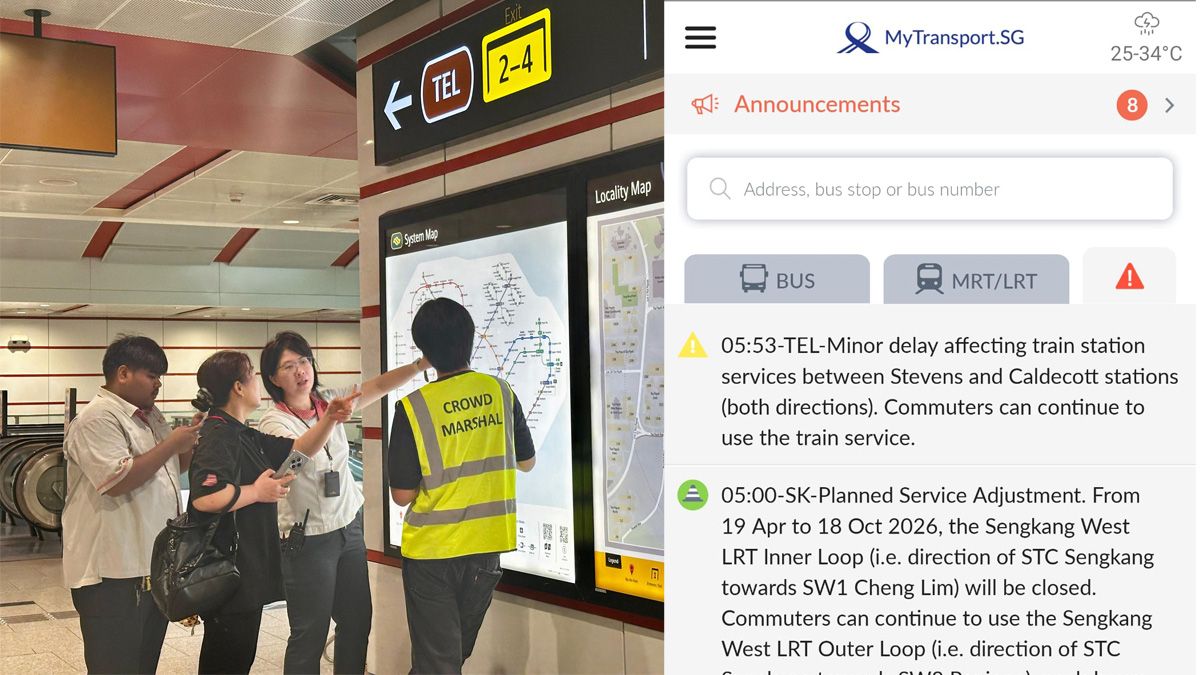
The first public alert was issued at 5.53am, describing a minor delay affecting services between Stevens and Caldecott stations only. The disruption was not posted to Facebook until 7.25am, and it was not until 7.35am that SMRT announced the minor delay had extended to the entire TEL in both directions.
At 7.47am, SMRT upgraded the situation to a major delay, confirming there were no train services along a five-station stretch between Caldecott and Orchard stations. Commuters were advised to use alternative MRT lines or switch to free bus services between the affected stations.
By 8.14am, the Land Transport Authority's (LTA) MyTransport platform was showing a major delay across the entire TEL in both directions, with free bus services available between Caldecott and Marina Bay stations.
Services progressively restored
An update at 8.48am indicated that train services were resuming progressively from Woodlands North to Caldecott, and from Orchard to Bayshore, but services between Caldecott and Orchard remained suspended across the five-station gap.
By 10.48am, SMRT announced that train services between Caldecott and Orchard had resumed, though trains would be travelling at reduced speeds. Lam confirmed at 11.10am that trains along the affected stretch were being driven manually in both directions while the signalling system was stabilised.
Full service recovery, along with the cessation of bridging and free bus services, was confirmed at 1.14pm.
Commuters question announcements and bridging coverage
The disruption drew significant criticism on social media, particularly over the speed and adequacy of SMRT's public communications and the scope of bridging arrangements.
The gap between SMRT's initial characterisation and the experience on the ground drew sharp responses. A commuter asked: "What is the definition of minor? 1 hour? 1 second?" — a pointed reference to the operator's use of the phrase "minor delay" in its first alert, issued nearly two hours before the situation was formally upgraded.
A commuter said she boarded the MRT at Woodlands North at 7.03am and only reached Springleaf station at 7.47am, a journey that typically takes approximately ten minutes. She noted that bridging bus services were only arranged from Caldecott onwards, leaving commuters travelling from the northern end of the line with limited alternatives and no clear guidance.
Another commuter reported that no station announcement had been made at Woodlands station informing passengers of the delay. SMRT responded that station announcements had been made regularly and that updates were shared as the situation evolved.
One commuter said he had been on a stationary train at Caldecott station for at least an hour. SMRT replied directing him to the free bus service between Caldecott and Orchard stations.
Another commuter criticised the pace of on-ground response, writing that station staff were required to wait for instructions from a central authority before acting, which he said resulted in slow handling during the critical early phase.
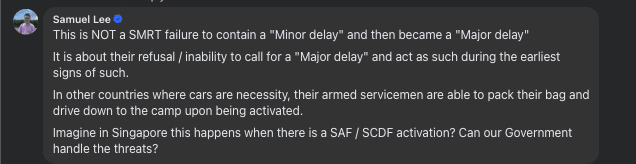
Former People's Power Party GE candidate Samuel Lee questioned SMRT's characterisation of the disruption, saying the operator had refused or been unable to declare a major delay and respond accordingly during the earliest signs of the failure.
Pattern of TEL signalling faults
Sunday's disruption is the latest in a recurring pattern of signalling-related failures on the TEL. In September 2025, a signal fault caused a two-hour disruption on the line.
In July 2025, a separate signalling fault halted services between Napier and Great World stations for more than an hour.
Between late December 2024 and early January 2025, the TEL experienced three disruptions within a single week, which SMRT said were unrelated to one another.
The TEL's fourth stage, which brought 27 of the line's 32 stations into operation, opened in June 2024.