"Hypocrite": Netizens slam SMRT for removing pavement artwork outside Mounbatten station while claiming support for the arts
The removal of a power-washing artwork outside Mountbatten MRT station has sparked widespread criticism of SMRT, with netizens accusing the transport operator of hypocrisy after it claimed to support the arts despite the artwork being cleaned away following a complaint.
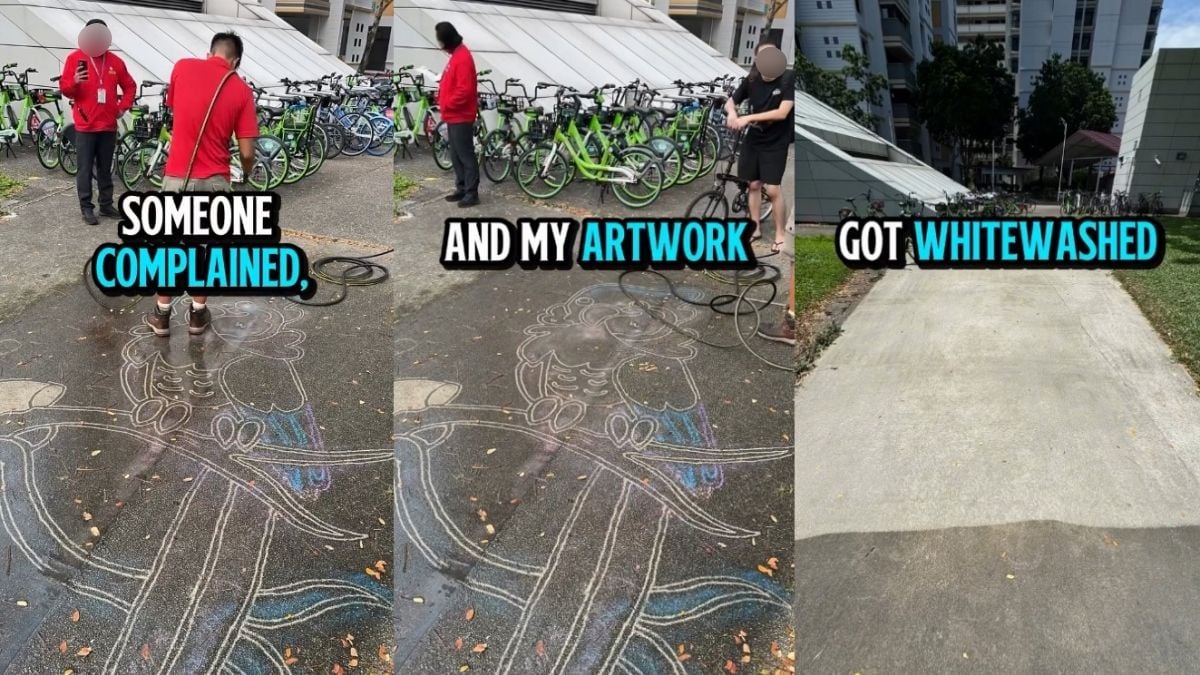
- Netizens criticised SMRT after a power-washing artwork outside Mountbatten MRT station was removed.
- SMRT's public response drew backlash, with many accusing the operator of hypocrisy.
- MPs, legal professionals and social media users joined a wider debate about public art and regulations.

SINGAPORE: The removal of a temporary pavement artwork outside Mountbatten MRT station has triggered widespread criticism online, with many netizens accusing SMRT of hypocrisy after the transport operator publicly described itself as a supporter of the arts despite the artwork being cleaned away shortly after it was created.
The controversy began after Singapore power-washing artist Marcus Pang revealed that his artwork, titled Heart of Mountbatten, had been removed less than a day after he completed it.
The incident has since evolved into a broader discussion about public art, bureaucratic decision-making, community expression and how authorities respond to complaints in shared public spaces.
Heart-shaped artwork removed after complaint
In an Instagram post published on 5 June 2026, Pang, 24, recounted how he spent around five hours on 31 May creating a large heart-shaped design on a pavement outside Mountbatten MRT station.
Unlike traditional street art, Pang's work was created by cleaning dirt from concrete surfaces using power-washing equipment and collected rainwater, leaving behind a visible pattern through contrast rather than paint or permanent markings.
According to Pang, station staff approached him during the project after receiving a complaint alleging that he was spraying chemicals onto nearby grass.
"Five hours in, I was stopped by the train station staff as someone had complained about me spraying chemicals onto the grass," Pang said.
He explained that he was using collected rainwater to power wash the pavement and suggested that petrol used by his equipment may have been mistaken for chemicals.
Pang said station personnel subsequently detained him because he did not possess a permit for the activity.
"Unfortunately, the staff detained me as I had no permit to do such artwork, which I replied I did not require one," he said.
Police attended but found no offence
According to Pang, police officers later arrived at the scene and recorded his statement.
He said officers informed him that no offence had been committed and that he was free to continue creating the artwork.
However, Pang said officers encouraged him to seek a letter of endorsement from the area's Member of Parliament.
The following day, Pang returned to the location only to discover that the section of pavement containing the artwork had been thoroughly cleaned.
The artist questioned why a single complaint appeared sufficient to result in the artwork's removal.
"Why do we let one bad apple have power over something where the majority would appreciate?" he wrote.
Pang also expressed disappointment that station staff had not discussed the matter with him before the artwork was removed.
"We could have negotiated something that benefits both the community and train station," he said.
The artist added that the project had been intended as the first in a nationwide initiative.
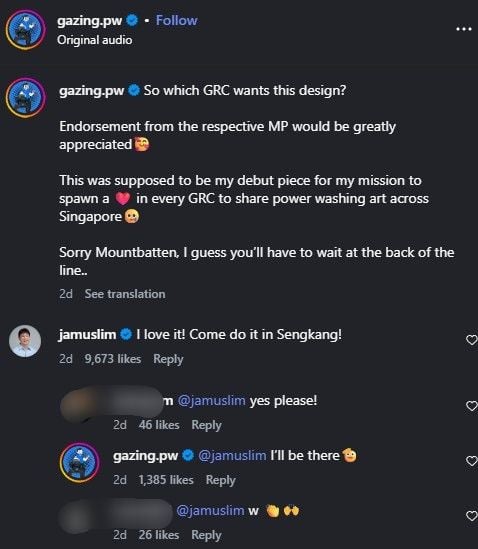
"This was supposed to be my debut piece for my mission to spawn a heart in every GRC to share power washing art across Singapore," Pang wrote.
"Sorry Mountbatten, I guess you'll have to wait at the back of the line."
View this post on Instagram
Growing online backlash
The post quickly gained traction online, attracting more than 78,600 likes and over 2,200 comments within two days.
Many social media users questioned why a temporary and non-destructive artwork had been removed while other sections of the pavement remained visibly dirty.
Several commenters argued that the response reflected excessive bureaucracy and a lack of support for community-driven artistic initiatives.
Others questioned whether police involvement and subsequent removal were necessary given that the artwork caused no permanent damage to public property.
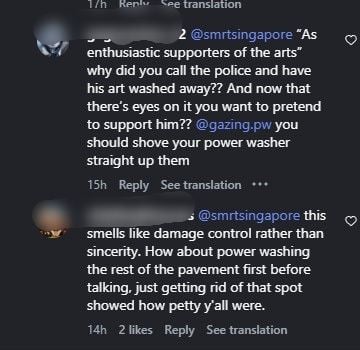
A recurring criticism centred on what many perceived as authorities reacting disproportionately to a single complaint.
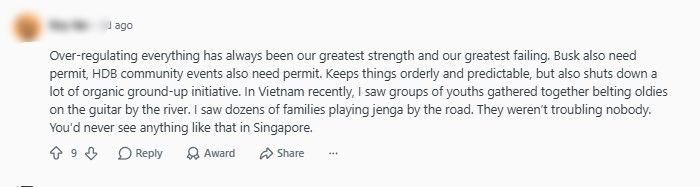
Some commenters argued that harmless creative works should not automatically trigger enforcement responses, while others suggested the incident reflected broader concerns about excessive regulation of spontaneous community activities in Singapore.
Not all reactions were critical of the authorities.
A minority of users argued that permits and regulations should be applied consistently regardless of artistic intent and maintained that procedures existed for a reason.
SMRT's response sparks further criticism
As discussion intensified, SMRT entered the conversation directly through the comments section of Pang's Instagram post.
"We're flattered you chose the pavement outside our station as your latest canvas — clearly the power washer was feeling particularly inspired that day," the operator wrote.
"As enthusiastic supporters of the arts, we'd love to chat about collaborating on something with a longer run. We champion non-disappearing art."
The response immediately drew criticism because it did not address why the artwork had been removed.
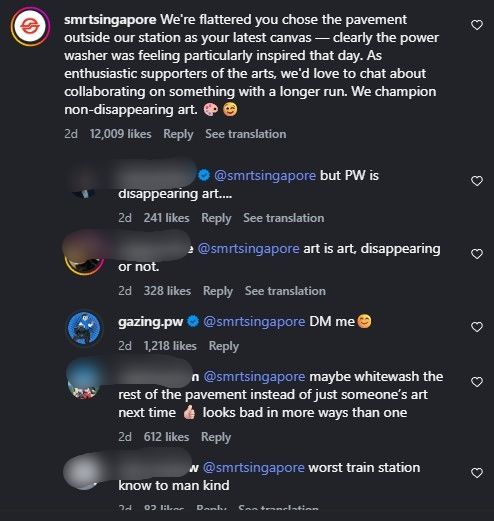
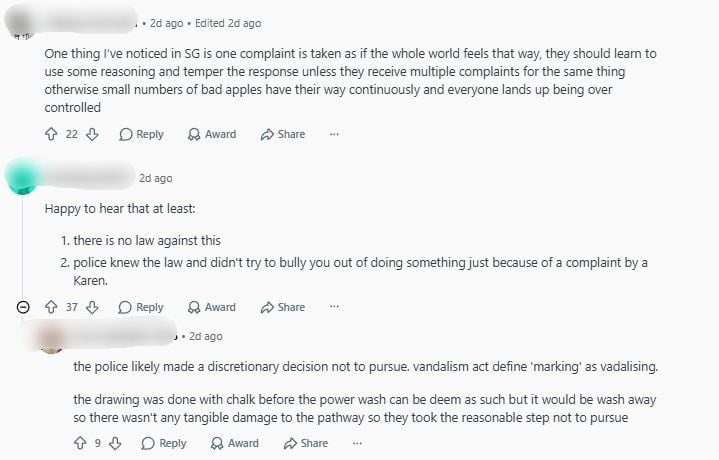
Many users highlighted what they viewed as a contradiction between SMRT's stated support for art and the apparent removal of an artwork that had already attracted public attention.
Several pointed out that power-washing art is inherently temporary.
Others responded with comments such as "art is art, disappearing or not" and questioned why discussions about collaboration emerged only after the artwork had been removed.
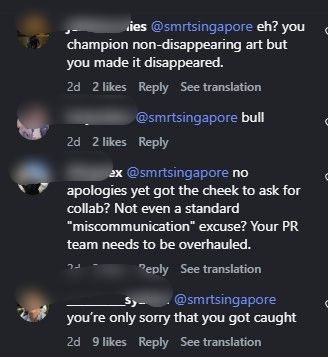
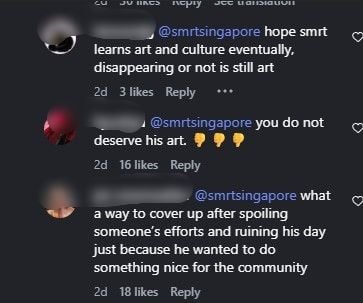
One commenter wrote: "His art already disappeared no thanks to you guys, still tryna comment to do damage control."
Another criticised the tone of the response, writing: "No apologies yet got the cheek to ask for collab?"
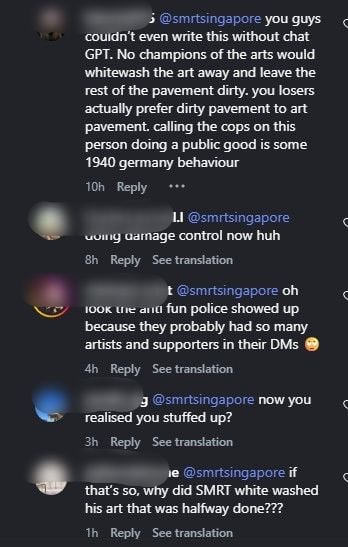
Some users described the comment as overly managed public relations messaging, while others accused the company of focusing on damage control rather than addressing public concerns.
Lawyer criticises SMRT response
Lawyer Yeoh Lian Chuan was among those who publicly criticised the transport operator's handling of the situation.
Yeoh described SMRT as "speaking in a Janus-like manner" and argued that if the company genuinely supported artistic expression, it should have left the artwork untouched.
"What's the use of claiming to support the arts and then go and whitewash the work. Comes across as fake and hypocritical!" Yeoh wrote.
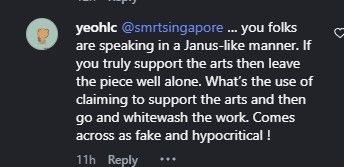
Many netizens echoed similar sentiments, arguing that the company's messaging appeared inconsistent with its actions.
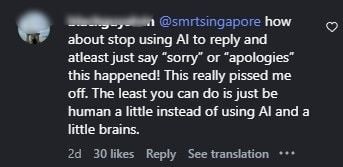
Some also mocked the response as an AI-generated statement, with one commenter writing that the company should "just say sorry" instead of relying on what they perceived as corporate language.
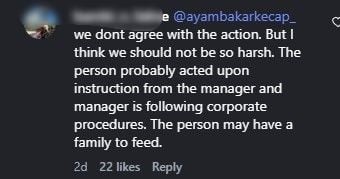
Others defended frontline staff, suggesting employees were likely following internal instructions and procedures rather than acting independently.
Several urged the public not to direct hostility toward individual staff members.
Debate extends beyond artwork
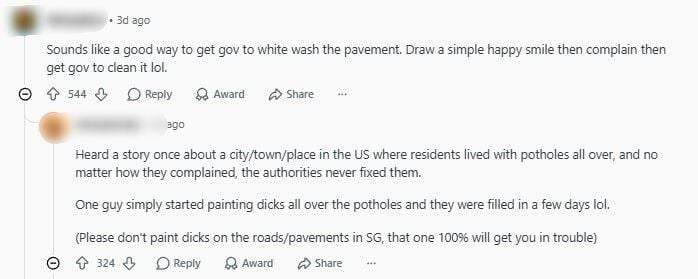
The incident also prompted wider discussions on Reddit and other social media platforms.
Some users joked that power-washing art could become a method of forcing authorities to clean neglected public spaces.
Others argued that the police had handled the matter appropriately by determining that no offence had occurred.
Several comments questioned why resources appeared to be deployed quickly in response to a complaint about artwork while other public concerns often attracted slower responses.
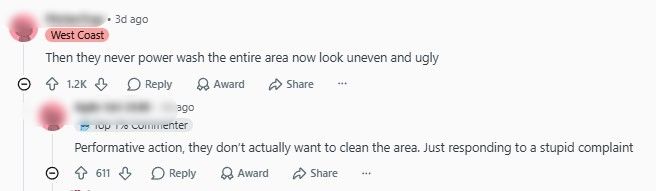
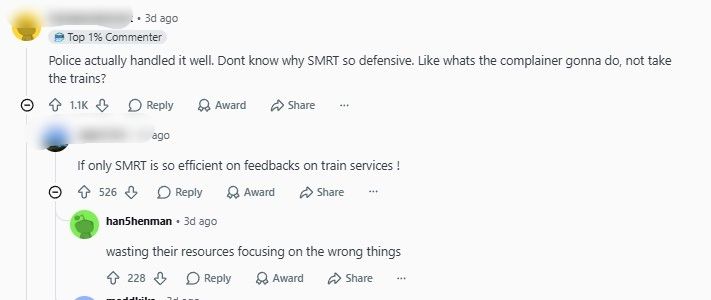
Another common theme was whether Singapore's permit-based regulatory framework, while effective at maintaining order, sometimes discourages spontaneous community-led initiatives that might otherwise enrich neighbourhood spaces.
MPs express support
The incident also attracted attention from elected representatives.
Associate Professor Jamus Lim, Member of Parliament for Sengkang GRC, publicly invited Pang to bring his artwork to the constituency.
"I love it! Come do it in Sengkang!" Lim commented on Instagram.
The comment attracted more than 9,600 likes.
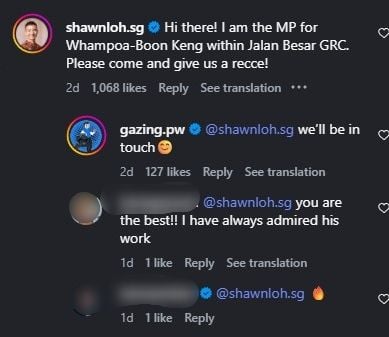
Shawn Loh, Member of Parliament for Whampoa-Boon Keng within Jalan Besar GRC, also expressed interest in hosting similar artwork.
Mountbatten MP responds
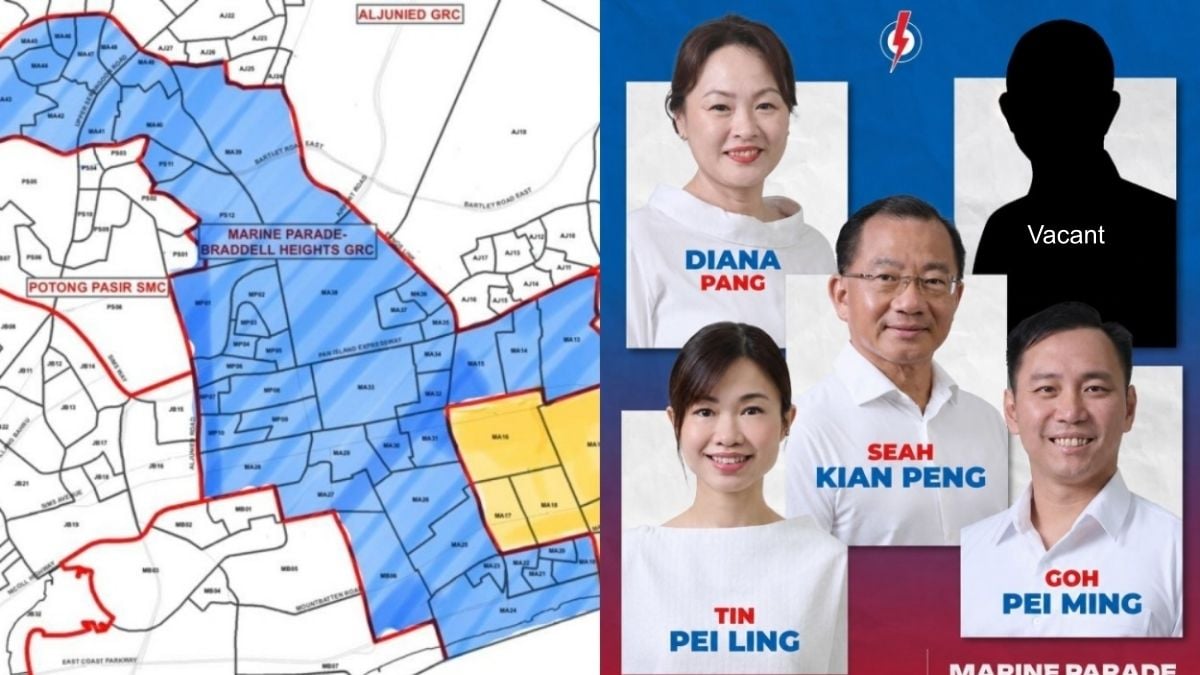
On 7 June, Mountbatten MP Gho Sze Kee addressed the matter in a Facebook post.
Gho clarified that the area surrounding the station falls under SMRT's jurisdiction rather than the town council's control.
"The work was not cleaned off by the town council but by SMRT staff," she wrote.
Gho explained that she had initially chosen to engage with SMRT, the Land Transport Authority and the police before commenting publicly in order to establish the facts.
She added that she had previously seen Pang's work and personally considered it "a nice touch to the neighbourhood".
According to Gho, she had even recorded videos of the artworks during evening walks but avoided posting them earlier because she did not wish to appear to be "opportunistically" drawing attention to the issue.
The MP said she believes in "quiet deeds, and not performative action" and confirmed that a grassroots leader had been asked to contact the artist.
While acknowledging the complexities of managing public spaces involving multiple agencies, Gho said the episode raised broader questions about balancing artistic creativity and free expression with rules governing shared environments.
She concluded by encouraging collaboration and inviting artists to reach out with future ideas, adding that public spaces ultimately "do belong to everyone".