Singapore and New Zealand sign world-first essential supplies trade agreement
Singapore and New Zealand have signed the world's first legally-binding bilateral agreement to keep food, fuel and other essential supplies flowing during crises, as both countries brace for prolonged disruption from the Strait of Hormuz closure.
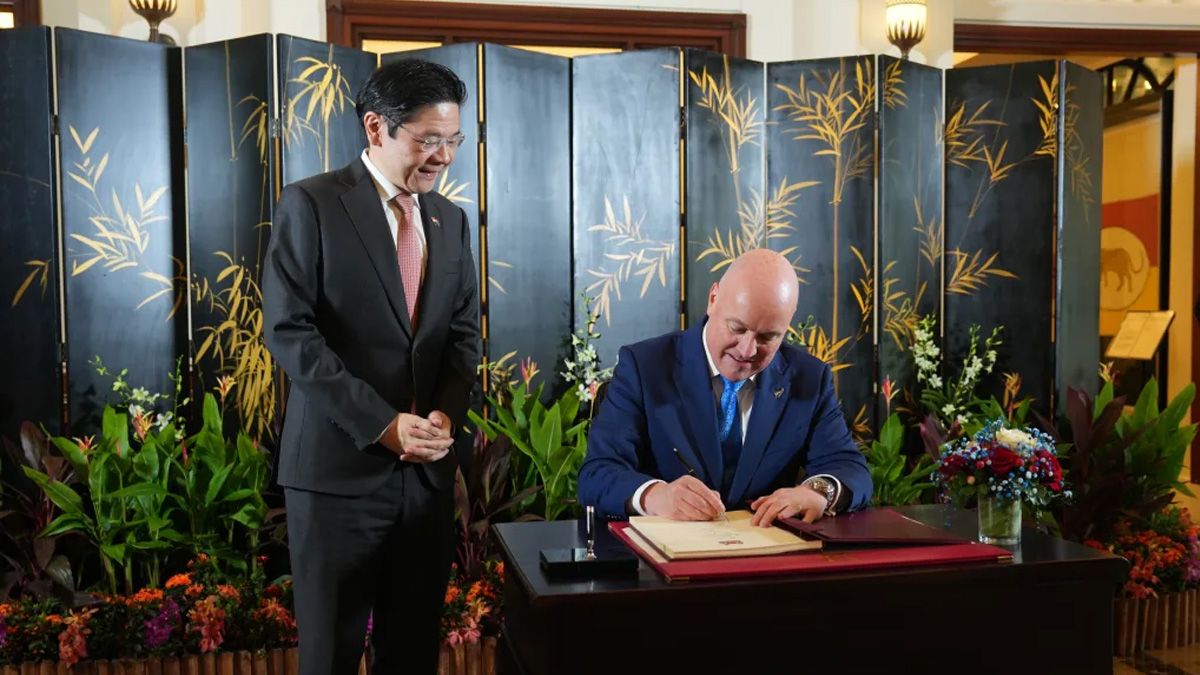
- Singapore and New Zealand signed the world's first legally binding bilateral supply chain resilience agreement on 4 May 2026.
- Both governments committed not to impose unnecessary export restrictions on food, fuel, healthcare, chemicals and construction goods.
- Singapore is planning for reduced Strait of Hormuz flows through at least the end of 2026.

Singapore and New Zealand on 4 May 2026 signed the world's first legally binding bilateral agreement to keep essential goods — including food, fuel, healthcare products, and chemical and construction materials — flowing between the two countries even during supply crises.
The Agreement on Trade in Essential Supplies (AOTES) was signed at the inaugural Singapore-New Zealand Annual Leaders' Meeting in Singapore, witnessed by Prime Minister Lawrence Wong and New Zealand Prime Minister Christopher Luxon.
Singapore's Minister-in-charge of Energy, Science and Technology Tan See Leng and New Zealand's Minister for Trade and Investment Todd McClay signed the document on behalf of their respective governments.
The agreement will be incorporated into the existing New Zealand-Singapore Closer Economic Partnership (SNZCEP), the bilateral free trade agreement between the two countries, once domestic procedures on both sides are completed.
Under the AOTES, both governments have committed not to impose unnecessary export restrictions on an agreed list of essential supplies. It also establishes a framework for facilitating the movement of goods, sharing information, and holding consultations before or during supply chain disruptions.
Singapore's Ministry of Trade and Industry (MTI) said the pact would provide businesses and consumers with greater confidence and stability during periods of disruption.
World-first agreement
Speaking at a joint press conference following the signing, Prime Minister Wong said the agreement sends a clear signal that trusted partners would keep faith with each other under strain.
"It means that even in times of crisis or shortages, we will keep essential goods flowing — food, fuel and other critical supplies. We will not shut each other out. And instead, we will work actively to keep trade moving," he said.
Prime Minister Wong warned that in difficult times every country would be tempted to turn inward, but that such a response would cause supply chains to break down, leaving all parties worse off.
"The agreement represents both countries' commitment to doing things differently — keeping markets open, continuing to trade essential goods and standing by each other when it matters most," he added.
New Zealand's Prime Minister Luxon described the agreement as translating longstanding trust into practical action.
"It takes a longstanding trust and it turns it into really practical action, a commitment to keep essential trade flowing in a crisis, and a commitment to give businesses, governments and the public confidence that trusted supply lines will remain open under huge pressure," he said.
Prime Minister Luxon highlighted the depth of the two countries' mutual dependence on essential trade flows. About a third of New Zealand's fuel is refined in Singapore, he noted, while the diesel New Zealand receives from Singapore underpins the farming and freight systems that move New Zealand's food into the region.
"New Zealand is also a trusted supplier of food and other essential goods to Singapore," he added.
Strait of Hormuz disruptions
The signing comes as both countries navigate ongoing disruption to global energy supply chains caused by the closure of the Strait of Hormuz.
In their joint statement, both leaders called for the unconditional, unrestricted and immediate reopening of the strait, reaffirming the right of transit passage under international law as reflected in the United Nations Convention on the Law of the Sea (UNCLOS).
They described the closure as having a significant impact on global supply chains, particularly on oil, gas and petrochemical products, as well as essential goods and critical downstream derivatives such as fertilisers and plastics for packaging.
Prime Minister Wong said Singapore's base case was that it was prepared for a situation in which supplies from the Strait of Hormuz remained limited for a prolonged period — at least until the end of the year.
"Even if the Strait of Hormuz reopened very soon, there would still be hindrances to ships coming through," he said, noting that energy and port infrastructure had been damaged and that ships would need assurances against threats such as drone attacks before resuming normal passage.
"And all these, we think, take months at least to restore. So we are working on the assumption that flows from the Strait will be limited," he said.
Prime Minister Wong acknowledged that even with alternative supply routes and other sources of crude oil, Singapore was bracing for a residual supply gap.
"Their throughput is lower than it used to be, but they are still able to continue with their production and to meet the needs of all their customers," he said of Singapore's refineries.
Prime Minister Luxon said he had met leaders of refineries and oil companies at the leadership forum that morning, and that they had been able to find alternative sources of crude oil.
"Our key priority of course is to maintain supply. We appreciate that as long as the market's functioning there'll be a price effect to that, which we are all struggling with," he said.
New Zealand anticipated the situation would be "potentially bumpy" but did not foresee a risk to supply based on its projections for the coming months, he added.
Pathfinder for broader network
Responding to a question about whether the AOTES could serve as a model for similar agreements with other countries, Prime Minister Wong said he hoped the standard would extend beyond the two signatories.
"It is between us, but it's not exclusive, it's not meant to be exclusive. We welcome other countries to join us, and if they are able to meet the same standards, then it will start to expand a network of trusted partners who can provide similar assurances to one another," he said.
Prime Minister Luxon echoed the sentiment, saying both countries were "inventing new trade architecture" and were open to other economies meeting the standard and joining the framework.
Broader cooperation
The AOTES was among several agreements concluded at the inaugural Annual Leaders' Meeting, which was launched as part of the New Zealand-Singapore Comprehensive Strategic Partnership (CSP) established in October 2025.
The health ministries of both countries signed a five-year memorandum of understanding (MOU) on healthcare cooperation, covering areas including pandemic preparedness, supply chain resilience for healthcare supplies, healthcare regulation and health technology assessment.
MTI and New Zealand's Ministry of Foreign Affairs and Trade also concluded an implementing arrangement on the use of electronic certification for trade in food and primary products, aimed at streamlining agri-food trade certification processes.
Prime Minister Wong said both countries were also strengthening cooperation in unmanned technologies under their defence relationship, and that both leaders had discussed the work of the Singapore-New Zealand Leadership Forum, which brought together senior business leaders from both countries to build new partnerships and identify opportunities in the region.
Both leaders also noted that as incoming chairs of the Pacific Islands Forum and ASEAN respectively in 2027, they had agreed to explore ways to enhance relations between the two regional bodies.
"We may be small countries, at least in terms of population. But we have agency. And when we work together with clarity, with purpose, and with trust, we can shape outcomes together, turn challenges into opportunities and bring benefits to our peoples," Prime Minister Wong said.