When the gambler who always loses tells you to bet small, consider betting big
Goh Meng Seng is advising Workers' Party cadres on how to win middle ground voters. His party received 0.43 per cent of the vote at GE2025 in the same constituency where WP received 47.37 per cent. The full electoral history across four elections at Tampines GRC — and his own 2006 result under the WP banner — tells us what the evidence strongly suggests has been driving his numbers all along. It was likely never him. It was likely never his party. And the data gives little reason to trust his political judgment.


There is an old observation about gamblers: when the one who always loses tells you to bet small, you should seriously consider betting big.
People's Power Party (PPP) chief Goh Meng Seng has published a lengthy post urging Workers' Party (WP) cadres to vote against secretary-general Pritam Singh at the party's special cadres conference on 28 June 2026.
His central argument is that Singh's conviction represents an integrity deficit that will cost the WP middle ground voter support — and that cadres should remove him to demonstrate the kind of clean governance standards necessary for a party aspiring to replace the People's Action Party (PAP).
Goh positions himself throughout the post as someone who understands what middle ground voters want. He frames his advice as counsel grounded in political reality rather than personal animus. He even invokes the language of democratic development, suggesting that how WP handles this moment will determine Singapore's political future.
Before accepting that framing, it is worth looking at what middle ground voters have actually said about Goh Meng Seng's political judgment — across five elections, two parties, and fifteen years.
The data from Tampines GRC
Goh was part of the WP team that contested Aljunied GRC in 2006, receiving 43.91 per cent. He subsequently left the WP, joined NSP, and led their team at Tampines GRC in 2011, receiving 42.78 per cent.
Both were strong results. Both were widely cited at the time as evidence of his personal political standing.
Then the controlled experiment began.
In 2020, NSP returned to Tampines without Goh and received 33.59 per cent — still respectable, suggesting some brand presence remained.
In 2025, WP entered Tampines GRC for the first time. NSP's vote collapsed to 0.18 per cent.
Goh, contesting the same constituency under PPP, received 0.43 per cent, or 596 votes. Both parties forfeited their election deposits. WP received 47.37 per cent. The PAP received 52.02 per cent. Between them, the two parties with genuine institutional depth captured 99.39 per cent of the vote. PPP and NSP together received 0.61 per cent.
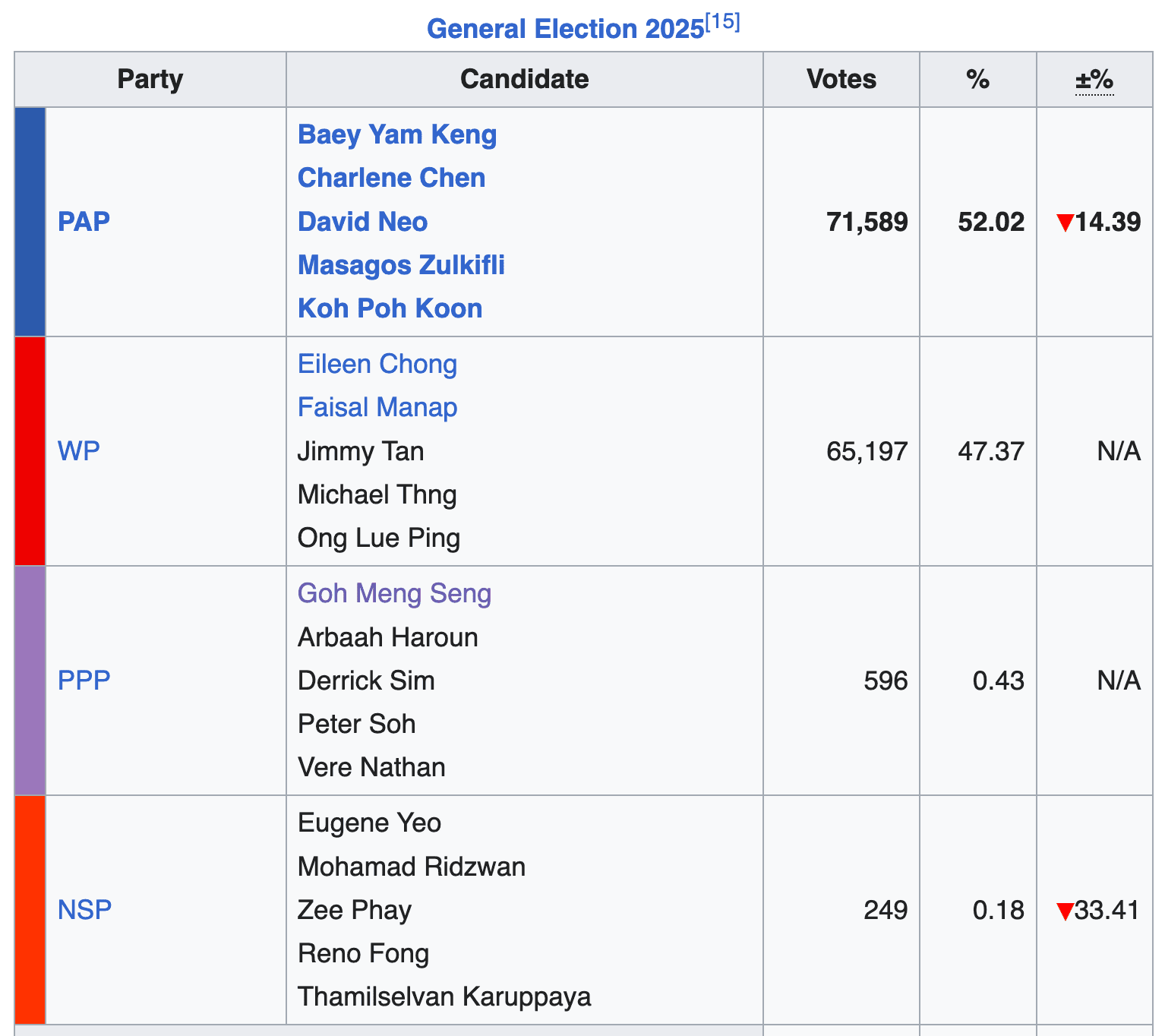
The picture across five elections is now complete and its meaning is unambiguous.
The 43.91 per cent at Aljunied in 2006 was produced under the WP banner, during a political cycle when the WP's organisational work was building momentum toward the 2011 breakthrough. The evidence strongly suggests it was not Goh's vote to claim. It was the WP's.
The 42.78 per cent at Tampines in 2011 was produced during the same political wave that swept the WP into Aljunied GRC for the first time — the same national sentiment that Yee Jenn Jong described at his recent book launch as the opposition pendulum swinging at its hardest. Every credible opposition contestant that year benefited from that wave. The numbers suggest it was not Goh's vote. It was the wave's.
The 33.59 per cent for NSP at Tampines in 2020, without Goh, was produced in a political environment where WP was absent from the constituency. Opposition-inclined voters who wanted to register a protest vote had limited options. They chose NSP. The result was most likely not NSP's vote to claim. It was displaced WP support waiting for somewhere better to go.
When WP arrived in 2025, that vote went home. What remained with Goh under PPP, and with NSP independently, was what was genuinely theirs. The market gave its verdict: 0.43 per cent and 0.18 per cent.
The 2025 results also demonstrate something important about what actually drives vote shares in Singapore. With four teams contesting simultaneously, the results function as a near-controlled experiment.
Individual candidate profiles did not override party brand as the dominant variable. Voters were not choosing between personalities. They were choosing between institutions — and they chose the two institutions with genuine depth, consistent presence, and demonstrated track records.
The WP's 47.37 per cent at Tampines was not about any individual candidate on that team. It was about fifteen years of organisational work, constituency management, parliamentary performance, and accumulated credibility.
Which brings us to the structural flaw in Goh's argument.
What the numbers tell us about his advice
Goh is arguing that the WP should remove its most recognised individual leader to satisfy a perceived integrity standard.
But the 2025 results demonstrate that individual leader recognition is not what drives WP's vote. The WP brand is what drives WP's vote. And that brand was built collectively — by Low Thia Khiang, by Sylvia Lim, by Pritam Singh, and by the entire institutional apparatus of constituency work, town council management, and parliamentary performance that the party has built over two decades.
Removing Singh does not strengthen that brand. Removing Singh in response to PAP political pressure signals that the brand is vulnerable to external destabilisation — which is precisely what undermines the perception of institutional solidity that the 47.37 per cent at Tampines was voting for.
A gambler who wins when conditions are favourable and loses consistently when they are not has not demonstrated skill. He has demonstrated that he is good at riding tailwinds he did not create. When Goh tells WP cadres that removing Singh is the path to winning middle ground voters, he is offering counsel based on a misreading of what produced his own best results — and what produced the WP's.
Former WP member Mohamed Jufrie bin Mahmood, who described himself as having been with the party decades before most of its current members, put the practical consequence of Goh's intervention plainly: "As members of the opposition we don't do things like what GMS is now doing, because it only benefits the PAP."
That is the most important observation in the entire thread of responses to Goh's post. Whatever its stated purpose, his post amplifies from within the opposition space the PAP's preferred framing of Singh's conviction — as a straightforward integrity failure that the WP must respond to on the PAP's terms, without asking how those terms were set or who benefits from the WP accepting them.
The WP cadres who will vote on 28 June built something real. They did not build it by following the advice of people whose results demonstrate a difficulty retaining voter support independent of external factors, without borrowing it from a political wave or a stronger party's brand. They built it by showing up, doing the work, and refusing to be reactive.
The gambler who always loses — and whose electoral record across five elections and two parties now provides the data to prove it — has spoken. The cadres can decide for themselves what that means for the bet.